Showing posts with label fossils. Show all posts

Thursday, May 10, 2012

We need another explanation for our big brains like we need a hole in the head


(source)
Something was definitely up, up top, once our bodies, down below, committed to walking and running upright.

It’s only after things got familiarly human in the locomotor anatomy--when we got long legs, non-grasping toes, and reconfigured butts--that brains started increasing beyond ape proportions.

For the first four or five million years of hominin evolution (from 7-2.5 million years ago) the story’s about bipedalism. For the last two and a half, it’s about encephalization. We've known this thanks to fossils for a while and genetic evidence is saying the same thing. It’s natural, then, for such a cerebral organism to wonder whether the two are connected.

As you hypothesize, you could go the technology route. Freed forelimbs, not necessary for locomotion, are free to be handy. O! the possibilities for hurling turds and building worlds! So that's one idea: Selection for a brainier hominin (both physically and cognitively) could occur only after the hands were habitually free to be freaky.

You could go the ecology route. Once our bodies committed to bipedalism our diet changed to include more meat, hominin body size increased, and geographic dispersal did too, no doubt aided by our more efficient bodies built for long distance travel. These characteristics, together, have been compared to those of scavenging and predatory carnivores. Regardless of how small or large a part meat played in our ancestors’ diets, there’s no denying that an ecological shift occurred in the early Pleistocene, with an increase in diet and habitat diversity, and that shift must have included new requirements of the brain.

Or, you could go the sociality route. As hominins relied more and more on cooperative foraging and parenting behaviors, etc, navigating social networks became key. Once complex speech and language arrived, then there would be new demands on the brain as well.

These pressures, requirements, demands, however you want to think of them, could be working in concert and at different times (e.g. technology plus socializing) over deep, geologic time and many many hominin generations. By "working," I mean contributing to the more-or-less sustained differential reproductive success of hominins with slightly larger brains. And because it’s the way that the fossil and archaeological records reveal behaviors over time, I tend to think of these three categories (technology, ecology, sociality) as describing the last 2.5 million years in the order I listed them. Technology was strongest earliest (starting with the Oldowan stone tools by 2.6 mya), and persisted. An ecological shift came along with that technological shift and then persisted. And of course social complexity came along with the technological and ecological shifts and then persisted.

These are some of the most mainstream hypotheses for encephalization (1) and they're implicitly or explicitly predicated on the prior evolution of bipedalism.

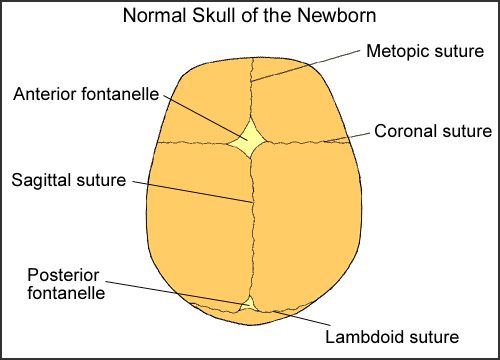
But now there's a new tie between big brains and walking upright--offered up in a  new paper just out in PNAS--and it's based in the human-, not ape-, like tendency to fuse the metopic suture later in life, to delay the close of what starts as a hole in the top of a baby's head known as its anterior fontanelle. The authors suggest that we need this hole in our head to exit our mother's bipedally-adapted birth canal safely and we also, as they suggest, need it to grow up to be an encephalized creature.

According to the authors, the "Taung child", an Australopithecus africanus kid (a member of a well-known bipedal hominin lineage) had an unfused metopic suture, left as an imprint on the fossil brain endocast.

Raymond Dart with the Taung child fossil.  http://en.wikipedia.org/wiki/File:Raymond_Dart_with_Taung.jpg 
Seven other australopith and Homo fossils are also described in the paper as having unfused metopic sutures. You might too! The odds are small, but since you started with a hole in your head as a baby, you could still be walking around with it unzipped.


To any chimps reading this, your metopic suture most likely closed just after birth and before your first deciduous molar erupted. But for 90% of humans (as reported in the paper), the suture closes later, after the eruption of the first deciduous molar. There’s a much slower fusion rate in humans than in chimpanzees.

However, to interpret the Taung child’s anatomy, things get a bit dicey, like things just love to get with hominin fossils. So often they can go either way: chimpy or humany.

Check out the figures below. A is for Pan troglodytes (common chimps) and B is for Homo sapiens. Those are frequencies of metopic suture fusion per dental age group. By listing them this way, instead of by chronological age, we're able to compare between two species that grow at different rates but share the same pattern of dental eruption. Chimpanzees grow up faster than us and experience earlier metopic suture fusion than us. Flipped around, humans grow up slower than chimps and experience delayed fusion of this suture compared to them. The Taung baby's dental age category is starred (*) at the "M1" stage in A and B. (The Taung child died at around 3.8 years of age, when its first permanent molar, M1, was erupted.)
Because it's more likely you'll find a human at that age (*) with an unfused metopic suture than a chimp, the researchers leaned toward calling the Taung child's state human-like, rather than ape-like. They backed that assertion up by listing seven other late Pliocene-early Pleiostocene hominins with unfused metopic sutures... it's a trend in the hominin lineage that begins with some australopiths, like the Taung child, they say.

"The presence of a still patent fontanelle and of a partially fused [metopic suture] in the Taung child, and the incidence of unfused [metopic sutures] in five adult and two other younger Australopithecus/ early Homo specimens is thus taken as evidence that a human-like pattern of late [metopic suture] fusion was already present in mid-to-late Pliocene gracile hominins."

Okay. Intriguing! But now we must explain!

[This is the part where, if you listen very carefully, you can hear the collective curmudgeonly groans from within and beyond the walls of paleoanthropology.]

Enter the new hypothesis for encephalization based on the late fusion of metopic sutures. The authors nod to two papers that offer "adaptively neutral" explanations for late metopic suture fusion but argue that the fossil evidence combined with the differences observed in chimps and humans beg for an adaptive explanation. (This tack is unsurprising given how paleoanthropology generally operates.)

The authors offer us three adaptive hypotheses to explain late metopic suture fusion:

1. Reorganization and expansion of the frontal neocortex (explains late metopic suture fusion)
Something about the changing and enlarging frontal cortex required changes to the cranial bones, how they form, grow, and fuse.

2. The difficulty of giving birth to large-headed neonates through birth canals that were reconfigured for bipedalism, the “obstetrical dilemma” (explains late metopic suture fusion)

The squishy neonatal head, thanks to the fontanelle,  "probably occurred in conjunction with refining the ability to walk on two legs," Falk (the lead author) said to the media. "The ability to walk upright caused an obstetric dilemma. Childbirth became more difficult because the shape of the birth canal became constricted while the size of the brain increased. The persistent metopic suture contributes to an evolutionary solution to this dilemma."

The trouble with this hypothesis as applied here is, although we know modern humans have a tight fit at birth now, there's little evidence for a tight fit between neonate and birth canal during australopith times.

And you can't help but wonder whether a squishy head was, or still is, required for successful birth. Do children suffering from craniosynostosis require a c-section to be born? Also, since the metopic suture fuses after chimpanzee birth, are we certain they aren't squishing their brains as they exit their relatively roomy birth canals? These questions may sound silly, but they're illustrating the built-in assumptions of the paper (or my ignorance about squishiness of baby heads).

The squishy head may be helpful during childbirth, but if it's occuring as early as australopith times, an adaptive explanation as a "solution" to an obstetrical dilemma is hard to swallow. That is unless DeSilva's estimates cited by the authors-- that australopiths had large neonates and tight fits at birth--are correct.

3. High early postnatal brain growth rates (explains late metopic suture fusion)
We know that humans have high rates of postnatal brain growth and this is what a lot of the news media picked up on: Your baby's head has gaps between the bones so the brain can grow like crazy after it's born to the gargantuan size of an adult human brain. As established in hypothesis #2, the need for the fontanelles in the first place is the crunch at birth thanks to the obstetrical dilemma, implying that without the pressure to be born small enough to escape the bipedal birth canal, we'd grow larger fetal brains in the womb.

So with this new paper we're presented with something even more fundamental than the notion that bipedalism as a necessary precursor for technological, ecological and social selection pressures for encephalization (as covered above): The tight fit at birth, caused by antagonistic selection for bipedal pelvic anatomy and large neonatal brains, created the selection pressure for a squishy neonatal head (which is facilitated by the fontanelles) and because of that roomy cranium, postnatal growth rates were able to ramp up in selective environments that favored encephalization.

So I'm left wondering, Do we need a hole in our head to be born successfully? Do we need a hole in our head to be encephalized? If the answer to both of those is yes, then what is a hole in the head doing in a hominin genus that may not have had much difficulty with childbirth and was hardly (if at all) encephalized? And, given the overlapping chimp and human fusion patterns, how can we be sure this feature on Taung is humany and not chimpy?

And, further, you can't (or at least I can't) help but wonder if there's a biomechanical/functional explanation for late metopic suture fusion, given how feeding behaviors and masticatory muscles put stress on the cranium. The skulls of australopiths and other hominins experienced stresses differently than chimpanzees. These differences may have begun as early as the nursing stage. Could this have anything to do with delayed fusion of the sutures? (here's just one study I found that addresses these kinds of questions)

And finally, it's hard not to link Falk (the lead author) to her research on Homo floresiensis. The hobbit (LB 1) looks like it has a fontanelle, something the disease-hypothesis folks point out is consistent with their perspective, and that’s one reason why I assumed these authors are onto this topic.
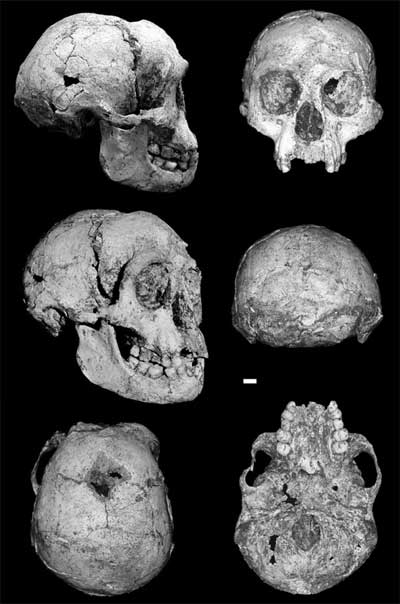
But LB 1 is conspicuously absent from the laundry list of hominin fossils in the supplementary section. Either they're saving what they've got on metopic suture and fontanelle anatomy in H. floresiensis for an upcoming paper or they just didn't think it was worthwhile to include this specimen. After all,  the latest paper on hobbit anatomy claims that the hobbit's "fontanelle" isn't real. Peter Brown writes, "direct examination of the asymmetrical hole in the posterior frontal of LB1, supported by CT scans, clearly indicates that this is the result of post-mortem excavation damage and is definitely not an unfused anterior fontanelle." (2)

Good thing, because if the hole in LB 1's cranium is of biological and not of taphonomic origin, then who knows how anybody'd explain its adaptive significance in such a tiny-brained hominin.

But, going way back to Taung and the australopiths: They were, after all, bipedal and the big brain train had to pull out at some point!

And, stay tuned. I got a tip from one of the authors about a paper coming out soon that demonstrates how weak the obstetrical dilemma hypothesis is, for explaining fetal size and growth, given the current evidence and given what we know about maternal metabolism.

Notes
(1) Of course, these hypotheses don’t represent all of paleoanthropology. I just intended to cover the major bases. And you need to consider what many paleoanthropologists assume which is that brain tissue is expensive so something extraordinary must have kept up selection on its increasing size for the last 2.5 million years. The assumption is that if brains were cheap, everyone would have big ones, but I don’t buy that. I think it's clear that other species aren’t encephalized because they don’t have to be. They do just fine without big brains. We have a rather warped perspective on selection for encephalization, thanks to our presentism and our big brains.
(2) Thanks to K. Baab for the tip.

Tuesday, October 25, 2011

Australopithecus erotimanis, and the evolution of the human hand

WARNING:  The following post contains adult content!

From the very beginning of formal taxonomy in biology, genus and species names have been assigned partly as descriptions of important aspects of a species.  Hence, Homo sapiens refers to our species' purported wisdom.  The underlying idea is that one correctly understands important key functions that characterize the species.  Linnaeus did not have 'evolution' as a framework with which to make such judgments, but we do.  And we should use that framework!

However, sometimes, in the rush to publish in the leading tabloids (in this case, Science magazine), a name is too hastily chosen.  That applies clearly to the recently ballyhooed 1.9+ million year old South African human ancestor.  Substantial fossil remains of two individuals, a male and a female, were found and seemed clearly to be contemporaneous.  Many features suggested that they could be marketed as a Revolutionary! revision to our entire understanding of human origins.

Now, too often in paleoanthropology there is little substantial evidence for such a dramatic consequences, similar to the pinnate carnage known as the War of Jenkins' Ear between Britain and Spain in 1739.  But not in this case here!   In this case, the specimens were dubbed Australopithecus sediba (See the special issue of Science, Sept 9, 2011 [subscription required]), and there are many traits, some more dramatic than others, by which to argue that it is Really (this time) important.

We haven't the space to outline all these features, but although we are amateurs at paleontology (for expertise, we fortunately have Holly the Amazing Dunsworth as part of our MT team from time to time), we feel qualified to comment.  One of the most remarkable features of A. sediba is its long, delicate digits on its obviously dextrous hand, and in particular its long and clearly useful thumb.  But useful for what?

One who is rooted, or rutted, in classical human paleontology, and thinks that tool use is what Made us Human, the obvious inference is:  a dextrous hand for tool use!   There is, however, a tiny problem: no tools were found in the site.

Now this can be hand-waived away in defense of the explanatory hypothesis that is derived from classical adaptive thinking.  Wooden tools, like stems chimps strip and use to ferret out termites, wouldn't preserve, and at that early stage of our evolution, stone pebbles might have been used--or even made--but would be perhaps sparse and if not remodeled by the creatures, unrecognizable.  Or perhaps these creatures hadn't carried their tools to the site.  There may indeed be perfectly reasonable explanations for why no tools were found, but one must at least admit that the absence of tools does not constitute evidence for the tool hypothesis. 

Still, if you believe there must be a functionally adaptive explanation for absolutely everything, and you are committed to the current framework of explanations about our ancestry, then tool-use is the obvious one.  How occasional use of pebbles led to higher reproductive success--which, remember, is what adaptive explanations must convincingly show--is somewhat less than obvious.  Also, it is the female specimen whose hand is best preserved, though the male is inferred (from one finger bone!) to have been similarly handy.  But females don't throw pebbles to gather berries!

A satisfying explanation
So how solid or even credible is the tool-use explanation?  Could there be better scenarios? We think so, and we believe our idea is as scientifically valid as the tired old one of tool use.

It is obvious upon looking at the fossil hand, that its most likely purpose was, not to mince words about it, masturbation.  Just look at the hand itself and its reach position (figure 2).  Think about it:  deft and masterly self-satisfying would yield  heightened sexuality, indeed of keeping one's self aroused at all times, ready for the Real Thing whenever the opportunity might arise. Unlike having to wait for prey to amble by, one could take one's evolutionary future in one's own hands--and use one's tool in a better way, one might say.


Being in a dreamy state is a lot less likely to provoke lethal strife within the population nor "Not tonight, I'm too tired" syndromes, compared to the high-stress life of hunting giraffes (much less rabbits) or trying to bring down berries, by throwing chunky stones at them.  Our laid-back scenario does not require fabricating stories of how rock-tossing indirectly got you a mate, because pervasive  arousal would be much more closely connected to reproductive coupling, a way of coming rapidly to the important climax: immediate evolutionary success.

Indeed, and here is a key part of our explanation, the same fitness advantage would have applied to both the males and the females.  If both parties were at anticipatory states more of the time, fitness-related activity would have occurred even more frequently than it does now, if you can imagine that, and quickly led to our own very existence as a be-thumbed if not bewildered species.

Supporting our hypothesis, vestiges of the original use are still around, as for example the frequency with which football and baseball players grab themselves before each play.  Of course, humans seem subsequently and unfairly to have evolved to be less gender-symmetric in this regard.  But our explanation is far better than the tired stone-axe story-telling with which we're so familiar.  For this reason, we suggest the new nomenclature for our ancient ancestor:  Australopithecus erotimanis.

Now, you may think our scenario is simply silly and not at all credible.  But is it?  By what criterion would you make such a judgment?  Indeed, even being silly wouldn't make it false.  And, while you may view the standard Man the Hunter explanation as highly plausible, being plausible doesn't make it true. Nor when you get right down to it, is the evidence for the stone-age hypothesis any better than the evidence for our hypothesis.

Indeed, if you think carefully about it, even the presence of some worked pebbles would not count as evidence that hands evolved for tool use.  The dextrous hand could have been an exaptation, that is, a trait evolved in some other context, and then later was co-opted for a new function--in this case, the flexible hand, once evolved for one use, could then be used to make and throw tools.  What we have explained here is the earlier function that made the hand available in that way.

Don't laugh or sneer, because this is actually a not-so-silly point about the science, or lack of science, involved in so much of human paleontology.  It's a field in which committed belief in the need for specific and usually simple adaptive scenarios, using a subjective, culture-specific sense of what is  'plausible', determines what gets into the literature and the text-books (though our idea might have a better chance with National Geographic).

Will anthropology ever become a more seriously rigorous science, with at least an appropriate level of circumspection?  It's something to ponder.

Friday, April 8, 2011

Deep Time: The Movie

The online journal PaleoAnthropology has recently posted the longest boringest movie ever made!

Why would anyone do that? Well, hopefully, you'll see for yourself.


The movie begins with the earliest hominin fossil from between 7-6 million years ago and ....93 hours later... it ends with
[SPOILER ALERT!] modern humans.

You can download the movie here
and you can also check out the brief article that accompanies it called, "Deep time in perspective: An animated fossil hominin timeline."

(Notice the author's name?)


Because here on the Mermaid's Tale I can address a broader audience--and I'm also free to write about celestial bodies and microbes as much as I please--I thought I'd post about the movie here.


So stock up on raisinettes, nuke enough popcorn to last 93 hours, find a comfortable chair, and enjoy your journey through deep time....


Darwin and Deep Time

Darwin heavily stressed the concept of deep time in Origin of Sp
ecies because he knew it was a major obstacle to understanding evolution.
It is hardly possible for me to recall to the reader who is not a practical geologist, the facts leading the mind feebly to comprehend the lapse of time. (Darwin 1872: 294)
Deep, geologic time is absolutely crucial to evolution but it is difficult to grasp let alone represent in a drawing.

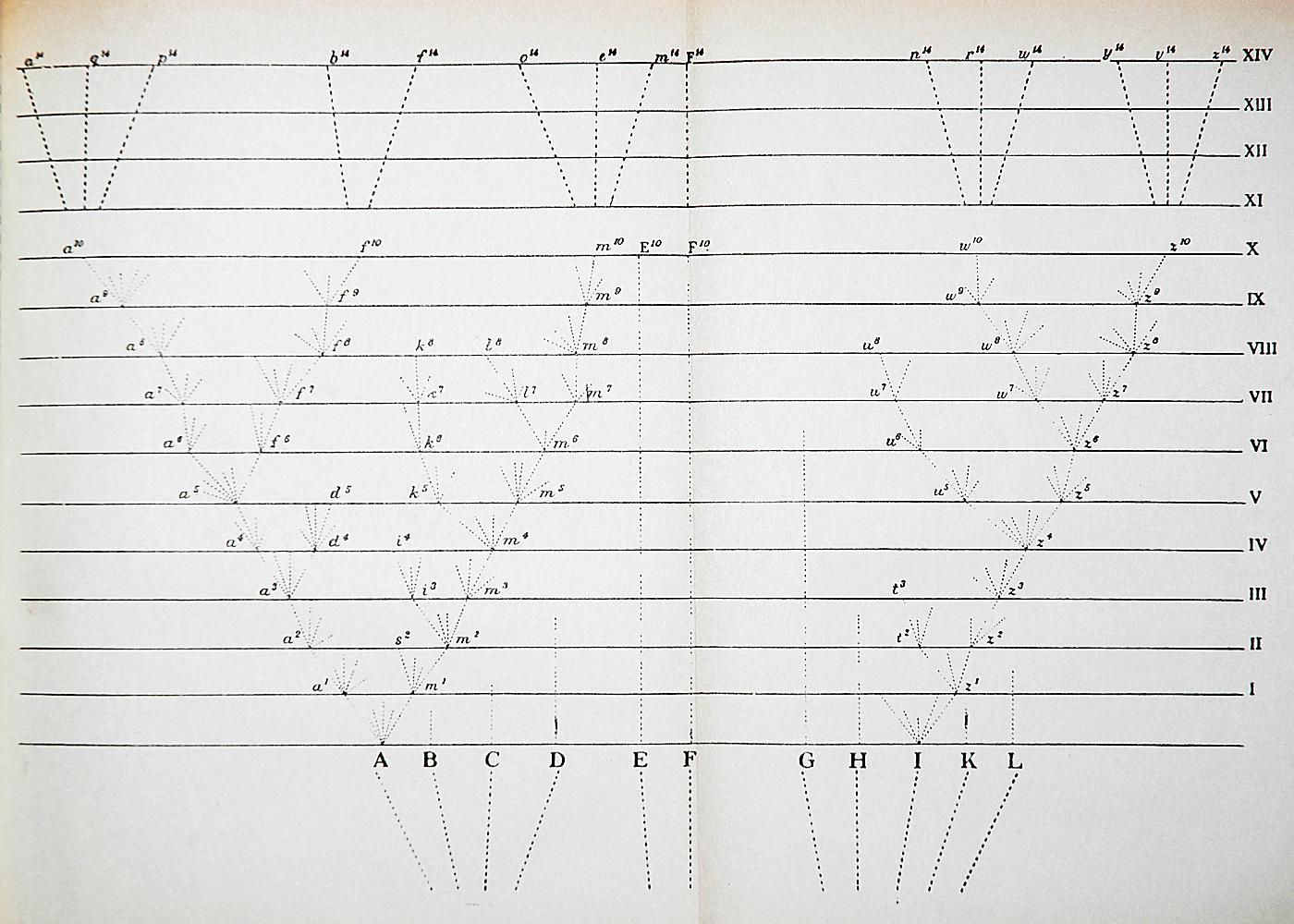
Scientists, like everyone else, have no frame of reference and so the lapse of deep time is all but ignored in evolutionary trees, like this one that Darwin drew.

Mr. Croll, a Strip of Paper, a
nd Deep Time
A colleague of Darwin’s, a "Mr. Croll" mentioned in Origin of Species, offered a c
rafty illustration of deep time.

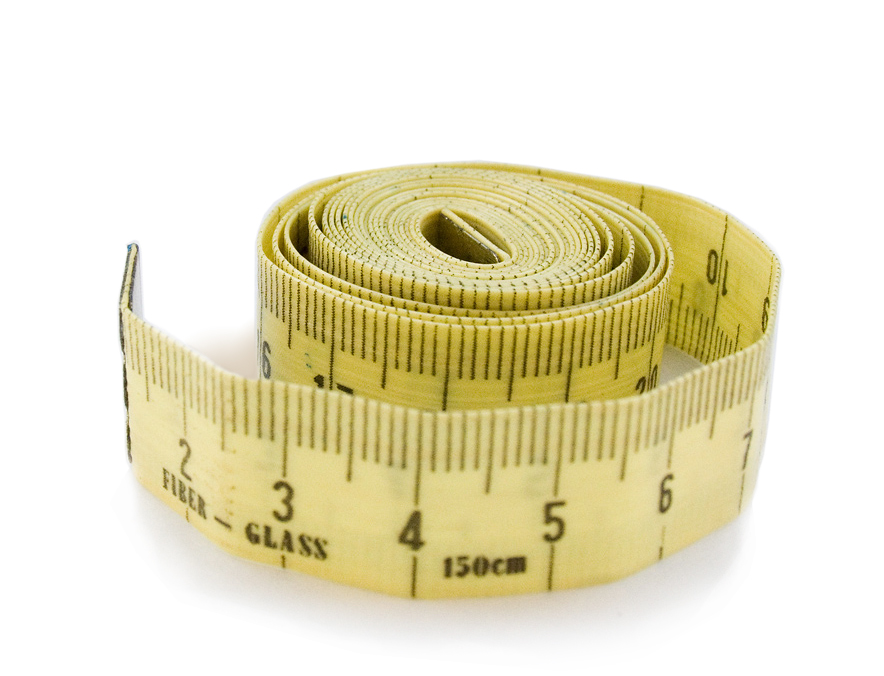
Take a narrow strip of paper, 83 feet 4 inches in length, and stretch it along the wall of a large hall; then mark off at one end the tenth of an inch. This tenth of an inch will represent one hundred years and the entire strip a million years. But let it be borne in mind in relation to the subject of this work, what a hundred years implies, represented as it is by a measure utterly insignificant in a hall of the above dimensions. (Darwin 1872: 269)
Demonstrations like this offer a glimpse into the expanse of deep time and conjure up a feeling of awe. Everyone should try Mr. Croll’s exercise.

Wait. What? You don’t have 83 feet of paper? You’d like to experience more than one million years of deep time?

Well, here’s a solution for you. It’s an animated movie of Mr. Croll’s strip of paper and the inspiration to make it came from marking off the hominin fossil record on a long strip of register receipt paper in Alan Walker's paleoanthropology lab several years ago.

Making the Movie about Deep Time
Because a movie about the entire fossil record of life on Earth might take a lifetime to make and a lifetime to watch, we focused in on the last six and a half million years of human evolution.
We built a database of the majority of significant fossil hominin specimens beginning with the late Miocene Sahelanthropus cranium and going up until about 40,000 years ago.

(This was back in 2005 so we could only include fossils that were published at that t
ime. We could also only use the known dates/ages from that time. We also had to stop adding fossils near the end (the present day) because that part of the record gets enormous and the fossils overwhelmed the movie... you'll see if you watch it all the way through.)

Then, with help from our programmer friends, we created a movie using the software
Shockwave® that turned the record of hominin fossil specimens and their ages into an animated timeline.
The movie pauses with each fossil to allow the viewer to see it. Skeleton icons represent complete and nearly complete skeletal remains. Skull icons represent complete and nearly complete skulls and crania. Partial skull icons represent skull fragments. Full tooth row icons represent nearly complete maxillae and mandibles. Partial tooth row icons stand for jaw fragments. A single molar icon stands for an isolated tooth.

Watching the Movie about Deep Time
To watch the movie, you need to go to this link, find my article
and click on "PA20110013_S03.zip." Download it, unzip it or "extract" the files (crucial), and then click on the "timeline" which should run in Mozilla Firefox or another browser. Detailed instructions on how to do this are here.

Viewers of the movie may begin by following these st
eps:
  1. When you open the movie, it starts rolling immediately. The movie can be stopped at any time by clicking on the red button, which, when clicked again, causes the movie to resume playing. The default rate is 20 years per second and at this rate time ticks by at one generation (20 years) per second.
  2. When you watch the movie at the default rate for at least 2 minutes, you will experience onlyabout 2400 years and will see very few icons. At this rate, watching the entire 6.5 million yearsof the timeline would take about 93 hours!
  3. For a different perspective, you can click on the drop down menu and set the pace to 50,000 years per second (same as 2,500 generations per second). At this pace you can witness the entire timeline of hominin evolution in a more practical length of time... with the film taking only several minutes to watch from beginning to end.
A Guide to the Movie about Deep Time
The clock starts at 6.5 Ma with the cranium from
Chad (Sahelanthropus tchadensis). Time ticks by on the screen at the chosen rate until 6 Ma when symbols representing the next known specimens (belonging to the species called Orrorin tugenensis) flash into view. Then specimens belonging to Ardipithecus pop on the screen, and so on until the proliferation of anatomically modern humans in the Late Pleistocene. This movie offers a different perspective on the hominin fossil record from that of conventional evolutionary tree drawings, where the time span of a species is sometimes estimated based on a single specimen or very few specimens. See this diagram below for just one of the myriad examples (Dunsworth, 2007).


Gaps in the Fossil Record and Deep Time
There are literally tons of fossils in museums around the world, yet it
is clear from watching the movie that there are more gaps than there are fossils. How can that be? Part of the answer has to do with the fact that not all creatures fossilize; and, of those that do fossilize, not all preserve to the present; and, of those that do preserve to the present, only a rare few are actually discovered by paleontologists. This enormous Earth is teeming with life. And it has been teeming with life for longer than we can comprehend from our limited perspective.

So not only is the fossil record spotty because of the rare conditions that are required for fossils to form, and the special conditions that enable paleontologists to find them, but the fossil record also has gaps simply because it is so long. The record covers so much deep time that it is taking generations upon generations of scientists to fill in those gaps.

Like your body, like the Milky Way, and like the universe, the fossil record is more empty space than matter.


However, that does not diminish the wealth of information that we can glean from the thousands of hominin fossils and artifacts that have been discovered so far.

In general, hominin fossils are more similar to others that share space and/or time than they are to those found further away in space and/or time. There are a few instances where different types or species of hominins were living practically side-by-side (e.g. robust australopiths and early Homo) and when that is discovered, the hominins are placed on separate evolutionary lineages, marked by separate species or generic designations. Noting similarities and making distinctions are all part of the process that paleontologists use to reconstruct evolutionary history.

In spite of the gaps in the hominin fossil record that are made obvious by the movie, scientists know a great deal about human evolution.

Overall Trends in Hominin Aanatomy and Behavior
The traits and behaviors that distinguish hominins at the genus level are evident in their teeth, their skulls, their bones and the artifacts that they leave behind such as stone tools and butchered bones.

Ardipithecus, Orrorin, and Sahelanthropus: As the fossil record stands now, the bipedal abilities and adaptations of the earliest hominins are disputed (as is their inclusion as hominins!). Some of the teeth of these small-bodied apes have thick enamel and their canines are relatively small—both trends that link them to later hominins.

Australopithecus: The main trend in the time of the australopiths is that of bipedal adaptation. It’s during this era that two separate lineages diverged: The robust australopiths (or Paranthropus) and the genus Homo to which humans belong.

Robust australopiths (a.k.a. Paranthropus): With their large molars and large jaws, these hominins adapted to hard, tough diets and then went extinct.

Homo: With their nearly modern (and, later, totally modern) skeleton, these hominins made and used stone tools as they added meat to their diet. It’s during this time that the brain makes a significant expansion. Species in the genus Homo are the only hominins to be discovered outside of Africa.

Lamarck and Deep Time

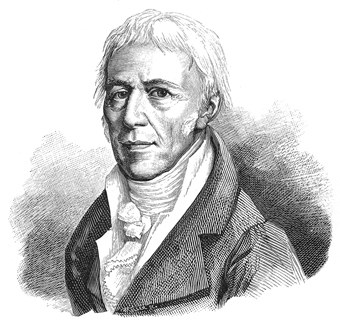
Prior to Darwin, Jean Baptiste Lamarck grappled with deep time and described how miniscule the present perspective is in comparison to the vast stretches of time that came before.

There is one strong reason that prevents us from recognizing the successive changes by which known animals have been diversified and been brought to the condition in which we observe them; it is this, that we can never witness these changes. Since we see only the finished work and never see it in course of execution, we are naturally prone to believe that things have always been as we see them rather than that they have gradually developed. Throughout the changes which nature is incessantly producing in every part without exception, she still remains always the same in her totality and her laws; such changes as do not need a period much longer than the duration of human life are easily recognized by an observer, but he could not perceive any of those whose occurrence consumes a long period of time. (Lamarck, 1809)
Thanks to controlled breeding experiments on organisms like bacteria and basset hounds we can witness evolutionary changes. What’s more, that you are not a clone of your parents, that your generation is different from the previous one, is evolution. However, the dramatic changes that occurred over thousands and millions of years before the present, and that will carry on for thousands and millions of years into the future, are beyond our imagination.

Deep Time is beyond Human Imagination
It is impossible to comprehend deep time. Even if we had a time machine and could visit an australopith 3 million years ago, we would only gain a snapshot of the past.

To gain a better perspective on deep time than we have now—that is, to really se
e evolution taking place—we would have to increase our life spans substantially, which would require a substantial increase in body size as well.

Being as large as Earth would certainly give us a better feel for the lapse of deep, geologic time. Being as big as the Milky Way would be even better. And so on.


This is why so many evolutionary biologists study microbes. To a microbe you are slow and absolutely enormous.


It’s from this present and human point of view that we must continue to work towards the scientific truth about the evolution of all life on Earth, from microbes to mammals. Our inability to truly comprehend deep time does not prevent us from understanding evolution. As long as we accept our limitations we can forge ahead.

Acknowledgments

Alan Walker was the inspiration behind this project which was carried out at Penn State University. Jessica Berry, Stephanie Kozakowski, Gail E. Krovitz, Maria Ochoa, Joseph D. Orkin, and Kelli L. Welker helped compile the fossil hominin database. Brian Shook and Patrick Besong creatively programmed our ideas into the computer. Kevin Stacey, Ken Weiss, and Michael Rogers provided helpful insights, comments, and discussion.


References
Darwin, C. 1872. Origin of Species, 6th edition. John Murray, London.
Dunsworth, HM. 2007. Human Origins 101. Greenwood Press, CT.
Dunsworth, HM. 2011. Deep time in perspective: An animated fossil hominin timeline. PaleoAnthropology 2011: 13-17.

Lamarck, JB. 1809. Additions to Part I, Zoological Philosophy. From 1914 translation.


P.S. Time's Deep, Man...

Wednesday, July 28, 2010

Getting past evolutionary pointilism--or creationism in the journal Nature?

The July 15 issue of Nature, in true Nature style, has a high human-interest picture of a fossil cranium fragment (glaring at you from the cover!) that purportedly shows that the separation between ancestors of Old World monkeys and apes had occurred. The find was in Saudi Arabia, and while Holly is the person most appropriate to discuss the details, we have a few words to say about it until she does.

The fossil is about 29 million years old. It does not have a specific trait found only in modern Old World monkeys, but not in apes. If the interpretation is correct, and we have no reason to question it based on our own fragmentary knowledge of this area, then it does suggest that the monkey-ape divergence occurred subsequent to when this individual lived.

Fine. Our issue, and it's yet another complaint about Nature's drive to be a pop-culture rather than serious scientific journal, is with the heading: " Parting of the Ways: Saudi Arabian fossil pinpoints divergence of Old World monkeys."

The implication in Nature is almost creationist in nature. It is the assumption that this lump of one-time bone was at the 'parting' of the ways, and that such events occur instantaneously. If not, how could a specimen 'pinpoint' the separation?

In fact, speciation is a gradual, statistical, probabilistic population phenomenon. It does not generally occur in a moment.

But suppose this is science, not Creationism on Nature's part. Even then, what is the chance that this particular specimen, or even any specimen from thousands of square kilometers or thousands of generations around this time, was the 'point' of speciation? The odds are minuscule, and in a deeper sense untestable.

Speciation, in the usual definition, would be the time at which no individual from either of the two new-lineage populations could successfully mate. But for thousands of generations, gradual divergence would in reality merely have diminished the probability that a random male from one and female from the other ancestral population could have mated successfully.

Even a mutation that by itself would make such mating impossible would not have spread throughout one of the populations so that the two species lineages were suddenly discrete and immiscible.

To melodramatize speciation and evolution in a way that almost makes it creationistic is yet another editorial decision by the journal that shows either crass grabbing for sales, the superficial understanding of science even by scientists or science journalists, or the simple dumbing down of science. The last thing it is, is a contribution to evolutionary science (we note that this is the editors' fault, not the authors: their paper makes none of these idiotic claims. Instead, they say that the fossil record may now show that the split happened during a 5 million year period after the demise of this current individual).

Friday, April 23, 2010

Ant misbehavin'


There's a new paper in PNAS that looks like one that really is interesting and relatively important. It is a story that made the popular science news, and reports paleontological findings with at least some interesting aspects.

This is the discovery of fossils ants and other insects, preserved in amber (tree resin, basically) that is estimated to be about 95 Million years ago, along with other species of plants. The insects are shown here. Apparently (we're no experts!) it has been thought from the available evidence that the ant lineages originated to the north (Asia or North America), rather than Europe. If the dating of this site is accurate, then the old idea is incorrect. At least, by this ancient time clearly recognizable ants were already in Africa.

Now this is not a story to shatter evolutionary theory, though overturning accepted views, no matter how arcane, gets played in the news headlines as being transformative. But it does seem to qualify as new and worth discovering and so on. That is, its appearance in the news doesn't seem to qualify as just more Big Discovery hype.

There may well be ecological, geological, or climatological reasons why this find is interesting. Or it could just be that, while the environments Way Back When were suitable for some of these arthropods, they just hadn't managed to get to all of them by this time, having originated elsewhere with suitable climate. So ant lovers can now start trying to explain this expansion, and EO Wilson can stop writing bad novels about ants and get back to what he does really well.

But there is something that is much more interesting to us. It's another example of a fact that is already well-known but that these specimens give us the occasion to write about. It's the very deep conservation of very modern-looking form, in this case of insects (but other groups of animals and plants show some similar characteristics).

Now, evolution is supposed to be a relentless struggle to keep ahead, to survive in changing environments (that include the ever-changing mix of other species, climate, and so on). If you look at the DNA from a group of critters like, say, ants, their sequence differences correspond to their species differences, and separation times estimated from the amount of sequence difference correspond to fossil evidence. Since Way Back When, there has been a proliferation of related species, with their own morphological differences and adaptations.

But wait! Why, then, do these very ancient fossils look just basically just like the bugs that bother you when you try to eat out on your back deck? Why can morphology stay essentially unchanged for 100 million years? Why hasn't selection or even just genetic drift (chance changes) led to changes in the form of these bugs?

The standard answer is that selection has kept it so. That means that the environments haven't changed. But why then did the species divergence also occur? Long-term stasis is not a new discovery; it was the basis of a famous, but over-hyped 'theory' called punctuated equilibrium, but that has to do with other aspects of evolution and the fossil record. For us here, what is not so clear at all is how selection keeps form so similar for so long in various lineages, yet allows divergence even in local areas as well as genomewide sequence differences to accumulate in the same way it does for less conserved branches of life. Various evolutionary ecologists, like a prominent acquaintance named Doug Futuyma, have advanced ideas about how genetic incompatibility can keep neighboring populations from interbreeding, so they retain their distinct forms and functions. But even without interbreeding as a source of variation, why doesn't form just drift--very slowly perhaps, but after 100 million years why not noticeably?

We don't have an answer, and maybe the rather superficial answer ('selection made it so') is correct. Even then, how that works with traits affected by many genes, as these insects' form certainly is, is a major question for evolutionary biology....if evolutionary biologists would think more seriously about it rather than assuming the answer is known.

We'll post on this subject again.

Monday, February 8, 2010

Kissing the lipless

“Holly, it’s fossil time!”

My doctoral adviser, let’s call him Sid, made an appointment with a man from Philipsburg—which is about a 30-minute drive northwest over the ridges from Penn State—to see some fossils he had collected. Over the phone he claimed to have an Australopithecus skull.

Naturally I wanted to be involved even though I was 99% sure this guy had nothing and was even surer that he had nothing even remotely close to an australopith.

Lucy (source)
Australopithecus (which includes dear old “Lucy”) lived between about 4-2.5 million years ago and the only known fossil representatives come from Africa. That’s a long way from Happy Valley. Not that they couldn’t be found outside of Africa, but it’s incredibly unlikely they’d be found in Pennsylvania since the fossiliferous rocks in PA are hundreds of millions of years older than any primate, let alone any hominin. It was a solid bet that he had nothing, but there was no way I could have anticipated the extent of the nothing that he was so proudly about to show us.

The man came up to our lab and introduced himself, then took us down to the loading dock where he parked his car. He was about six-foot-five and built like a small power forward, but dressed like a Nascar mechanic. As we rode the elevator to go down to his car he described how he’s been out of work, on disability, for quite a while with nothing to do but search for fossils. He boasted, “As soon as I started looking there were fossils everywhere!”

His red American car was decorated with Nascar stickers to match his clothing. Inside the car a woman was sitting shotgun, but she never looked back at us, never came out, never made a sound. He popped open the trunk.

I could see lots of rocks but no fossils. I was expecting to see fish, brachiopods, trilobites, plants. You could tell Sid shared my waning hope that we’d be able to discern something fossilized.

While we picked over the rocks, the man muscled a boulder out of the trunk and onto the ground. “Here’s a skull,” he proclaimed.

“No it ain’t,” Sid deadpanned.

“See, here’s the septum.” He pointed to a deep impression in the middle of the oblong rock. “And here’s the nostril and here’s the lip,” he continued.

“I’m afraid you’ve just got a big curiously shaped rock there,” Sid said graciously. Never mind that it was the size of King Kong’s cranium.

Undeterred, the man moved onto the smaller bits that we were scouring. If we could find even the tiniest fossil, we could show him what real fossils from PA look like.

“Here’s an arrowhead. Here’s a spearhead. Here’s a tool. These are all tools,” he sorted through every last one of the box full of flat rocks, none of which had been flaked into tools.

“They all could be used for tools, sure,” said Sid.

I tried to help, “There’d be flake marks on the edges if these were arrowheads or spearheads. They’re also not the kind of rocks that Indians from around here liked to use to make tools. These are sandstone and Indians in this area preferred jasper. I can show you some tools in the museum upstairs.”

Sid wanted to teach this man about fossils so he said, “Holly why don’t you go get some of your stuff.”

I dashed into the building and up the stairs because I didn’t want Sid to suffer all alone in what was becoming a pathetically awkward situation. When I returned, the man was showing Sid a human footprint on the underside of the skull boulder.

“You can see the big toe. One. And then the rest of the toes here. Two. Three. Four. Five.”

“So it’s a human you think?” I asked to clarify things.

“Of course!” he grumbled, exasperated with me.

We tried to tell him that it was just an illusion due to the weathering of the rock. Sid even explained, “How old are these deposits, Holly? Something like 350 million years? Listen, back then the creatures that could have left footprints had 8 toes!”

I added, “The first land-fish, but even those are rare in these parts.”

This didn’t’ stop him from pulling out, from the same huge box full of stone tools, some thin, flat, foot-shaped rocks. Human footprints. Baby footprints. Matching sets, lefts and rights, fanned out like poker cards and dealt one-by-one into our hands.

This was about all we could take. We didn’t have any fossil human footprints to show him, but we did have all that other stuff I’d carted down to illustrate how bone looks when it’s fossilized. We showed him an oreodont skull. Then some Green River fishes that I got at a garage sale. Then a gorgeous brachiopod that I found by Tussey Mountain. It’s just like the Shell logo and all white in a black rock. Then we showed him some bits of placoderm fishes that I found to the north. Although broken up, they’re so obviously fossilized animal parts. We explained that fossils will look symmetrical like animals and plants do during life. Even if they’re flattened or crushed, there are patterns.

Then we showed him that he did have some fossils—tiny bits and smashed up pieces of invertebrates, like brachiopods and the like, were preserved in some of his cobbles. These were dead organisms, we said.

source
We thought we’d open his eyes the way most people need help the first time they prospect for fossils. To most newcomers any old interestingly shaped rock looks like a fossil because they imagine they’re hard to spot. Searching for fossils, to some amateurs, is like spotting bunnies and bears in the clouds.

Once rookies see how conspicuous fossils can be, they realize that they’re easy to spot, but that they’re just hard to come by because they’re rare or they’re buried for so long until erosion exposes them or a road cuts through. It doesn’t take imagination to see fossils. It takes prior knowledge about where to look and then patience and focus to find them. And, of course, luck.

This guy never had a eureka moment. He barely acknowledged the fossils that we showed him and he wouldn’t even touch them. He just lurched toward his boulder and ran through its facial features all over again. “But see, here’s the lip, and there’s an eye, and then …” We just shook our heads and pursed our lips as friendly as we could.

“Well folks I’ll have to say I disagree with you.” Then we shook hands and he drove off towards the geology department for another opinion.

*****

If you laughed at the lip part of the story... if you think it’s funny that someone would expect a hominin fossil to have a preserved lip, nostril, eyeball, well, trust me, you weren’t alone. That part gets people every time. But try to imagine if you knew next to nothing about fossils. From a newcomer’s perspective, it’s actually not that crazy to think that Lucy would come with lips.

I mean, think about your last trip through a museum or your last perusal of a book on evolution. Colorful reconstructions of the earliest of Earth's creatures look just like spruced-up versions of the fossils they left behind! It's as if trilobites are just little Han Solos waiting for Leia to push the button to unfreeze them and then they'll be right back to swimming around in the ancient sea.

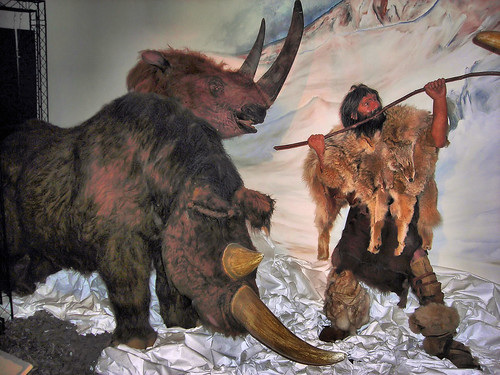
But as time goes on, as you make your way toward the present, through the exhibit or page-by-page toward the end of the book, reconstructions of lumbering wooly rhinoceroses and spear-toting Neanderthals don’t look anything like their fossil remains!

We fully expect our hominin ancestors to be reduced to bones and teeth and that's okay.
-->It's unfortunate, but we're totally over the fact that we will probably never uncover Lucy's skin and hair, lips and nose, snot and earwax, muscle and ligaments, blood and bile, mouth and gut microbes, mucous membranes and epithelial linings, fat and eggs, and etc. But it's okay because her bones and teeth tell us quite a lot. Not as much as we'd like, but they reflect her growth patterns, dietary behavior, locomotor behavior, etc. - all of which form a combination of traits not only unlike other apes alive today, but also unlike other fossil groups in our family tree. The absence of soft tissue in our fossil record - traits which would be informative and just plain cool to have - has thus far not prevented paleoanthropologists from performing quality phylogenetic analyses of our fossil record.
But the decomposition of soft tissues can really screw up interpretations of other realms of the fossil record. For instance, the earliest chordates (a group of animals with notochords that includes vertebrates and, of course, humans) from Cambrian rocks all over the world aren't preserved like Lucy at all. They're also so tiny and delicate and they can get buried so quickly in sediments at the bottoms of large bodies of water, that they get sealed in rocks in such a way that impressions of their entire bodies, lips and all are preserved beautifully.

Or so we thought until this recent innovative paper in Nature showed that early chordates may not be preserved so beautifully after all. Sure paleontologists never take decay and decomposition for granted (or they shouldn't), but there's something potentially worse going on, as the authors explain.

They took living anatomical proxies of early chordates, choosing ones from very different branches of the tree, killed them, and then watched them decay.

Starred in (a), their subjects (b) were larval Lampetra (ammocoetes; Vertebrata; TOP) and Branchiostoma (amphioxus; Cephalochordata; BOTTOM).


As the creatures rotted, the researchers noted which traits disappeared first in the process.


And guess what?

In general, the most phylogenetically informative traits - the ones that are best at finely discriminating which branch of the tree each creature fits on - were the first to go! The least informative were the traits that stuck around, that held up to the most decay. Traits that point to more advanced vertebrates are gone, but traits that point to general chordate remain.

(FYI, the lips which don't say much at all (heheh), go almost immediately.)


So by the end of the experiment, distantly related creatures looked basically, at least phylogenetically, the same!


Say you found one of these rotten creatures that these researchers were observing... say you found it fossilized and, because this is what you do as a paleontologist, you must discern where it belongs on the chordate phylogeny.

You'd only have the parts present to diagnose its place in chordate evolution. And according to this study in experimental taphonomy, you might not have very many, or any, of the parts that can help you say much more than "stem" chordate. The authors called this "stem-ward slippage", meaning that, thanks to decay prior to fossilization, many fossil chordates are put deeper on the tree than they belong. In life they weren't as primitive as they are in death. The most significant result from "stem-ward slippage" could be placing a fossil organism at the base of a lineage, claiming it as a possible ancestor to the rest of the creatures on that lineage, when in reality it was just a side branch with no living descendants.

If you are a paleontologist and you work on creatures that lived near the base of major splitting events, like I do, then you, like me, need to keep your eyes and ears wide open to this notion of "stem-ward slippage" - no matter that we don't expect Proconsul or Ardi or Lucy to come with lips.

References
1. "Non-random decay of chordate characters causes bias in fossil interpretation" by Sansom, Gabbott and Purnell

2. "Kissing the Lipless" by The Shins

Monday, October 5, 2009

The Many Tales of “Ardi”

The Inspirational Tale

Common metaphors in paleoanthropology are those of winning the lottery and being struck by lightning. But although fossils are rarely preserved or exposed at just the right place to be spotted, the assumption that fossil discoverers are supremely lucky is an unfair one.


Eugene Dubois decided he’d find a missing link on Java, moved his family there, and found the first Homo erectus fossils. Louis and Mary Leakey dedicated their lives to traversing East Africa for fossils and they found beautiful ones. It took most paleoanthropologists years and even decades of hunting, sometimes walking over the same doggone dust every season, just to spot a tiny speck of something spectacular.


This is the kind of tenacity it took for Tim White and his team to amass a fossil record of as many as 36 Ardipithecus individuals and to collect over 150,000 plant and animal specimens from the Middle Awash study area in the Afar region of Ethiopia. Not only that but “Ardi’s” fragile skeleton had to be prepared sliver by tedious sliver in the laboratory before the analysis could be accomplished. Last week’s special issue of Science came 15 years after the first announcement of the project because of the massive amount of collection and analysis that followed.


It's no surprise that paleoanthropologists were glued to their computer monitors last Thursday and Friday. Many of us are still carrying around our stack of 11 papers, picking our way through them every spare moment we get.


The Paradigm Shifting Tale

This is not just a new skeleton. Depending on your take, this is a renovation or an entire upheaval of the way we interpret the last 23 million years of ape evolution. Here is a list of just some of these new perspectives that Team Ardipithecus has presented to us:


1. Ardipithecus is a hominid yet it is much more primitive than chimpanzees and gorillas which are both highly derived. (This one is exciting because it links Proconsul (the 18 million-year-old ape that I work on) to hominids.)


2. Anatomical and behavioral similarities between ape species that have to do with suspension and locomotion-in-general are independently evolved. That is, they’re convergences or homoplasies. Even these traits in the fossil apes Dryopithecus and Ouranopithecus do not link them phylogenetically to living apes because they too evolved independently as homoplasies. Conclusion: Ardipithecus shows that phenotypic and maybe genotypic homoplasy is rampant in the hominoid (ape) fossil record.


3. Chimpanzees and humans share a deeper last common ancestor than the one estimated to have lived 6 million years ago (mya). Although the 6 mya hypothesis is currently “in vogue,” the last common ancestor actually lived more like 7-10 mya.


4. Even though the split between the chimp and human lineages occurred 7-10 million years ago, Ardipithecus from between 4-5 mya is our best model for the last common ancestor, better than any other fossil apes from Africa from between 6-11 mya such as Orrorin, Sahelanthropus, Chororapithecus, and Samburupithecus.


If paleoanthropologists were stifled, rather than stimulated, every time something new overturned old ideas, they would quit the field, or flunk out.


However, the suite of game-changers proposed by Team Ardipithecus are bound to raise not just eyebrows but hackles as well.


For example, they explain the ape evolutionary tree with multiple homoplasies (rather than with parsimony or the simplest explanation: that the traits evolved once in a common ancestor), but then they use parsimony analysis (which excludes homoplasies whenever possible) to claim that Ardipithecus is a hominid. Furthermore, the claims about ape homoplasies are grounded in the assumption that Ardipithecus is a hominid in the first place. Could they have done it any other way? I don't know the answer yet. But as it stands, it makes an already large pill even harder to swallow. The whole field is now charged to test these new hypotheses and we certainly have our work cut out for us.


The Snarky Tale

Tim White’s papers are always thrilling to read. Usually the science is tight and methodical, which is highly satisfying, but you can also count on enjoying a bit of snark, and when I write “enjoy” I guess I’m being snarky.


Here’s an example: As the authors explain how un-chimp-like Ardi is, and how derived chimps and gorillas are compared to hominids, they write,


“Some hold that our last common ancestors with African apes were anatomically and behaviorally chimpanzee-like, that extant chimpanzees can be used as “time machines” and/or that unique features of Gorilla are merely allometric modifications to accommodate its great body mass.”(White et al., Science 326(64): 75)


These hypotheses of "Some" paraphrased and quoted by Team Ardipithecus may not sound so strange to any of you. They don't to me. But we're being admonished. Sure, the authors can forgive Darwin for thinking this way because he was forced to work without a fossil record. But the rest of us seem to have no excuse even though up until now we’ve all had to do paleoanthropology without Ardi.


A decent hypothesis for what our last common ancestor with chimps looked like is that it looked a lot like chimps. It’s pretty simple. And it’s only a hypothesis, not a personality trait. And it’s going to remain a decent hypothesis until scientists beyond these authors also support Ardipithecus as a hominid.


If they must lash out at colleagues, the authors should wait until after we've ignored their findings or rejected their arguments. Bashing us over the head the second we get a chance to read about Ardi is something Ardi might do.