Showing posts with label australopithecus. Show all posts

Wednesday, June 26, 2013

Can you throw with half a brain?

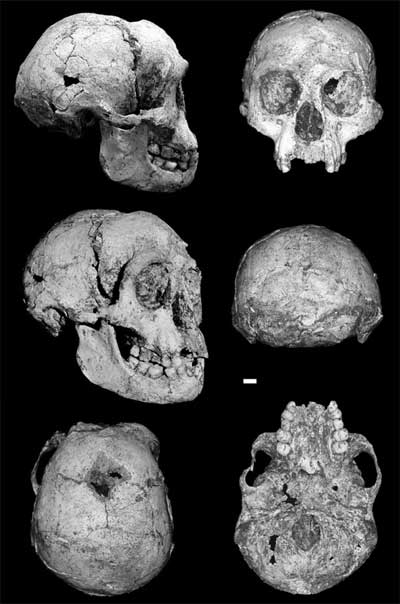
Homo erectus had half the brains that we have. This guy's got even less. (source)
This being at least my third post about the evolution of throwing here on the MT ("A prehistory of throwing things" and "Hurling words and turds, an evolutionary link"), I think I should give a little background about my interest. Even before I started graduate school my doctoral advisor got me (a lifelong athlete) interested in it, we teamed up with a biomechanist, did some modeling, wrote about what throwing might have been like for extinct hominins like Lucy and the Nariokotome Boy ("Throwing and bipedalism: A new look at an old idea" will email the pdf, just ask), and I was awarded an NSF graduate fellowship for the proposal to come out of that project.

So obviously I earnestly thought I was going to study hominin throwing for my dissertation, but when I started to try to pull a comparative experimental study together and realized that everything I wanted to do would require that I go somewhere(s) else and work with someone(s) else, it didn't make much sense. I needed a biomechanics lab and I needed lots of practice in one too. And, I couldn't even begin to figure out where to find chimps or other primates that I could work with, let alone that I could get to visit me in that biomechanics lab. Or I'd have to learn ways to study kinematics of animals without much control. And I'd have to go somewhere else to do most dissections too. And let's not forget how much smaller the fossil hominin sample was 12 years ago. It wasn't feasible for my dissertation.

It was okay though because while I was doing what eventually became my dissertation research on Proconsul feet in Kenya I met Neil Roach who was just starting his studies at Harvard and was working on the evolution throwing! If it wasn't going to be me, at least someone was going to figure this out for us, and that someone had the resources to do so. And that someone's research made the cover of Nature this week.

The paper's called "Elastic energy storage in the shoulder and the evolution of high-speed throwing in Homo." [link to paper]

Here's a promotional video that Harvard posted:


In the paper, the authors ask, Why can we throw like we do and why can't chimpanzees? and they look to the musculoskeletal differences between us to find out.

In this paper, it's all about the whip-like motion of the human body during a throw and the slingshot-like energy storage in tendons, ligaments and muscles that makes it work. They elegantly describe this process and write about three key differences between humans and chimpanzees that they say are critical to why we throw like pros:

(1) our flexible torsos that allow more rotation at the waist
Human (a) and Chimpanzee (b)
(Source: Figure 3 from Bramble and Lieberman, 2004)

(2) our lower amount of humeral torsion in our throwing arms
from Roach et al., 2012: "Fig. 1 Humeral torsion (in blue) is determined by measuring the angle
between the orientation of the humeral head and the distal condyle
of the humerus. In the clinical literature, the same angle is referred to
as humeral retroversion (in yellow) and is measured in the opposite
direction."

(3) the lateral, not cranial, orientation of our shoulder joints

From the study's website: "This image shows differences in the position of the shoulder between chimpanzees (left) and humans (right). These differences can be seen in both the muscular anatomy and in the bony anatomy of the scapula (shoulder blade). (Image credit: Brian Roach/Neil Roach)" 
Then the meat of the paper is devoted to their experimental analyses of a group of skilled human throwers that appear to support the importance of these traits in throwing, particularly for storing elastic energy for fast throws. I say "appear to" because I wasn't given any of the supplemental materials and what's in the main text (which is all I have) doesn't quite pull the analyses and those traits together for me, but that could just be my very rusty biomechanics training rearing its rusty head. Or it could be my incredibly high and probably impossible expectations about what we can take to the fossil record with only a study of human throwers upon which to rest our assumptions of functional anatomy.

For example, humeral torsion is often asymmetrical in humans, being lower in the dominant arm, adding support for the assumption that humeral torsion changes depending on activity during an individual's lifetime. Is it fair to compare that trait to chimpanzees when it's not necessarily an in-born difference? Yes. But that makes explaining selection on that trait a little bit more difficult. I think it's fair to consider it, at least its asymmetry, a marker that an individual may have been habitually throwing during its life. So in that regard, it's worth looking for in the fossil record.

But then there's another snafu: How important could it be in reality and across space and time when there is so much overlap in the quite acceptable (but relatively small compared to reality) sample here?

from the study (with my blue box added to highlight overlap): "d, Humans and chimpanzees show comparable degrees of torsion5, although throwing athletes show reduced dominant-arm torsion2 consistent with low torsion in Australopithecus and Homo erectus5. Chimpanzees are a combined sample as they do not show arm dominance, whereas human values are split between dominant and non-dominant arms as they show arm dominance. In d, the black and grey boxes and whiskers show torsion-angle quartiles, and the red dot shows the torsion angle mean."

There's good reason to believe that low torsion is different. But there's also reason to wonder if it's necessarily due to throwing or to, say, using the dominant arm to do any number of things, one of which is throwing.

There's also good reason to curse the early hominin fossil record for providing us with only five individuals to include in this figure!

And there's also good reason to curse australopiths for not clearly fitting in the human or chimpanzee box.

And there's also good reason to curse chimpanzees for not being different enough from us so that our evolutionary histories are easier to reconstruct.

That these three traits listed above do exist in Homo erectus means Homo erectus could have thrown like us. (How else would they have experienced such a shift in foraging strategy?) And that these traits don't exist in australopiths (although the flexible waist issue is still up in the air) means that australopiths couldn't have thrown like us, not with the force that we can put behind a projectile.

And if that caused you to pause and recall that chimpanzees are stronger than us, and to wonder why such a powerful animal is such a weak thrower... then you're right here with me, in my head.

This paper provides a strong explanation: it's all the elastic energy storage and the coordinated movements of the body to maximize it and to maximize its transfer to the projectile.

But that may be only part of it.

And because it's probably like most things about living organisms are (and like most things in the universe are), human throwing is probably more complicated... even more complicated than a complicated sequence of elastic energy storage and use.

There's a large body of literature that explains human throwing with another major difference we see between chimpanzees and humans: Our big brains.

That coordinated fine motor control of the body, head to toe, during a forceful throw is brainy. Is it brainier than what a chimpanzee's working with? It's not yet known, but it's not a bad assumption.

That fine-tuned timing of release that's crucial for accuracy, particularly with forceful throws is also brainy. Is it brainier than what a chimpanzee's working with? This is also, I believe, not yet known, but it's not a bad assumption either.

This isn't to say chimpanzees are klutzes. Far from it. It's to say that evolutionarily new and/or simply more motorneuronal matter in the brain and throughout the body is probably required to throw like a human, and to do all the things we do with our dexterous and powerful fingers, hands, and arms, and to do new-fangled, fast, sequential coordinated movements with our bodies. And it's probably a big part of why chimpanzees cannot or do not. (But trust also that it's highly likely that they have neurologically based abilities that we do not!)

Unfortunately, in this department, all we really have is brain size for early hominins and that's just not going to cut it for parsing apart these details we need to reconstruct throwing in extinct hominins even if we knew exactly what our brains were doing to aid in throwing. But comparative work with living species will continue to be enlightening about the brainy differences among us, even if they don't enable us to nail down behavioral details about fossil hominins.

Even still, I think there's a lot we can still hope to figure out about australopith throwing. We have a biped without a modern body. It would be really useful to better understand how well australopiths could throw under these circumstances. There’s a lot of variation on the baseball field but none that comes close to that between us and the australopiths. If we knew about their throwing ability and style, we could better know how they foraged for food, thwarted predators, and socialized with one another since action-at-a-distance is key for all. It's also important to know because there's only a bit (as one would predict), but there's evidence for tool use among them  (for example). What if having all the built-in throwing skill of a chimp is good enough as long as you’re built to be upright, you’ve been practicing, and you’re hungry?

As our 2003 research suggested...the long australopith arm would have given them a larger release window for slow, lobbing throws, something their puny brains could work with and still hit a target. But as arms got shorter with the genus Homo, particularly the forearms, the release window shrank, particularly as throwing velocity increases, and that’s when their larger brain would help with accuracy, especially for fast, flinging throws.

But that's only if the brain matters.

But it probably does.

And if brains do matter, then Homo erectus, with its half to three quarters of ours, was either throwing like a pro without all our fancy gear (suggesting we’re over-equipped) since it was pretty good at hunting  ...or that Homo erectus overcame its lackluster equipment somehow and still survived and reproduced just fine. Fine enough so that they could, over time, leave much brainier descendants. 

And then there's of course the running issue. Aside from humeral torsion, all the skeletal traits for human throwing are also for running. And doesn't every little step you take in a run feel like a little throw?

And then, to add to that, throwing anatomy appears to be important for making and using tools of all kinds, not just projectiles. If that's not intuitive, think of the similarities between throwing a ball and swinging a bat. If we want to reconstruct hominin evolution as a sequence of origins of traits and selection "for" this or that trait...this then that then this then that then tadaaa: modern  humans... we'll have to parse apart adaptations for throwing and for running and for tool making and use. But if that makes you wince, like I'm doing, that's because maybe that's the wrong question, the wrong tack. The more we understand about things like throwing, the more obvious it becomes that things are complicated (even moreso than this) and things are interrelated and they always were and in varying ways back through time.

While we're figuring out whether Homo erectus could throw like us with only half the brains that we have (at least as far as we're limited by cranial capacity and reconstructions of spinal cord diameter), and while we're figuring out more about what the australopiths could do, let's also figure out why chimpanzees are so much stronger than us. Is it because of this hypothesis about trading off muscular strength for speed? If someone has solved this mystery and I just missed out, please leave a comment! I feel like I could ramble on and on and on, but I'm going to leave it right here for today.


Note: References are linked within.

And here's one I just found while writing that I haven't read yet: "The uniquely human capacity to throw evolved from a non-throwing primate: an evolutionary dissociation between action and perception."

Thursday, May 10, 2012

We need another explanation for our big brains like we need a hole in the head


(source)
Something was definitely up, up top, once our bodies, down below, committed to walking and running upright.

It’s only after things got familiarly human in the locomotor anatomy--when we got long legs, non-grasping toes, and reconfigured butts--that brains started increasing beyond ape proportions.

For the first four or five million years of hominin evolution (from 7-2.5 million years ago) the story’s about bipedalism. For the last two and a half, it’s about encephalization. We've known this thanks to fossils for a while and genetic evidence is saying the same thing. It’s natural, then, for such a cerebral organism to wonder whether the two are connected.

As you hypothesize, you could go the technology route. Freed forelimbs, not necessary for locomotion, are free to be handy. O! the possibilities for hurling turds and building worlds! So that's one idea: Selection for a brainier hominin (both physically and cognitively) could occur only after the hands were habitually free to be freaky.

You could go the ecology route. Once our bodies committed to bipedalism our diet changed to include more meat, hominin body size increased, and geographic dispersal did too, no doubt aided by our more efficient bodies built for long distance travel. These characteristics, together, have been compared to those of scavenging and predatory carnivores. Regardless of how small or large a part meat played in our ancestors’ diets, there’s no denying that an ecological shift occurred in the early Pleistocene, with an increase in diet and habitat diversity, and that shift must have included new requirements of the brain.

Or, you could go the sociality route. As hominins relied more and more on cooperative foraging and parenting behaviors, etc, navigating social networks became key. Once complex speech and language arrived, then there would be new demands on the brain as well.

These pressures, requirements, demands, however you want to think of them, could be working in concert and at different times (e.g. technology plus socializing) over deep, geologic time and many many hominin generations. By "working," I mean contributing to the more-or-less sustained differential reproductive success of hominins with slightly larger brains. And because it’s the way that the fossil and archaeological records reveal behaviors over time, I tend to think of these three categories (technology, ecology, sociality) as describing the last 2.5 million years in the order I listed them. Technology was strongest earliest (starting with the Oldowan stone tools by 2.6 mya), and persisted. An ecological shift came along with that technological shift and then persisted. And of course social complexity came along with the technological and ecological shifts and then persisted.

These are some of the most mainstream hypotheses for encephalization (1) and they're implicitly or explicitly predicated on the prior evolution of bipedalism.

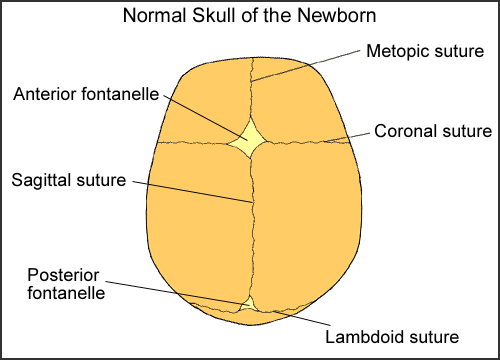
But now there's a new tie between big brains and walking upright--offered up in a  new paper just out in PNAS--and it's based in the human-, not ape-, like tendency to fuse the metopic suture later in life, to delay the close of what starts as a hole in the top of a baby's head known as its anterior fontanelle. The authors suggest that we need this hole in our head to exit our mother's bipedally-adapted birth canal safely and we also, as they suggest, need it to grow up to be an encephalized creature.

According to the authors, the "Taung child", an Australopithecus africanus kid (a member of a well-known bipedal hominin lineage) had an unfused metopic suture, left as an imprint on the fossil brain endocast.

Raymond Dart with the Taung child fossil.  http://en.wikipedia.org/wiki/File:Raymond_Dart_with_Taung.jpg 
Seven other australopith and Homo fossils are also described in the paper as having unfused metopic sutures. You might too! The odds are small, but since you started with a hole in your head as a baby, you could still be walking around with it unzipped.


To any chimps reading this, your metopic suture most likely closed just after birth and before your first deciduous molar erupted. But for 90% of humans (as reported in the paper), the suture closes later, after the eruption of the first deciduous molar. There’s a much slower fusion rate in humans than in chimpanzees.

However, to interpret the Taung child’s anatomy, things get a bit dicey, like things just love to get with hominin fossils. So often they can go either way: chimpy or humany.

Check out the figures below. A is for Pan troglodytes (common chimps) and B is for Homo sapiens. Those are frequencies of metopic suture fusion per dental age group. By listing them this way, instead of by chronological age, we're able to compare between two species that grow at different rates but share the same pattern of dental eruption. Chimpanzees grow up faster than us and experience earlier metopic suture fusion than us. Flipped around, humans grow up slower than chimps and experience delayed fusion of this suture compared to them. The Taung baby's dental age category is starred (*) at the "M1" stage in A and B. (The Taung child died at around 3.8 years of age, when its first permanent molar, M1, was erupted.)
Because it's more likely you'll find a human at that age (*) with an unfused metopic suture than a chimp, the researchers leaned toward calling the Taung child's state human-like, rather than ape-like. They backed that assertion up by listing seven other late Pliocene-early Pleiostocene hominins with unfused metopic sutures... it's a trend in the hominin lineage that begins with some australopiths, like the Taung child, they say.

"The presence of a still patent fontanelle and of a partially fused [metopic suture] in the Taung child, and the incidence of unfused [metopic sutures] in five adult and two other younger Australopithecus/ early Homo specimens is thus taken as evidence that a human-like pattern of late [metopic suture] fusion was already present in mid-to-late Pliocene gracile hominins."

Okay. Intriguing! But now we must explain!

[This is the part where, if you listen very carefully, you can hear the collective curmudgeonly groans from within and beyond the walls of paleoanthropology.]

Enter the new hypothesis for encephalization based on the late fusion of metopic sutures. The authors nod to two papers that offer "adaptively neutral" explanations for late metopic suture fusion but argue that the fossil evidence combined with the differences observed in chimps and humans beg for an adaptive explanation. (This tack is unsurprising given how paleoanthropology generally operates.)

The authors offer us three adaptive hypotheses to explain late metopic suture fusion:

1. Reorganization and expansion of the frontal neocortex (explains late metopic suture fusion)
Something about the changing and enlarging frontal cortex required changes to the cranial bones, how they form, grow, and fuse.

2. The difficulty of giving birth to large-headed neonates through birth canals that were reconfigured for bipedalism, the “obstetrical dilemma” (explains late metopic suture fusion)

The squishy neonatal head, thanks to the fontanelle,  "probably occurred in conjunction with refining the ability to walk on two legs," Falk (the lead author) said to the media. "The ability to walk upright caused an obstetric dilemma. Childbirth became more difficult because the shape of the birth canal became constricted while the size of the brain increased. The persistent metopic suture contributes to an evolutionary solution to this dilemma."

The trouble with this hypothesis as applied here is, although we know modern humans have a tight fit at birth now, there's little evidence for a tight fit between neonate and birth canal during australopith times.

And you can't help but wonder whether a squishy head was, or still is, required for successful birth. Do children suffering from craniosynostosis require a c-section to be born? Also, since the metopic suture fuses after chimpanzee birth, are we certain they aren't squishing their brains as they exit their relatively roomy birth canals? These questions may sound silly, but they're illustrating the built-in assumptions of the paper (or my ignorance about squishiness of baby heads).

The squishy head may be helpful during childbirth, but if it's occuring as early as australopith times, an adaptive explanation as a "solution" to an obstetrical dilemma is hard to swallow. That is unless DeSilva's estimates cited by the authors-- that australopiths had large neonates and tight fits at birth--are correct.

3. High early postnatal brain growth rates (explains late metopic suture fusion)
We know that humans have high rates of postnatal brain growth and this is what a lot of the news media picked up on: Your baby's head has gaps between the bones so the brain can grow like crazy after it's born to the gargantuan size of an adult human brain. As established in hypothesis #2, the need for the fontanelles in the first place is the crunch at birth thanks to the obstetrical dilemma, implying that without the pressure to be born small enough to escape the bipedal birth canal, we'd grow larger fetal brains in the womb.

So with this new paper we're presented with something even more fundamental than the notion that bipedalism as a necessary precursor for technological, ecological and social selection pressures for encephalization (as covered above): The tight fit at birth, caused by antagonistic selection for bipedal pelvic anatomy and large neonatal brains, created the selection pressure for a squishy neonatal head (which is facilitated by the fontanelles) and because of that roomy cranium, postnatal growth rates were able to ramp up in selective environments that favored encephalization.

So I'm left wondering, Do we need a hole in our head to be born successfully? Do we need a hole in our head to be encephalized? If the answer to both of those is yes, then what is a hole in the head doing in a hominin genus that may not have had much difficulty with childbirth and was hardly (if at all) encephalized? And, given the overlapping chimp and human fusion patterns, how can we be sure this feature on Taung is humany and not chimpy?

And, further, you can't (or at least I can't) help but wonder if there's a biomechanical/functional explanation for late metopic suture fusion, given how feeding behaviors and masticatory muscles put stress on the cranium. The skulls of australopiths and other hominins experienced stresses differently than chimpanzees. These differences may have begun as early as the nursing stage. Could this have anything to do with delayed fusion of the sutures? (here's just one study I found that addresses these kinds of questions)

And finally, it's hard not to link Falk (the lead author) to her research on Homo floresiensis. The hobbit (LB 1) looks like it has a fontanelle, something the disease-hypothesis folks point out is consistent with their perspective, and that’s one reason why I assumed these authors are onto this topic.

But LB 1 is conspicuously absent from the laundry list of hominin fossils in the supplementary section. Either they're saving what they've got on metopic suture and fontanelle anatomy in H. floresiensis for an upcoming paper or they just didn't think it was worthwhile to include this specimen. After all,  the latest paper on hobbit anatomy claims that the hobbit's "fontanelle" isn't real. Peter Brown writes, "direct examination of the asymmetrical hole in the posterior frontal of LB1, supported by CT scans, clearly indicates that this is the result of post-mortem excavation damage and is definitely not an unfused anterior fontanelle." (2)

Good thing, because if the hole in LB 1's cranium is of biological and not of taphonomic origin, then who knows how anybody'd explain its adaptive significance in such a tiny-brained hominin.

But, going way back to Taung and the australopiths: They were, after all, bipedal and the big brain train had to pull out at some point!

And, stay tuned. I got a tip from one of the authors about a paper coming out soon that demonstrates how weak the obstetrical dilemma hypothesis is, for explaining fetal size and growth, given the current evidence and given what we know about maternal metabolism.

Notes
(1) Of course, these hypotheses don’t represent all of paleoanthropology. I just intended to cover the major bases. And you need to consider what many paleoanthropologists assume which is that brain tissue is expensive so something extraordinary must have kept up selection on its increasing size for the last 2.5 million years. The assumption is that if brains were cheap, everyone would have big ones, but I don’t buy that. I think it's clear that other species aren’t encephalized because they don’t have to be. They do just fine without big brains. We have a rather warped perspective on selection for encephalization, thanks to our presentism and our big brains.
(2) Thanks to K. Baab for the tip.

Friday, March 30, 2012

Forget bipedalism. What about babyism?


First, a little time travel experiment...

Here's a newspaper headline and blurb from 709,987 CE: 

Hominin fossils dated to 2,012 CE show arboreality


Artists have made a realistic reconstruction (above) of an early human species based on the anatomy of the latest fossil discovery in paleo-Alabama by a team of paleontologists. These primitive hominins were still climbing trees!

source
In yet another reconstruction of this primitive species (above), an adult forages for honey by scrambling nimbly up a tall tree trunk. 


In other paleontology news, a team of scientists determined that a Morrocan variety of domestic goat, from roughly the same primitive era, could adeptly climb small bush-like trees.
**
*A-hem*

I promise that's not sarcasm or postmodernism! That's just me trying to jossle you loose of some traditional assumptions and spark you to wonder about how we know what we know about the functional relationships between anatomy and behavior.

I'm thinking about this because of the latest and greatest news in the world of paleoanthropology, published this week in Nature and here's a nice video to bring you up to speed:


If this Burtele foot fossil represents a hominin, it's different enough in anatomy (and the functional interpretation of that anatomy) to be considered something separate from other hominins on record.

It's this whole other animal.

As of now, all hominins at this time in the mid Pliocene (the foot is dated to 3.4 mya) belong to the genus Australopithecus and are only known from sites in East and South Africa. Perhaps the Burtele foot is another species that is not A. afarensis (which supports long-existing arguments that there are two lineages at this time) or maybe this is an ancestor to the Paranthropus radiation that occurs in the early Pleistocene. Or maybe it's not even a hominin, because the foot is very ape-like. Moreso than any australopiths on record.

Chimpanzee displaying it's non-human-like hallux (big toe). 
Can we tell what this animal is? Without teeth and cranial bones--our gold standard for identification and distinction--can we surmise what kind of creature this Burtele foot belonged to?

For starters, if it's to be deemed a "hominin," we should determine what exactly about this foot is human-like.

In terms of metrics, the Burtele foot shares traits with humans but these are also shared by gorillas and sometimes chimpanzees and sometimes old world monkeys too. The striking similarities between human and gorilla feet have been known since the earliest comparative anatomy studies and it was only a matter of time before a new primitive fossil brought the problem to heightened prominence.

For the qualitative traits, more similarities appear to be shared with the famous "Ardi" skeleton from about a million years earlier in time (belonging to Ardipithecus ramidus) than with extant humans.

According to the paper, there appears to be few derived, hominin-specific features in this foot. And that's even if you are on board with calling Ardi a hominin. Granted, we expect more primitive hominins to share few of those traits with us and traits evolve mosaically, even within the foot. And granted, not all hominins contributed directly to our evolution, so we might find species on the hominin branches of the TOL that share no derived features with humans. Still, the case isn't very strong for this Burtele foot being a hominin.

One of the reported hominin-like traits has to do with the shape and orientation of the proximal phalangeal joint where it articulates with the second metatarsal head. This appears to indicate that the foot was experiencing more toe-off during walking, more like human walking than like ape walking since it's not the condition found in ape feet. This functional interpretation seems to be based on that made of Ardi's foot. Unfortuantely I don't think anyone's looked at the biomechanics of this joint in apes (and ape feet) as they walk bipedally, yet. (But I could be wrong!)

Also, although the degrees of torsion in the second metatarsal is ape-like, the torsion in the first metatarsal is more humanlike. (Torsion describes the orientation of the proximal joint surface relative to the orientation of the head. The Burtele foot's MT2 and MT4 are reported to have less torsion than that seen in African apes (where this is associated with a grasping orientation), yet are still significantly twisted compared to human metatarsals.)  The torsion in the big toe (hallucial metatarsal) is reported to be unlike that of African apes, and presumably more like humans? It's not clear. But the actual measure of the degree is not included in Table 1, nor is it demonstrated in the Supplemental section as implied. So we have to take their word for it. And by the look of the Burtele first metatarsal in the photos, that's probably not a problem.*

So there are some leads away from extant African apes and weak ones toward Ardipithecus and possibly extant humans, but what the paper demonstrates better than the hominin status of the Burtele foot is just how difficult it is to pin down hominin-ness.  We don't always know it when we see it.

For most of us and I assume the authors of the paper, this is what makes paleoanthropology so fun! But it's also why we fight.

That's not because we don't know how anatomy and behavior are linked in extant humans, apes, monkeys, etc... we seem to have a pretty good handle on that. At least big picture. The problems arise when you zoom in. Are chimpanzees really arboreal? Yes. Are they really terrestrial? YES. Same for gorillas.

So reconstructing an evolutionary scenario in which our hominin ancestors went from a state of arboreality to a state of terrestriality is not that simple. The Burtele foot describers definitely understand this. It's just the popular media that doesn't have the time or the inclination to get this. Hence my intro above.

But that intro up there with the futuristic newspaper wasn't purely reaction-against-media-reaction. It's also me reflecting on issues closer to home for paleoanthropologists.

Do primitive "arboreal" traits in hominin skeletons really correlate with arboreal behaviors? Or are they ancestral relics? We don't do much climbing anymore but we have all kinds of anatomy that links us to our tree-hugging relatives, and presumably to our shared tree-hugging ancestors.

So at what point do we recognize primitive traits as being only that? Why must all traits we observe in extinct animals be so USEFUL?

The answer is.... because that is the only way to go about these functional studies. By definition functional anatomy indicates FUNCTION. So we go in with a bias toward identifying function, NOT with an aim to identify primitive relic anatomy that just happens to work for the animal. The latter is so much harder to perceive although one might argue it's what our null hypothesis should be. It's easier to assume that if an animal has the anatomy, then it's functional and therefore it's "for" doing whatever it is that it does with that anatomy.

Who cares about these subtly different approaches to comparative anatomy and evolutionary reconstruction?

Well if you're trying to determine when bipedalism became habitual and when hominins stopped relying on trees for foraging, fleeing, socializing, and nesting, then it matters whether functional anatomy is function or whether functional anatomy is just hanging on. (pun intended) Welcome to the nightmare that is paleoanthropology!

So where does the Burtele foot leave us?
1. Looks like we've got a separate ape-y thing that's not Lucy's species (A. afarensis) living around the same time and place as Lucy and her ilk.
2. Looks like whatever this animal is it doesn't have the few derived features found in some australopith feet. (those are even debated...)

But speciation, co-habitation, and bushy hominin phylogenies aren't even the coolest part of this story.

The two distinct foot morphs offer another kind of insight.

Lemme show you.

First of all, what is arboreality and how much arboreality is enough to require specific grasping adaptations in the big toe?

We know that cercopithecines (like macaques and baboons) vary pretty widely in their degrees of arboreality and terrestriality, but regardless, they're good in the trees and they're good in the trees despite their short and diminutive big toes! Arboreal behavior can be accomplished via many different evolutionary processes revealed to us via skeletal anatomy.

Here are two baboons showing off their small big toes.


Baboons are considered to have terrestrial adaptations in their feet that are similar to those in humans like with their shorter phalanges, but they're also the opposite of humans with their short, not long big toe.  Like with arboreality, terrestriality works via many different evolutionary processes that are revealed via the skeletal anatomy...and this goes beyond primates. (The crux of it all for human evolutionary reconstructions is determining how bipedal terrestriality differs from quadrupedal terrestriality.)

Gibbons (apes) are super aboreal, but their locomotion biases grasping hands, not feet. However, their suspensory behavior does use the grasping big toes.

Here are some gibbon feet displaying their big big toes.


Here's a film showing a gibbon using its grasping big toe: http://www.arkive.org/bornean-gibbon/hylobates-muelleri/video-08a.html

Conclusion: The arboreal use of the strong grasping big toe is not necessarily about climbing or even walking on tree limbs;** it's probably more about suspension.  Suspensory behavior is typified by the gibbons, orangutans (many at least), and the rest of the apes and so is the grasping big toe. That's the strongest functional explanation for the ape's thumblike big toe.

Now, larger apes are not suspending as much with their toes. And they can get up into the trees just fine without grasping with their big toe.****

DeSilva (2008)
So think about who's doing much of the suspension particularly in African apes: Juveniles.


Suspending from vines and tree branches is one thing, but also, climbing trees with immature musculature is certainly helped by a grasping big toe.
And then of course, grasping not just trees and vines, but grasping mother is important as well.


Is there any way we can investigate this ontogeny-based hypothesis for a grasping hallux?

Let's consider the foot as a whole first, and then get back to the big toe as a grasping tool.

We can see whether foot size varies during ontogeny in different primates.

I have looked at the size of macaque (monkey), gorilla and chimpanzee (Pan) feet through ontogeny (granted, a cross-sectional sample, not a longitudinal one).***

Because macaques grow up faster than the two apes which share developmental pace, here's how I lined up the age groups (1-5; 1 = infants and 5 = adults) so that I could fairly compare growth among them.


And here are the results where I compared relative foot size during ontogeny (over age groups 1-5). Femur length was my measure for overall body size.


The box and whisker plots show you how macaques are born with big feet relative to body size, relative to adult proportions. The ontogenetic changes in proportions that they experience, over the age groups I've constructed, are significant according to the ANOVA.

By contrast, and granted I had small samples of chimp and gorilla infants ... those apes are born with adult foot size proportions which are small relative to what macaque infants are working with. Larger, more adult feet at birth contribute to macaques' relative behavioral precociality compared to young gorillas and chimpanzees who are relatively altricial. With those big feet macaques can better navigate a big world.

Chimps (and especially humans) are relatively behaviorally altricial at birth compared to macaques. Neurological development factors into this, but the small feet (in a big world) are also part of that altricial package.


Now, to bring this back around to grasping thumb-like big toes in apes!

During their longer periods of infant and juvenile dependency, gorillas and chimpanzees spend quite a bit of time clinging to mom. Big feet for body size would help cling to mother like with macaques. On a relatively small foot for body size--and in a relatively more dependent baby which is taking longer to achieve independence and is requiring more mother-infant care and bonding and learning--the thumb-like grasping big toe would come in handy (or footy).

(We've got some residual ability still...see here.)

In this scenario, the grasping hallux is an adaptation for surviving the earliest stages of life as a small footed more vulnerable, slower-developing, extensively dependent ape infant.

So what does this have to do with Pliocene hominins?

First of all, it means that morphology should be considered in an ontogenetic context so that our adaptive hypotheses and evolutionary reconstructions are as robust as possible.

And second of all, if you're basically a dedicated biped and you've got free hands to help carry your baby (rather than demand it hang on for dear life)  then selection for grasping ability in babies might be relaxed. Meaning that relaxed selection on grasping foot anatomy could have preceded any selection for all the derived features we associate with bipedalism. This isn't new territory. Most of us assume that bipedal behavior preceded the refined (as much as it can be considered refined) bipedal anatomy.

To sum up, at some point hominin infants lost the ability to cling to mother and at some point we lost our foot thumbs. These evolutionary events might be related.

What does this mean for Lucy and her kind (with their non-grasping feet) and for the Burtele foot's kind (with their foot thumbs)?

Lucy would have had to care for infants more intensely than the Burtele gang. These species would have had different mother-infant interactions.


Babyhood and motherhood...that's a whole lot more profound than straight up metatarsal anatomy.


*I was derided for not strongly-enough demonstrating claims like this in my one attempt at publishing fossil foot bone descriptions. I trust this was an oversight in moving information to the supplementary section or collateral damage due to some other editorial process. Or it's my inability to read this paper properly!
**Wunderlich (1999) measured metatarsal head pressure during walking on the ground and a pole (branch) in chimps and found that the peak pressures for MT1 were higher on the ground than on the pole. And that's not just absolutely, but relative to to the other MTs.
***Dunsworth HM. 2006. Proconsul heseloni feet from Rusinga Island, Kenya. Doctoral dissertation, Pennsylvania State University.
****Correction: should have better worded what I see as a diminished role of the grasping big toe, not the elimination of it.


"Bless the blog. Nothing else like it."

Note on the missing images: Apologies for the now dead links to once-adorable images! When I originally posted this piece, I didn't know how to best post images that could potentially disappear in the future from their source sites. 

Tuesday, November 8, 2011

The Bug Eaters

A week or so ago we provided a much-needed explanation for the evolutionary morphology of the recently reported roughly 2 million year old human ancestral fossil, named Australopithecus erotimanis.  There, the key fact to explain was the human hand.  How did it evolve?  We noted that the explanation of the hand as an adaptation for tool use was not undermined by the absence of tools at the site.  Our alternative explanation is too risque to repeat here, but had a comparable amount of overwhelming evidence from the site.  For details, you'll have to read the post and its comments, and a  follow-up a couple of posts later.

The point of that post was to note how free-lance speculation about what a trait evolved 'for' is all too rampant in evolutionary biology, taken too seriously, and often without support or when it is very easy to develop (conjure up?) comparably plausible alternative stories.

Now, recently in the journal PNAS , a similar kind of story has appeared, concerning the evolutionary consequences of cooking and otherwise preprocessing food.  Well, they say it better than we can, so here's the abstract to the paper:
Unique among animals, humans eat a diet rich in cooked and nonthermally processed food. The ancestors of modern humans who invented food processing (including cooking) gained critical advantages in survival and fitness through increased caloric intake. However, the time and manner in which food processing became biologically significant are uncertain. Here, we assess the inferred evolutionary consequences of food processing in the human lineage by applying a Bayesian phylogenetic outlier test to a comparative dataset of feeding time in humans and nonhuman primates. We find that modern humans spend an order of magnitude less time feeding than predicted by phylogeny and body mass (4.7% vs. predicted 48% of daily activity). This result suggests that a substantial evolutionary rate change in feeding time occurred along the human branch after the human–chimpanzee split. Along this same branch, Homo erectus shows a marked reduction in molar size that is followed by a gradual, although erratic, decline in H. sapiens. We show that reduction in molar size in early Homo (H. habilis and H. rudolfensis) is explicable by phylogeny and body size alone. By contrast, the change in molar size to H. erectus, H. neanderthalensis, and H. sapiens cannot be explained by the rate of craniodental and body size evolution. Together, our results indicate that the behaviorally driven adaptations of food processing (reduced feeding time and molar size) originated after the evolution of Homo but before or concurrent with the evolution of H. erectus, which was around 1.9 Mya.
Apparently we began keeping the home fires burning way back at the beginning.

Campfire, Wikimedia Commons
Now it is true that no Agas have been found at any Australopithecine camp-sites, which were established even before Sterno and Coleman camp-stoves were developed.  Indeed, little if any serious evidence of the controlled use of fire of any kind has been found that far back.  Still, the suggested scenario is that reduced molar (back tooth) size and presumed decreased time spent feeding combine to show that our ancestors must have been cooking, because to get as much energy as was needed they had to chow down a lot of high-octane food, such as meat which cooking makes more digestible.  Yet they took (and we their descendants take) precious little time doing so, assuming as the authors did that modern hunter-gatherer patterns are a good model for 2 million years ago.

If this is an adaptive explanation, that is, based on natural selection, for these findings, it implies that some individuals in the Australopithecine group caught and gobbled enough meat that they had a systematic reproductive fitness advantage because of their diet. We say 'some' individuals because if we had said the whole group we'd have crossed the line into the Never-Never Land of group selection.  So the scenario had to be that sometime in pre-history George and Georgina Goomp, lonely and childless, gazed enviously at Don and Donna Drmilg, surrounded by their bevy of plump-bellied children, chewing dreamily on medium-well WildeBurgers. 

Such stories conjure up the usual robust idea of reliance on meat, which presumably they could get because of their evolving mental powers, even though it is not clear that they had the wherewithal not just to hunt and scratch matches, but to hunt enough, regularly enough, to nourish on tasty viands often enough to have had such a reproductive advantage. Again, as with our previous commentary on the erotimanii, the argument seems to have been bolstered (somehow) by the absence of actual evidence for cooking at the time. The glamorous Man the Hunter is a hard canard to give up.  Never mind the details!

Now we're having a bit of sport here, because this is a blog, not a journal.  There is no doubt that humans do differ from other primates and our dentition, body size, and other traits are clearly part of that.  The authors of the PNAS paper did a sophisticated job of analyzing the statistical strength and consistency of patterns of species  relationships among us and our primate relatives, with patterns of morphology and feeding times.  The data, methods, and analysis are clear.  But whether our morphology inherently had to do with feeding duration or whether even if it did it was the result of natural selection, and whether that selection had anything to do with cooking are less than obvious.  And that is where speculation or even pure story-telling begins.

Part of the evidence is the presence of small molar (back, grinding) teeth relative to the metabolic demands of a brain thinking away at a fevered pitch.  But it is not enough to say that the Australopithecines have small teeth because they did not need big teeth to mash up tough plant material.  There had to be an advantage to small molars.  But what could that have been?

The subtle underlying idea is that small teeth were not sufficient for slow, grinding up of tough, low-energy plant foods that their hunting-capable, fire-discovering brains demanded.  But the Australopithecines' brains weren't all that different from the brains of the more or less contemporary Hominids, who had big teeth. They did, it's true, eventually become extinct while we didn't.  The common evolutionary theory is that everything must have got here by natural selection, and something not used will eventually mutate away because there would be no selective pressure to maintain the metabolic cost of keeping it.  Thus, as the frying pan heated up, the teeth became smaller.  That's the micromanagement view of natural selection, and may seem sensible on the face of it.  We're not partial to that view, but even on its own terms there are problems.

Relaxation of selection would normally be expected to yield mutantly decrepit or lost structures, not the smaller but otherwise normal, fully functional, well-formed teeth that the Australopithecines had (and we have).  The strict selectionistic idea is that maintaining such structures costs the individual and if it doesn't need them  there's no selection pressure to keep them around, and mutations in tooth-building genes will eventually destroy them.  There's not much evidence for mutational chaos in hominin molars as they evolved smallness, and in fact there are developmental genetic reasons why the dentition can become smaller without being degraded.  Be that as it may, why wouldn't it be worth the trivial metabolic cost of making big molars, for the rainy day when you couldn't make a fire or the hunt was a bust?  At least you could still munch on tubers.  Once developed, teeth make very few energetic demands on the individual.  That fall-back ability might, in fact, seem like an advantage! 

Given these kinds of problems one can ask--one always should ask--whether some alternative hypothesis might provide as plausible an evolutionary explanation, and of course MT is right here, as always, with the answer:

Our ancestors evolved by eating insects!

We confess we've never been to Africa, but it is likely that even 2 million years ago arthropods were everywhere, all year long.  There are countless types of catchable insects for a varied diet.  They're a mighty source of protein, have a nice snappy crunch to them, and if you don't get grossed out by wing bits between your teeth, they can satisfy the hungriest appetite.   And, remarkably, while they are delicious fried and chocolate-covered, you don't have to cook them!

Our argument here is strongly bolstered, as in the case of our earlier explanation of the Australopithecine hand, by the complete lack of actual evidence for insectivory, which by precedent with other evolutionary stories seems to lock down our scenario tight as a moth's cocoon.  It's not as romantic as heroically bringing down a giraffe for dinner, and since we in the west forbear the eating of these hexapods and octopods (much less centipedes!), it's easy simply to assume that our forebears didn't either.  But there is little if any substance to such prejudicial judgments. And we haven't even mentioned nice, meaty worms!

Circumstantial evidence can certainly be used to formulate hypotheses in science, and there are precedents, such as the theoretical prediction of the existence of Neptune from oddities in the orbit of Uranus, and one could argue that the kinds of Platonic shadow-evidence we have in the fossil record may be analogous.  Fair enough in principle, and the cooking scenario is certainly a plausible one.  But it's not the only one, and we think it's safe to say that the the theoretical basis from which to extrapolate from circumstantial evidence in evolutionary anthropology is not quite as rigorous as physics.

Again, the point here is not when our ancestors began to cook their bacon, which certainly happened long ago, but the widespread lack of restraint before not only cooking up simple Darwinian explanations for complex traits, nor in marketing them with blaring trumpets to the hungry media who are always ready to splash a simple story to the eager public.  This kind of evolutionary story-making is not new to our field by any means.  Perhaps it's typical.  It's a (legal) way to have fun and  make a living.  But it shouldn't be portrayed as science. 

But on this note, it's time for another episode of....

==========================

The Misadventures of P'Qeeb:  "Me smell bacon!"

Sniff.  Sniff.  P'Qeeb's ready nose (see earlier related comments here) caught his attention.
"Me smell bacon!"  he said.
"Can't be bacon, " replied Ugmup confidently, "pigs not yet evolved."
"Me smell smoke, too," retorted P'Qeeb, irritated.

The two hulking paranthropine Hominids and their slow-witted cousin Slthmch crept carefully through the trees towards the enticing aroma.  Then they were stopped in their tracks by a strange, loud buzzing sound.

"Sound like a bee--a very big bee," said Ugmup.
"Youp!  Must have very big stinger!!  Me go home," said Sthlmch, horrified at the images it conjured in his limited mind. 

But the buzzing stopped, and all was quiet again.  Even Sthlmch felt safer, and they moved closer to the  puffs of smoke they could see drifting through breaks in the trees.  With each step the savory aroma also grew stronger, drawing them forward.  Finally, keeping  well hidden, they were able to see the Australopithecines' camp.  The males were circled around a fire, the females close behind them.

"That the smallest forest fire me ever see," said Sthlmch, "a forest fire on the ground!"  And they realized to their surprise that this forest fire was burning not whole standing trees but only smaller branches.  Who had ever heard of such a thing?

Soon Ugmup found the explanation: laying on the ground near the fire he spotted a ring of sharp small objects wrapped along an oblong piece of shiny material, all connected to a lumpy end that seemed to have a handle on it.  Ugmup nodded knowingly, and pointed to this object, but could do no more, because their primitive language had not yet got a word for chain-saw.  (but that at least explained the buzzing they'd heard)

The  males squatting closely round this small forest-fire-on-the-ground each held a stick on which were impaled a few greenish globular objects sizzling just above the flames.

"What they doing?" asked P'Qeeb.

As they gazed in curious amazement at the tiny forest-fire, Ugmup's attention was naturally drawn to the females--because of their big, beautiful pair of .... hands.  He saw that they were busily placing green leaves on something flat and whitish, and adding bright red juicy objects atop the leaves.

This previously unknown sight naturally confused Ugmup until he was struck by a flash of comprehension.  He looked at the sun blazing high in the African sky.  "It lunch time," he exclaimed, "and they making BLTs--beetle, lettuce, and tomato sandwiches!"*

"Right!" Sthlmch and P'Qeeb in whispered chorus. But although the sight and smell made them salivate desperately,  they knew they were not powerful enough to attack the more advanced Australopithecines and seize their savory meal.  So, rather than remain frustrated in hopeless temptation, they turned to wend their way back through the woodland, all as quiet, and as contemplatively as was possible with their rudimentary brains.

"Me still hungry....but very sad," remarked P'Qeeb after a while, as they walked along.  His hairy stomach gurgled loudly.
"Why you sad?" asked Ugmup.
"Why P'Qeeba no make me forest-fire-on-ground?  Why she no make me BLT?" asked P'Qeeb, a tear running down his  cheek.
"Because....because she....she no have...." started Ugmup sympathetically.  But then he stopped.  He understood the reason, but could explain it no further because, as we said, they had no word for 'chain-saw'.

So they trod somberly through the trees and out into the savannah.


*NOTE:  This is obviously only an allegory, not a true story.  Tomatoes didn't get to Africa for another 2 million years.

Tuesday, October 25, 2011

Australopithecus erotimanis, and the evolution of the human hand

WARNING:  The following post contains adult content!

From the very beginning of formal taxonomy in biology, genus and species names have been assigned partly as descriptions of important aspects of a species.  Hence, Homo sapiens refers to our species' purported wisdom.  The underlying idea is that one correctly understands important key functions that characterize the species.  Linnaeus did not have 'evolution' as a framework with which to make such judgments, but we do.  And we should use that framework!

However, sometimes, in the rush to publish in the leading tabloids (in this case, Science magazine), a name is too hastily chosen.  That applies clearly to the recently ballyhooed 1.9+ million year old South African human ancestor.  Substantial fossil remains of two individuals, a male and a female, were found and seemed clearly to be contemporaneous.  Many features suggested that they could be marketed as a Revolutionary! revision to our entire understanding of human origins.

Now, too often in paleoanthropology there is little substantial evidence for such a dramatic consequences, similar to the pinnate carnage known as the War of Jenkins' Ear between Britain and Spain in 1739.  But not in this case here!   In this case, the specimens were dubbed Australopithecus sediba (See the special issue of Science, Sept 9, 2011 [subscription required]), and there are many traits, some more dramatic than others, by which to argue that it is Really (this time) important.

We haven't the space to outline all these features, but although we are amateurs at paleontology (for expertise, we fortunately have Holly the Amazing Dunsworth as part of our MT team from time to time), we feel qualified to comment.  One of the most remarkable features of A. sediba is its long, delicate digits on its obviously dextrous hand, and in particular its long and clearly useful thumb.  But useful for what?

One who is rooted, or rutted, in classical human paleontology, and thinks that tool use is what Made us Human, the obvious inference is:  a dextrous hand for tool use!   There is, however, a tiny problem: no tools were found in the site.

Now this can be hand-waived away in defense of the explanatory hypothesis that is derived from classical adaptive thinking.  Wooden tools, like stems chimps strip and use to ferret out termites, wouldn't preserve, and at that early stage of our evolution, stone pebbles might have been used--or even made--but would be perhaps sparse and if not remodeled by the creatures, unrecognizable.  Or perhaps these creatures hadn't carried their tools to the site.  There may indeed be perfectly reasonable explanations for why no tools were found, but one must at least admit that the absence of tools does not constitute evidence for the tool hypothesis. 

Still, if you believe there must be a functionally adaptive explanation for absolutely everything, and you are committed to the current framework of explanations about our ancestry, then tool-use is the obvious one.  How occasional use of pebbles led to higher reproductive success--which, remember, is what adaptive explanations must convincingly show--is somewhat less than obvious.  Also, it is the female specimen whose hand is best preserved, though the male is inferred (from one finger bone!) to have been similarly handy.  But females don't throw pebbles to gather berries!

A satisfying explanation
So how solid or even credible is the tool-use explanation?  Could there be better scenarios? We think so, and we believe our idea is as scientifically valid as the tired old one of tool use.

It is obvious upon looking at the fossil hand, that its most likely purpose was, not to mince words about it, masturbation.  Just look at the hand itself and its reach position (figure 2).  Think about it:  deft and masterly self-satisfying would yield  heightened sexuality, indeed of keeping one's self aroused at all times, ready for the Real Thing whenever the opportunity might arise. Unlike having to wait for prey to amble by, one could take one's evolutionary future in one's own hands--and use one's tool in a better way, one might say.


Being in a dreamy state is a lot less likely to provoke lethal strife within the population nor "Not tonight, I'm too tired" syndromes, compared to the high-stress life of hunting giraffes (much less rabbits) or trying to bring down berries, by throwing chunky stones at them.  Our laid-back scenario does not require fabricating stories of how rock-tossing indirectly got you a mate, because pervasive  arousal would be much more closely connected to reproductive coupling, a way of coming rapidly to the important climax: immediate evolutionary success.

Indeed, and here is a key part of our explanation, the same fitness advantage would have applied to both the males and the females.  If both parties were at anticipatory states more of the time, fitness-related activity would have occurred even more frequently than it does now, if you can imagine that, and quickly led to our own very existence as a be-thumbed if not bewildered species.

Supporting our hypothesis, vestiges of the original use are still around, as for example the frequency with which football and baseball players grab themselves before each play.  Of course, humans seem subsequently and unfairly to have evolved to be less gender-symmetric in this regard.  But our explanation is far better than the tired stone-axe story-telling with which we're so familiar.  For this reason, we suggest the new nomenclature for our ancient ancestor:  Australopithecus erotimanis.

Now, you may think our scenario is simply silly and not at all credible.  But is it?  By what criterion would you make such a judgment?  Indeed, even being silly wouldn't make it false.  And, while you may view the standard Man the Hunter explanation as highly plausible, being plausible doesn't make it true. Nor when you get right down to it, is the evidence for the stone-age hypothesis any better than the evidence for our hypothesis.

Indeed, if you think carefully about it, even the presence of some worked pebbles would not count as evidence that hands evolved for tool use.  The dextrous hand could have been an exaptation, that is, a trait evolved in some other context, and then later was co-opted for a new function--in this case, the flexible hand, once evolved for one use, could then be used to make and throw tools.  What we have explained here is the earlier function that made the hand available in that way.

Don't laugh or sneer, because this is actually a not-so-silly point about the science, or lack of science, involved in so much of human paleontology.  It's a field in which committed belief in the need for specific and usually simple adaptive scenarios, using a subjective, culture-specific sense of what is  'plausible', determines what gets into the literature and the text-books (though our idea might have a better chance with National Geographic).

Will anthropology ever become a more seriously rigorous science, with at least an appropriate level of circumspection?  It's something to ponder.

Thursday, September 29, 2011

Parallel pillars point to "Paranthropus"

Are you lying awake at night wondering whether or not you should call robust australopiths "Australopithecus" or "Paranthropus"?

SK 48 - P. robustus from Swartkrans, South Africa
This is just what you need to help you fall asleep quickly. It's a recent article in PNAS called, "CT-based study of internal structure of the anterior pillar in extinct hominins and its implications for the phylogeny of robust Australopithecus."  

The researchers looked at the inside of traits (the anterior pillars on either side of the nose) that look similar on the outside in two South African species (A. africanus and its neighbor robustus) and determined that they're different. They conclude that they're different because they develop differently due to genetic differences and so they are not the same structure in the two homs. 

Without that link to africanus anymore, robustus does not need to be reconstructed as part of a South African lineage of Australopithecus. Instead, it can be appreciated for all its obvious, massively toothy similarities to another well-known robust species, boisei from East Africa. 

Before this study, based heavily on the anterior pillar link, it looked like robustus and boisei may have evolved in parallel or convergently from local africanus (South) and afarensis (East) respectively. This is why they were kept in Australopithecus but were always labeled as "robust australopiths." This study indicates that they did not evolve in parallel and supports the lumping of all robusts into one genus with a single (monophyletic) origin: Paranthropus. 

But to even more strongly support that robustus and boisei evolved from a common ancestor--to support one genus for the "robust australopiths"--they needed to look at the internal structure of that same region of the face in some boiseis and girlseis and show us that the similarities there with robustus beat out the differences between africanus and robustus. 

And they did that...how satisfying!

And guess what they found? The boiseis look like the robustuses on the inside even though the outside is different. 

Teeth and jaws are no longer parallels between East and South, instead anterior pillars are a parallel within the South. The case is strengthened for lumping australopiths with the huge teeth and jaws into their own genus with a single origin. Where that origin took place is another question for another time...

Tuesday, June 7, 2011

Australopithecine teeth: evidence for mating patterns?

A Nature paper, and a Nature News story about it, widely covered in the news (e.g., here), concerns the mating patterns of 2 million year old Australopithecines (human ancestors, or related side-branch(es)) and their mating patterns, as inferred from mineral analysis of teeth.
Fossilized teeth of early human ancestors bear signs that females left their families when they came of age, whereas males stayed close to home.
A chemical analysis of australopithecine fossils ranging between roughly 1.8 million and 2.2 million years old from two South African caves finds that teeth thought to belong to females are more likely to have incorporated minerals from a distant region during formation than those from males.
In non-human primate societies, it is typical for adolescent males to get into conflict with adult males in the local group or troop, and be kicked out.  They then have to break into neighboring groups to find mates.  In most 'primitive' human societies, it is the female exogamy that is most common.  That is, females must find a mate in a different--usually nearby adjoining--local village or population, often also specified by some sort of social or kinship relationship (clan, type of cousin, etc.).

Here's a summary of the interpretation being given to the paper (in part by the authors, but extended greatly in the usual way by the melodramatic media--and, as usual, by Nature).  This study of Australopithicene specimens in Southern Africa reports that male teeth all seem to share the same molecular signature of dietary intake when young that is consistent with residence in the local area where they were found.  But the females show molecular signatures of distant locations.  This suggests to the authors that there was female exogamy at that time.  Whether or not these Australopithecines were direct human ancestors, the authors infer that they showed that the typical human mating pattern had begun to evolve.

But hold on.  In fact, the samples were small. The inference was made based on current assessment of the morphology of Australopithecine specimens that this was a single, sexually dimorphic species.  If that is so, then relatively small teeth would be from females, and larger teeth from males.  But of course this is an assummption. Dental molecular composition was compared between small and large teeth, assuming they represented males and females.  Other animal fossils were used as comparison, assuming taxa that today have particular ranges had them back then.  Molecular evidence in males was that it seemed similar to local-remaining species, and the nature of the environment was measured by molecular data from current species--modern plants and animals within 50 km of the Australos' sites.  And the evidence was statistical, that is, 'at least 50%' of the females were non-local by the authors' criteria, while only 11% of the males were.  The statistical significance was marginal (p=0.49), and given the kinds of data manipulation one does with such indirect inference, and the prior assumptions made, is rather weak. But the authors then found that there were more non-local small hominins than non-local small-range mammals, with p=0.028 (somewhat more  statistically significant) but no such distinction for non-local large hominins and non-local small-range mammals, again suggesting that the small hominins were relatively non-local.

This is interesting but must be viewed as circumstantial and rather weak evidence.  An important question is how, in this case, the inference could have been made about population structure since usually not only do the individuals come from nearby demes--not more than 50 km away?--but they keep exchanging every generation, and essentially every, not just some, male or female in a group has to follow the same rules.  Also, we must accept that these specimens were essentially contemporary, but of course fossil dating is not so precise as a rule.  Unless the environmental patterns varied very locally how could one determine origins?  The authors didn't, so far as we see in the paper, identify by molecular means where the females came from--only that their signature was 'non-local'.

Still, this is of some potential interest,  This is especially so if the different environments were far apart, to understand how contemporaries--mates--know of each other's group and travel so far to meet each other?  Such things, if true, would be interesting to understand!  In sparse settlement areas, with hunter-gatherer population densities (in humans ~1 person per 10 square km), distances could be traveled on foot that could exceed 50km, at least in principle for modern hunter-gatherers.  So, even if we reject the authors' assumptions, it is interesting to ask what explains their findings.  And if we accept them, again, we have interesting things to think about.

Note that these 'people' were not 'people' in the modern sense, as we only came on the scene around 100,000 years ago, not 2 million.   And they were not 'cavemen' and 'cavewomen' as the hyperbolic telegenic press so typically categorizes anyone not living in New York or London today.