Showing posts with label brains. Show all posts

Thursday, May 10, 2012

We need another explanation for our big brains like we need a hole in the head


(source)
Something was definitely up, up top, once our bodies, down below, committed to walking and running upright.

It’s only after things got familiarly human in the locomotor anatomy--when we got long legs, non-grasping toes, and reconfigured butts--that brains started increasing beyond ape proportions.

For the first four or five million years of hominin evolution (from 7-2.5 million years ago) the story’s about bipedalism. For the last two and a half, it’s about encephalization. We've known this thanks to fossils for a while and genetic evidence is saying the same thing. It’s natural, then, for such a cerebral organism to wonder whether the two are connected.

As you hypothesize, you could go the technology route. Freed forelimbs, not necessary for locomotion, are free to be handy. O! the possibilities for hurling turds and building worlds! So that's one idea: Selection for a brainier hominin (both physically and cognitively) could occur only after the hands were habitually free to be freaky.

You could go the ecology route. Once our bodies committed to bipedalism our diet changed to include more meat, hominin body size increased, and geographic dispersal did too, no doubt aided by our more efficient bodies built for long distance travel. These characteristics, together, have been compared to those of scavenging and predatory carnivores. Regardless of how small or large a part meat played in our ancestors’ diets, there’s no denying that an ecological shift occurred in the early Pleistocene, with an increase in diet and habitat diversity, and that shift must have included new requirements of the brain.

Or, you could go the sociality route. As hominins relied more and more on cooperative foraging and parenting behaviors, etc, navigating social networks became key. Once complex speech and language arrived, then there would be new demands on the brain as well.

These pressures, requirements, demands, however you want to think of them, could be working in concert and at different times (e.g. technology plus socializing) over deep, geologic time and many many hominin generations. By "working," I mean contributing to the more-or-less sustained differential reproductive success of hominins with slightly larger brains. And because it’s the way that the fossil and archaeological records reveal behaviors over time, I tend to think of these three categories (technology, ecology, sociality) as describing the last 2.5 million years in the order I listed them. Technology was strongest earliest (starting with the Oldowan stone tools by 2.6 mya), and persisted. An ecological shift came along with that technological shift and then persisted. And of course social complexity came along with the technological and ecological shifts and then persisted.

These are some of the most mainstream hypotheses for encephalization (1) and they're implicitly or explicitly predicated on the prior evolution of bipedalism.

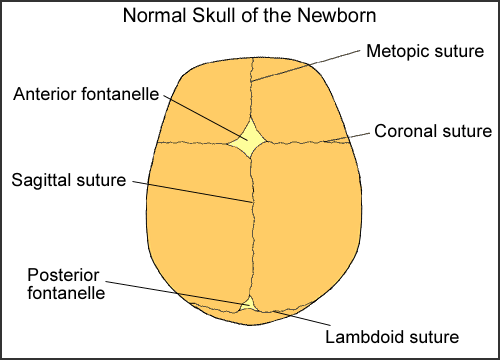
But now there's a new tie between big brains and walking upright--offered up in a  new paper just out in PNAS--and it's based in the human-, not ape-, like tendency to fuse the metopic suture later in life, to delay the close of what starts as a hole in the top of a baby's head known as its anterior fontanelle. The authors suggest that we need this hole in our head to exit our mother's bipedally-adapted birth canal safely and we also, as they suggest, need it to grow up to be an encephalized creature.

According to the authors, the "Taung child", an Australopithecus africanus kid (a member of a well-known bipedal hominin lineage) had an unfused metopic suture, left as an imprint on the fossil brain endocast.

Raymond Dart with the Taung child fossil.  http://en.wikipedia.org/wiki/File:Raymond_Dart_with_Taung.jpg 
Seven other australopith and Homo fossils are also described in the paper as having unfused metopic sutures. You might too! The odds are small, but since you started with a hole in your head as a baby, you could still be walking around with it unzipped.


To any chimps reading this, your metopic suture most likely closed just after birth and before your first deciduous molar erupted. But for 90% of humans (as reported in the paper), the suture closes later, after the eruption of the first deciduous molar. There’s a much slower fusion rate in humans than in chimpanzees.

However, to interpret the Taung child’s anatomy, things get a bit dicey, like things just love to get with hominin fossils. So often they can go either way: chimpy or humany.

Check out the figures below. A is for Pan troglodytes (common chimps) and B is for Homo sapiens. Those are frequencies of metopic suture fusion per dental age group. By listing them this way, instead of by chronological age, we're able to compare between two species that grow at different rates but share the same pattern of dental eruption. Chimpanzees grow up faster than us and experience earlier metopic suture fusion than us. Flipped around, humans grow up slower than chimps and experience delayed fusion of this suture compared to them. The Taung baby's dental age category is starred (*) at the "M1" stage in A and B. (The Taung child died at around 3.8 years of age, when its first permanent molar, M1, was erupted.)
Because it's more likely you'll find a human at that age (*) with an unfused metopic suture than a chimp, the researchers leaned toward calling the Taung child's state human-like, rather than ape-like. They backed that assertion up by listing seven other late Pliocene-early Pleiostocene hominins with unfused metopic sutures... it's a trend in the hominin lineage that begins with some australopiths, like the Taung child, they say.

"The presence of a still patent fontanelle and of a partially fused [metopic suture] in the Taung child, and the incidence of unfused [metopic sutures] in five adult and two other younger Australopithecus/ early Homo specimens is thus taken as evidence that a human-like pattern of late [metopic suture] fusion was already present in mid-to-late Pliocene gracile hominins."

Okay. Intriguing! But now we must explain!

[This is the part where, if you listen very carefully, you can hear the collective curmudgeonly groans from within and beyond the walls of paleoanthropology.]

Enter the new hypothesis for encephalization based on the late fusion of metopic sutures. The authors nod to two papers that offer "adaptively neutral" explanations for late metopic suture fusion but argue that the fossil evidence combined with the differences observed in chimps and humans beg for an adaptive explanation. (This tack is unsurprising given how paleoanthropology generally operates.)

The authors offer us three adaptive hypotheses to explain late metopic suture fusion:

1. Reorganization and expansion of the frontal neocortex (explains late metopic suture fusion)
Something about the changing and enlarging frontal cortex required changes to the cranial bones, how they form, grow, and fuse.

2. The difficulty of giving birth to large-headed neonates through birth canals that were reconfigured for bipedalism, the “obstetrical dilemma” (explains late metopic suture fusion)

The squishy neonatal head, thanks to the fontanelle,  "probably occurred in conjunction with refining the ability to walk on two legs," Falk (the lead author) said to the media. "The ability to walk upright caused an obstetric dilemma. Childbirth became more difficult because the shape of the birth canal became constricted while the size of the brain increased. The persistent metopic suture contributes to an evolutionary solution to this dilemma."

The trouble with this hypothesis as applied here is, although we know modern humans have a tight fit at birth now, there's little evidence for a tight fit between neonate and birth canal during australopith times.

And you can't help but wonder whether a squishy head was, or still is, required for successful birth. Do children suffering from craniosynostosis require a c-section to be born? Also, since the metopic suture fuses after chimpanzee birth, are we certain they aren't squishing their brains as they exit their relatively roomy birth canals? These questions may sound silly, but they're illustrating the built-in assumptions of the paper (or my ignorance about squishiness of baby heads).

The squishy head may be helpful during childbirth, but if it's occuring as early as australopith times, an adaptive explanation as a "solution" to an obstetrical dilemma is hard to swallow. That is unless DeSilva's estimates cited by the authors-- that australopiths had large neonates and tight fits at birth--are correct.

3. High early postnatal brain growth rates (explains late metopic suture fusion)
We know that humans have high rates of postnatal brain growth and this is what a lot of the news media picked up on: Your baby's head has gaps between the bones so the brain can grow like crazy after it's born to the gargantuan size of an adult human brain. As established in hypothesis #2, the need for the fontanelles in the first place is the crunch at birth thanks to the obstetrical dilemma, implying that without the pressure to be born small enough to escape the bipedal birth canal, we'd grow larger fetal brains in the womb.

So with this new paper we're presented with something even more fundamental than the notion that bipedalism as a necessary precursor for technological, ecological and social selection pressures for encephalization (as covered above): The tight fit at birth, caused by antagonistic selection for bipedal pelvic anatomy and large neonatal brains, created the selection pressure for a squishy neonatal head (which is facilitated by the fontanelles) and because of that roomy cranium, postnatal growth rates were able to ramp up in selective environments that favored encephalization.

So I'm left wondering, Do we need a hole in our head to be born successfully? Do we need a hole in our head to be encephalized? If the answer to both of those is yes, then what is a hole in the head doing in a hominin genus that may not have had much difficulty with childbirth and was hardly (if at all) encephalized? And, given the overlapping chimp and human fusion patterns, how can we be sure this feature on Taung is humany and not chimpy?

And, further, you can't (or at least I can't) help but wonder if there's a biomechanical/functional explanation for late metopic suture fusion, given how feeding behaviors and masticatory muscles put stress on the cranium. The skulls of australopiths and other hominins experienced stresses differently than chimpanzees. These differences may have begun as early as the nursing stage. Could this have anything to do with delayed fusion of the sutures? (here's just one study I found that addresses these kinds of questions)

And finally, it's hard not to link Falk (the lead author) to her research on Homo floresiensis. The hobbit (LB 1) looks like it has a fontanelle, something the disease-hypothesis folks point out is consistent with their perspective, and that’s one reason why I assumed these authors are onto this topic.
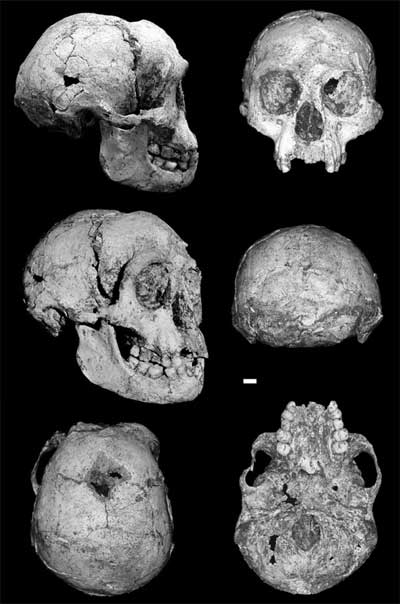
But LB 1 is conspicuously absent from the laundry list of hominin fossils in the supplementary section. Either they're saving what they've got on metopic suture and fontanelle anatomy in H. floresiensis for an upcoming paper or they just didn't think it was worthwhile to include this specimen. After all,  the latest paper on hobbit anatomy claims that the hobbit's "fontanelle" isn't real. Peter Brown writes, "direct examination of the asymmetrical hole in the posterior frontal of LB1, supported by CT scans, clearly indicates that this is the result of post-mortem excavation damage and is definitely not an unfused anterior fontanelle." (2)

Good thing, because if the hole in LB 1's cranium is of biological and not of taphonomic origin, then who knows how anybody'd explain its adaptive significance in such a tiny-brained hominin.

But, going way back to Taung and the australopiths: They were, after all, bipedal and the big brain train had to pull out at some point!

And, stay tuned. I got a tip from one of the authors about a paper coming out soon that demonstrates how weak the obstetrical dilemma hypothesis is, for explaining fetal size and growth, given the current evidence and given what we know about maternal metabolism.

Notes
(1) Of course, these hypotheses don’t represent all of paleoanthropology. I just intended to cover the major bases. And you need to consider what many paleoanthropologists assume which is that brain tissue is expensive so something extraordinary must have kept up selection on its increasing size for the last 2.5 million years. The assumption is that if brains were cheap, everyone would have big ones, but I don’t buy that. I think it's clear that other species aren’t encephalized because they don’t have to be. They do just fine without big brains. We have a rather warped perspective on selection for encephalization, thanks to our presentism and our big brains.
(2) Thanks to K. Baab for the tip.

Friday, January 7, 2011

Idiocracy is always looming, but not because of genes

As the first day of the semester approaches and the clenching sets in, my mind digs up irksome questions that I’ve fielded in past classes. Usually I mentally rehearse how I can most awesomely answer them, but for one issue in particular I’m launching a pre-emptive strike right here.


In my course Human Origins: Intro to Biological Anthropology a student will no doubt insert the movie Idiocracy into a question. And this never fails to annoy and befuddle me.

And it’s not because of the self-righteous tone that so often accompanies mention of that movie. Though it doesn't help.

And it’s not because I don’t care for the movie. We bought the DVD and the dialogue has really spiced-up domestic banter. (Unfortunately all of our favorite quotes are inappropriate for this venue.)

It’s because, in an educational setting, Idiocracy opens up a huge can of worms, too sophisticated to properly address in the first few days of an introductory course. And yet the can of worms can't be ignored once it's open because Idiocracy's take on the heritability of intelligence bows to common misconceptions held by all sorts of people.

So it's a case of misconceptions being perpetuated by culture. And in our case the culture (movie) that is perpetuating the misconceptions happens to be satirizing the fact that culture perpetuates misconceptions. Trippy.

But like I said, it also plays on half-baked assumptions regarding genes and intelligence.

If you haven’t seen it, the movie’s plot is just about an average guy who finds himself 500 years in the future with the task of saving the world. That future world is Idiocracy where nothing works, where politicians are mere entertainers (um?), where pilots, lawyers and doctors are “tarded,” and where someone decided that sports drinks are better for crops than water. Yep, they’re so stupid that they killed their food and fertile soil. With his average intelligence from 25 generations ago, our hero shows these idiots how to fix their problems. All of this is based on a simple premise that’s briefly outlined in the first few moments of the movie:

IN A WORLD…. where intellectuals have little reproductive success…. future generations are populated by non-intellectuals….and the cumulative result of each generation’s increasingly widespread stupidity is… Idiocracy.

By describing my own fertility when I explain reproductive success, students who are already privy to these sorts of demographic trends discover that I fit the norm for a female university professor. These real patterns are the basis for Idiocracy’s fictitious premise and lead me to unwittingly help my students connect dots that shouldn't be.

Also, it’s one of the few Hollywood films to conspicuously invoke evolution that my students have seen, so it’s a convenient mental touchstone while they experience my course.

I get it.

And here's why it's a problem...

If they take further classes in biology or biological anthropology then they will get a more sophisticated perspective and experience. But for first-timers to evolution (= many of my students) just taking one General Education course at a university is not enough. Chances are that they’ll actually buy into the movie’s premise after my course, simply because their radar's tuned to genes and evolution yet they aren’t solidly equipped with the tools to think critically about it all yet.

So, for the fun of it, let’s lay out the trouble with assuming that if the world’s intellectuals stop reproducing then future generations will be stupid.
  • A person’s intelligence (i.e. how it is greater or lesser than someone else’s within the normal range, however that may be quantified) is not significantly determined by genes.
  • People can improve their intelligence with training, practice, learning, etc... You don't come out of the birth canal all set to be Bill Gates or an astronaut. You need quite a bit of environmental impact to become anything that you are or might be. If you think of intelligence in terms of potential, most people on the planet never cultivate as much of it compared to what the privileged few are able to.
  • A person’s intelligence (again, within the normal range) does not correlate with the level of education they receive. Although people try to make it so. IQ, SAT, and other tests are (1) assumed to measure a person’s intelligence and (2) used overtly and covertly to discourage and encourage young people within the educational arena.
  • Education can improve your intelligence which can get you more education which can improve your intelligence which can get you more education which can improve your intelligence.
Given the tangled complexities of genes, intelligence, and education, would you assume that if highly educated people stop reproducing entirely that the next generation will be any less intelligent? NO!
What’s more, you can’t on the one hand assume that variation in human intelligence is determined significantly by genes and then on the other hand assume that you’re smarter than your parents.

Wouldn’t you agree that our individual intelligence has only increased compared to that of our ancestors? It’s not necessarily because alleles that code for greater intelligence have become more widespread than before. That may be true, but it’s undetectable…which doesn’t mean that genes are an insignificant contribution, but it supports the notion that they are not a large factor either.

You may be smarter than your parents or your siblings (or you may not) and that could have everything or nothing or betweenthing to do with genes.

Let’s go back deeper in time to our geologic parents. We share a common ancestor with chimps that lived 6 million years ago. We’re pretty sure we’re smarter than chimps. (This is according to cognitive measures that we’ve created, not them, but okay.) Thus, we assume that our ancestors were not as smart as us, yet we’re here today as these smart beings. Sure genomes have evolved during the last 6 million years, but is it really true that we're more intelligent today simply because the most intelligent individuals contributed to the gene pool during all that time?

(For a related treatment of human intellectual evolution click here.)

And back to the main point....Your particular level of normal intelligence hasn't been shown to be disproportionately impacted by anything that you inherit genetically from your parents.
Your intelligence is about (1) your genes that influence all sorts of interconnected machines and networks in your body, both outside and inside of your brain, (2) your environment’s impact on your body, including the establishment of neuronal networks (i.e. from family, teachers, stimulation, training, food, health, etc…), and (3) all the technology and innovation that has come before this very moment to which you may or may not have access.

Can you blame your parents’ genes for all of that? No. Intelligence is a complex trait with normal variation between you and your parents, me and my parents, and you and me that cannot be causally linked to the stretches of DNA that are either similar or different between us.

Now, without introduction, I ask you to perform a simple exercise…
Think of the smartest person you know.
Got it?
Now think of the wealthiest person you know.
Got it?
Okay, now scroll down…


Are they the same person?


For the majority of people (of whom I’ve asked this question), the answer is no.

Yet when you look at a globe, where are the strong economies? Where is the wealth?

The strongest economies and the wealth are located in regions of the world that are often considered (along a spectrum of naivete to racism) to harbor the most innately/genetically intelligent people.

For reasons that must be due to our evolved ability (sarcasm!) to seek out and dream up causative correlations, the global distribution of wealth leads so many of us to assume that (1) variation in innate intelligence is distributed in the same pattern, and that (2) intelligence causes wealth even though the reverse is also true: Wealth causes intelligence.

Wealth also causes wealth causes wealth causes wealth.
(And intelligence causes intelligences causes intelligence, too.)

Wealth also builds super-comfy superiority goggles. Even ones that fit snugly on the poor, undereducated folks within wealthy populations!

If you chose two different people for that silly exercise above, then you've helped to demonstrate that patterns and associations that we make between intelligence and wealth at the population level (e.g. Japan is wealthy because it's full of superiorly-genomed Japanese people) do not always fit those that we see in our daily lives. Yet we rarely question ourselves when we apply those causative patterns to populations. 

Accounting for individual variation among those we know is one thing we're good at, however, resisting the urge to generalize is not.

The misconception played-up by Idiocracy—that genes govern intelligence—is the basis for claims that biological “race" explains the distribution of wealth in the world. Philosophy like this has supported the killing of millions of people throughout our history.

This flow chart I've drawn for you describes this completely wrong view of genes, intelligence and wealth. (Click on the diagram to see it in full readable size.) We confound the accumulation and transmission of culture (knowledge and wealth) with the transmission of genes. And that’s not entirely due to our ignorance. These are complex issues!

But these are also very old mistaken ideas that persist despite generations of people living their lives and collecting their own experiential data and despite a couple hundred years of scientists and scholars professionally aimed at finding the causes of variation in intelligence, let alone the definition of intelligence.

You’d think we’d be further along than this...assuming so much even though we know only that intelligence is a complex trait. But that habit of ours of establishing causation for all correlations is mighty strong!
Especially when that convenient cause (our special personal genomes and our superior ancestral stock) makes us feel so good about ourselves.

Especially when that convenient cause lets us off the hook for helping the less fortunate because, well, they were born that way. Whaddya gonna do?

This second flow chart is a stab at a more realistic view of genes, intelligence and wealth. (Click on the diagram to see it in full readable size.) It’s not as gloriously and utterly hopeless as a previous flow chart I posted here, but I hope it reflects the complexity of the biological and cultural forces involved in intelligence.

Relative to the first flow chart above, this second one is not such a great recipe for a Hollywood plot is it?

Oh, c’mon... Idiocracy is still a hoot even if the biology's not true. I mean, who doesn’t adore Ghostbusters even though there is no such thing as ghosts?

Please go ahead and LOL and ROFL at Idiocracy... you just have to cleverly ignore its evolutionary ghosts.

And when the movie’s over, and you’re all done laughing, please heed the intended satirical message of the movie:

In a world... where the intellectuals (not an exclusive group!) are stopped from protecting knowledge and passing it down to future generations....future generations are intellectually compromised ....and they seem really stupid.... and they suffer terribly as a consequence.
See, the movie's not entirely a joke.

Idiocracy looms as a threat over all of our freakishly huge heads. And, yes, I mean to use that word exactly as Fox News does. It's a threat that humans have had to avoid ever since our ancestors fared better (i.e. they out-survived and out-reproduced others) if they passed knowledge down to future generations. This has probably been going on for a very long time given how many other animals learn behaviors from each other.

And this age-old threat, that we must keep up proper education or else suffer the consequences, is still here with us today.

And what are people without scholarly merit doing on our school boards? They're purchasing textbooks written by inept Googlers.

Too many science educators are teaching under fear of repercussion. Too many are asked to tolerate or even respect a specified few false folk biologies. While, as far as I know, not a single English teacher has been asked to tolerate or respect grammatical errors.

I mean, You better learn proper English or else go back to where you came from--
Right?

What about, You better learn proper science or else go back to being primordial goo?

And the breathtaking inanity of it all is that the ones issuing the threat of idiocracy are actually members of a species that has depended--more than any other organism on Earth--on the accumulation and application of knowledge!


Oh, I guess it's not so inane if you think intelligence and knowledge are innate, god's gift, mostly opinion, and come from the gut.

For many of us in education biz, the Apoca-Lapse of Reason that is portrayed in Idiocracy is even scarier than other doomsday scenarios we see on the big screen and read in books.

The Road
? Pshaw. At least I'd die pretty quickly. Living for fifty more years under an idiocracy? Now that's dreadful.

Perhaps I laugh so hard at
Idiocracy because if I didn’t laugh I’d cry.


Notes (added January 9, 2011)
1. I do not share commonly held views that IQ is a perfect measure of intelligence, that it is fixed sometime during development, or that mother nature would particularly care about what IQ tests measure (among "normal" people).

2. There is a body of literature on just about every single thing I discuss in the above and it is highly contentious, full of contradictory evidence and debate. However, you cannot dispute the role that status, stress, nutrition, wealth, culture (and more) play in the variation of IQ scores, educational success, and brain and body development... all three of which are involved in "intelligence."

3. There is good reason to believe that components of intelligence are plastic and can improve during life. (Intelligence must be plastic or else you'd have what you've got now as an embryo, but I mean during adulthood too.): http://www.pnas.org/content/105/19/6829.full

4. My use of "intelligence" is not scientific, but that does not make the concept insignificant. In this post, "intelligence" is what we're all able to assess in someone through interacting with them and I think this is a meaningful use of intelligence for this discussion even though it's not quantifiable.


Please read all the comments below by all, not just me. This post is not complete without them.

Tuesday, October 13, 2009

Did my genes make me do it?

David Brooks of the New York Times seems to be heavily into neuroscience these days. Having dismissed evolutionary psychology some time ago, he's apparently not going at this to understand the genetics behind why some people vote Republican and others Democratic (though there are people doing just this), but perhaps instead in the hopes of understanding how people can be taught to vote Republican. He tells in today's column of his recent attendance at a conference on neuroscience, to his surprise a conference of and by the young. He says
Young scholars have been drawn to this field from psychology, economics, political science and beyond in the hopes that by looking into the brain they can help settle some old arguments about how people interact.

These people study the way biology, in the form of genes, influences behavior. But they’re also trying to understand the complementary process of how social behavior changes biology. Matthew Lieberman of U.C.L.A. is doing research into what happens in the brain when people are persuaded by an argument.

Examples he gives of the kinds of studies being done include:

Reem Yahya and a team from the University of Haifa studied Arabs and Jews while showing them images of hands and feet in painful situations. The two cultures perceived pain differently. The Arabs perceived higher levels of pain over all while the Jews were more sensitive to pain suffered by members of a group other than their own.

Mina Cikara of Princeton and others scanned the brains of Yankee and Red Sox fans as they watched baseball highlights. Neither reacted much to an Orioles-Blue Jays game, but when they saw their own team doing well, brain regions called the ventral striatum and nucleus accumbens were activated. This is a look at how tribal dominance struggles get processed inside.
Brooks' point seems to be that people are malleable, and can be socialized to overcome tribalism or anti-social behaviors -- he has been writing about this for years, contending that poor Americans need to emulate the behaviors of middle and upper class families to have any chance of success. Once we understand how the brain works, he suggests, then policy wonks will "see people as they really are".

But how will that help, really? Even if neuroscientists show us that culture is taught, and people are teachable, who gets to decide who's the best role model? David Brooks thinks he knows, but so do Glen Beck and Rachel Maddow--and the rest of us. So, even if we ever do understand how the brain works, the politics won't get any cleaner or easier.

To us, though, the point is deeper than this. What it takes for major league pitchers to learn to throw a baseball so skillfully, and for violinists to learn to play the violin, and for anthropologists to learn to age and sex skeletons is practice--maybe 10,000 hours of practice. We didn't evolve 'to' do calculus, or play the violin, or throw a baseball or to agree or disagree with Rush Limbaugh, but instead to be able to learn how to do these things (although Alfred Wallace, the co-discoverer of evolution, became quite spiritual in later life, certain that humans were above nature because we could do calculus; he couldn't imagine how our ability to do math could have evolved).

The brain is plastic--learning changes synapses. Indeed, physiological changes in the brain from learning new tasks are measurable, as reported in a recent Nature Neuroscience paper on changes in the density of gray and white brain matter in subjects learning to juggle, described here. And, CNN is reporting on their website today about a woman who apparently had a stroke prenatally which destroyed half of her brain; many of the functions stereotypically performed by the missing part of her brain have been taken over by the active side.

It is natural, especially within western culture with its focus on cause and effect, to seek (or hunger for) simple causes for 'effects' we are interested in. We put the word in quotes because from the inquiry point of view what constitutes an 'effect' is often quite subjective. Is the party you vote for a meaningful effect, or is your vote based on deeper issues that, at present, you find affiliated with some particular party?

It is easy to think about finding the gene 'for' some specific effect, especially if you define the effect meaningfully. It's the view that evolution has hard-wired us for the effect, DNA being the prescriptive cause. But that may have things quite backwards. It makes more evolutionary sense that organisms be programmed to be facultative in sensing, assessing, and responding to the environment. If the human brain is anything it is like that rather than hard-wired for voting this way or that. Even ants, as Darwin observed, seem quite intelligent if we shed our anthropocentric biases.

However, it is much, much more difficult to think of understanding the genetic basis of facultative assessment and response, than of hard-wiring. We don't have good ways to define the trait, much less to find its genetic basis. Yet, clearly, that is the trait we should be trying to understand.

Tuesday, September 22, 2009

My brain is no bigger than a caveman’s

Many people, including myself, consider Richard Dawkins to be well above average when it comes to intelligence.


So is the size of his brain above average too?


Not necessarily.


Nobody has discovered a way to use a person’s intelligence to predict their brain size and vice versa.


What’s more, all of our brains are no larger on average than those of half-million-year-old “archaic” humans - the kind of people who hunkered down in caves to rest between hunting expeditions or to hide from hungry saber-toothed cats.


In spite of these issues - in spite of it being impossible to use someone’s head size to predict their IQ score or even to predict whether they are simply above or below average in the intelligence department – so many of us mistakenly cling to the notion that that “smart” people have bigger brains than “stupid” people.


It’s partly evolution’s fault.


Evidence from the fossil record and from comparative anatomy of living species makes it clear. Along with body size, an increase in brain size is a common trend in many evolutionary lineages. Over the last two million years our lineage experienced an extreme increase in brain size. And although it has not been as pronounced in other lineages, encephalization has also occurred in apes, monkeys, elephants, whales, carnivores, birds, cephalopods, etc. Mother Nature certainly likes big brains, but she would never ramp up the growth of something so metabolically and developmentally expensive if there wasn’t a payoff. We assume this has something to do with brain function, or intelligence.


Even those who know little or nothing about evolution (or deny it happens all together) can make the connection. After all, our brain is where our intelligence lives and our brains are conspicuously large. We can do all sorts of wonderful things that other animals cannot, so of course our large brains play a role in that.


It is hard not to apply this logic to the variation that we see within our species. But we shouldn’t.


And neither should Richard Dawkins as seen in this recent interview…[start at minute 4]

What’s the big deal? What’s wrong with what he said? It sounds pretty reasonable. Aren’t I just reacting too sensitively to his use of the fact that less educated people have more children than highly educated ones? They do. He’s right. We shouldn't have to be politically correct about facts. I sound like a knee-jerk liberal. Okay okay.


The point here is not to bark about Dawkins potentially misspeaking. He may wish he had said things differently here, and Darwin knows that I wish that very thing after most teaching bouts.It’s just that his hypothetical future evolution scenario was supposed to clarify evolution for the public, but it only raised questions and further supported racist beliefs. Ambassadors of Evolution should be more careful.


Looking around the animal kingdom, it is clear that brain size is correlated to intelligence. Those animals with big brains are the most intelligent. Our common mistake lies in applying that observation to modern humans and towards understanding our current variation in brain size and intelligence.


Whatever drove human brains to achieve modern size about 500,000 years ago is something that unites us all. This is true regardless of our current variation. And this was a type of intelligence, which we all carry with us, that laid the groundwork for all the cognitive and cultural development that has occurred since.


So the development of art, farming, calculus, plastics, microchips, neurosurgery, crossword puzzles, etc… all that stuff (all of which is a big part of intelligence estimations and measures) has nothing to do with why our brains got big in the first place.


Of course intelligence varies between people. But if brain size and intelligence were linked in our species, wouldn’t we be able to spot an intelligent person just by looking at the size of their head? Wouldn’t NASA and Harvard measure heads just to keep their applicant pools in check? Wouldn’t women give up trying to compete with men who have bigger brains than us? Wouldn’t people who wear small hats give up their Jeopardy! or architect school ambitions or just never dream them up in the first place? Most of us already know, whether we realize it or not, that brain size and intelligence are not linked anymore in the hominin lineage.


Once we get past that, then we can ask a couple of really interesting questions.


What did Mother Nature find so fascinating about our brains 500,000 years ago? What kind of function was our brain providing in the middle Pleistocene that required it to be so big back then?


Stone tool technology - which is one of the few things that is preserved from this time period – steadily advanced and became more and more elaborate and complex during this phase of our evolution. So, invention and technological intelligence, which goes along with physical intelligence like manual dexterity, is a good explanation for our encephalization. Another strong hypothesis suggests that social networking was so utterly important to our survival and reproduction that only with a larger cortex could a person maneuver and compete within a large society full of other intelligent creatures. Political games, power struggles, relationship forming, relationship maintenance, and resource acquisition (e.g. cooperative foraging and hunting) may have all relied on a big social brain. Language was another likely brain size booster.


Given that the trend for increasing brain size began 2 million years ago and lasted for about 1.5 million years, why did it just stop in the Middle Pleistocene?


Maybe we had all the brain we needed. Look how far we’ve come with caveman-sized brains!


It’s also possible that this is as big as it gets: Metabolic and developmental constraints may prevent our brains from getting any bigger.


Okay, so Dawkins jumbled up the story of human brain size evolution and intelligence. Still, what’s the big deal? What part of it flirts with racist beliefs out there? If you look back into the history of science and pseudo-science, there is a long tradition of measuring heads in different human populations and a long history, which continues today, of concluding that some “races” have smaller brains than others. There is also a long-held belief that some races (which are historically grouped by geographic origin, skin color, language, and other cultural traits) are more intelligent than others. In both brain size and intelligence, guess who gets ranked lowest most often in these "studies"? Africans and people with African ancestry. So to determine if someone is intelligent, we might take into account skin color, nose shape, eye shape, and cultural factors like language and body adornment. Dawkins's misstep adds unfortunate credence to this pseudo-scientific nonsense.


One big confounder is that we know very little about what causes variation in human intelligence. We know that intelligence is not determined by genes alone, but that genes do play a role since they build the brain. Natural Selection could act on these genes and drive evolution, as Dawkins said. However, intelligence is much more than “good genes”. Something as simple (but often so hard to obtain in a crowded world) as good nutrition contributes greatly to neurological and cognitive development.Environment is another key factor. Stimulation, practice, learning, and discovery, along with a healthy diet, help children become mental gymnasts who can grow up to qualify for the intellectual Olympics. It seems to me that if we put the need for nutrition and education programs in terms like, “Granting all Americans the opportunity to be intelligent citizens,” there may be may be more taxpayer support.


As Ambassadors of Evolution, it is our duty to clarify for others what we know and what we don’t know about the evolution of the human brain and intelligence. Even more than the “aquatic ape” hypothesis, the evolution of intelligence is consistently the most popular topic in public and classroom discussions of human evolution, and yet is the most dangerous given our sordid history, but having this discussion holds the potential to improve the human experience.

- Holly Dunsworth, guest blogger

Further Reading:

Race is a Four-Letter Word: The genesis of the concept by C. Loring Brace (2005)


Tuesday, May 26, 2009

For God's sake!

We have just reviewed a book by CE Cosans, called Owen's Ape & Darwin's Bulldog: Beyond Darwinism and Creationism (Indiana Univ Press, 2009). It's an interesting discussion of the famous debate between Darwin's public (pugilistic) advocate, TH Huxley, and Darwin's opponent Richard Owen (founder of the British Natural History Museum). The question was whether humans have distinct anatomical characters compared to apes (genes were not known at the time).

The brain, naturally, was the organ of interest. Huxley claimed that there were only quantitative differences between the anatomy of ape and human brains. Owen claimed distinct differences, including a structure called the hippocampus minor. The debate was long, public, and bitter. In the end, because Darwinism won the nature-of-life debate, Huxley is treated as the winner of this debate, too. But Cosans provides good evidence that, considering their worldviews and what they actually said, Owen's interpretation was perhaps closer to the anatomical truth. Cosans analyzes the history in terms of theories about science and its relationship to the empirical world and our interpretations of it.

The analysis of this history is fine, but Cosans also delves into what Darwin, Huxley, and Owen believed about God (and hence his subtitle). This is only peripherally relevant to the main event, the debate about anatomy. It makes a saleable subtitle, and we guess that these days nobody can simply leave the religion vs 'creationism' fight alone.

The point here, however, is not who believes what and why in that regard, but that the religion debate provides a distraction, that we constantly see these days, away from the merits of the various scientific cases. In particular, we should no longer be concerned as scientists about what Darwin's or Huxley's personal religious views were. Darwin's writing is of interest to history, certainly, but not as a sacred text (though one to be revered, to be sure!).

What we think today about biology and its nature needs to be evaluated in terms of what we know and what we can testably speculate about. The gravitational pull of gossipy food-fights is natural, since even scientists are human. We have enough trouble being objective about the science itself, such as the relative roles of natural selection, population structure, environmental change, and chance in the nature of life. But too often we relate these discussions to irrelevant, but often highly emotive, sideshows.

We don't need that in order to struggle with truly fascinating questions such as what makes humans seem so different from other animals, despite great similarities in our genomes!