Yesterday we discussed the genomic heterogeneity that comprises each organism, except a single-celled organism during its pre-division lifetime. When each cell divides into two 'daughter' cells, they both experience some mutations. Since you are made of many billions of cells, and they are constantly turning over, you do not have a single genotype, and haven't had one since you started life as a single fertilized egg cell.
But, you might say, at least the result is a single phenotype, that is, you. But that is not true, either. The mutations in each cell are inherited in the cell's subsequent daughter cells during your life, and cells come and go, and the mutations may sometimes affect gene regions that affect their respective tissue, and hence the behavior of the tissue itself. So, really, you don't have a specific phenotype, either.
One illustration of that is just the definition of different states. Monday's NY Times reports a deliberation about 'cancer' and whether the definition or use of the term should change. Many things, if not everything about you changes during your lifetime. Cancer as we have called it is a disease resulting from some cells behaving differently from what is 'normal.' Of course, that's happening all the time in your body, but the idea of cancer is that it is a lineage of abnormally dividing cells that grows without limits and thus threatens your life. But not all abnormal growth is like that.
We've known this for decades or millennia. Some growths are benign or haven't even been called cancer. But even things that have been diagnosed as cancer are highly variable. The new idea is that many that are slow-growing or not aggressive or not able to metastasize (spread to other parts of the body) are not dangerous and may never become dangerous. They should not be called 'cancer', a scary word that is also expensive since doctors don't like to just leave it alone. That's why it is perhaps wrong to screen too widely and diagnose something that will then have to be 'treated'. But treatments all involve risk, if not also misery or fear, and expense. So would re-defining be a good idea?
That's a clinical question we're not qualified to answer. But we did think it relevant to the way we characterize people, and in particular, ways that could be dangerous to them. We have in mind behavioral characterizations, especially when purportedly based on estimates of a person's genotype when s/he was a single cell, as estimated from a cheek swab or blood sample. Not only do our cells' genotypes change with time, and due to environmental exposures, but our behavior is not nearly all hard-wired. So really we don't have a clear-cut immutable phenotype, physically or behaviorally.
Of course, we are not completely changeable, so the challenge is to know what limits there are to change and how they are expressed or could be predicted. The cancer story led us to raise this, as something to think about. There is a tendency to simplify things beyond what is appropriate.

Showing posts with label genotype. Show all posts
Showing posts with label genotype. Show all posts
Tuesday, July 30, 2013

Monday, July 29, 2013
What is 'your' genotype? There's no answer because you have millions of them!
No one has a single genotype. We begin life as a single cell, a fertilized egg containing two human genome copies, one inherited from each parent. It also contains hundreds or thousands of mitochondrial DNA molecules that were in the egg cell. They will not all be identical. Then the initial cell divides to begin the process by which we formed an embryo that grew its many tissues and organs. This involved billions of cell divisions.
Each time a cell divides, some mutations occur. These are not germline (sperm or egg) mutations, differences between your parents and you, the usual notion of mutation. Instead, they are somatic (body cell) mutations. The embryo forms a tree of cell descent (and, in that sense, so do you), and mutational changes in a cell are inherited when it divides into two daughter cells and their descendant cells throughout the rest of your life. So that the earlier a mutation occurs in the embryo the greater the number of cells that will have that change.
As a result, each person is a genotypic mosaic. When people talk about a genotype, they usually and sloppily refer to what would be sequenced in a sample of blood or cheek cells. Most of this will be the inherited sequence but there will be a mix of cells with rarer changes (that the sequence-reading software may regard as sequencing errors and ignore), and mutations that may be common in other tissues from different embryonic cell branches will not be seen.
Somatic mutations can have no effect or great effect depending on when and where they occur. You can have a BRCA1 mutation that arose during your development but that was not inherited and/or isn't in the sample that was sequenced to determine 'your' genotype. Since your cells are always dying and dividing, you don't really have 'a' genotype!
A recent commentary in Science points out the potential importance of somatic mutations and the complexities they introduce into trying to infer genetic causation in medicine. This is quite important, and is well-explained. But there is a deeper history to this than covered in the piece.
Indeed, people had realized by the 1970s that somatic mutation was probably a contributor to cancer, because one transformed cell that had misbehaving behavior as a result of mutant genes could grow into a life-threatening tumor. The idea was bruited in a wonderful and famous paper by Al Knudsen at the University of Texas in Houston (my Dean, where I was at the time) in the early '70s, in relation to the eye cancer retinoblastoma. He showed the potential joint impact of inherited and somatic variation. That conceptually led various people to pursue the idea of multistage somatically based tumorigenesis, and work largely by Bert Vogelstein and colleagues at Johns Hopkins established early ways of genomic screens to compare tumor cells with the patient's normal cells to show this.
Many of us were writing about the implications of somatic mutation at that time. It was explicit in articles, book chapters, and books. I myself attempted to awaken people to the potentially broader and challenging impact of somatic mutation (e.g., in Trends in Genetics in 2005). Ranajit Chakraborty and I wrote many papers in the '80s about the way somatic mutation might explain why cancer is not usually present at birth and to account for the age of onset patterns of cancer, and in my 1993 book Genetic Variation and Human Disease (20 years ago!) and elsewhere I provided a speculative account of how this could apply to age-related diseases (most diseases) more widely.
There were and are many other examples and instances of the importance of somatic mutation, in humans and other animals (and plants). But the bemused human genetics establishment, anchored in early 20th century concepts of simple inheritance, established its juggernaut of GWAS and the idea of relating 'the' genome of a person to his/her fate, paying conveniently little attention to somatic mutation.
Because the situation is so clear in regard to cancer, cancer research has gone to great lengths to understand somatic mutation, as has some smattering of other work here and there, such as attempts to account for some effects of aging in terms of mitochondrial somatic mutation. In a way, the idea of genomewide 'expression profiling'--looking for cell-specific gene expression in specific tissues--is related to the idea that you can't describe a person from an inherited genotype.
The challenge is outlined well in the current paper, even if the author decided or neglected to cite the earlier literature or note that somatic mutation has been widely ignored out of convenience or culpable unawareness (pick your favorite explanation). Until we face up to the problem, we will be wastefully pouring funds down the GWAS and sequence database drain.
The issues are complex. We know now that the same inherited mutation has variable effects depending on the rest of a person's genotype--and that's why the effectiveness of personalized genomic medicine is heavily misrepresented by various hopeful and/or vested interests. Similarly, a person's somatic mutations will interact with each other, and with his/her inherited genotype to produce resulting traits, normal as well as disease. That two-set pattern 'squares' the amount of complication we have to deal with.
Working out how to handle what we know about genotypic variation will not be easy, but we should slow down the train while we try to work out a useful strategy, or at least stop over-promising. However, the likelihood is that most people who read the article (or, indeed, this post!) will say "Hmm, that's interesting," and then, feeling satisfied about their new awareness, finish their coffee....and go back to business as usual.
 |
| Human blastocyst; Wikimedia |
Each time a cell divides, some mutations occur. These are not germline (sperm or egg) mutations, differences between your parents and you, the usual notion of mutation. Instead, they are somatic (body cell) mutations. The embryo forms a tree of cell descent (and, in that sense, so do you), and mutational changes in a cell are inherited when it divides into two daughter cells and their descendant cells throughout the rest of your life. So that the earlier a mutation occurs in the embryo the greater the number of cells that will have that change.
As a result, each person is a genotypic mosaic. When people talk about a genotype, they usually and sloppily refer to what would be sequenced in a sample of blood or cheek cells. Most of this will be the inherited sequence but there will be a mix of cells with rarer changes (that the sequence-reading software may regard as sequencing errors and ignore), and mutations that may be common in other tissues from different embryonic cell branches will not be seen.
Somatic mutations can have no effect or great effect depending on when and where they occur. You can have a BRCA1 mutation that arose during your development but that was not inherited and/or isn't in the sample that was sequenced to determine 'your' genotype. Since your cells are always dying and dividing, you don't really have 'a' genotype!
A recent commentary in Science points out the potential importance of somatic mutations and the complexities they introduce into trying to infer genetic causation in medicine. This is quite important, and is well-explained. But there is a deeper history to this than covered in the piece.
Indeed, people had realized by the 1970s that somatic mutation was probably a contributor to cancer, because one transformed cell that had misbehaving behavior as a result of mutant genes could grow into a life-threatening tumor. The idea was bruited in a wonderful and famous paper by Al Knudsen at the University of Texas in Houston (my Dean, where I was at the time) in the early '70s, in relation to the eye cancer retinoblastoma. He showed the potential joint impact of inherited and somatic variation. That conceptually led various people to pursue the idea of multistage somatically based tumorigenesis, and work largely by Bert Vogelstein and colleagues at Johns Hopkins established early ways of genomic screens to compare tumor cells with the patient's normal cells to show this.
Many of us were writing about the implications of somatic mutation at that time. It was explicit in articles, book chapters, and books. I myself attempted to awaken people to the potentially broader and challenging impact of somatic mutation (e.g., in Trends in Genetics in 2005). Ranajit Chakraborty and I wrote many papers in the '80s about the way somatic mutation might explain why cancer is not usually present at birth and to account for the age of onset patterns of cancer, and in my 1993 book Genetic Variation and Human Disease (20 years ago!) and elsewhere I provided a speculative account of how this could apply to age-related diseases (most diseases) more widely.
There were and are many other examples and instances of the importance of somatic mutation, in humans and other animals (and plants). But the bemused human genetics establishment, anchored in early 20th century concepts of simple inheritance, established its juggernaut of GWAS and the idea of relating 'the' genome of a person to his/her fate, paying conveniently little attention to somatic mutation.
Because the situation is so clear in regard to cancer, cancer research has gone to great lengths to understand somatic mutation, as has some smattering of other work here and there, such as attempts to account for some effects of aging in terms of mitochondrial somatic mutation. In a way, the idea of genomewide 'expression profiling'--looking for cell-specific gene expression in specific tissues--is related to the idea that you can't describe a person from an inherited genotype.
The challenge is outlined well in the current paper, even if the author decided or neglected to cite the earlier literature or note that somatic mutation has been widely ignored out of convenience or culpable unawareness (pick your favorite explanation). Until we face up to the problem, we will be wastefully pouring funds down the GWAS and sequence database drain.
The issues are complex. We know now that the same inherited mutation has variable effects depending on the rest of a person's genotype--and that's why the effectiveness of personalized genomic medicine is heavily misrepresented by various hopeful and/or vested interests. Similarly, a person's somatic mutations will interact with each other, and with his/her inherited genotype to produce resulting traits, normal as well as disease. That two-set pattern 'squares' the amount of complication we have to deal with.
Working out how to handle what we know about genotypic variation will not be easy, but we should slow down the train while we try to work out a useful strategy, or at least stop over-promising. However, the likelihood is that most people who read the article (or, indeed, this post!) will say "Hmm, that's interesting," and then, feeling satisfied about their new awareness, finish their coffee....and go back to business as usual.
Wednesday, June 12, 2013
My dogs' evolutionary history. Part 1: Predictions
[Click here to skip to Part 2 and Part 3]
You might remember Murphy and Elroy from the time we used science to solve the book-eating mystery. Or the time they figured out evolution. (Still looking for puplisher! [sick]) Or maybe you already know Elroy because you follow him (@ElroyBeefstu) on Twitter.
These are the mutts that inhabit our lives, and we theirs.
It's because of our tremendous love for these dogs but mostly because of our tremendous fascination with evolution that we ordered Wisdom Panel kits for each, for my birthday.
What we do
Both Elroy and Murphy are mixed breed dogs. Here's the list of breeds they say they can detect. And here's more from the website:
For Elroy (85 lbs)
Our guesses = 50% sharpei or chow chow; 50% rottweiler
Kevin was told he was half sharpei and half rottweiler when he adopted him and all his litter mates were black and looked like rotts. He's got tiny ears and a huge square head and heavy neck relative to his body.
We started to wonder whether he was chow chow instead of sharpei when I checked my best dog reference for another breed with a black tongue.

Unlike for Elroy, Murphy's behavior came into play for these predictions. Her main occupation is to herd each car that comes down the lane along the edge of our lot. She also stalks squirrels and chases shorebirds. And compared to Elroy, she doesn't have as many breed-specific morphological traits.
Who knows? We could be way off. After all, I just took this Dog Bark Interactive Quiz and failed miserably despite knowing exactly what Elroy and Murphy's vocalizations mean.
Results and analysis, right here, tomorrow...
You might remember Murphy and Elroy from the time we used science to solve the book-eating mystery. Or the time they figured out evolution. (Still looking for puplisher! [sick]) Or maybe you already know Elroy because you follow him (@ElroyBeefstu) on Twitter.
 |
| Elroy (I fit in your phone!) |
 |
| Murphy (awww) |

It's because of our tremendous love for these dogs but mostly because of our tremendous fascination with evolution that we ordered Wisdom Panel kits for each, for my birthday.
What we do
With Wisdom Panel, the process on the consumer end isn't a whole lot different from 23andMe. You purchase the kits online, they arrive at your house, you activate the kits online, you swab your dogs' mouths, pop the kits back in the mail with the postage-prepaid packaging, and wait for an email with the results.
Wisdom panel needs far less of the contents of a dog's mouth than 23andMe requires. And that's not only because the analysis will be far less extensive, but because dogs' lips and face muscles aren't hooked up for spitting into a test tube.

The turnaround was speedy. We sent in the samples on May 28 and got the results June 6.
At this stage in the process, the only red flag is that they require you to submit your dog's weight during online registration. For the love of science, there should be no phenotypic hints required. I hope they don't use weight to discard or confirm dog breeds for their results report.
What they do
Here's what the FAQ says:
Wisdom panel needs far less of the contents of a dog's mouth than 23andMe requires. And that's not only because the analysis will be far less extensive, but because dogs' lips and face muscles aren't hooked up for spitting into a test tube.

At this stage in the process, the only red flag is that they require you to submit your dog's weight during online registration. For the love of science, there should be no phenotypic hints required. I hope they don't use weight to discard or confirm dog breeds for their results report.
What they do
Here's what the FAQ says:
Testing your dog with Wisdom Panel® 2.0 begins when you use the cheek swabs to simply collect a small DNA sample from inside your dog’s cheek and send the swabs into the laboratory. Once your sample is received at our lab it is scanned into our database and assigned to a batch for testing. It then undergoes processing to extract the DNA from your dog’s cells which is examined for the 321 markers that are used in the test. The results for these markers are sent to a computer that evaluated them using a program designed to consider all of the pedigree trees that are possible in the last three generations. The trees considered include a simple pedigree with a single breed (a likely pure-bred dog), two different breeds at the parental level (a first-generation cross), all the way up to a complex tree with eight different great-grandparent breeds allowed. Our computer used information from our extensive breed database to fill these potential pedigrees. For each of the millions of combinations of ancestry trees built and considered, the computer gave each a score representing how well that selected combination of breeds matched to your dog’s data. The pedigree with the overall best score is the one which is selected and provided to you in your dog’s individualized report.This doesn't really cut it for me. I want to know what the methods are and this is all they provide in answers to "Science Based Questions!" This isn't helping much:
Not only does the computer analyze a dog’s DNA for the breeds and their likely proportions in the dog’s ancestry, but it also models which side of a dog’s ancestry each breed is likely coming from.
I'll just have to assume for now that they use something like a chip (because sequencing is still not thrifty) to identify markers that they've already linked to breeds and then they're applying their probability-based analyses to those markers in our dogs in order to provide an estimate of our dogs' ancestry. And what are those markers?
Wisdom Panel only uses what are called autosomal DNA markers, chromosomes that contain most of the genetic instructions for every canine’s body make up (height, weight, size etc.). There are no markers from either the so-called sex chromosomes (the canine X or Y chromosomes). Mitochondrial DNA, or Y-chromosome DNA testing, is rather different as these parts of the genome are passed on intact from mother to child and father to son respectively, but are therefore only representative of either the female or the male lineage. Autosomal DNA is inherited both from the maternal and paternal lineages equally and constantly shuffled by a process called recombination at each successive generation, and therefore is able to give useful information on the breeds found on both sides of a dog’s lineage.
To find the genetic markers that performed best at distinguishing between breeds, Mars Veterinary™ tested over 4,600 SNPs (single nucleotide polymorphisms or genetic markers, where genetic variation has been found between different dogs), from positions across the whole canine autosomal genome from over 3,200 dogs. To further refine the search, Mars Veterinary determined the best 1,536 genetic variations and ran them against an additional 4,400 dogs from a wide range of breeds. This stage of testing resulted in the selection of the final panel of DNA markers that performed best at distinguishing between breeds, ultimately creating the Wisdom Panel genetic database which presently covers over 200 different breeds.
Both Elroy and Murphy are mixed breed dogs. Here's the list of breeds they say they can detect. And here's more from the website:
Wisdom Panel® 2.0 breaks down a dog’s lineage in the form of an ancestry tree. This allows you to see which breeds are present at a parent, grandparent, or great-grandparent level. Keep in mind that a parent contributes 50% of their DNA to the puppy while a grandparent contributes about 25% of their DNA on average to the puppy. It follows that a great-grandparent would contribute approximately 12.5% of their DNA to the puppy on average.
Since each of these different levels can contribute different amount of DNA to the puppy, you can see a variety of influence in the puppy’s physical and behavioral traits. With a parental breed, you are likely to see some physical and behavioral traits from this breed represented unless some of the genes are recessive (requires two copies of the gene variant to show it). Examples of recessive traits include longhair in most breeds, a clear yellow or red hair coat, a brown or chocolate hair coat, and prick or upright ear set (e.g. like a German Shepherd Dog). You may see traits from breeds at the grandparent level and it becomes less likely to see physical and behavioral traits from breeds at the great-grandparent level unless those traits are dominant (requires only one copy of the gene variant to show it). Examples of dominant traits include shorthair in most breeds, black hair coat, black nose, a drop or down ear set (e.g. like a Beagle), and merle/dapple (e.g. like a Australian Shepherd or Great Dane).
For Elroy (85 lbs)
Our guesses = 50% sharpei or chow chow; 50% rottweiler
Kevin was told he was half sharpei and half rottweiler when he adopted him and all his litter mates were black and looked like rotts. He's got tiny ears and a huge square head and heavy neck relative to his body.
We started to wonder whether he was chow chow instead of sharpei when I checked my best dog reference for another breed with a black tongue.

If he's part chow chow then my envy of his fur is no longer so crazy, since the breed was long made for that... and for dinner too. It makes me chuckle every time I call Elroy's dinnertime, "chow time."

For Murphy (40 lbs)
My guess = 25 % German shepherd; 25 % Border collie; 25 % Hound of some kind; 25% unknown village dog. Kevin's guess = 25% German shepherd; 75% Border Collie

For Murphy (40 lbs)
My guess = 25 % German shepherd; 25 % Border collie; 25 % Hound of some kind; 25% unknown village dog. Kevin's guess = 25% German shepherd; 75% Border Collie
 |
| Before her greybeard took over. |
Who knows? We could be way off. After all, I just took this Dog Bark Interactive Quiz and failed miserably despite knowing exactly what Elroy and Murphy's vocalizations mean.
Results and analysis, right here, tomorrow...
Friday, February 17, 2012
First we were snapped, now we're SNP'd
I got a grant from my university to purchase genotyping kits and analysis with 23andMe for all 130 of my biological anthropology students this semester.
I know what you're thinking: CAN OF WORMS!
But maybe that's not what you're thinking at all. Because if you follow this blog you may be familiar with how poorly we understand the causal relationships between genes and so many of our emotionally- and socially- and politically-charged behaviors, disease risks, and causes of death. That is, at least for the genes we know about. And what's a 'gene' these days anyway? It's not necessarily restricted to a stretch of nucleotides.
But it's only nucleotides, or more specifically SNPs (single nucleotide polymorphisms; pronounced "snips"), that 23andMe analyzes. They genotype thousands of SNPs that vary in people including those that link us to our relatives around the world, to interesting phenotypic traits (like whether our pee stinks when we eat asparagus), and to diseases and risks of developing diseases (like diabetes and Alzheimer's).
Ah, there it is...CAN OF WORMS!
But can a DNA test tell you that you're going to die? No, you know that already. Struggling with death is a part of life and certainly not a topic new to college classrooms.
But if wild classroom worms make you squirm beyond your comfort zone, then this definitely is not the right curriculum for you to implement. On the other hand, if you're like me and you believe that opening cans of worms is an often awkward but crucial part of your job then... okay...you're with me. Still, maybe you're wondering about the disease risk information? That's still pretty harsh, right?
It can be. Which is why I told the students that agreeing to 23andMe's terms of service is basically acknowledging that you are willing to be traumatized and that you can't blame anyone but yourself for choosing to go through with it.
Some didn't. It's completely voluntary. Students who do not want to send in their saliva for analysis can make a demo account and still participate fully and still earn an A in the course. They can also opt out of seeing disease risk results (and only see ancestry data) when the results come back to them.
Totally on board with being traumatized, many took the codes home with them to order their spit kits on-line. They did this despite the small chance that peering into their genome may show them evidence to suggest that their father did not father them.
Wait. What?
Yes. That really is possible... THE KING OF THE WORMS!
Part of what students have to do this semester is form a 'plan of action.' That's what I've called their assignment where they predict what their SNPs will hold and where they explain what they will do if they find out they're at high risk for a disease or even, yes, that they might not be related to their father. (This discovery doesn't require paternal DNA. Since half of your genome is from your father, and since a few traits are pretty simple, the rare participant with the rare SNP can deduce that they did not get their DNA from their father who doesn't show the trait in question.)
But like I said, regardless of the high risk that they'll learn of risks, most students will still spit in the tube and send it off. And I believe this will be true not just of my students but this generation at-large in just a few short years (or less).
The cost is already ridiculously low compared to just a few years ago. With about 200 of your dollars and up to eight weeks of your patience, 23andMe can do what just recently took thousands or even millions of dollars not to mention years to accomplish. And the price just keeps dropping. Once it's low enough, everyone will be having large portions of their genome analyzed, with just a click of the mouse and a spit in a tube and a stamp in the mail. That's it. And most of those people who have or who will participate in such a thing would not have the support of an entire college course, their peers, the faculty and the stellar guest experts (ethics, counseling, law, adaptation, geographic variation, disease risk variation, and the Personal Genome Project) that are coming to visit us in April.
The personal genome can of worms is already open. This curriculum may be cutting edge but it really is just about going along for the ride, but with eyes wider open than the dude in his mom's basement on his brother's old laptop with his dad's credit card.
We're pioneers of introspection and explorers of identity, much like the first folks to be photographed. We all take for granted seeing snaps of our person; soon we'll take for granted seeing SNPs of our personal genome.
Some of the students involved in this curriculum started a terrific blog. Check it out!
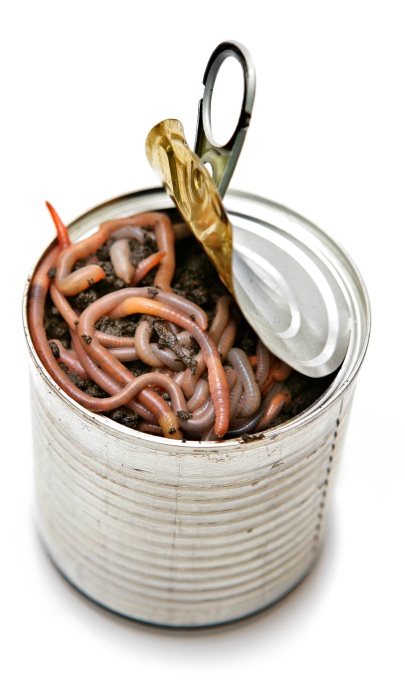 |
| Can of annelids |
But maybe that's not what you're thinking at all. Because if you follow this blog you may be familiar with how poorly we understand the causal relationships between genes and so many of our emotionally- and socially- and politically-charged behaviors, disease risks, and causes of death. That is, at least for the genes we know about. And what's a 'gene' these days anyway? It's not necessarily restricted to a stretch of nucleotides.
But it's only nucleotides, or more specifically SNPs (single nucleotide polymorphisms; pronounced "snips"), that 23andMe analyzes. They genotype thousands of SNPs that vary in people including those that link us to our relatives around the world, to interesting phenotypic traits (like whether our pee stinks when we eat asparagus), and to diseases and risks of developing diseases (like diabetes and Alzheimer's).
Ah, there it is...CAN OF WORMS!
But can a DNA test tell you that you're going to die? No, you know that already. Struggling with death is a part of life and certainly not a topic new to college classrooms.
But if wild classroom worms make you squirm beyond your comfort zone, then this definitely is not the right curriculum for you to implement. On the other hand, if you're like me and you believe that opening cans of worms is an often awkward but crucial part of your job then... okay...you're with me. Still, maybe you're wondering about the disease risk information? That's still pretty harsh, right?
It can be. Which is why I told the students that agreeing to 23andMe's terms of service is basically acknowledging that you are willing to be traumatized and that you can't blame anyone but yourself for choosing to go through with it.
Some didn't. It's completely voluntary. Students who do not want to send in their saliva for analysis can make a demo account and still participate fully and still earn an A in the course. They can also opt out of seeing disease risk results (and only see ancestry data) when the results come back to them.
Totally on board with being traumatized, many took the codes home with them to order their spit kits on-line. They did this despite the small chance that peering into their genome may show them evidence to suggest that their father did not father them.
Wait. What?
Yes. That really is possible... THE KING OF THE WORMS!
 |
| http://scienceblogs.com/zooillogix/2008/05/giant_blue_earthworms_and_frie.php |
But like I said, regardless of the high risk that they'll learn of risks, most students will still spit in the tube and send it off. And I believe this will be true not just of my students but this generation at-large in just a few short years (or less).
The cost is already ridiculously low compared to just a few years ago. With about 200 of your dollars and up to eight weeks of your patience, 23andMe can do what just recently took thousands or even millions of dollars not to mention years to accomplish. And the price just keeps dropping. Once it's low enough, everyone will be having large portions of their genome analyzed, with just a click of the mouse and a spit in a tube and a stamp in the mail. That's it. And most of those people who have or who will participate in such a thing would not have the support of an entire college course, their peers, the faculty and the stellar guest experts (ethics, counseling, law, adaptation, geographic variation, disease risk variation, and the Personal Genome Project) that are coming to visit us in April.
The personal genome can of worms is already open. This curriculum may be cutting edge but it really is just about going along for the ride, but with eyes wider open than the dude in his mom's basement on his brother's old laptop with his dad's credit card.
We're pioneers of introspection and explorers of identity, much like the first folks to be photographed. We all take for granted seeing snaps of our person; soon we'll take for granted seeing SNPs of our personal genome.
 |
First humans to be snapped: Boulevard du Temple by Daguerre, 1839 (wikipedia) |
Some of the students involved in this curriculum started a terrific blog. Check it out!
Wednesday, January 6, 2010
Penetrating the fog of 'penetrance'
In genetics there is a hoary old concept called 'penetrance'. It's not a definition of sexual success, so those of you who come to this post (no pun intended) with prurient interest should seek satisfaction elsewhere.
Penetrance is the probability that an individual has a specified trait given that s/he has a specified genotype. Usually, we think of the latter in terms of an allele, like the proverbial dominant A or recessive a in classical Mendelian terms in which genetics is taught.
Penetrance can range from zero -- the trait is never found in a person with genotype G -- to 1.0 (100% of the time the trait is present in persons with genotype G). If 'G' refers to an allele, that allele is called dominant if its presence is always associated with the trait, or recessive if the trait is present only in the absence of the other allele (in gg genotypes).
The key concept, that links simple Mendelian inheritance with general aspects of penetrance is that penetrance is almost always a relative term. The effect of an allele is always dependent on the other alleles in the individual's genome, as well as to aspects of the environment, and also to chance.
Sometimes things seem simple enough that we need not worry too much about these details. Very strong effects that are (almost) always manifest are examples. But when things are relativistic in this way, genetic inherency usually must take a back seat to a more comprehensive understanding.
The first step, and usually a difficult one, is to specify just what genotype you are referring to and, often even more challenging, just what phenotype (trait or aspects of a trait) you are referring to. To use the Einstein phrase that applies to relativity in physics, you have to be clear about your frame of reference.
This is much, much more easily said than done. Is 'heart disease' a useful frame of reference relative to alleles at some gene like, say, ApoE (associated with lipid transport in the blood)? We work with a colleagues, including Joan Richtsmeier here in our own department, who are concerned with craniofacial malformations. There are many such traits, including abnormal closure of cranial sutures (where bones meet in the skull). And, cancer is a single word that covers a multitude of syns (syndromes).
These are examples in which no two cases are identical. When that's so, how can we tell what the penetrance is of a mutation in a particular gene? Probabilistic statements require multiple observations, but also that each observation be properly classified (since probabilities refer to distinct classes of outcomes).
Since a given mutation affects only a single part of a single gene, it can be identified specifically (if, for the moment, we discount the mutations that take place within the person's body each time any of his/her cells divide). But traits can be variable and hard to define precisely, and the rest of the genome will vary in each person, even in inbred mice (because they undergo mutations). The amount of variation depends on the situation, but is very difficult to quantify precisely (recent work on genetic mutations in cancer begins to show this in detail, though we've known it in principle for a long time).
Most of the additional variation, not to mention purely chance aspects of development, homeostasis, and every cell's behavior, is unknown and much of it perhaps not even documentable in principle. Thus, in trying to characterize complex traits, we face real challenges just of definition, and much more so of understanding.
The same is true of evolution. An allele that has zero penetrance cannot be seen by natural selection. An allele with 100% penetrance is always 'visible' to selection in principle. But even there it has no necessary evolutionary implications unless it also affects fitness, that is, reproductive success. And that is another layer of causation with complex definitional issues, that we have written much about.
One bottom line is that just knowing a complete DNA sequence from some representative cell of an individual does not explain phenotypes, phenotypic effects, or evolution.
Penetrance is the probability that an individual has a specified trait given that s/he has a specified genotype. Usually, we think of the latter in terms of an allele, like the proverbial dominant A or recessive a in classical Mendelian terms in which genetics is taught.
Penetrance can range from zero -- the trait is never found in a person with genotype G -- to 1.0 (100% of the time the trait is present in persons with genotype G). If 'G' refers to an allele, that allele is called dominant if its presence is always associated with the trait, or recessive if the trait is present only in the absence of the other allele (in gg genotypes).
The key concept, that links simple Mendelian inheritance with general aspects of penetrance is that penetrance is almost always a relative term. The effect of an allele is always dependent on the other alleles in the individual's genome, as well as to aspects of the environment, and also to chance.
Sometimes things seem simple enough that we need not worry too much about these details. Very strong effects that are (almost) always manifest are examples. But when things are relativistic in this way, genetic inherency usually must take a back seat to a more comprehensive understanding.
The first step, and usually a difficult one, is to specify just what genotype you are referring to and, often even more challenging, just what phenotype (trait or aspects of a trait) you are referring to. To use the Einstein phrase that applies to relativity in physics, you have to be clear about your frame of reference.
This is much, much more easily said than done. Is 'heart disease' a useful frame of reference relative to alleles at some gene like, say, ApoE (associated with lipid transport in the blood)? We work with a colleagues, including Joan Richtsmeier here in our own department, who are concerned with craniofacial malformations. There are many such traits, including abnormal closure of cranial sutures (where bones meet in the skull). And, cancer is a single word that covers a multitude of syns (syndromes).
These are examples in which no two cases are identical. When that's so, how can we tell what the penetrance is of a mutation in a particular gene? Probabilistic statements require multiple observations, but also that each observation be properly classified (since probabilities refer to distinct classes of outcomes).
Since a given mutation affects only a single part of a single gene, it can be identified specifically (if, for the moment, we discount the mutations that take place within the person's body each time any of his/her cells divide). But traits can be variable and hard to define precisely, and the rest of the genome will vary in each person, even in inbred mice (because they undergo mutations). The amount of variation depends on the situation, but is very difficult to quantify precisely (recent work on genetic mutations in cancer begins to show this in detail, though we've known it in principle for a long time).
Most of the additional variation, not to mention purely chance aspects of development, homeostasis, and every cell's behavior, is unknown and much of it perhaps not even documentable in principle. Thus, in trying to characterize complex traits, we face real challenges just of definition, and much more so of understanding.
The same is true of evolution. An allele that has zero penetrance cannot be seen by natural selection. An allele with 100% penetrance is always 'visible' to selection in principle. But even there it has no necessary evolutionary implications unless it also affects fitness, that is, reproductive success. And that is another layer of causation with complex definitional issues, that we have written much about.
One bottom line is that just knowing a complete DNA sequence from some representative cell of an individual does not explain phenotypes, phenotypic effects, or evolution.
Subscribe to:
Comments (Atom)