Showing posts with label barnacles. Show all posts

Wednesday, December 19, 2018

Barnacles? What about, say, Primates?

On Nov 8, here, I wrote about Darwin's work on the forms and evolution of barnacles.  I asserted that he had a deterministic view of the process of evolution, that I think reflected the Newtonian legacy of science at the time.  Darwin described the mode of sexual reproduction in different species of barnacles, as observed today, as if they were at various stages along the way to a most 'mature' kind of final stage of fully separate adult males and females.   

Darwin wrote several books on barnacles, with typical detail and care, and I cited a fine book by Rebecca Stott (Darwin and the Barnacle) that summarized the story very well and which I highly recommend.  The idea, basically, was that various stages of barnacle reproduction in the past had led to fully separate sexual reproduction in the most advanced present-day barnacles.  Thus, various of today's barnacles that are in these intermediate states are on their evolutionary way to the final one--they're just eons behind their most advanced compatriot species.

In a sense, I think this is part of a more general issue, the equating of induction with deduction--using what we can observe from the present, to make predictions about the future--and a deterministic force-like view of evolution.  Sometimes this means assuming that the future will be like the past, so that, for example, (as in the case of Darwin's barnacles) the present can be viewed tacitly or explicitly, as a cross section of a stream of events, each contemporary state leading to some future state that is already achieved by the most 'advanced' instance observed.

I think a way to understand the point, at least as I see it, is to use an example closer to home.  After all, it's possible that most people don't really know anything about barnacles because they've not seen them or, if they have on some beach trip, they didn't pay any attention, certainly not a Darwinian kind of attention.  So Darwin's barnacle work, even for those who would care to read it or about it, might seem too abstract.  Perhaps there are other ways we might explore his same point, about animals evolving toward a more mature or final stage.

For example, we could just as easily posit that other primates--lemurs, monkeys, and apes (orang-utans, gorillas, chimps), are each on their separate way to--are in separate stages of--becoming human-like.  Perhaps an equivalent suggestion to Darwin's about barnacles would be that non-human-primates are in various states on the road to 'humanity', which we can assume they will eventually reach.  What would this mean, and how could we tell--or could we?  If not, can we say anything about them, or, rather, about their future in this regard?

The fossil record and comparative genomics clearly show that all contemporary apes share relatively recent monkey-like common ancestry. We can take the living descendants and look, comparatively, at their various structures and behaviors.  Nothing stops us from making what would seem to be an obvious statement that we, humans, are more 'advanced' than the other primates.  Yes, of course, they do well today in their own ways, but we are obviously superior.  In some senses, it can be argued that other apes are more human-like than monkeys as if, though they are all contemporary (as with Darwin's barnacles), they can all be viewed as on the 'road to humanity', one of progress that is often to be taken.  Isn't that implicit in the famous figure from TH Huxley's Man's Place in Nature (1863)?
Image result for human evolution timeline
From Frontispiece in Huxley
He showed contemporary primates aligned as if, in a sense, they reflect our evolutionary history, from most primitive to most advanced (us).  Similar figures have been shown based on fossils representing stages, or prior times, during human evolution, such as this famous one grabbed from Google images.

Related image
After Time-Life books' image

These images have something in common: they use reconstructions of a linear evolutionary past, based on fossils, or they do the same by equating current species to past stages in our ancestry.  Yet, obviously, the other apes living today are no more our ancestors than living barnacles are the ancestors of the most 'advanced' species today.  Nor are they "less evolved".

Evolutionary inevitabilities?
What we have is a subtle kind of theory of inevitability, one that implicitly at least and in a sense explicitly asserts that there is in evolution a particular, in a sense pre-determined path.  Some species living today have reached a more advanced stage along that path (their future of course not yet knowable).  But others, though alive today, are as yet only part-way along the path.

Is there any reason to think, much less assume, that chimps are (if we don't wantonly kill them all off first) 'on the way' to becoming humanlike?  This kind of thinking was, I believe, implicit in Darwin, as if evolution were a kind of 'Newtonian' force, like gravity.  But does such thinking still lurk around?  If we share that kind of worldview we can ask, for example, why there are still chimps, if one branch of our shared ancestors evolved to become us humans.  If today's chimps are not on the way to becoming 'human', why did (some of) our chimp-like ancestors do so? If from a common ancestor we could evolve as we did, why not them and why haven't they yet--or will they?

We may have outgrown Darwin's more literal linear thinking, but perhaps not entirely.  As noted in our earlier post, the 'rewind the tape' argument is still raised from time to time.  Is evolution a 'force' that cannot be denied, a kind of inevitability, or is it so local, ad hoc, and related to existing genotypes at a time and place that has no real parallelism?

These are perhaps literally unanswerable questions, but perhaps they are in fact glibly answered by evolutionary biology. Darwin seemed, to me, to assert a sense of replicable inevitabilism, while we seem to have ad hoc accounts that don't suggest that.  If today's apes are on their evolutionary way to something else, it is legitimate at least to ask, at least rhetorically, whether that will be something human-like.  Today we generally say that despite similarities, our common human-chimp ancestors branched into our two present-day species and because of the random nature of mutation and local circumstance, we each evolved our separate ways.  But we'd also say that because of the randomness of mutations, and of environmental changes and so on, they are not destined to become like us.  But then, in the future, if the root abilities are there, and we share so much of our genomes......?

A plausible, indeed basically irrefutable view--so, rather, an axiom of life--is that today's species will either become extinct without issue, or will evolve into forms different from today's.  But can we make any sort of rigorous inference of the sort that today's apes will become human-like?  We know they will not become beetles, or trees--or mermaids--because they are constrained by what they already are, their future forms contingent upon the present.  But is there any rigorous or knowable sense in which a cross-section at any given time is a montage of the evolutionary future?  How precisely does their present form determine their evolutionary future?  Must they evolve into human-like creatures because our primate ancestors did?  If the rewind-the-tape argument has relevance for understanding the past, is the tape being played before our eyes today?  If not, is the biological future predictable with any kind of precision?

These are long-term questions, and modern biology would either just say we can't know or that the idea of parallelism is nonsensical since each species today is unique, as are its circumstances.  But it a non-trivial sense, when we take a sample of human populations for, say, disease-genetic mapping, and extend that to other people or populations, are we not making similar assumptions of parallelism, or the even stronger one that different populations are at the same stage?

Thursday, November 8, 2018

The horseshoe crab and the barnacle: induction vs deduction in evolution

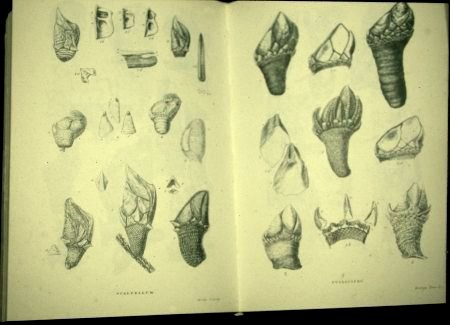
Charles Darwin had incredible patience.  After his many-year, global voyage on the HMS Beagle, he nestled in at Down House, where he was somehow able to stay calm and study mere barnacles to an endless extent (and to write 4--four--books on these little creatures).  Who else would have had the obsessive patience (or independent wealth and time on one's hands) to do such a thing?

Image result for darwin barnacles
      From Darwin's books on barnacles (web image capture)
Darwin's meticulous work and its context in his life and thinking are very well described in Rebecca Stott's compelling 2003 book, Darwin and the Barnacle, which I highly recommend, as well as the discussion of these topics in Desmond and Moore's 1991 Darwin biography, The Life of a Tormented Evolutionist.  These are easier, for seeing the points I will describe here, than plowing through Darwin's detailed own tomes (which, I openly confess, I have only browsed).  His years of meticulous barnacle study raised many questions in Darwin's mind, about how species acquire their variation, and his pondering this eventually led to his recognition of 'evolution' as the answer, which he published only years later, in 1859, in his Origin of Species.

Darwin was, if anything, a careful and cautious person, and not much given to self-promotion.  His works are laden with appropriate caveats including, one might surmise, careful defenses lest he be found to have made interpretive or theoretical mistakes.  Yet he dared make generalizations of the broadest kind.  It was his genius to see, in the overwhelming variation in nature, the material for understanding how natural processes, rather than creation events, led to the formation of new species.  This was implicitly true of his struggle to understand the wide variation within and among species of barnacles, variation that enabled evolution, as he later came to see. Yet the same variation provided a subtle trap:  it allowed escape from accusations of undocumented theorizing, but was so generic that in a sense it made his version of a theory of evolution almost unfalsifiable in principle.

But, in a subtle way, Mr Darwin, like all geniuses, was also a product of his time.  I think he took an implicitly Newtonian, deterministic view of natural selection.  As he said, selection could detect the 'smallest grain in the balance' [scale] of differences among organisms, that is, could evaluate and screen the tiniest amount of variation.  He had, I think, only a rudimentary sense of probability; while he often used the word 'chance' in the Origin, it was in a very casual sense, and I think that he did not really think of chance or luck (what we call genetic drift) as important in evolution.  This I would assert is widely persistent, if largely implicit, today.

One important aspect of barnacles to which Darwin paid extensive attention was their sexual diversity.  In particular, many species were hermaphroditic.  Indeed, in some species he found small, rudimentary males literally embedded for life within the body of the female.  Other species were more sexually dichotomous.  These patterns caught Darwin's attention.  In particular, he viewed this transect in evolutionary time (our present day) as more than just a catalog of today, but also as a cross-section of tomorrow.  He clearly thought that what we saw today among barnacle species represented the path that other species had taken towards becoming the fully sexually dichotomous (independent males and females) in some species today: the intermediates were on their way to these subsequent stages.

This is a deterministic view of selection and evolution: "an hermaphrodite species must pass into a bisexual species by insensibly small stages" from single organisms having both male and female sex organs to the dichotomous state of separate males and females (Desmond and Moore: 356-7).

But what does 'must pass' mean here?  Yes, Darwin could array his specimens to show these various types of sexual dimorphism, but what would justify thinking of them as progressive 'stages'?  What latent assumption is being made?  It is to think of the different lifestyles as stages along a path leading to some final inevitable endpoint.

If this doesn't raise all sorts of questions in your mind, why not?  Why, for example, are there any intermediate barnacle species here today?  Over the eons of evolutionary time why haven't all of them long ago reached their final, presumably ideal and stable state?  What justifies the idea that the species with 'intermediate' sexuality in Darwin's collections are not just doing fine, on their way to no other particular end?  Is something wrong with their reproduction?  If so, how did they get here in the first place?  Why are there so many barnacle species today with their various reproductive strategies (states)?

Darwin's view was implicitly of the deterministic nature of selection--heading towards a goal which today's species show in their various progressive stages.  His implicit view can be related to another, current controversy about evolution.

Rewinding the tape
There has for many recent decades been an argument about the degree of directedness or, one might say, predictability in evolution.  If evolution is the selection among randomly generated mutational variants for those whose survival and reproduction are locally, at a given time favored, then wouldn't each such favored path be unique, none really replicable or predictable?

Not so, some biologists have argued!  Their view is essentially that environments are what they are, and will systematically--and thus predictably--favor certain kinds of adaptation.  There is, one might quip, only one way to make a cake in a particular environment.  Different mutations may arise, but only those that lead to cake-making will persist.  Thus, if we could 'rewind the tape' of evolution and go back to way back when, and start again, we would end up with the same sorts of adaptations that we see with the single play of the tape of life that we actually have. There would, so to speak, always be horseshoe crabs, even if we started over.  Yes, yes, some details might differ, but nothing important (depending, of course, on how carefully you look--see my 'Plus ça ne change pas', Evol. Anthropol, 2013, a point others have made, too).


Others argue that evolution is so rooted in local chance and contingency, that there would be no way to predict the details of what would evolve, could we start over at some point.  Yes, there would be creatures in each local niche, and there would be similarities to the extent that what we would see today would have to have been built from what genetic options were there yesterday, but there the similarity would end.

Induction, deduction, and the subtle implications of the notion of 'intermediate' forms
Stott's book,  Darwin and the Barnacle, discusses Darwin's work in terms of the presumed intermediate barnacle stages he found.  But the very use of such terms carries subtle implications. It conflates induction with deduction, it assumes what is past will be repeated.  It makes of evolution what Darwin also made of it: a deterministic, force-like phenomenon.  Indeed, it's not so different from a form of creationism.

This has deeper implications.  Among them are repeatability of environments and genomes, at least to the extent that their combination in local areas--life, after all, operates strictly on local areas--will be repeated elsewhere and else-times.  Only by assuming not only the repeatability of environments but also of genomic variation, can one see in current states of barnacle species today stages in a predictable evolutionary parade.  The inductive argument is the observation of what happened in the past, and the deductive argument is that what we see is intermediate, on its way to becoming what some present-day more 'advanced' stage is like.

This kind of view, which is implicitly and (as with Darwin) sometimes explicitly invoked, is that we can use the past to predict the future.  And yet we routinely teach that evolution is by its essential nature locally ad hoc and contingent, based on random mutations and genetic drift--and not driven by any outside God or other built-in specific creative force.

And 'force' seems to be an apt word here.

The idea that a trait found in fossils, that was intermediate between some more primitive state and something seen today, implies that a similar trait today could be an 'intermediate stage' today for a knowable tomorrow, conflates inductive observation with deductive prediction.  It may indeed do so, but we have no way to prove it and usually scant reason to believe it.  Instead, equating induction with deduction tacitly assumes, usually without any rigorous justification, that life is a deductive phenomenon like gravity or chemical reactions.

The problem is serious: the routine equating of induction with deduction gives a false idea about how life works, even in the short-term.  Does a given genotype, say, predict a particular disease in someone who carries it, because we find that genotype associated with affected patients today?  This may indeed be so, especially if a true causal reason is known; but it cannot be assumed to be.  We know this from well-observed recent history: Secular trends in environmental factors with disease consequences have indeed been documented, meaning that the same genotype is not always associated with the same risk.  There is no guarantee of a future repetition, not even in principle.

Darwin's worldview
Darwin was, in my view, a Newtonian in his view.  That was the prevailing science ethos in his time.  He accepted 'laws' of Nature and their infinitesimally precise action.  That Nature was law-like was a prevailing, and one may say fashionable view at the time. It was also applied to social evolution, for example, as in Marx's and Engels' view of the political inevitability of socialism.  That barnacles can evolve various kinds of sexual identities and arrangements doesn't mean any of what Darwin observed in them was on the way to full hermaphrodism or even later to fully distinct sexes...or, indeed, to any particular state of sexuality.  But if you have a view like his, seeing the intermediate stages even contemporaneously, would reinforce the inevitabilistic aspect of a Newtonian perspective, and seemingly justify using induction to make deductions.

Even giants like Darwin are products of their times, as all we peons are.  We gain comfort from equating deduction with induction, that the past we can observe allows us to predict the future.  That makes it comfortingly safe to make assertions, the feeling that we understand the complex environment in which we must wend our way through life.  But in science, at least, we should know the emptiness of the equation of the past with the future.  Too bad we can't seem to see further.

Tuesday, August 3, 2010

Darwin's barnacles: The boringest book...with the sexiest story ever told!

Charles Darwin was a prolific author of long books. Other than a few, these are now dusty tomes in the reserve annex of university libraries (they're also now available on line, fortunately).

The Origin of Species and a couple of others are good reading, and show the enormity and thoroughness of Darwin's mind and method. He covered the waterfront, from orchids to earthworms. But less well known and hardly read is the way he covered the waterfront's huge population of barnacles. A fairly recent book, Darwin and the Barnacle (Stott, 2003) is about Darwin's fascination, if not obsession, with barnacles, but if you actually try to read Darwin's four barnacle volumes from scratch you'll find them as dry as an Iraqi sandstorm. Most of Darwin's books are dense compendiums of facts, but the barnacle books are more like telephone books than narratives.

At the same time, they tell an incredibly fascinating story, and Darwin was well aware of it (and his letters show that they were far from boring or dry material to him). In fact, while he deals with many issues including species relationships and anatomy, the most fascinating part of the barnacle story is their bizarre, and highly variable reproduction. It's as near to a natural X-rated story as you could image.

Most barnacles are hermaphrodites, carrying both male and female sex organs. But they can't self-fertilize and must mate with nearby barnacles. For this, males in some species have the longest penises in relation to body size that are found in nature (or they may have multiple penises!). Some barnacle species are only partly hermaphrodites, having degenerated organs of one sex or the other. Yet others, discovered by Darwin to his utter amazement, have males as parasites living within the body of the female, which in some cases only have retained a partly hermaphrodite body! In some, these 'husbands' are so rudimentary that they're little more than sex organs.

Darwin noted that in the countless species of barnacles, every trait in every species was variable. He used the data on variation to determine barnacle phylogeny: their relative relationships and order of evolution. By looking at contemporary species with various stages of sexual reproduction strategy, he inferred that some stages, such as live-in husbands, and degenerate husbands, represented stages along the way to being non-hermaphroditic.

The complexity and variation among species must also be found within species, in order for the traits observed today to have evolved over time -- the trait must have varied within species so that today's form would gradually become the standard for that species.

Darwin was trying to solve the species (or 'transmutation') problem of his day. But his very sexy story also reveals the problem of reconstructing adaptations. Darwin assumed that different stages he saw in different species were traits along the way to some final trait. But that's not necessarily so and it nearly assumes predestination, a total no-no in evolution. Just because a species of barnacle has host-husbands does not imply that it, like some other existing barnacle species, is on the way to having only rudimentary husbands or to losing hermaphroditic structure. Or, at least, such arguments about how predictable evolution is are highly debatable based on what we know today.

Darwin is great reading, as a way to see a great mind at work. His utterly dull but sexy barnacle books show some of the problems we face in reconstructing selective stories from the past, because when so many traits vary at the same time, over so much time, it's hard to know why each stage on the way was favored by selection. This is especially true because we can only tell so much from fossils.

Maybe everything in life, even everything totally boring, eventually boils down to sex. But whether HBO can make an exciting film about barnacle bedroom behavior is unclear.