Showing posts with label Creationism. Show all posts

Thursday, November 8, 2018

The horseshoe crab and the barnacle: induction vs deduction in evolution

Charles Darwin had incredible patience.  After his many-year, global voyage on the HMS Beagle, he nestled in at Down House, where he was somehow able to stay calm and study mere barnacles to an endless extent (and to write 4--four--books on these little creatures).  Who else would have had the obsessive patience (or independent wealth and time on one's hands) to do such a thing?

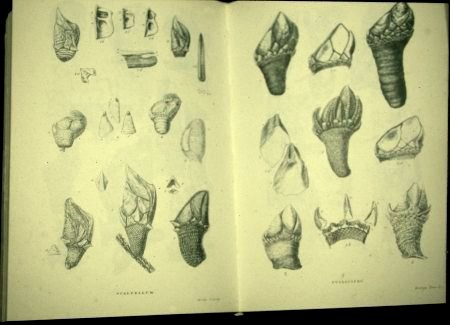
Image result for darwin barnacles
      From Darwin's books on barnacles (web image capture)
Darwin's meticulous work and its context in his life and thinking are very well described in Rebecca Stott's compelling 2003 book, Darwin and the Barnacle, which I highly recommend, as well as the discussion of these topics in Desmond and Moore's 1991 Darwin biography, The Life of a Tormented Evolutionist.  These are easier, for seeing the points I will describe here, than plowing through Darwin's detailed own tomes (which, I openly confess, I have only browsed).  His years of meticulous barnacle study raised many questions in Darwin's mind, about how species acquire their variation, and his pondering this eventually led to his recognition of 'evolution' as the answer, which he published only years later, in 1859, in his Origin of Species.

Darwin was, if anything, a careful and cautious person, and not much given to self-promotion.  His works are laden with appropriate caveats including, one might surmise, careful defenses lest he be found to have made interpretive or theoretical mistakes.  Yet he dared make generalizations of the broadest kind.  It was his genius to see, in the overwhelming variation in nature, the material for understanding how natural processes, rather than creation events, led to the formation of new species.  This was implicitly true of his struggle to understand the wide variation within and among species of barnacles, variation that enabled evolution, as he later came to see. Yet the same variation provided a subtle trap:  it allowed escape from accusations of undocumented theorizing, but was so generic that in a sense it made his version of a theory of evolution almost unfalsifiable in principle.

But, in a subtle way, Mr Darwin, like all geniuses, was also a product of his time.  I think he took an implicitly Newtonian, deterministic view of natural selection.  As he said, selection could detect the 'smallest grain in the balance' [scale] of differences among organisms, that is, could evaluate and screen the tiniest amount of variation.  He had, I think, only a rudimentary sense of probability; while he often used the word 'chance' in the Origin, it was in a very casual sense, and I think that he did not really think of chance or luck (what we call genetic drift) as important in evolution.  This I would assert is widely persistent, if largely implicit, today.

One important aspect of barnacles to which Darwin paid extensive attention was their sexual diversity.  In particular, many species were hermaphroditic.  Indeed, in some species he found small, rudimentary males literally embedded for life within the body of the female.  Other species were more sexually dichotomous.  These patterns caught Darwin's attention.  In particular, he viewed this transect in evolutionary time (our present day) as more than just a catalog of today, but also as a cross-section of tomorrow.  He clearly thought that what we saw today among barnacle species represented the path that other species had taken towards becoming the fully sexually dichotomous (independent males and females) in some species today: the intermediates were on their way to these subsequent stages.

This is a deterministic view of selection and evolution: "an hermaphrodite species must pass into a bisexual species by insensibly small stages" from single organisms having both male and female sex organs to the dichotomous state of separate males and females (Desmond and Moore: 356-7).

But what does 'must pass' mean here?  Yes, Darwin could array his specimens to show these various types of sexual dimorphism, but what would justify thinking of them as progressive 'stages'?  What latent assumption is being made?  It is to think of the different lifestyles as stages along a path leading to some final inevitable endpoint.

If this doesn't raise all sorts of questions in your mind, why not?  Why, for example, are there any intermediate barnacle species here today?  Over the eons of evolutionary time why haven't all of them long ago reached their final, presumably ideal and stable state?  What justifies the idea that the species with 'intermediate' sexuality in Darwin's collections are not just doing fine, on their way to no other particular end?  Is something wrong with their reproduction?  If so, how did they get here in the first place?  Why are there so many barnacle species today with their various reproductive strategies (states)?

Darwin's view was implicitly of the deterministic nature of selection--heading towards a goal which today's species show in their various progressive stages.  His implicit view can be related to another, current controversy about evolution.

Rewinding the tape
There has for many recent decades been an argument about the degree of directedness or, one might say, predictability in evolution.  If evolution is the selection among randomly generated mutational variants for those whose survival and reproduction are locally, at a given time favored, then wouldn't each such favored path be unique, none really replicable or predictable?

Not so, some biologists have argued!  Their view is essentially that environments are what they are, and will systematically--and thus predictably--favor certain kinds of adaptation.  There is, one might quip, only one way to make a cake in a particular environment.  Different mutations may arise, but only those that lead to cake-making will persist.  Thus, if we could 'rewind the tape' of evolution and go back to way back when, and start again, we would end up with the same sorts of adaptations that we see with the single play of the tape of life that we actually have. There would, so to speak, always be horseshoe crabs, even if we started over.  Yes, yes, some details might differ, but nothing important (depending, of course, on how carefully you look--see my 'Plus ça ne change pas', Evol. Anthropol, 2013, a point others have made, too).


Others argue that evolution is so rooted in local chance and contingency, that there would be no way to predict the details of what would evolve, could we start over at some point.  Yes, there would be creatures in each local niche, and there would be similarities to the extent that what we would see today would have to have been built from what genetic options were there yesterday, but there the similarity would end.

Induction, deduction, and the subtle implications of the notion of 'intermediate' forms
Stott's book,  Darwin and the Barnacle, discusses Darwin's work in terms of the presumed intermediate barnacle stages he found.  But the very use of such terms carries subtle implications. It conflates induction with deduction, it assumes what is past will be repeated.  It makes of evolution what Darwin also made of it: a deterministic, force-like phenomenon.  Indeed, it's not so different from a form of creationism.

This has deeper implications.  Among them are repeatability of environments and genomes, at least to the extent that their combination in local areas--life, after all, operates strictly on local areas--will be repeated elsewhere and else-times.  Only by assuming not only the repeatability of environments but also of genomic variation, can one see in current states of barnacle species today stages in a predictable evolutionary parade.  The inductive argument is the observation of what happened in the past, and the deductive argument is that what we see is intermediate, on its way to becoming what some present-day more 'advanced' stage is like.

This kind of view, which is implicitly and (as with Darwin) sometimes explicitly invoked, is that we can use the past to predict the future.  And yet we routinely teach that evolution is by its essential nature locally ad hoc and contingent, based on random mutations and genetic drift--and not driven by any outside God or other built-in specific creative force.

And 'force' seems to be an apt word here.

The idea that a trait found in fossils, that was intermediate between some more primitive state and something seen today, implies that a similar trait today could be an 'intermediate stage' today for a knowable tomorrow, conflates inductive observation with deductive prediction.  It may indeed do so, but we have no way to prove it and usually scant reason to believe it.  Instead, equating induction with deduction tacitly assumes, usually without any rigorous justification, that life is a deductive phenomenon like gravity or chemical reactions.

The problem is serious: the routine equating of induction with deduction gives a false idea about how life works, even in the short-term.  Does a given genotype, say, predict a particular disease in someone who carries it, because we find that genotype associated with affected patients today?  This may indeed be so, especially if a true causal reason is known; but it cannot be assumed to be.  We know this from well-observed recent history: Secular trends in environmental factors with disease consequences have indeed been documented, meaning that the same genotype is not always associated with the same risk.  There is no guarantee of a future repetition, not even in principle.

Darwin's worldview
Darwin was, in my view, a Newtonian in his view.  That was the prevailing science ethos in his time.  He accepted 'laws' of Nature and their infinitesimally precise action.  That Nature was law-like was a prevailing, and one may say fashionable view at the time. It was also applied to social evolution, for example, as in Marx's and Engels' view of the political inevitability of socialism.  That barnacles can evolve various kinds of sexual identities and arrangements doesn't mean any of what Darwin observed in them was on the way to full hermaphrodism or even later to fully distinct sexes...or, indeed, to any particular state of sexuality.  But if you have a view like his, seeing the intermediate stages even contemporaneously, would reinforce the inevitabilistic aspect of a Newtonian perspective, and seemingly justify using induction to make deductions.

Even giants like Darwin are products of their times, as all we peons are.  We gain comfort from equating deduction with induction, that the past we can observe allows us to predict the future.  That makes it comfortingly safe to make assertions, the feeling that we understand the complex environment in which we must wend our way through life.  But in science, at least, we should know the emptiness of the equation of the past with the future.  Too bad we can't seem to see further.

Saturday, January 4, 2014

I'm with the GOP. I don't believe in evolution if that's what it is.

Yesterday I riffed a little on stories we tell in the evolutionary sciences. I'm compelled to share a footnote to those thoughts with a rare weekend post.

You don't even have to know a story very well to claim it as your own or to prefer it over others. This is usually where people like to point out that so many creationists know little about the Bible. Stuff like that.

But, actually, a great example of a story that people prefer and even defend yet don't always understand is evolution.

How many people do you think are reading this NPR piece (and many others) about the recent Pew survey and are feeling pretty superior to the evolution deniers?

I'd say a good many.

Yet, how many of those enlightened evolution fans do you think noticed the ridiculous figure and caption "showing the evolution of humans" that went with the piece?

I'd say fewer than a good many.

"Culture Wars"...they're just the worst. For more on this, see my Evolution P.S.A. today...
source

Thursday, June 20, 2013

Evolution's got a P.R. problem

People aren't just anti-evolution, evolution-averse, or pro-"teaching the controversy" because they're clinging to supernatural explanations that help them identify with a tribe. Culture is mighty powerful but it's a lot more complex than stubborn beliefs in the supernatural as deciphered from, and reinforced by, an ancient text.
Evolution's got a public relations problem that spans beyond fundamental Creationism. It's not exactly looked upon favorably by many non-fundamental yet kind, open-minded, and educated folks either! Here I've jotted down a few thoughts about why...

1. Who cares about evolution? Sheesh, what's the big deal?
Evolution doesn't appear to matter to so many people. And getting frothy over evolution can certainly spark interest but it can also, in gut reaction, intensify the apathy. We love to go on and on about how "human" it is to wonder where we came from or to wonder how the world works. Well, it's not exactly a species-wide phenomenon, at least acting on that wonder isn't. With these folks, we can just keep doing what it is that we do and hope that they will come around to see why evolution matters and hope that until then they don't influence others to be as tuned out or turned off.   People are less likely to voice apathy about knowledge that they're accustomed to like biology, history, chemistry, geology, physics, literature, English, composition, mathematics. I think this attitude about evolution will go away once biology becomes a synonym for evolution in K-12 classrooms and beyond. 

2. Mystery is mystical by default. 
It's still acceptable to fill-in ignorance about biology with the supernatural. This is not as much the m.o. with chemistry or physics, but we tend to do it there too (like with quantum mechanics). I couldn't explain how the Internet works but I assume it's not magic and I don't know anyone who thinks it is either. Yet, missing pieces of understanding in biology are not, as default, just missing pieces of understanding. We jump automatically to magical thinking rather than assume that we just don't know and that maybe someone already does! Unfortunately, gaps in our biological knowledge don't always spark us to take more classes, to read, or to watch videos to see that many of those mysteries aren't mysteries to anyone who's studied them. Gaps in our knowledge don't always spark us to undertake controlled observation or to devise experiments at home. For some reason, instead... and I think it's the Bible and other powerful cultural influences, and also the way that the history of science unfolded ... biology's mysteries are comfortably cloaked in magic. If biological mystery is mystical, then it's easier to uphold allegiance to Creationism, or to maintain intellectual empathy with fundamentalists who ask that we simply "teach the controversy." 
3. It takes quite a bit of study, observation and life experience to understand evolution. 
Evolution is a complex, multi-disciplinary matter that few people can master in one semester of study. You need anatomy, physiology, genetics, behavior, comparative anatomy, zoology, ecology, geology, history, math, philosophy, etc. But you need only dabble a few toes in those areas to begin to form the picture. Because the e-word is so often left out of K-12 classrooms, students don't realize that they're learning it all along, in all its bits and pieces as they advance year to year. When they finally do get to a classroom that uses the e-word, they think it's a whole new subject matter and that's actually quite an obstacle. Plus, that evolution takes a while to understand in any sort of useful way means we have an under-informed population full of people who, at best, had one year of solid evolutionary exposure in high school...one year of learning our one natural explanation for all of biology. That's evidently not enough to bring everyone far enough along to overcome #1 and #2. 
4. Evolution's not even well-understood by those who claim to. 
It's not. There's a lot we don't know about evolutionary history, about how it unfolded, and that means there's a lot that we are earnestly trying to figure out. And it's clear that public patience for science is lacking and that's rooted in a lack of appreciation for how science is done, how knowledge is formed, and how the truth changes. On the one hand there are those who know full well that feeble, foibly humans are devising this knowledge and on the other hand are those who've got far too much respect for "KNOWLEDGE." (The latter is revealed on the petrified faces of my students when I announce they're "creating knowledge" by doing a laboratory assignment.) Both perspectives are working against science every time something pops up in the press as being "debated" or "overturned." Every piece ends with "more research is needed." No wonder patience is running thin. The skeptics think science is fraught with fraud because it's done by people. The others flirt with thinking (or do literally think) that knowledge comes from on high, or from Revealed Natural Truths, and not possibly from mere humans. And then there are those who study evolution who are not earnestly trying to  understand it better. They're using a half-baked tool that they call "evolution" to do their work or to advocate for evolution education. And often when their views get in the popular press they're parroted or presented uncritically by writers with an equally non-nuanced understanding of evolution, who are equally oblivious to it. 

5. Evolution is being pushed by so many unhuggable atheist intellectuals. 
This has to do with what many public intellectuals like to call "tribalism" and in-group, out-group identity. Aligning yourself with professors or intellectuals is social and political suicide for many. Aligning yourself with the godless can be even worse. Of course there are lots of folks who retain their beliefs and accept evolution, but there are fewer of them (at least in the limelight) than us who eschew or reject the supernatural.  We need more huggable atheists. We need more huggable intellectuals. We need fewer anti-intellectuals. We need fewer anti-atheists. Lack of belief in the supernatural needs to be seen as a legitimate way to be a friend, a parent, a child, a relative, a neighbor, a community member, a leader, a teacher, a human.  

6. People don't want to be animals.

With education, people come to accept reality. And they accept what they cannot change. Right?

7. Evolution seems to support racism, sexism, (and atheism, intellectualism, evolutionism, vegetarianism,) and every other -ism that's wrong with humanity.  
But it doesn't. There's too much to unpack here in this small space, but this is a huge problem contributing to the aversion to evolution out there. Evolution isn't just subversive because it goes against established religious dogma. It's subversive because it, as completely misunderstood and misapplied, supports racism and sexism and murder and warfare and rape and infanticide, etc etc etc... Understood well, or even just a little bit well, evolution cannot be used in those ways and then, as a result, avoided by those who are afraid to align with such an unsavory worldview. Evolution is just generation to generation change in lineages that have shared ancestors in the past. Evolution describes how everything depends on what came before. That is all. Evolution requires no differential value placed on one species over another (human exceptionalism). Evolution requires no differential value placed on one skin color over another (racism).  Evolution requires no differential value placed on one sex over another (sexism). Those are human inventions. Culture is powerful.  

8. Evolution tells me I'm going to die when I die. 
This is the human condition. Belief in the supernatural or not, acceptance of evolution or not, this is what we're all dealing with. We often lament how, "evolution reduces the meaning of life to survival and reproduction." Well, if it does, is that so bad?
**
Evolution's got a lot more than fundamental religious beliefs working against it.  As an educator, I can't help but think that, first and foremost, a clear understanding of what evolution is (and isn't) is key to addressing all of these issues contributing to evolution's P.R. problem.  Yesterday's post was my attempt to help provide that clear understanding: 


Tuesday, May 29, 2012

More nature, less supernature: Results of a new biological anthropology curriculum

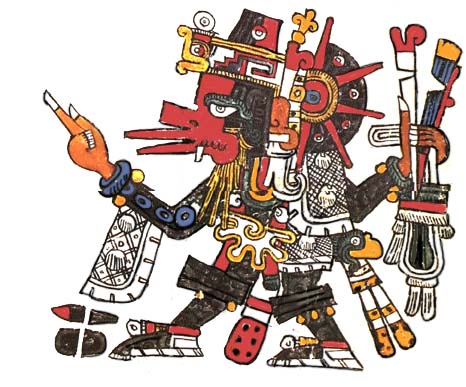
Wind God (Tokyo National Museum)
This semester, Spring 2012, I made three significant changes to my Introduction to Biological Anthropology curriculum (aka APG 201: Human Origins) .

Number one. I rearranged everything relative to all the mainstream textbooks. That includes teaching evolution (common ancestry, deep time), then inheritance, variation, and mutation, then genetic drift and gene flow and THEN natural selection.

Number two.  I actively teach creation alongside evolution and am ashamed that it took me this long to do it (but won't beat myself up too much about it considering all the political pressure to keep it out of science classes, which I'm sympathetic to but no longer agree with entirely. For more read here.)

Number three. Students voluntarily spat for 23andMe and were able to see thousands of their SNPs that were genotyped for free and also heard excellent guest speakers on genetics and genetic testing. (All thanks to a teaching grant I received from my university.)

Students who take this course are mostly freshmen and sophomores (18-20 years old) who are undecided majors or non-majors. It serves as a "general education" credit in the natural sciences that fulfills graduation requirements for nearly all majors on campus. The course is required for any anthropology majors and minors in the class, and future ones.

I pre- and post-tested them on science and evolution issues--using the same questions* I asked of students in the Fall 2011 course where I did not implement this curriculum. I also surveyed the students at the end of the semester about the 23andMe experience (and I may report the results of that survey in a later post).

Based on those pre- (n = 82) and post- (n = 85) tests, here's a bit of what I learned about what they learned during Spring 2012, either inside or alongside my course, during those three or so months of their lives. Percentages are presented as pre...post %.**
Wind God, Ehecatl, an avatar of Quetzalcoatl (en.wikipedia.org)

Result #1: Greater understanding of, and confidence about, evolution and science

Showed improvement.
From already correct majority to even larger correct majority. Listed from least to most improvement.
  1. There is lots of evidence against evolution.  78...81% disagree
  2. If two light-skinned people moved to Hawaii and got very tan their children would be born more tan than they (the parents) were originally.   85...88%  disagree  
  3. Humans and chimpanzees evolved separately from an ape-like ancestor. 70...73%  agree  
  4. Dinosaurs and humans lived at the same time in the past.    83...87% disagree 
  5. A species evolves because individuals want to.   83...88%  disagree  
  6. Variation among individuals within a species is important for evolution.  84...92% agree    
  7. You cannot prove evolution happened.  70...79%  disagree   
  8. A scientific theory is a set of hypotheses that have been tested repeatedly and have not been rejected.   78...88% agree    
  9. The theory of evolution correctly explains the development of life. 77...88%  agree  
  10. Evolution is always an improvement.   54...72%  disagree  
  11. Evolution cannot work because one mutation cannot cause a complex structure (e.g., the eye). 62...88%   disagree   
From incorrect majority to correct majority.
  1. New traits within a population appear at random. 59% disagree...55% agree 
  2. A species evolves because individuals need to.   73% agree... 49% disagree 
  3. “Survival of the fittest” means basically that “only the strong survive.”   65% agree...72% disagree
For comparison...Fall 2011 students (remember, they did not have the three curricular changes; n= 70) improved on only 10 of the 14 questions above. Here are the four exceptions where they did not improve (and instead got worse!):
  • Dinosaurs and humans lived at the same time in the past.
  • If two light-skinned people moved to Hawaii and got very tan their children would be born more tan than they (the parents) were originally.
  • A species evolves because individuals need to.
  • “Survival of the fittest” means basically that “only the strong survive”.

Showed improvement, but still WRONG. 
Fewer students chose the wrong answer and by extension more students chose the correct answer. None of these questions showed improvement by Fall 2011 students.
  1. The environment determines which new traits will appear in a population. 80...76% agree (should  disagree) 
  2. All individuals in a population of ducks living on a pond have webbed feet. The pond completely dries up. Over time, the descendants of the ducks will evolve so that they do not have webbed feet.  69...59% agree (should disagree)
  3. If webbed feet are being selected for, all individuals in the next generation will have more webbing on their feet than individuals in their parents’ generation.  59...51% agree (should disagree)
Got worse.
Fewer chose the correct answer. All of these also got worse for 2011 students.
  1. Small population size has little or no effect on the evolution of a species. 79...78% disagree 
  2. If two distinct populations within the same species begin to breed together this will influence the evolution of that species.  88...83% agree 
  3. A scientific theory that explains a natural phenomenon can be defined as a “best guess.” 45% disagree...53% agree 
Huh?
88% agree with:  A scientific theory is a set of hypotheses that have been tested repeatedly and have not been rejected.   
Okay, great, but 53% also agree with: A scientific theory that explains a natural phenomenon can be defined as a “best guess.” 


Stayed the same.  Also stayed the same in 2011.
Two of the most important factors that determine the direction of evolution are survival and reproduction. 94...94% agree

On confidence...
I have a clear understanding of the meaning of scientific study. 76...89% agree
I have a clear understanding of the term “fitness” when it is used in a biological sense.  58...88% agree 

Comments
In terms of some fundamentals, undergrads seem to have a decent handle on things coming into my class but there's still a lot of room for improvement. It's frustrating how some of these that show improvement only to 73% (like question 8). I mean, roughly 95% get question 8 right on the exam but with different wording. To get to the bottom of it, I think I'll talk through #8 explicitly with students. I do think that in many instances  semantics are muddying the results. Unfortunately I can't change the wording if I want to keep comparing results to prior semesters (and to the results published in the source article*). 


Nevertheless, it's clear that 2012's students outperformed 2011's by improving on more questions (both the ones the majority already knew and the ones that the majority still does not know but is getting there!). Next time I'm going to need to better cover "theory," population size effects, gene flow effects, and general population variation over the generations. Or I can continue, like I do, to go further in depth with population genetics in the upper level courses, since I can't expect students to learn everything in one semester. I didn't after all. Still haven't!

Based on only two semesters of data, it's hard to link my curricular changes to the improvement between Fall 2011 and Spring 2012 that is demonstrated here, but at least it's clear that my changes haven't harmed student performance. Why they improved on some of the questions but not others isn't intuitively obvious. But because they did, I'll continue on with this overall approach next semester, trying of course to lead them to improve further. I can't help but assume that changing things up like I did (by teaching natural selection last, and not all tangled up with the basic evolutionary principles at the start of the semester) helped students see evolution and selection beyond just "survival of the fittest" and beyond ideas of progress, perfection, and agency.

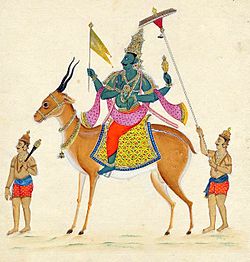
Wind God, Vayu (en.wikipedia.org)

Result #2: No need of that hypothesis

The last question on the pre-and post-tests is this one: Humanity came to be through evolution, which was controlled by God.

Let's compare the responses between 2011 (remember, no rearranged presentation, no teaching creation, and no 23andMe) and 2012 with their pre...post %.

Fall 2011
Agree: 26...25%
Disagree: 57...58%
No opinion/undecided: 17...17%

Spring 2012 
Agree: 26...15%
Disagree: 57...72%
No opinion/undecided: 17...13%

Comments
That's an increase of 15% of students in my course who disagree, which is to report that they have no need of the god hypothesis for human evolution and no need for human exceptionalism.***

That degree of change is roughly on par with the improvement seen here (from above):
  • The theory of evolution correctly explains the development of life. 77...88%  agree  
  • Evolution is always an improvement.   54...72%  disagree  
  • Evolution cannot work because one mutation cannot cause a complex structure (e.g., the eye). 62...88%   disagree   
  • A species evolves because individuals need to.   73% agree... 49% disagree 
  • “Survival of the fittest” means basically that “only the strong survive.”   65% agree...72% disagree
  • I have a clear understanding of the meaning of scientific study. 76...89% agree
  • I have a clear understanding of the term “fitness” when it is used in a biological sense.  58...88% agree 

I'll have to do the statistics if I want to test whether those students who were likely to disagree with the god question were more likely to answer the above questions correctly or confidently (for the last two). If that turns out to be the case, then there is support for claiming that a deeper understanding or acceptance of more nuanced, complex, and agency-free evolutionary principles and processes (or confidence about them) leads to letting go of the supernatural. But we can't say that yet without those predictive tests.

Even if stats enable me to predict improvements with letting go of supernature, I'm not so sure that it will be clear that this change was caused by my course and new curriculum. For me, my loss of the supernatural was so gradual that I can't credit one course! I just kind of sloughed off the supernatural over time. So it's quite possible that these results don't reflect a change in many of those students, as much as their new found willingness to admit that a change is occurring or has occurred. Still, that I tried out this new curriculum... it's hard not to assume causation from correlation. (But like I said, I have to do the stats if I'm to see about that.)

I'm not going to lie... I'm so proud of my students for how they answered this one question. And I'm not going to pretend this isn't dangerous information that our friends and heroes who battle creationist politicians might not like to share with those creationist politicians!

The fear of losing the god hypothesis is a major reason why creationists don't want evolution to be the only explanation taught in K-12 biology classrooms (or don't want it taught at all). And it's also why the human animal is so often left out of K-12 biology curriculum. And my experience, here, suggests that that fear is justified! But what's ironic about the creationist plea for getting creation into science classes to better "teach the controversy" and to cover "competing theories" (the only two being creation and evolution) is how my experience suggests that teaching creation alongside evolution is a recipe for losing supporters of the supernatural. (see here)

It's important to notice that the question I ask students is not about whether they believe in God, or are religious or spiritual, or pray or meditate, or whether they believe in a higher power or a greater force or anything like that! It's just asking whether human nature requires supernature. And they're saying no.

Why does that matter? Why am I so proud of them? Here's just one reason: Because if you accept nature, then you somehow understand the delicate role of each species, including humankind, in the ecosystem. And maybe humans who see this more clearly will take more compassionate, human-friendly, and Earth-friendly actions at the market, in the voting booth, and in their communities.
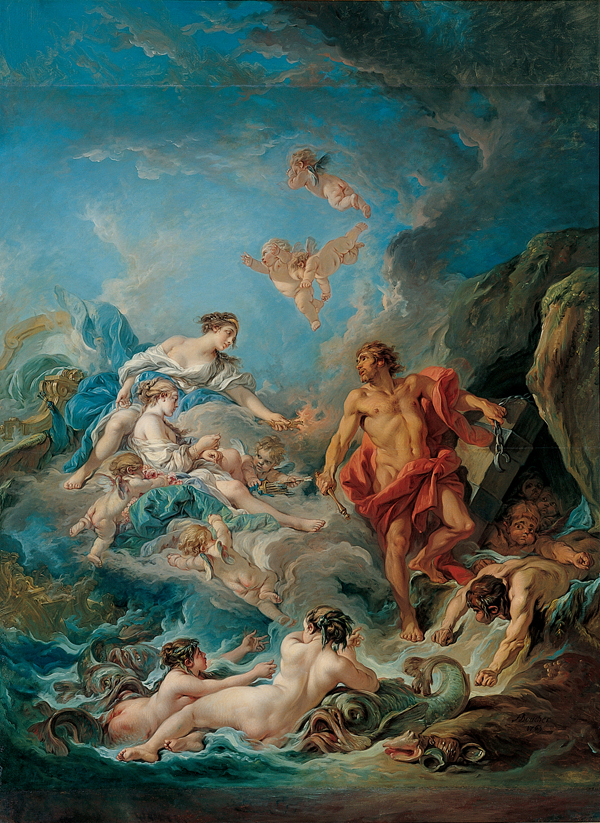
Juno Asking Aeolus to Release the Winds, F. Boucher, Paris, 1769
(Uppity note: The original title was Pull My Finger and Boucher's later variations on this theme incorporated Prometheus.)

Notes
* Assessment pre- and post-test questions are taken from this article: Cunningham DL, Wescott DJ. Still more "fancy" and "myth" than "fact" in students' conception of evolution. Evolution: Education and Outreach 2009;2:505-517.

**Students are asked to report whether they "strongly agree," "somewhat agree," "somewhat disagree," "strongly disagree," or "no opinion/undecided/never heard of it." I don't report everything here. And I'm lumping "strongly" and "somewhat" categories into just plain "agree" or "disagree."

***Unfortunately another way to read this statement and yet still disagree with it is from the hard core creation perspective: No evolution at all! However, I have few of those students in my course and expect to have fewer of them, not more of them, by the end of the course. That's not because they change their minds about hardcore creation, necessarily, but because the few who'd take my course in the first place would probably drop it before it's over.  I will add a question that is better worded to the next round of tests in the Fall semester and I'll keep this one as reference. Something like "Evolution does not explain human existence" would help me gauge how many might disagree with the above question from the minority  (no evolution at all) perspective.

Thursday, February 23, 2012

A modest proposal: Please make us teach creationism


Many of you want us to teach other theories alongside evolution in science classes.

No problem!

We agree whole-heartedly and apologize that we have appeared to resist you, causing such consternation and turmoil.

Evolution is fundamentally important to teaching the natural sciences (as you've probably heard us say a million times), but teaching other theories alongside it can be extremely effective. So we are blushing with embarrassment that this curricular adjustment continues to be thwarted at the local, state, and federal levels.

Granted, there's a deep history of strife and for good reason. In order to get evolution into science classes, we demanded that creationism be taken out. But now with all that behind us and with evolution in the science classes where it belongs, not only are we cool with including the other theories, but we want you to know that we need them!

See, those of us who teach from an epistemological perspective try our best to convey to students not just what we know but more importantly how we know what we know. This is an eye-opening and empowering way to learn which is why we try to create this experience for students. The only way to do that is to teach about evolution now--how scientists have come to understand it--compared to how people used to explain the natural world, which greatly influenced unscientific beliefs about nature that people still hold today. This epistemological approach means that we strive for a non-dogmatic and non-indoctrinating presentation of the material, upholding prized scientific ideals that aren't shared by many of those who support creationism. 

Here's a taste of the experience. 

Look around the world. (You don't have to go anywhere. Click here, arkive.org, and look at pangolins, cuttlefishes, polar bears, wolverines, belugas, aye-ayes, gorillas, etc.) Now that you've made observations, what can you make of all those common traits, features, trends, behaviors, that we see among all living things?

With generations upon generations of humans making these observations, there are still only two main theories for explaining them: 

1. At some point in history, a divine or supernatural force created all the living things exactly as we see them today. Patterns of similarity among groups are only the whim of the creator, nothing more: CREATION.

2. Similarities among groups indicate shared ancestry, just like family resemblance but on a larger scale. Any two living creatures on Earth share a common ancestor at some point in history. And so on. If you trace all lineages back far enough, everything alive today shares a common ancestor. Organisms did not always look as they do now because over deep time, all lineages have accumulated changes generation after generation: EVOLUTION.

For #2 there is a subset of important and exciting theories--some more popular and better supported than others--as to how evolution unfolds and how separate lineages arise. And that's partly because there is more than one way to evolve. Darwin's adaptation by natural selection is a good example of a process that's got lots of supporting evidence. Lamarck's ideas, which aren't so different but receive less support, are also useful in the classroom for contrasting with natural selection, for putting modern genetics in context, and for introducing our burgeoning understanding of epigenetics. Mutation, genetic drift and gene flow are some other processes that are fundamental to evolution, so are concepts of deep time, competition, cooperation, symbiosis, and metabolic and developmental constraint.  

But given all those scientific theories, creation theory is the most effective way to put evolution in scientific context. It's a perfect foil for evolution, illuminating the scientific nature of evolutionary theory by demonstrating what science is not and what the scientific method cannot address.

It's not just hand-waving, creation theory is also arms-in-the-air-tossing and shoulders-shrugging. To apply such a dead-end theory to all lines of inquiry would prevent all science, not just the natural sciences, from advancing with our young people. This is powerful stuff that students can appreciate when we're free to be open about creationism during evolution lessons.  

So, again, we're really embarrassed that it's come to such political fisticuffs. There's really no need for all this fighting because we're all on the same side. Please sign those scientific curricular demands into laws. We want you to force us to teach creationism and intelligent design in science classes. Being not only free but legally required to cover competing theories will only strengthen science education!

Thanks for all your efforts to strengthen science education.


Note:  "We" refers to Holly Dunsworth and anyone else who supports her by commenting here or elsewhere.

Wednesday, July 28, 2010

Getting past evolutionary pointilism--or creationism in the journal Nature?

The July 15 issue of Nature, in true Nature style, has a high human-interest picture of a fossil cranium fragment (glaring at you from the cover!) that purportedly shows that the separation between ancestors of Old World monkeys and apes had occurred. The find was in Saudi Arabia, and while Holly is the person most appropriate to discuss the details, we have a few words to say about it until she does.

The fossil is about 29 million years old. It does not have a specific trait found only in modern Old World monkeys, but not in apes. If the interpretation is correct, and we have no reason to question it based on our own fragmentary knowledge of this area, then it does suggest that the monkey-ape divergence occurred subsequent to when this individual lived.

Fine. Our issue, and it's yet another complaint about Nature's drive to be a pop-culture rather than serious scientific journal, is with the heading: " Parting of the Ways: Saudi Arabian fossil pinpoints divergence of Old World monkeys."

The implication in Nature is almost creationist in nature. It is the assumption that this lump of one-time bone was at the 'parting' of the ways, and that such events occur instantaneously. If not, how could a specimen 'pinpoint' the separation?

In fact, speciation is a gradual, statistical, probabilistic population phenomenon. It does not generally occur in a moment.

But suppose this is science, not Creationism on Nature's part. Even then, what is the chance that this particular specimen, or even any specimen from thousands of square kilometers or thousands of generations around this time, was the 'point' of speciation? The odds are minuscule, and in a deeper sense untestable.

Speciation, in the usual definition, would be the time at which no individual from either of the two new-lineage populations could successfully mate. But for thousands of generations, gradual divergence would in reality merely have diminished the probability that a random male from one and female from the other ancestral population could have mated successfully.

Even a mutation that by itself would make such mating impossible would not have spread throughout one of the populations so that the two species lineages were suddenly discrete and immiscible.

To melodramatize speciation and evolution in a way that almost makes it creationistic is yet another editorial decision by the journal that shows either crass grabbing for sales, the superficial understanding of science even by scientists or science journalists, or the simple dumbing down of science. The last thing it is, is a contribution to evolutionary science (we note that this is the editors' fault, not the authors: their paper makes none of these idiotic claims. Instead, they say that the fossil record may now show that the split happened during a 5 million year period after the demise of this current individual).

Wednesday, October 21, 2009

The 'God' gene, continued

So, let's assume that some lucky scientist actually finds a scientific rather than faith-based proof of the existence of God. Hey, let's go one better and assume that Anne and I are the lucky scientists (we want the Nobel prize money and the appearances on Colbert)! For the moment, let's just say we proved that God is something person-like (whether or not He/She/It has various unmentionable organs, hands to be on the right side of, form to be the image and likeness of, or eyes for us to be pleasing to the sight of.

Now, what would the impact of that be for science?

Of course, the immediate impact would be great relief that we will, after all, have an after life, assuming we don't use our science for greedy or harmful purposes (well, that may exclude a lot of us from the pearly gates).

First, the God we prove might act in a deist way: He/She/It created the Universe, gave it some laws to run by, and let it the go off on its own without further intervention. This, after all, is a concession that some scientists, even Darwin, have made to religion as a possibility. In that case, the nature of science would not change one iota. We would just, for self-praise, newsiness, and grantsmanship, change our rhetoric to say that we propose this or that study to understand God's laws--think of the 'significance' section of our grants!! But novel? Not a bit of it! That was what the greats like Newton were explicitly doing centuries ago.

Alternatively, we might say that God did create things-as-they-are, and that our job is to characterize the mind of God in that way, but that occasionally God intervenes in mundane affairs. He/She/It might do so in answer to a prayer, though it's hard to see how so puny a thing as a single human could have such influence on the Eternal Omniscient, and specific tests of the efficacy of prayer have bombed completely.

Nonetheless, what that means is that when an experiment to characterize the laws of Nature--the same experiments we do anyhow--didn't work, our explanations would have to include the possibility (besides that our theory was wrong) that God altered the pH of our reactions. But in practice, that would just another source of occasional measurement or experimental error in our analysis and interpretation.

Ad hoc interventions by the deity would be singleton events and science usually is not designed to identify cause in those cases, in the same way that one-off lab errors or sample design flaws often can't be identified. That's why we repeat experiments. We already accept that odd occurrences do happen, and our inference about theoretical validity is, and would remain, statistical in the face of occasional divine speed-bumps. Because intervening in that way by definition means that there are laws of Nature to intervene with. So nothing in routine science would change on that account.

Even if God always intervened in the same way if we repeated the same experiment (the wily imp!), that would be just another kind of special case of, or change in, the law of Nature that we're trying to understand.

In any case, the evidence is already prohibitively strong that the universe is law-like, so that such interventions cannot be too common. That's why literal religion has such difficulty with scientists in the first place! Indeed, some physicists speculate that the laws of Nature are no such thing, they are just generalizations about our particular place in the universe, or our particular universe in the universe of universes (i.e., that we could get to if we could sail through black holes).

And what if the proof sees 'God' only, as we've been already warned, through a glass darkly? What if God is not person-like and can't be interpreted as such, or doesn't respond to human events that way? What if He/She/It is something more abstract, like the Oneness of Buddhism, or the varied origin stories of different cultures around the world. Or what if He/She/It is more remote and distanced from us rather than a conductor bothering to steer our puny earth on its daily mundane way? How could even science that proved that He/She/It existed use that knowledge to interpret things any differently than we already do? Again, the world clearly appears law-like, and science is a set of methods to understand those generalities of how-things-are. If science has imperfections in understanding Nature, maybe it's our reliance on current methods and concepts, that we inherited, after all, from the Enlightenment period a few centuries ago and need not be written in stone.

If some clever person suggests a different way to study what we call transcendental or immaterial realities themselves, and showed that your brain really can communicate with He/She/It (or your long-deceased ancestor or pet dog), that would open up a whole new (and extremely exciting) realm for human research. But it wouldn't change how-things-are in the material world that we already know about.

Overall, knowing that God exists might make a big difference to scientists personally, but would not make any major difference to science, except returning its rhetoric to something that goes back to classical times. Just as accepting evolution doesn't make a major difference to creationists, or even many scientists, in their daily work.

These things are at least worth thinking about--they help clarify the true nature of the science-religion debate as a conflict over cultural resources, rather than one about the physical realities of the world.

Tuesday, October 20, 2009

The Greatest scientific discovery of all times (but naming no names!)

We said yesterday both that Creationist literal claims are clearly bunk and that many advocates for teaching evolution in the schools are not all that sophisticated about evolution. In the latter case, and certainly naming no names!, they may have a over-simplified idea of the role and strength of natural selection in evolution, or may not appreciate the subtle relationships between drift and selection, or have little idea about the sophisticated kinds of evidence coming out of molecular biology labs that so beautifully confirms evolution, and so on.

The blunt fact is that some of what we say in evolutionary biology, especially when dumbed-down for public or textbook consumption is also bunk. The proliferation of Just-So stories in evolutionary biology, even at the highest level, is extensive and well-known. So we're told confidently such things as that our body parts evolved 'for' such-and-such a purpose, and our physiological responses were selected 'for' a reason, and we have genes 'for' all of it.

In fact, anything that's here today can be given such explanations with little in the way of constraint much less testability. Nice, tight stories sell big!

Humility should have a deeper role in science and among us members of the Science-tribe. It seems unassailably true that life today is the result of a history. Darwinian selection also seems undeniably important, though there are other equally important evolutionary forces. And, humans really did come from terrestrial ancestors. We might hope to discover something that refutes such ideas, because it would be so energizing and exciting for science and the public alike! Alas, nothing suggests it will happen.

Still, who knows how much we don't know about life? What factors or forces might be as yet undiscovered but have an effect on biological change? What kind of real 'dark matter', that today is to us what, say, electrons or infra-red radiation were to Aristotle--or real dark matter to astronomists?

When we discuss the evidence for 'evolution', we should be humble enough to acknowledge that that word isn't so clear as it may seem. There are gaps in what we know, gaps in the fossil record, gaps in our theory (e.g., of how to predict phenotypes from complex genotypes, which we assume are causally connected, or how species evolve, or how to know when selection is acting, rather than drift).

We can't let Creationists cower us into asserting more than we know, or simply adopting a party line, as that would be a kind of victory of non-knowledge over knowledge. What sends us to work every day is the pursuit of what we don't yet know. There is likely to be a lot of that out there. It is hard to imagine something that would be so profound as to change our basic view of life as the product of historical evolution, much less anything that could convert us to a theologically literalist view. But we might discover things as new and exciting as the awareness that Darwin and Wallace brought to us about the nature of life. We should remain open to that possibility.

In fact, many scientists are atheists, some (naming no names!) so aggressively so that it is their way of hyping themselves and rolling in the book-sales and TV appearances. Of course, proving a negative is difficult, but science is not likely to prove, using its current set of principles, that God does not exist (even if He was just kidding about a 7-day creation). Many scientists are proud of their atheism, but let's not be hypocrites. And here is a warning to Creationists, who like to trash scientists for their views:

It is hard to imagine a scientist who would not crave being the one who discovered and could truly prove that the source of our hopes and dreams (naming no names!) really does exist. As the scientific discoverer of God, such a scientist would become the most distinguished human being in the history of our species. Darwin would be a puny dustman by comparison. The reason scientists don't take much to religious arguments is not that they'd not like to show them to be true, but simply, and perhaps sadly, because the evidence doesn't suggest that such a thing is even worth pursuing in science.

--Ken & Anne

Monday, October 19, 2009

Recreating Creationism

Every time you turn around there's some new lecture, Forum, or working group on teaching evolution in the schools. Audiences are usually packed. These all sound like they are serious, sober academic discussions about policy and the like. But since this is anything but a new phenomenon, and the issues have been aired countless times, and science invariably wins in the courts, why is it still going on?

It is not really that we have to arm or prepare our selves in any technical sense to present compelling new facts--the evidence for evolution is solid, and has been for a long, long time. The facts are out there, in public and on daily television. Instead, these meetings are a kind of recreation: again and again it's the re-creation of creationism as a sporting event.

And they are generally preaching to the converted. The audience already knows the facts, and likes to cite them aggressively, needing no cue cards to know when to give a derisive snort. In fact, as sincere as they may be, and as much public service as they may be doing, some advocates for teaching evolution don't really understand evolution at a very deep level relative to the knowledge we now have in genetics and population biology.

These meetings are not being held because creationism has amassed legitimate arguments that threaten evolution and require careful rebuttal. Anyone who is even halfway aware of biology and geology knows that literal creationism is simply bunk, and truthfully, most Intelligently Designed Creationists know this too, in their heart of hearts. They know the Devil didn't plant Ardipithecus to mislead us into lives of sin.

But bashing these benighted people has become something of a self-congratulatory blood sport. Indeed, many biology blogs--that get thousands of hits--cover this subject tirelessly, usually with great glee, but rarely is anything new being said. For that reason we try to avoid evolution-creation 'lectures', and don't regularly follow the food-fight blogs. Our open minds are closed to the point that we've never been to an Intelligent Design-sponsored event, and we'd be willing to bet that anyone reading this who has didn't go to honestly weigh the evidence in favor of intelligent design.

Indeed, we all come at this "debate" with our preconceived notions safely intact--and leave with them untouched. See the Lola comic we posted on Saturday. At these events it is repeatedly said that the organizers want 'dialog', not confrontation, but that's insider-code for "we want to educate these poor souls, so they'll convert to our point of view."

This is the 150th anniversary of Darwin's 1859 Origin of Species but the evolution-creation debate, with all of its current vituperation, goes back well before Darwin. Darwin in fact tapped into discussions that had been fueled (in the UK) by an 1844 book called Vestiges of the Natural History of Creation, by an amateur naturalist named Robert Chambers, and as Darwin acknowledged in his Preface, it made the environment more receptive to his own book. And even Chambers basically rested on already known facts and ideas.

People often cite figures about the large proportion of the US population that doesn't 'believe in' evolution as evidence that science education is failing in this country. But, this is not about educating the uneducated. If our kids, or your kids, were taught ID in school, we, and you, would unteach what they'd learned as soon as they got home. Symmetrically, when evolution is taught, this is what fundamentalists do when their kids get home. Every child is largely home-schooled, or at least home-acculturated--in spite of the number of hours they spend in class.

And even if science education demonstrably is lacking, and should be seriously upgraded, the divide is not about the facts anyway. Most creationists readily accept that animal breeds can be molded by artificial selection, that bacteria can evolve antibiotic resistance, and so on--it's not about whether evolution per se can happen. It's partly at least about not being able to accept that humans aren't above Nature, and weren't landed intact on Earth by a Creator.

But, really, how much difference does it make? Theodosius Dobzhansky famously said, in the context of the school debate in 1973, that nothing in biology makes sense except in the light of evolution. This statement is cited almost religiously by evolution proponents. But it's not really true--much of biology can be done very productively with no reference to evolution at all. Many life scientists, especially for example in biomedical research, have little more than a cardboard cutout understanding of evolution and do their work perfectly, or imperfectly, well without it.

And whether or not creationists accept the truth of evolution is not an issue with many practical implications to speak of--it's not like not accepting vaccinations or the importance of clean water.

We said above that this was only 'partly' about the fact of human origins. No matter how manifestly uneducated the uneducated truly are in this area, this is a clash of world views, a conflict over cultural and even economic power, a battle against fear (of death), for feelings of belonging to a comforting tribe, and so on. And the often vehement intolerance of biologists, equally convinced about their own tribal validity, is of a similar nature.

Perhaps it's easy for us to be cavalier about this because science always wins in court in the long run. Indeed, we followed the 2005 Dover trial here in Pennsylvania with interest, and we like others found Judge Jone's decision to be brilliantly argued, and routinely assign it to our students, generally when we also teach about the somewhat symmetric misconceptions about the 1926 Tennessee Scopes Trial (see Ken's article in his Crotchets & Quiddities columns: you may be surprised about that trial!).

Many if not most senior evolutionary biologists alive today were trained with evolution-free textbooks in their high school biology, in public schools in which they (we) recited a morning prayer, every school day from grades 1 through 12. Evolution had deliberately been purged by the textbook publishers to prevent loss of sales to states in certain regions of our country. Lack of early evolutionary training clearly doesn't hamper later learning. And evolutionary training manifestly doesn't generate understanding. Other factors are involved.

What the answer is, is unclear, if the question is "Why can't they be like us???" Maybe it's a selfish one: let those in the Creationist world have their schools as they want them. That will mean those with correct knowledge, your children and ours, will face fewer competitors for the desirable jobs in science and and other areas where properly educated people are required.

At least, those who can't stay away from the Creationist food fight should recognize that they are largely exercising their egos--and recreating Creationism over and over, to knock it down again and again. It's their tribal totem-dance, war paint and all. Serious resolution will come at a much higher price than blogging, no matter how many followers anti-creationist bloggers pull in, and it will come in a form as yet unknown. But that form will almost surely have to involve increased teacher salaries, higher education-major SATs, and education certificates given to those whose major was science and not education.

-Anne and Ken

Monday, September 7, 2009

Fundamentalism and anthropological naivety

We were channel hopping this weekend, looking for the broadcast of Penn State's first football game of the season (well, Ken was looking; Anne wasn't). That led us to pass through several religious channels that our cable service provides.

It is in a sense an incredible phenomenon. Someone, usually manifestly poorly educated, in a robe of some sort, spouting off patent non-sense and opinion, in a rhetorical and tonal style to appeal to unquestioning emotion, and audiences (sometimes very large audiences) nodding unquestioningly (often in tears).

It is incredible that in our supposed age of science, this can still occur. It is an unsavory dose of reality, that wealth, education, and comfort do not actually educate people (unless by some weird chance these preachers are right and the entire empirical world an illusion). This is culture in action. We scientists and intellectuals flatter ourselves that we're the enlighteners of a benighted world, but it's not really true. People are surrounded by science, including evolution, and still it doesn't sink in.

In fact, we probably err in bemoaning the degenerating world that these religious hawkers are selling (and selling is an appropriate word for much of it, of course). We are perhaps the most formally educated population in human history: by far more people with more years of school, more credentialist degrees, technical training, and access to knowledge. Nonetheless, today as ever before, it has only been a small elite that is really 'educated' in the sense that applies here. High levels of this kind of knowledge have never been the daily bread of the majority of people, and they aren't now either.

The arguments produced in favor of sacred-text religion are specious and in the US often culpably misrepresent the claims of science, and we have every duty to try to correct them. But the real issue is not the physical facts of evolution vs theology. It's a deeper cultural fact about people, and symbolic battles for power and feelings of importance.

People generally like simple answers that explain everything. And they need opiates to calm their unease about the harsh realities they know are part of life. Mysteries can be appealing but also frightening, especially to those who know they're mortal. Science is no exception--simple answers are very appealing--which is why we do our best to resist unquestioned genetic determinism or darwinism. There should be no Gods, or gods (whether the latter be Marx or Darwin, Michael Jackson, or $$). Gods are dangerous. People are still willing, sometimes eager, to die for them.

We saw a comment in the news this weekend to the effect that fundamentalism will be the downfall of civilization. The rise of fundamentalism, according to this British scientist, means that global problems, such as climate change and population growth, won't be addressed with the kinds of worldwide cooperation needed to solve them. We realize that this was meant as a bemoaning of the human strife caused, justified, or motivated by fundamentalist belief, and we share that view. But it's important to understand that, as stated, it's totally wrong. First, it's probably fair to say that economic differences rather than religious ones are preventing global agreement on climate change. And secondly, if anything, the most advanced civilizations have thrived on marauding justified by religion (theological or, as in Marxism, secular). Mass-scale malevolent treatment of groups of people by other groups of people is perhaps one of the characteristics of large-scale complex societies.

It may also be natural for there to be people of good will who resist these dire aspects of human culture. There may be no precedent for it, but we hope they will eventually prevail.

Tuesday, May 26, 2009

For God's sake!

We have just reviewed a book by CE Cosans, called Owen's Ape & Darwin's Bulldog: Beyond Darwinism and Creationism (Indiana Univ Press, 2009). It's an interesting discussion of the famous debate between Darwin's public (pugilistic) advocate, TH Huxley, and Darwin's opponent Richard Owen (founder of the British Natural History Museum). The question was whether humans have distinct anatomical characters compared to apes (genes were not known at the time).

The brain, naturally, was the organ of interest. Huxley claimed that there were only quantitative differences between the anatomy of ape and human brains. Owen claimed distinct differences, including a structure called the hippocampus minor. The debate was long, public, and bitter. In the end, because Darwinism won the nature-of-life debate, Huxley is treated as the winner of this debate, too. But Cosans provides good evidence that, considering their worldviews and what they actually said, Owen's interpretation was perhaps closer to the anatomical truth. Cosans analyzes the history in terms of theories about science and its relationship to the empirical world and our interpretations of it.

The analysis of this history is fine, but Cosans also delves into what Darwin, Huxley, and Owen believed about God (and hence his subtitle). This is only peripherally relevant to the main event, the debate about anatomy. It makes a saleable subtitle, and we guess that these days nobody can simply leave the religion vs 'creationism' fight alone.

The point here, however, is not who believes what and why in that regard, but that the religion debate provides a distraction, that we constantly see these days, away from the merits of the various scientific cases. In particular, we should no longer be concerned as scientists about what Darwin's or Huxley's personal religious views were. Darwin's writing is of interest to history, certainly, but not as a sacred text (though one to be revered, to be sure!).

What we think today about biology and its nature needs to be evaluated in terms of what we know and what we can testably speculate about. The gravitational pull of gossipy food-fights is natural, since even scientists are human. We have enough trouble being objective about the science itself, such as the relative roles of natural selection, population structure, environmental change, and chance in the nature of life. But too often we relate these discussions to irrelevant, but often highly emotive, sideshows.

We don't need that in order to struggle with truly fascinating questions such as what makes humans seem so different from other animals, despite great similarities in our genomes!