Showing posts with label Darwin. Show all posts

Thursday, December 20, 2018

Mr Darwin's new science

In his recent, marvelous must-read book, Naturalists in Paradise, about the major explorers of the Amazon (Wallace, Bates, and Spruce), John Hemming quotes Alfred Wallace lauding Darwin's Origin of Species in a letter to fellow explorer Henry Bates, saying that "Mr. Darwin has created a new science and a new philosophy."

I am no historian of science by any means, but I think that there is substance in this grand characterization.  Prior to Darwin--taking him as representative and perhaps the most explicit spokesperson for the view--western science had viewed life as the result of one or more divine creation events.  The inanimate, physical universe was also created 'In the beginning', but as a law-like place.  At least, by Galileo and Newton and others, it had come formally to be seen as following universal mathematical principles.  The key, in my view, is the 'universal' aspect of this view of existence.

Later, with various scientists leading up to them, Darwin, Wallace and a few others saw life itself as also having arisen at some 'beginning', but a natural one, and as a process, having diversified thereafter to what is here today.  That process has come to be called evolution.  The idea from Darwin's time to now, with no evidence of serious challenge, as he said, all life today has descended from some beginning in 'a few forms or into one' following universal 'laws acting all around us'.  In asserting his view, in terms of laws, Darwin reflected his essentially explicit Newtonian viewpoint.

These 'laws' were, as specified by Darwin in the elegant last paragraph in his Origin of Species:

  1. Growth with Reproduction
  2. Inheritance
  3. Variability 'from the indirect and direct action of the external conditions of life, and from use and disuse'
  4. Resource-limited rates of increase leading to a struggle for life
  5. Natural Selection, which led to divergence of Character and Extinction of less improved forms.

I often note my view that Darwin was a product of his times, that is, believing in 'laws' of Nature and a kind of determinism in evolution, and a poor sense of probabilism.  As I note in some recent posts, I think he held this view, expressed clearly in terms of barnacles, but I wonder what he would have said about primates and humans in particular, as recently mused about here.

We're now in the world of probabilism in science, with fundamental probabilistic notions (mutation, drift, quantum mechanics, and so on).  Darwin would certainly have understood the ideas, but I wonder what his view of the probabilistic aspects would be.  That they were just a nuisance on the 'real' selective signal?  That they challenged the idea of precise adaptation?  How would they have affected his analysis of barnacles, as we've discussed recently here?

But is evolution law-like the way physics is?  Physics' 'laws' are universals.  Yet evolution (including selection) happens probabilistically, in the context of specific local circumstances.  This seems at odds with Newtonian universality and its consequent determinism.  Is anything missing in our 'theory' of life and evolution, for example, that vitiates promises of 'precision' genomic medicine?  Or that could be used to derive such predictability?  Or is it just that such promises are Newtonian, and don't fit the evolutionary living world in which we live?

Mr Darwin (and some contemporaries, in particular Alfred Wallace) founded a new science, but we have to go beyond his times to understand where that science will, or should, take us.

Thursday, November 8, 2018

The horseshoe crab and the barnacle: induction vs deduction in evolution

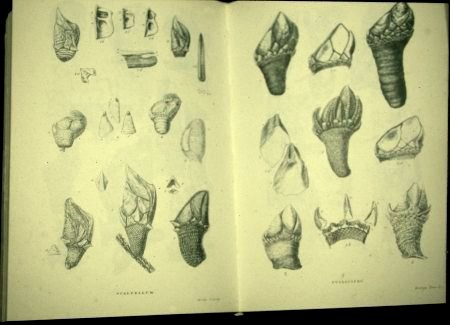
Charles Darwin had incredible patience.  After his many-year, global voyage on the HMS Beagle, he nestled in at Down House, where he was somehow able to stay calm and study mere barnacles to an endless extent (and to write 4--four--books on these little creatures).  Who else would have had the obsessive patience (or independent wealth and time on one's hands) to do such a thing?

Image result for darwin barnacles
      From Darwin's books on barnacles (web image capture)
Darwin's meticulous work and its context in his life and thinking are very well described in Rebecca Stott's compelling 2003 book, Darwin and the Barnacle, which I highly recommend, as well as the discussion of these topics in Desmond and Moore's 1991 Darwin biography, The Life of a Tormented Evolutionist.  These are easier, for seeing the points I will describe here, than plowing through Darwin's detailed own tomes (which, I openly confess, I have only browsed).  His years of meticulous barnacle study raised many questions in Darwin's mind, about how species acquire their variation, and his pondering this eventually led to his recognition of 'evolution' as the answer, which he published only years later, in 1859, in his Origin of Species.

Darwin was, if anything, a careful and cautious person, and not much given to self-promotion.  His works are laden with appropriate caveats including, one might surmise, careful defenses lest he be found to have made interpretive or theoretical mistakes.  Yet he dared make generalizations of the broadest kind.  It was his genius to see, in the overwhelming variation in nature, the material for understanding how natural processes, rather than creation events, led to the formation of new species.  This was implicitly true of his struggle to understand the wide variation within and among species of barnacles, variation that enabled evolution, as he later came to see. Yet the same variation provided a subtle trap:  it allowed escape from accusations of undocumented theorizing, but was so generic that in a sense it made his version of a theory of evolution almost unfalsifiable in principle.

But, in a subtle way, Mr Darwin, like all geniuses, was also a product of his time.  I think he took an implicitly Newtonian, deterministic view of natural selection.  As he said, selection could detect the 'smallest grain in the balance' [scale] of differences among organisms, that is, could evaluate and screen the tiniest amount of variation.  He had, I think, only a rudimentary sense of probability; while he often used the word 'chance' in the Origin, it was in a very casual sense, and I think that he did not really think of chance or luck (what we call genetic drift) as important in evolution.  This I would assert is widely persistent, if largely implicit, today.

One important aspect of barnacles to which Darwin paid extensive attention was their sexual diversity.  In particular, many species were hermaphroditic.  Indeed, in some species he found small, rudimentary males literally embedded for life within the body of the female.  Other species were more sexually dichotomous.  These patterns caught Darwin's attention.  In particular, he viewed this transect in evolutionary time (our present day) as more than just a catalog of today, but also as a cross-section of tomorrow.  He clearly thought that what we saw today among barnacle species represented the path that other species had taken towards becoming the fully sexually dichotomous (independent males and females) in some species today: the intermediates were on their way to these subsequent stages.

This is a deterministic view of selection and evolution: "an hermaphrodite species must pass into a bisexual species by insensibly small stages" from single organisms having both male and female sex organs to the dichotomous state of separate males and females (Desmond and Moore: 356-7).

But what does 'must pass' mean here?  Yes, Darwin could array his specimens to show these various types of sexual dimorphism, but what would justify thinking of them as progressive 'stages'?  What latent assumption is being made?  It is to think of the different lifestyles as stages along a path leading to some final inevitable endpoint.

If this doesn't raise all sorts of questions in your mind, why not?  Why, for example, are there any intermediate barnacle species here today?  Over the eons of evolutionary time why haven't all of them long ago reached their final, presumably ideal and stable state?  What justifies the idea that the species with 'intermediate' sexuality in Darwin's collections are not just doing fine, on their way to no other particular end?  Is something wrong with their reproduction?  If so, how did they get here in the first place?  Why are there so many barnacle species today with their various reproductive strategies (states)?

Darwin's view was implicitly of the deterministic nature of selection--heading towards a goal which today's species show in their various progressive stages.  His implicit view can be related to another, current controversy about evolution.

Rewinding the tape
There has for many recent decades been an argument about the degree of directedness or, one might say, predictability in evolution.  If evolution is the selection among randomly generated mutational variants for those whose survival and reproduction are locally, at a given time favored, then wouldn't each such favored path be unique, none really replicable or predictable?

Not so, some biologists have argued!  Their view is essentially that environments are what they are, and will systematically--and thus predictably--favor certain kinds of adaptation.  There is, one might quip, only one way to make a cake in a particular environment.  Different mutations may arise, but only those that lead to cake-making will persist.  Thus, if we could 'rewind the tape' of evolution and go back to way back when, and start again, we would end up with the same sorts of adaptations that we see with the single play of the tape of life that we actually have. There would, so to speak, always be horseshoe crabs, even if we started over.  Yes, yes, some details might differ, but nothing important (depending, of course, on how carefully you look--see my 'Plus ça ne change pas', Evol. Anthropol, 2013, a point others have made, too).


Others argue that evolution is so rooted in local chance and contingency, that there would be no way to predict the details of what would evolve, could we start over at some point.  Yes, there would be creatures in each local niche, and there would be similarities to the extent that what we would see today would have to have been built from what genetic options were there yesterday, but there the similarity would end.

Induction, deduction, and the subtle implications of the notion of 'intermediate' forms
Stott's book,  Darwin and the Barnacle, discusses Darwin's work in terms of the presumed intermediate barnacle stages he found.  But the very use of such terms carries subtle implications. It conflates induction with deduction, it assumes what is past will be repeated.  It makes of evolution what Darwin also made of it: a deterministic, force-like phenomenon.  Indeed, it's not so different from a form of creationism.

This has deeper implications.  Among them are repeatability of environments and genomes, at least to the extent that their combination in local areas--life, after all, operates strictly on local areas--will be repeated elsewhere and else-times.  Only by assuming not only the repeatability of environments but also of genomic variation, can one see in current states of barnacle species today stages in a predictable evolutionary parade.  The inductive argument is the observation of what happened in the past, and the deductive argument is that what we see is intermediate, on its way to becoming what some present-day more 'advanced' stage is like.

This kind of view, which is implicitly and (as with Darwin) sometimes explicitly invoked, is that we can use the past to predict the future.  And yet we routinely teach that evolution is by its essential nature locally ad hoc and contingent, based on random mutations and genetic drift--and not driven by any outside God or other built-in specific creative force.

And 'force' seems to be an apt word here.

The idea that a trait found in fossils, that was intermediate between some more primitive state and something seen today, implies that a similar trait today could be an 'intermediate stage' today for a knowable tomorrow, conflates inductive observation with deductive prediction.  It may indeed do so, but we have no way to prove it and usually scant reason to believe it.  Instead, equating induction with deduction tacitly assumes, usually without any rigorous justification, that life is a deductive phenomenon like gravity or chemical reactions.

The problem is serious: the routine equating of induction with deduction gives a false idea about how life works, even in the short-term.  Does a given genotype, say, predict a particular disease in someone who carries it, because we find that genotype associated with affected patients today?  This may indeed be so, especially if a true causal reason is known; but it cannot be assumed to be.  We know this from well-observed recent history: Secular trends in environmental factors with disease consequences have indeed been documented, meaning that the same genotype is not always associated with the same risk.  There is no guarantee of a future repetition, not even in principle.

Darwin's worldview
Darwin was, in my view, a Newtonian in his view.  That was the prevailing science ethos in his time.  He accepted 'laws' of Nature and their infinitesimally precise action.  That Nature was law-like was a prevailing, and one may say fashionable view at the time. It was also applied to social evolution, for example, as in Marx's and Engels' view of the political inevitability of socialism.  That barnacles can evolve various kinds of sexual identities and arrangements doesn't mean any of what Darwin observed in them was on the way to full hermaphrodism or even later to fully distinct sexes...or, indeed, to any particular state of sexuality.  But if you have a view like his, seeing the intermediate stages even contemporaneously, would reinforce the inevitabilistic aspect of a Newtonian perspective, and seemingly justify using induction to make deductions.

Even giants like Darwin are products of their times, as all we peons are.  We gain comfort from equating deduction with induction, that the past we can observe allows us to predict the future.  That makes it comfortingly safe to make assertions, the feeling that we understand the complex environment in which we must wend our way through life.  But in science, at least, we should know the emptiness of the equation of the past with the future.  Too bad we can't seem to see further.

Friday, May 6, 2016

Darwin the Newtonian. Part II. Is life really 'Newtonian'?

In yesterday's post I suggested that Darwin had a Newtonian view of the world, that is, he repeatedly and clearly described the organisms and diversity of life as the product of evolution, due to natural selection viewed as a force, which in an implicit way he likened to gravity.  At the same time, he knew that there was widespread evidence of various kinds for long-term evolutionary stasis, which a prominent geologist has recently called  "Darwin's null hypothesis of evolution," the idea that evolution does not occur if the environment stays the same.

That suggests that a changing environment leads to a changing mix of organisms that live in the environment, including of their genotypes.  It makes evolutionary sense, of course, because environments screen organisms for 'fitness'.  However, its negative--no change in the environment implies no evolution-- doesn't make sense and badly misrepresents what is widely assumed that we know about evolution. Even if we define evolution, as often done in textbooks, as 'change in gene frequencies' such change clearly occurs even in stable environments.  Mutations always arise, and selectively neutral variants, that is, that don't affect the fitness of their bearers, change in frequency by chance alone, not by natural selection, which means that at the genomic level evolution still occurs. It's curious that not only can organisms stay very similar in what seem like static environments, but also can be similar even in changing environments.

The idea of dual environmental-genetic stasis is an inference made from species that seem to stay similar for long time periods in environments that also appear similar--but how similar are they really?

Indeed, there are several problems with the widely if often implicitly assumed 'null hypothesis':

  1.  It is a very narrow assumption of the meaning of 'evolution', implicitly implying that it refers only to functionally important traits or their underlying genotypes. As we will see, there are ways for genetic change (and even trait change) to occur even in static environments, so that an unchanging environment doesn't imply no biological change.
  2.  It implies that 'the environment' actually stays the same, although 'environment' is hard to define.
  3.  It implies a tight essentially one-to-one fit between genotype and adaptive traits, so that in unchanging environments there will not be any functional genomic change.

All of these assumptions are wrong.  In essence, there cannot be 'the', or even 'a' null hypothesis for evolution.   Sexual reproduction, horizontal transfer, and recombination occur even without new sequence mutation.  To ignore that along with assuming a stationary environment, and adopt a null hypothesis that had anything like mathematical or Aristotelian rigor would be to reduce evolution's basis to something like this not-very-profound tautology:  Everything stays the same, if everything stays the same.

So let's look at this a little more closely
From the fossil record, we infer that some species stay the 'same' for eons, sometimes millions of years.  Then they change.  Gould and Eldridge called this 'punctuated equilibrium' and it was taken as a kind of up-dated version of Darwinism--mistakenly, because Darwin recognized it very clearly at least by the 6th edition of his Origin.  And while some aspects of animals and plants can hardly change in appearance for long time periods, close inspection shows that only some aspects of what can be preserved in fossils stays similar; other aspects typically change.  Also, speciation events occur and some descendants of an early form do change in form, even if the older species seems not to change. So we should be very careful even to suggest that environments or species really are not changing.

But mutations certainly occur and that means that even for a set of fossils that look the same, the genomes of the individuals would have varied, at least in non-functional sequence elements.  That itself is 'evolution', and it is misleading to restrict the term only to visible functional change.  But genetic drift is just the tip of the molecular evolution iceberg.  It is now very clear that there are many ways for an organism to produce what appears to be the same trait--and this is true both at the molecular and morphological levels.  That is, even a trait that 'looks' the same can be produced by different genotypes.  I wrote about this long ago in a rather simple vein, calling it phenogenetic drift, and Andreas Wagner in particular has written extensively about it, with sophisticated technical detail, in his book The Origin of Evolutionary Innovation, and this paper.  (The images are of my general paper and Wagner's book given just to break up the monotony of long text! ; he has written a more popular-level book as well called Arrival of the Fittest, which is a very good introduction to these ideas).

Recent exploration, with great detail


A modest statement of principl


Wagner explores this in many ways and among his views is that the ability of organisms to evolve innovative traits is based on the huge number of overlapping, essentially similar ways it can carry out its various functions, which allows mutations to add new function without jeopardizing the current one. Redundancy is protective against environmental changes as well as enabling new traits to arise.

This is in a sense no news at all. It was implicit in the very foundational concept of 'polygenic' control-- the determination of a trait by independent, or semi-independent of many different genes.  The way complex traits are thus constructed was clear to various biologists more than a century ago, even if the specific genes could not be identified (and the nature of a 'gene' was unknown).  A fundamental implication of the idea for our current purposes is that each individual with a given trait value (say, two people with the same height or blood pressure) can have its own underlying multi-locus genotype, which can vary among them.  Genotypes may predict phenotypes, but a phenotype does not accurately predict the underlying genotype (a deep lesson that many who promote simplistic models of causation in biomedical contexts should have learned in school).

And of course that does not even consider environmental effects, even though we know very well that for most characters of interest, normal or pathological, 'genetic' factors account only for a modest fraction of their variation. And, of course, if it's hard to identify contributing genetic variants, it's at least as difficult to identify the complex environmental contributors who make inference of phenotype from genotype so problematic. That is, neither does genotype reliably predict phenotype, nor does phenotype reliably predict genotype and the idea that they do so with 'precision' (to use todays' fashionable branding phrase) is very misleading.

In turn, these considerations imply that even if we accepted the idea of natural selection as a Newtonian deterministic force, it works at the level of the achieved trait, and can ignore (actually, is blinded to) the underlying causal genetic mechanism.  There can be extensive variation within populations in the latter, and change over time.  Just because two individuals now or in the past have a similar trait does not imply they have the same underlying genotype and hence does not imply there's been no 'evolution' even in that stable trait!

In this sense, evolution could be Newtonian, driven by force-like selection, and still not be genetically static.  But there's more.  How can there actually be stasis in a local environment?  If organisms adapt to conditions, then that in itself changes those conditions.  Even within a species, as more and more of its members take on some adaptive response to the environment, they change their own relative fitness by changing the mix of genotypes in their population, and that in turn will affect their predators and prey, their mate selection, and the various ways that the mix of resources are used in the local ecology.  If, say, the members of a species become bigger, or faster, or better at smelling prey, then the distribution of energy and species size must also change.  That is, the 'environment' cannot really remain the same.  That ecosystems are fundamentally dynamic has long been a core aspect of population ecology.

In a nutshell, it must be true that if genotypes change, that changes the local environment because my genotype is part of everybody else's 'environment'. In that sense, only if no mutations are possible can there be no 'evolution'. Even if one wants to argue that all mutations that arise are purged in order to keep the species the 'same', there will still be a dynamic mix of mutational variants over time and place.

One could even assert that an essence of Darwinism, literally interpreted, is that environments cannot be the same because the adaptation of one species affects others, even were new mutations not arising, because it affects the fitness of others. That is what his idea of the relentless struggle for existence among species meant, so stasis did cause him a bit of a problem, which he recognized in the later edition of the Origin.

I think that in essence Darwin viewed natural selection as being basically a deterministic force, like gravity, corresponding to Newton's second law of motion. And the idea of stasis corresponds to Newton's first law, of inertia. Today even many knowledgeable biologists seem to think in that way (for example, invoking drift only as a minor source of 'noise' in otherwise force-like adaptive evolution). Selective explanations are offered routinely as true, and the word 'force' routinely is used to explain how traits got here.
But there are deep problems even if we accept this view as correct.  Among other things, even if natural selection is really force-like, or if genetic drift exists as a moderating factor, then these factors should have some properties that we could test, at least in principle.  But as we'll see next time, it's not at all clear that that is the case.

Thursday, May 5, 2016

Darwin the Newtonian. Part I. The Darwinian worldview

History shows that, even in science, things that everyone has long taken for granted may not be true.  Thinking in ways more carefully constructed to be restrained by what we actually know is often difficult, and the temptation is to believe what we want to believe. There are many normal, human, not to mention professional reasons for this.  But it's not good for science.  What may appear to be clear-cut 'objective' concepts about the material world can verge on the abstract or even philosophical, based on subjective opinion more than fact.  As we've discussed before, in a sense this is due to our need in evolutionary biology to rely on statistical tests based on internal comparisons, rather than to use statistical methods to test hypothesized, externally derived laws of nature (see this series and earlier--search on 'statistics' or 'p-value').

In 1859, Charles Darwin's Origin of Species culminated what considerable contemporary rumination had been suggesting, with his assertion that life today is the result of a material, historical process, by which current organisms have arisen by divergence from a common ancestry.  His synthesizing insight transformed biology in many ways.  Before that biology had largely been a descriptive science.  Before Darwin, with a few very speculative exceptions, the best causal explanations for the diversity and adaptations of organisms had been that God created them on an ad hoc basis.  Darwin saw otherwise, but his thinking was embedded in his era's general views about science.

Thanks to developments in the European Enlightenment period, by Darwin's time causation in nature was being viewed, by scientific thinkers at least, as based upon natural laws.  The Newtonian view of the cosmos was the prevalent one and, in keeping with this, Darwin adopted an implicitly quantitative, law-like view of biology.  As far as I know, Darwin was not a diligent student except in relation to areas like geology and botany, and he certainly was not mathematical (he himself said so).  However, he must have known at least something about Isaac Newton (a rather famous Cambridge predecessor).

Isaac Newton; 1689 by Godfrey Kneller, Wikipedia

Still, whatever he formally knew of Newton's laws of motion Darwin essentially accepted some of Newton's basic laws of motion, which we can state as follows:
1.  An object at rest remains at rest (law of inertia)
2.  Objects move or change motion only when force-like acceleration is applied, (and the greater the mass of the object the greater the force needed to change its motion)
3. Every action involves an equal and opposite reaction (when pushed, an object pushes back)

There are, I think, important analogs in Darwin's thinking, and there is still today widespread uncritical application of Newtonian-like thinking to Darwin's ideas.  The other day, I heard a deservedly famous and prominent geologist say that Darwin's 'Null hypothesis of evolution' was that unless the environment changes, no evolution will occur. This is analogous to the law of inertia, and I think it's actually fundamentally quite wrong, but we will see why it seems tempting and plausible.

The classical idea, still asserted without much if any questioning, is that organisms are fitted to their environment.  Analogous to the Newtonian law of inertia, if the environment doesn't change, neither will the organisms.  Darwin was, to my knowledge, not wholly explicit about this, but it was at the very least implicit in his view as expressed in The Origin of Species.  At least, by the 6th edition he recognized that there can be long time periods when organisms seemed not to change.

However, and this is analogous to Newton's second law, if the environment changes, then in a force-like way it screens the varying genomes of organisms, favoring those that are suited to the new conditions.  The force Darwin called natural selection.  I'm mixing bits of new and Darwin-time terminology here, but the gist of Darwin's view is that natural selection is a deterministic force, which he likened to the force of gravity in his law-like, deterministic worldview in regarding to 'motion' (change) in organisms.  Indeed, he many times asserted that the smallest difference among organisms would be detected and screened by selection.

After this has gone on for a while, the selective 'acceleration' ceases because the organisms are now adapted to their surroundings.  At that stage, the law of inertia takes over. His theory of inheritance was fundamentally wrong, but the Darwinian idea expressed in modern genetic terms is that the organisms in a population at any time and place vary genetically, and when the environment changes, those whose genotypes are best suited to the new environment will reproduce more prolifically, and will increase in frequency, driving inferior genotypes out of the population.

The Darwinian analogue to Newton's third law of motion is that changes in the nature of one organism in a local area improves its use of, and thereby alters, its local ecology.  The faster foxes catch the rabbits and proliferate. But this in turn makes the rabbits hoppier.  This then sets up a new force--in the local organisms--that Darwin referred to as the relentless 'struggle for existence.'

There are some issues in this view that are not well enough appreciated.  Darwin's endless struggle for existence suggests a continuing maelstrom of change, and yet it has been noticed that some species, based, for example, on ancient fossils.  Likewise, widely dispersed species that seemed similar across their areas of habitation implied that they had long had been static--because it takes a long time to spread over vast geographic areas.   In the case of some dinosaurs, a hundred or more million years, and based on some bacterial fossils, several billion.

Stromatolite (bacterial fossil); Western Australia, By Didier Descouens 


The idea this suggests is one of evolutionary stasis. This was recognized by Darwin, at least by the 6th edition of the Origin, and he mused over how periods of stasis would lead eventually to evolutionary change.   This idea, often now called 'punctuated equilibrium,' was claimed by Gould
in his final tome to be his own life's main discovery and contribution.  Perhaps he had not read Darwin closely enough?

An important point here is to recognize what Darwin was trying to account for.  Either selection is a relentless force-like aspect of nature, or there can be a static period when no force is being applied. How can both be true?

One answer is that there is no way for genotypes to be static, because mutations always arise.  Even if some are purged by selection's force, many will be selectively neutral and genomic evolution will always be occurring.  However, what we can see in fossils is only some aspects of morphology.  This means that while genomes are evolving, at least neutral parts, some aspects of traits persist, for adaptive or whatever other reason.

The idea of an evolutionary 'Null hypothesis' is hence elusive.  In one sense, some trait may not change unless the selective environment changes.  In another sense, selection can maintain functionally adaptive traits, while other traits and neutral DNA sequences change.  The traits may not 'evolve', but the sequence does.

Such ideas go against even Darwin's idea of life as an endless universal struggle, and perhaps why he had to do some rationalizing to account for apparent stasis.

Even this account for stasis of a single species would seem incompatible with the view of a relentless struggle among species that drives all of them in the endless rat-race of adaptation.  In that reality every part of an ecosystem affects every other part, so how can there be stasis?

We will think about some of these issues in the next three posts.  First, we'll ask whether life really can be viewed as 'Newtonian,' as Darwin did.  Then, we'll ask whether natural selection and genetic drift actually exist as they are universally characterized to be.  We'll see that our theories and our methods of inference, leave major issues open even about these fundamental aspects of the theory of life.

Monday, July 13, 2015

After Darwin--then what? Finding a moral compass without a compass

When one is aware of the fact that life is the result of the evolutionary process it is only natural to think about the implications for how we live our lives—how we try to find a moral compass ….without having one handed down from On High.

Charles Darwin; drawn by Anne Buchanan

In 1859, Charles Darwin’s book The Origin of Species shook the world.  His discovery, that all life had evolved by a natural historical process from a common origin, overturned the widely accepted view that species were separately created by God.  With legendary evasiveness, all Darwin said then about humans was that
“Much light will be thrown on the origin of man and his history.”
During his 5-year world voyage as naturalist on the Beagle in the 1830s, Darwin noticed that the plant and animal species in a given place included groups that were more similar to each other than they were to somewhat similar species in other parts of the world.  Fossils also resembled the living animals in the area where they were found, and similar species have similar body structures, embryology, and even behavior.  Darwin realized that this resemblance is due to descent from common ancestry, and it is of course that fact that enables us to say that species are ‘related’.

Humpback whale; Public Domain

Darwin was also struck by the adaptations of species to their particular environment; mammals are land animals but whales can swim, hummingbirds have long beaks to reach nectar, cacti thrive in arid deserts, birds are reptile descendants but they can fly.  How could such adaptations have arisen, if not by divine Creation?  Darwin had an answer, and it was based on the cold cruelty of life and death:
“Nothing is easier than to admit in words the truth of the universal struggle for life, nor more difficult—at least I have found it so—than constantly to bear this conclusion in mind. . . .We behold the face of nature bright with gladness, [but] we do not see, or we forget, that the birds which are idly singing round us mostly live on insects or seeds, and are thus constantly destroying life; or how largely these songsters, or their eggs, or their nestlings, are destroyed by birds and beasts of prey.” 
Darwin also studied the exceedingly slow change in geological formations, which revealed the vast age of the earth.  Among other things, he found shells inland at high elevations, and he studied the slow formation of coral atolls.  Synthesizing these various facts and with deep and incisive insight, he reasoned that over countless thousands of generations, the ‘fittest’ individuals—those carrying genetically determined  traits that gave them even a very slight competitive advantage, survived and reproduced.  Eventually, their descendants evolved into new species—thus the ‘origin of species’—while extinction was the fate that awaited the less ‘fit’.  Darwin called this process “natural selection,” and he thought that it was a universal law of life, in the same way as Newton’s law of gravitation is a universal law of physics.

Struggling with the implications of his view, Darwin rationalized (with, we think, more than a bit of wishful thinking) that
“When we reflect on this struggle, we may console ourselves with the full belief, that the war of nature is not incessant, that no fear is felt, that death is generally prompt, and that the vigorous, the healthy, and the happy survive and multiply.” 
Painless?  No fear?  Well, in any case, to Darwin, a law of universal cruelty generated what he famously called the ‘grandeur’ of life.

Thirteen years after writing the Origin, Darwin finally did deal with human evolution.  In The Descent of Man, he showed in convincing physical and behavioral detail that we, too, have evolved as part of the living world.  He did acknowledge that in the Origin
“I perhaps attributed too much to the action of natural selection or the survival of the fittest….[but]… I may be permitted to say …. that I have at least, as I hope, done good service in aiding to overthrow the dogma of separate creations.” 
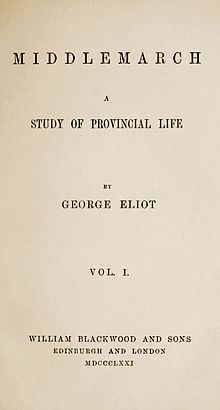
In fact, some recognition of the too-old-for-Genesis earth and the succession of species had been seeping into cultural awareness for some time even before down. Leading intellectuals of the day were understandably shaken by this new view of life, as well as its challenge to their faith.  They included novelists like Thomas Hardy, and George Eliot whose troubled reactions show up in her novel Middlemarch, and poets like Matthew Arnold, and Alfred Tennyson who gave us the phrase “Nature red in tooth and claw.” 

First edition title page of Middlemarch; Wikipedia

Though he is much less well known, the naturalist Alfred Russel Wallace discovered evolution independently, and at the same time as Darwin.  The two became friends, but Wallace struggled to accept that evolution could apply to humans: he felt that things like our mathematical and musical abilities could not have evolved by natural selection.  After all, hunter gatherers didn’t compose piano sonatas or work out integrals.  When in 1869 Wallace wrote that such abilities were evidence for the guiding intervention of God, Darwin famously replied in frustration,
“I hope you have not murdered too completely your own and my child.” 
We now have wholly plausible general explanations for traits evolving in one way and being used in another at some later time.  But it was a very logical question for Wallace to have raised.

Always a modest man, in a letter explaining his theory to the American botanist, Asa Gray, Darwin quipped,
“This sketch is most imperfect . . .[and] . . .your imagination must fill up many wide blanks.  Without some reflection, it will appear all rubbish; perhaps it will appear so after reflection.”
Natural selection is still today widely taken as law-like dogma, but while Darwin’s theory was deeply insightful, some of it is, in a sense, a sort of rubbish, at least because the truth is not so simple!  

The ability of natural selection to generate adaptive variation, and the glacial slowness of the process in what was by then recognized to be a very old earth, together removed the need to explain the diversity of life by sudden events of divine creation.  But that same snail-like pace means that competitive advantages at any given time must themselves usually be very slight. 

That’s important to our point here, because it means that relative success in life is mostly the result of chance, or luck, or happenstance, and not inherent genetic superiority. Harmful traits might be selected against if their bearers do not survive or reproduce. Even clearly genetic traits are typically affected by variation in many different genes, so that the ‘same’ trait will be genetically different in each person to a considerable extent.  Species are adapting simultaneously in many different ways, and so there are usually many ways to be ‘fit’.

As a result, in general, at any given time and place, the main criterion for what is ‘better’ is what happens to be luckier. An oak tree makes hundreds of thousands of acorns during its lifetime, but in a stable environment only one, on average, lives to become a mature oak itself—at least, we cannot say that the genetically very best acorn—whatever that could actually mean!—is that very one in a hundred thousand. 

Acorns; Wikipedia

Even individuals with otherwise slightly more advantageous genes that could otherwise make them, say, better hunters or gatherers, or bankers, violinists, athletes, nurses—or even professors or drug dealers!--may instead be the victims of accident or childhood disease, fail to find a mate, and so on. This quite obvious fact undermines the yen of a strict believer in natural selection for a single, precise law-like natural underpinning of life.  Life is just much more nuanced than that.

There are many religious questions about the implications of evolution.  For example, there were religious skeptics and atheists long before Darwin.  In a rather passive sense, these people simply did not see convincing evidence for the truth of sacred texts or of a personal God.  But evolution is different: it shows in an active sense not stories about where we might have come from, but facts about where we have come from. This insight removes the need for an external Creator who is also the provider of an absolute moral compass, a True North, by which to live, or claim to live, or try to live, our lives. 

Instead, evolution is an impersonal process, with no mission nor set of values.  But this need not be entirely distressing, because the fact of evolution liberates us to explore a moral compass for ourselves. 

It is certainly true that some people find that compass in Darwinian evolution itself, taking relentless natural selection as the True North of existence, at last revealed by science—Nature red in tooth and claw, in your face, whether you like it or not!

That Darwinian dogma has been used as justification for all sorts of real rubbish, including a cornucopia of discrimination, racism, and violence of humans against each other. This rationale—perhaps better called an excuse—is still reflexively and routinely extended to justify competition among societies, organizations, businesses, and even universities (beyond just their football teams)! At the extreme, leading scientists used evolutionary dogma to justify sterilizing the impaired, and providing cover for Hitler’s racist horrors on the grounds of preserving the supposed genetic superiority of the Aryan race. 

Cathedrals of unutterable evil have been constructed by people who, we must acknowledge, have in their own minds, and sometimes in Darwin’s name, as clear a moral compass as have saints.  But so have cathedrals of incredible beauty been constructed on Darwinian grounds.  In fact, if you try hard enough, you can find credible ways within Darwinian theory to account not just for mass murder, strident atheism, or nihilistic existentialism, but also for any of a smorgasbord of more ‘positive’ values, including sustainability, vegetarianism, social kindness, polygamy, even self-sacrifice and celibacy. 

In that sense evolution is a Rorschach test.  It’s most basic truth is successful descent with modification from a common ancestor.  Beyond that, you see in the theory what you bring to it.  If almost any behavior, even direct opposites, can be shown to be consistent with evolutionary theory, as they can, then to that extent the theory of evolution is no more useful for developing a moral compass than a creationist’s just saying “God said so”.

So, then, what about God?  Darwin recognized that evolution neither requires, nor precludes, a God—at least one who, as deists (probably including Darwin) might say, started everything and (given the state of the world) has been on an extended coffee break ever since. 

Evolution makes it possible for us, as beings, to conceive of and believe in a God, or many gods, or a world of spirits, or of none. Whether such beliefs are factual or not, it is perfectly consistent with evolution to believe in a Heaven paved in gold, if it comforts, because we evolved to seek comfort and safety. 

The point is that evolution itself doesn’t dictate the answer.  Despite the impression one might get from the daily news media’s hot new stories about genes for this and genetic cures for that, not everything we do or think, or that happens to us, is determined by our genes. The very notion of right and wrong is culturally constructed, and changes over time and place. As existentialist Jean-Paul Sartre said:
“Nowhere is it written that the Good exists, that we must be honest, that we must not lie.” 
A moral compass is a choice we must make for ourselves. Sometimes we invent our own, sometimes, consciously or not, we adopt one, but it is always based on our individual experiences.  

Of course, the fact that there is no easy answer ‘out there’ can be a challenging burden to accept.  Darwin himself faced this challenge, as do we all; his writings portray a complex man continually revisiting his own moral compass.

Three of his 10 children died young, one severely disabled.  As he wrote of his favorite daughter Annie, the joy of his life, who died painfully at age 10:
“We have lost the joy of the Household, and the solace of our old age:— she must have known how we loved her; oh that she could now know how deeply, how tenderly we do still & shall ever love her dear joyous face. Blessings on her.”
Darwin had been studying theology as a student at Cambridge, preparing to become a vicar, when he was offered the trip aboard the Beagle. As he viewed the natural world, his orthodox belief faded, and Annie’s death is said to have extinguished any remaining faith he may have had in a personal, intervening God.

Annie Dawrin's grave, Malvern, England; photo by A Buchanan

But he didn’t just brush her death off as the normal consequences of evolution, as a good and natural thing because it reflected natural selection.  Instead, Darwin had all the human inconsistencies that any of us do. And he had as much sympathy and empathy as well.  He wrote of the horrors of slavery that he had witnessed in his travels, and became a fierce abolitionist, yet he held a rather hierarchical view of human populations (with the ‘civilized’ ones like imperial Britain on top, naturally).  He was a humanitarian, yet he was comfortable with his status in the wealthy leisured class.

And if unlike his personal life, his theory stressed Nature’s harsh realities, Darwin also knew of the softer wonders of life, even if this appreciation may have come to him later in life: as he wrote wistfully in his autobiography
“… if I had to live my life again, I would have made a rule to read some poetry and listen to some music at least once every week. . .  The loss of these tastes is a loss of happiness, and may possibly be injurious to the intellect, and more probably to the moral character, by enfeebling the emotional part of our nature.”
So Darwin was not a one-dimensional man, and his Origin of Species is not a sacred text, not The Word from on high. Instead, it’s the fact of evolution in itself that provides an external kind of ‘authority’ that forces a recognition that there may be no external personal authority, and that we have to decide individually what to believe about what is right or wrong. 

If evolution’s impersonal nature seems a lonely view of life, evolution has also produced the almost mystical collective wholeness of life: everyone here, and every butterfly, mouse, tree, and blade of grass—yes, even every cockroach!—shares a single 3.5 billion year unbroken chain of successful ancestors.  

This magnificent cosmic unity will not remove the challenge of individual isolation, nor the pain of loss.  But it can lead to a greater appreciation of friends, family, colleagues, and social fellowships.


It is at the very least more than a small comfort to know even if facing the sorrows of life is a challenge, when you are trying to find your own moral compass these softer truths provide the joy of being able to live in ways that have been chosen by you, rather than for you.  This isn't written in evolutionary theory, but it is a direct consequence of knowing the evolutionary facts of life.  

Friday, June 19, 2015

"Mr Darwin's 'Researches' abound in misstatements"

By total serendipity, I recently learned from an ornithologist friend of a fascinating letter in an 1870 issue of the Proceedings of the Zoological Society of London.  It's from a Mr W.H. Hudson, addressed to the secretary of the Society, concerning the ornithology of Buenos Aires, and it is one parry in a wonderful example of scientific disagreement in action.

WH Hudson; Wikipedia

Hudson was a prolific author, naturalist and ornithologist born in Argentina in 1841 to English parents.  He published a lot of his ornithological work in the Proceedings of the Zoological Society, and would have been well-known to readers.  In the letter I happened to stumble across, Hudson writes of four species of woodpecker found in and around Buenos Aires. After describing the first three species, Hudson goes on to the Carpintero, the bird that is really of interest to him, because he believes he can reveal Charles Darwin to be a sloppy scientist or worse, with serious implications for Darwin's theory.  I quote at length because rewording would do it injustice.
The fourth species is the 'Carpintero;' more widely distributed and better known than the other members of the genus to which it belongs, and also of great interest in reference to the erroneous account of its habits in Mr. Darwin’s work, which makes it worthy of particular attention. However close an observer a naturalist may be, it is not possible for him to know much of a species from seeing perhaps one or two individuals in the course of a rapid ride across the pampas. Certainly, if Mr. Darwin had truly known the habits of the bird, he would not have attempted to adduce from it an argument in favour of his theory of the origin of species. In Chap. VI. of his well-known work on this subject the author speaks of the altered habits, caused by change of habitat and other extraneous circumstances, and infers that it would be an easy matter for natural selection to step in and alter an animal’s structure so as to make a new species of it, after its habits have been so altered. He then proceeds to ask whether 'there can be a more striking instance of adaptation given than that of a Woodpecker for climbing trees and for seizing the insects in the chinks of the bark;' and, in reference to this, states that there is a Woodpecker inhabiting the plains of La Plata, ‘where not a tree grows,’ and which is consequently a Woodpecker which never climbs a tree’ (Origin of Species, 4th ed. ch. vi. pp. 2 12, 2 13).
Mr. Hudson continues,
The perusal of the passage quoted by one acquainted with the bird referred to and its habits might induce him to believe that the author had purposely wrested the truth in order to prove his theory; but as Mr. Darwin’s ‘Researches’ were written long before the theory of natural selection was conceived, and abound in similar misstatements when treating of this country, the error must be attributed to other causes. The facts are, that besides orchards, and groves of willow, poplar, etc, which have been planted wherever the plains are settled, there is also the continuous wood, which I have already described, growing on the shores of the La Plata.
Hudson goes on to describe in even more detail the woody habitat in which this woodpecker lives.  And then the coup de grace.
It is not only the erroneous account of this bird’s habits that makes Mr. Darwin’s mention of it peculiarly unfortunate, but also because this bird rather affords an argument against the truth of Mr. Darwin’s hypothesis. Mr. Darwin describes it as a perfect Woodpecker, not only in conformation, but in its colouring, undulatory flight, and shrill obstreperous cries.  It is plain then that natural selection has left it unaltered...
My my.  So, Darwin was wrong in his observations of the Buenos Aires region of Argentina, wrong about this woodpecker, and wrong about the role of natural selection in this bird's evolution.  If Hudson was right, one would have to conclude that Darwin was so driven to prove his theory of evolution by natural selection correct that he filtered all his observations though this light, altering them when they didn't fit his theory. Or, that because his ideas about evolution and natural selection were only beginning to percolate as he roamed the pampas of Argentina, and he hadn't recorded his observations with natural selection in mind, he had to rework them in light of his theory, thus forcing them to fit.  Either of these are perfectly plausible.

Magellenic woodpecker from Southern Argentina and Chile; probably not the species Darwin and Hudson disagreed about, but a South American woodpecker, on the ground, so it will have to do (Hudson doesn't note the species in his letter); Source: "Magellanic Woodpecker Male (Campephilus magellanicus)" by Butterfly austral - Serge Ouachée - Own work. Licensed under CC BY-SA 3.0 via Wikimedia Commons

But there's another interpretation.  Here's the entire paragraph about that woodpecker from which Hudson chose just a few quotes:
Can a more striking instance of adaptation be given than that of a woodpecker for climbing trees and seizing insects in the chinks of the bark?  Yet in North America there are woodpeckers which feed largely on fruit, and other with elongated wings which chase insects on the wing.  On the plains of La Plata, where hardly a tree grows, there is a woodpecker (Colaptes campestris) which has two toes before and two behind, a long-pointed tongue, pointed tail-feathers, sufficiently stiff to support the bird in a vertical position on a post, but not so stiff as in the typical wood-peckers, and a straight strong beak.  The beak, however, is not so straight or so strong as in the typical woodpeckers but it is strong enough to bore into wood.  Hence this Colaptes, in all the essential parts of its structure, is a woodpecker.  Even in such trifling characters as the coloring, the harsh tone of the voice, and undulatory flight, its close blood-relationship to our common woodpecker is plainly declared; yet, as I can assert, not only from my own observations, but from those of the accurate Azara, in certain large districts it does not climb trees, and it makes its nest in holes in banks!  In certain other districts, however, this same woodpecker, as Mr. Hudson states, frequents trees, and bores holes in the trunk for its nest. (Origin of Species) 
This is a bird that mostly looks like a woodpecker, sounds like a woodpecker, but that lives in a variety of habitats, and has a variety of diets, as observed not only by Darwin as naturalist on the Beagle, but also by others.  And, Darwin has evidence of other woodpeckers that don't behave as woodpeckers ought -- they eat fruit and live in river banks!  This is exactly the kind of evidence that he sought to support his theory about adaptation.  What's going on?

Could it be that Mr. Hudson simply doesn't like Mr. Darwin's theory of evolution.  And that's what caused him to pick and choose his own evidence?  He was in fact well-known to Darwin as a good ornithologist, but Darwin also knew that Hudson didn't agree with him.  He stated plainly in his book that "Mr. Hudson is a strong disbeliever in evolution..." (Origin) And, Hudson is known to historians, as well.  He was a strong religious believer and very unhappy with Darwin's theory because it challenged his belief.  He was also unhappy with Darwin himself, because his own faith had been challenged.  According to Novoa and Divine, he was happier with Lamarck's explanations of evolution because they allowed for religious belief.

So, in the end, it seems this is not an honest disagreement between two scientists evaluating the evidence with nothing but curiosity about which interpretation is correct.  This is one scientist unhappy with another's ideas, even willing to go to the brink of accusing him of lying, something Darwin had no respect for, as he wrote in the Zoological Society Proceedings in 1870: "I should be loathe to think that there are many naturalists who, without any evidence, would accuse a fellow worker of telling a deliberate falsehood to prove his theory."  He did slightly expand on his description of the woodpecker in the 6th edition of Origin, saying that "in certain large districts it does not climb trees".  So, he took Hudson's critique to heart enough to clarify his observations, but it is clear that Hudson's critique was wrong, and driven by motives other than science.  

Still, there's a lesson here, and that is that science being a human pursuit, the same motives, blindnesses, conceits, passions and adherence to belief can drive what is in theory supposed to be objective evaluation of observations as they drive politics or religion.  Darwin was surely affected by his own interpretive frame when viewing nature, as we all are.  Even had he made a blinkered mistake, that in itself would not count against his theory. But he was very honorable and an extremely careful observer, and it would have been surprising if Hudson had been right.  But not unthinkable, Darwin being human too.