Showing posts with label accidental progress. Show all posts

Tuesday, July 5, 2011

How evolution's hope evolved away

In the incoming tide (or was it an onslaught?) of science in the 18th and, especially the 19th century a few interesting things converged, with interesting if perhaps saddening impact on western thought.

In the dawning of the age of science, leading thinkers advocated a strongly empirical way to understand the world: through observation, what we now call science.  The widely held belief in this period, known as the Enlightenment, was that empiricism would reveal knowledge of the nature of Nature that would enable humans to engineer a better more perfect society--a Utopia.  This society would rectify physical needs as well social inequities.

At the beginning of this era, Newton's and Galileo's physics had powerfully showed that if based on observation rather than received doctrine or faith, the world followed natural law.  Natural laws unchangingly governed the universe: they dictated how the stars did, do, and would forever go 'cycling on according to the fixed law of gravity'.  That phrase is in Darwin's last paragraph in the Origin of Species (1859), but Darwin had anything but a static world in mind:  instead, he was the century's icon of unremitting, mechanical change.

Darwin's insights reflected, were influenced, enabled, and inspired by the advances in geology showing that, while not static, geological processes were very slow and sometimes cyclical.  As a famous founding article in geology by Hutton (1788) ended: 'no vestige of a beginning, no prospect of an end.'

But Darwin showed that life on earth was changing in a gradual, but very different way: it was evolving, and from a beginning!  Darwin refined and reflected thinking by many others, who were suggesting general ideas about evolution, including about the evolution of life.  Many were relating scientific ideas about laws of change to society itself:  Herbert Spencer, Karl Marx, and others were suggesting that society was as much subject to laws of Nature as the earth and life were.  This thinking about society, (and to some extent Darwin's thinking about life, and that of many of his contemporary evolutionists), included a strong sense of progress.  In ways resembling Enlightenment Utopian thinking, they saw society as evolving from primitive states, to civilization, and on towards some idyllic end:  life had evolved the noble brow of humans, and society would evolve to be more equitable.

These were all about material laws, and one might think they would drive definitive nails into the coffin of changeless, religious thinking, based as it was on received word rather than observed fact.  How on earth (so to speak) could anyone speak of 'Heaven'?  In fact, however, at the time many writers suggested that the progress in earthly evolution was leading to a perfected end-state, often envisioned as being 'with God' and that this march of progress was in fact ordained by God.

Alfred Tennyson
We are stimulated to write this post by yet another installment of our favorite radio program, the wonderful BBC4's In Our Time.  This was a discussion of Alfred Tennyson's poem In Memoriam, AHH.  At Cambridge, the young Tennyson met an exceptionally brilliant student, one Arthur Hallam.  They became extremely close friends.  The program discusses their connections, and one can easily explore this on the web, including, of course, this In Our Time episode.  Hallam valued the young Tennyson's poems and the two were intellectually compatible to an unsurpassable degree.  But then, suddenly, while traveling in Europe and at age 22, and without warning, Hallam died, apparently from an aneurism.

Henry Hallam
Tennyson was totally devastated by this news--indeed he never recovered from the loss.  Seventeen years in the making, In Memoriam was his long, mournful eulogy or elegy to this closest of close friends.  The poem is wonderful to read, and famous as can be (' 'T is better to have loved and lost, than never to have loved at all.'; 'Nature, red in tooth and claw.').  Its moving and palpable pathos, and its metric magnetism, cannot be equaled.  If you have not read it, you really should (but do it patiently, to absorb the incredible, relentless, desperate mourning).

Of British intellectuals, Tennyson was among the most interested in, and aware of, contemporary science.  In Memoriam was published in 1850, some years before Origin.  But evolution in life and geology were in the air, and others had been writing about evolution (in particular a book by Robert Chambers called Vestiges of Creation, 1844), and in the kinds of progressive terms we mentioned above.  The earth and its life were working out God's plan so that its perfecting creature--humans--would eventually be worthy of, and end up with, God.  The progress in society and in the more complex organisms on earth than had been here before, suggested that change was heading to a goal that the evidence made obvious.

This view--or hope--provided the only solace of Tennyson's mourning, and he could look to the science we've just mentioned to support that hope.  The earth was mechanical, cruel, relentlessly dishing out sorrow.  All here was temporary, all would disappear as streams 'Draw down aeonian hills/The dust of continents to be,' and those who once lived 'seal'd within the iron hills.'  As for species 'a thousand types are gone....all shall go.'  into the bowels of history!  If there was no way to really recover from the death of close friends, the relentless earth meant there was no way to escape from it, either.  Tennyson would never again shake Hallam's hand or hear his voice, at least not in this world.  But he consoled himself by writing that Hallam was a creature ahead of his time, 'a noble type, Appearing ere the times were ripe', and his disappearance may have been because he was too good for his time.  But if Hallam had been taken from him for the time being, Tennyson yearned and dreamt, hopefully, for the day they would be reunited in a perfected world.  There will come a 'crowning race....No longer half-akin to brute....to which the whole creation moves.'

The Rapture redux, in the raiment of science
For a while, especially before Darwin, one could do as Tennyson did, and absorb the factual realities of earthly change into the teachings of some aspects of  religion.  But as science progressed, and the implications of biological evolution were realized, it became less and less possible to see either real progress in how life worked, or to find any evidence of a march to a specifiable, much less seeable, end on the evolutionary horizon.  Eventually, the earth would burn up or burn out, and return to the unrelenting cold womb of space, and life would go with it.

How could someone who had absorbed the idea of change--even progressive change--have ever got the idea that there would be a end-point?  Well, if the 2nd law of thermodynamics says the universe is moving towards maximum disorder (called 'entropy'), or randomness of matter and energy, then why can't there be some biological or societal end-point?   The comparable point to entropy might be when there was no social inequality, or when the mind had reached the maximum perfection (that was called 'God').  It's a stretch, because in a sense it implies there's a maximum IQ for God's perfecting creatures to reach (maybe that's God's IQ?).  In any case, define it how you want, one can imagine, or invent, such states.  Still, there was no evidence for them--in life, or in society.

Darwin may have grudgingly agreed that there might be a God who started it all, but the clockwork mechanism of evolution provided no goal or endpoint for life, nor so far as we know did Darwin ever make any such suggestion.  And as science has worked it out over the subsequent 150 years, our understanding of life as the product of evolution has largely closed the coffin lid on such goal-headed views of life.  If one wants to believe in a theistic religion, an Omega state, an after-life, or a benevolent deity, we know that one must seek it in some non-material rationale: the scientific study of the material earth simply doesn't provide any empirical support for such views.  Except perhaps that 'intelligence' will lead to rapid human-induced extinction of our own and all other life....

Religion does, however, calm and solace people from seeing the world in its stark, remorseless reality.  In Memoriam expresses the value of such a view.   Tennyson's grief was so deep that he needed at least that hope to hold onto, even if tentatively and with doubt--'Believing where we cannot prove'.  Even today it is a poem to be read, and as discussed in In Our Time, one that has given solace to many persons weeping in the long, dark night for a lost loved-one:

 Tears of the widower, when he sees
  A late-lost form that sleep reveals, 
  And moves his doubtful arms, and feels
Her place is empty, fall like these.

Perhaps the often-strident and prideful Darwinian atheists should take some pause.  They too, and you, and we, will someday experience Tennyson's grief.  Illusion?  Maybe.  But there is more to life than science.

A warmth within the breast would melt
  The freezing reason's older part,
  And like a man in wrath the heart
Stood up and answer'd "I have felt."

Tennyson's is a view not to be frivolously dishonored, even if the evolution of the science of evolution has unremittingly evolved away from any such notions of progress towards an idyllic endpoint. Or, even, from wishful thinking.

Tuesday, May 31, 2011

Another F-word of Evolution

I already fingered “fittest” and “favored” as f-words of evolution and here’s a third: forwards.

You don’t hear this one as much, but the concept infiltrates and sabotages much of our evolutionary thinking, limiting our understanding of nature, and, worse, leading us down that dangerous path to apathy, hate, and violence.

Here's the trouble with forwards and evolution.

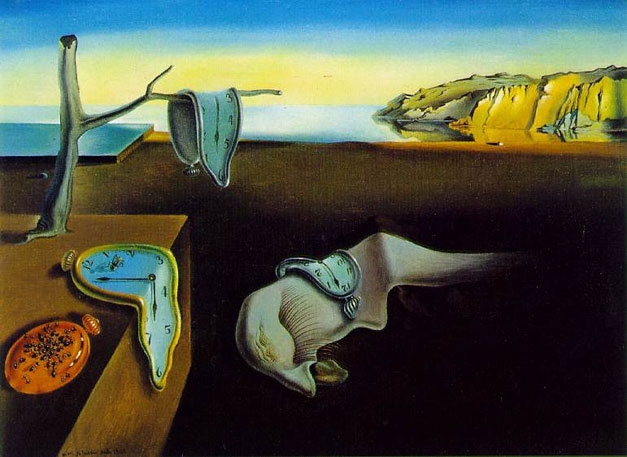
Time goes forwards. It's singular and linear. You might call it an arrow (like Carroll) or persistent (like Dali), but you wouldn’t call it progressing or progressive. That is, a minute now isn’t any better than a minute 30 minutes ago. A minute now isn't an improvement over a minute 30 billion minutes ago.

This is a very simple, value- and progress-free understanding of forwards that isn't transferred onto biological evolution.

Instead, with biology we equate forwards, or the passage of time, with progress but this is a biased view of nature.

Time goes forwards. Complexity requires time. Okay.

Yet, onward-and-upward-ness is our invention. It's a cultural notion, that we can't help but project onto nature. And if you see traits changing through time as each phase being better than the next, as being a part of some cosmic progress, then you’re falling into a dangerous trap.

While you're trapped by forwards-thinking, you might assume that:

(a) prior states of traits were worse than present ones

(b) losing a trait is bad

(c) traits that are not as complex/large/fast/furry/slimy/etc as in prior states are somehow lacking

(d) present traits that resemble earlier versions are somehow lacking, in other words, "primitive" traits are valued less than derived ones.

The last one can rear its ugly head when we naively or carelessly use our completely acceptable evolutionary jargon to describe human variation: Some people are derived at trait X, while others are "primitive."

(Can you call it an f-word if it starts with a p? Because "primitive" might need to get censored from evolution-speak too.)

While you're trapped by forwards-thinking, you might refer to early hominids as “proto-humans” implying they’re an imperfect draft or prototype and that they're not quite perfect or human. If this is true, then we’re proto-Pauls.

Try this. Get in your DeLorean, and set the dashboard to 50 million years ago. Make sure your flux capacitor is engaged and then drive 88 mph down your street and... Voila! You're back in time. Now, are all the animals drooling all over themselves, barely able to eat, walk, or do whatever it is that they do?

Of course not. They’re getting along just fine.

Evidence? Look around you in the year 2011. Nothing would be hunky dory now if nothing was hunky dory in the past.

Yet, 50 million years ago is full of half-baked, inadequate organisms like “proto-whales” and “proto-lemurs” and “proto-bears.” That’s because we have few ways to describe them in such a way that links them to their present-day relatives. They're ancestors or relatives to present day species and we can make those links thanks to some traits they share in their anatomy. But they're not prototypes of anything. They're not anticipating anything. They're not becoming anything. They're just anything--like you and me today are anything.

While you're trapped by forwards-thinking, you might even use the non-term “devolution” to describe the loss of a trait, or the decay of a trait or the decline of a trait. But that’s just evolution. Forwards/backwards, new versions/reversions, gains/losses... All that's just regular old evolution with our biased, value-laden vocabulary (and our aversion to reversion) draped over it. Thinking there's a backwards in nature is just backwards thinking.

We all fall into the forwards-thinking trap. We all have trouble escaping our linear, progressive, goal-oriented thinking. It’s difficult to step out of our present perspective and our culture while we absorb the evidence for evolution. Of course, it's hard... We're complex!

But there are lots of organisms that we wouldn't call complex that are just fine at doing their simple things. Furthermore, there are lots of traits within complex organisms that haven’t changed over millions of years because they’re fine just the way they are. DNA is just one example. Not only have there been myriad additions to organismal complexity during the span of Life on Earth, there have also been myriad losses of functioning
traits as well.

That certainly doesn’t sound like nature is progressing towards a goal or even just towards ever-increasing complexity for complexity’s sake.

Just because we consciously create increasingly complex technology ... just because we marvel at complex systems... just because we appreciate and even strive for complexity…just because we celebrate forwards-thinking... and just because we teach and reinforce goal-oriented behavior... that doesn’t have any bearing on what matters in nature.

Nature cannot strive for, marvel at, celebrate or appreciate, remember?

In nature, there's no forwards or backwards. Nature just is. What works works. What doesn’t doesn’t.

Some of it’s beautiful and some of it’s brutal, but nature has no idea.

Beautiful and brutal and forwards-thinking are ours.

Thanks to nature.

Thursday, January 14, 2010

Accidents do happen, but....

Touching on what seems to have turned into our theme of the week, John Hawks links to a story in the Telegraph yesterday reporting that a third of academics would leave Britain if threatened cuts to 'curiosity-driven' grants go through. This comes on top of deep cuts in funding for higher education in Britain across the board. According to the story, future research will be funded based on its perceived social and economic benefits; close to 20,000 people have signed a petition protesting this change.
...critics claim the move risks wiping out accidental discoveries as university departments struggle to support professors working on the kind of ground-breaking experimentation that led to the discovery of DNA, X-rays and penicillin.
But hold on.  'Curiosity-driven' research is different from accidental discoveries.

Ken, Malia Fullerton and I wrote a paper not long ago saying that epidemiology isn't working, and, basically, suggesting that people recognize this and come up with some better ideas. We had in mind specifically epidemiology's turn to genetics to explain chronic diseases, including diseases like type II diabetes and asthma, for which, even if people do carry some genetic susceptibility, the more important risk factors are clearly environmental, as shown by the fact that incidence of these diseases has risen sharply in recent decades.

We called the paper "Dissecting complex disease: the quest for the Philosopher's Stone?" (Not the Philosopher's Stone of Harry Potter fame, our reference was to the alchemist's dream of a substance that could turn base metals into gold.) The paper was published as one of the point/counterpoint papers in the International Journal of Epidemiology.

This was an interesting exercise. The paper wasn't reviewed in the usual sense, with us able to correct and revise before publication. The paper was published just as we submitted it, followed by commentaries by prominent epidemiologists. We knew people could find holes in our argument, and we waited for months for the comments, imagining how devastating they were going to be, and how we'd respond. But, when we finally got the commentaries, we were amazed. We could have done a much better job of blasting our paper than any of the comments we got. This was somewhat reassuring in that no one said we were wrong, but disappointing because we had very much wanted to start a dialog on the issues.

How is this relevant to the 'curiosity-driven research' story? Well, one of the major defenses of the status quo in the commentaries about our paper, of spending hundreds of millions of taxpayer dollars on research that everyone knows isn't working, was that we can't cut the funding to epidemiology because everyone knows that good stuff is often found by accident. This strikes us as a very strange justification for maintaining the hugely expensive system of researchers spending inordinate amounts of time and energy to write grants proposing research everyone recognizes isn't going to lead to much, never mind improve public health, and tie up equally inordinate amounts of time, energy and money on the part of reviewers who are also expected not to say that the emperor has no clothes (or the Philosopher has no Stone). In the hope that somebody will stumble across something unexpected one day that really will be progress.

This is not the same as 'curiosity-driven research'. Why is the sky blue? is an honest question and whether or not taxpayers should fund the research needed to answer it can be debated on its merits. If the UK has decided to no longer fund basic science, but only research that will lead to patents, or whatever 'social merits' are, that's very different from the idea that we should maintain a system that isn't working on the off chance that something good will come of it.  That decision can be debated, but at least it's an honest debate.