Showing posts with label evolutionary stasis. Show all posts

Monday, March 7, 2011

Everything's just the same, unless it isn't

Holly's latest poem, and her typically thoughtful comments about it, raise many fundamental problems in evolutionary biology.

She pointed out that while none of us is descended from today's monkeys, humans and monkeys alike are descended from some common ancestor.  She noted that we typically refer to that ancestor as a 'monkey', and drawings of how it probably looked, look like, well, like monkeys!  So how is it that we've changed but they haven't?

The usual image of Darwinian evolution is of continual change driven by relentless competition, often likened to the Red Queen in Through the Looking Glass, who had to run as fast as she could to stay in the same place.  But if that is so, and the environment (which includes competing species) is always changing, then how can a species not always be changing?

Fly in amber; Wikimedia Commons
There are countless instances of fossils so remarkably similar to today's descendants that one couldn't tell the difference.  A squid, complete with ink and looking as tasty as today's calamari; flies in amber caught cleaning their legs the way flies do today.  Beetles and barnacles, ferns, and fish all that look just like what we can see on a walk or dip, but tens or hundreds of millions of years old.  This is nothing compared to the appearance of the some of the very earliest fossils that are known, call 'stromatolites' that look exactly like bacterial microfilms today, but are 3.8 billion years old!

This is stasis on a grand scale and it's compatibility with adaptive change that is also clearly occurring  is what Gould and Eldridge were addressing with their idea of 'punctuated equilibrium'.  Their idea was that very stable environments lead to stable ecosystems that can last a long time but that at some point and in some local area too small to be found in the fossil record, local conditions favor major adaptive change and the lucky descendants are competitively advanced enough to expand into the larger area from which we then find them in the fossil record.
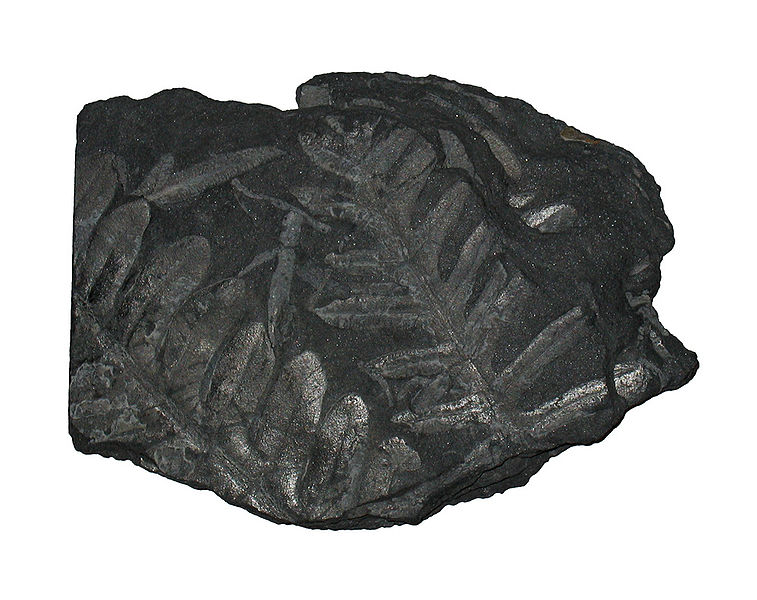
(Fossilized fern, 350 million yrs old; public domain)
Take beetles, horseshoe crabs, or bacteria, in which this stasis has been seen, and compare the DNA sequences of the present-day species and what we  find is that their sequences have diverged by an amount roughly corresponding to their ancestry in the fossil record.  That is, genome-wide, they have diverged as you'd expect--even if their morphology and behavior seem to have stayed unchanged.

I was at a meeting in Brazil and discussing this with the population ecologist Doug Futuyma.  We posted on this subject last April.  Doug's idea, which he has expressed in papers, is roughly that chromosomal incompatibility prevents too much mixing among contemporary species, maintaining them as isolates even if they live in the same area. 

One explanation is that the visible traits are controlled by functional parts of the genome, that might be highly conserved over time, but comprise a minority of the overall genome sequence, so that the rest of the genome is free to accumulate functionless variation in a clock-like way.

We certainly know that the more functional parts of genomes are much slower to change, and sometimes go a long time without changing, than the less functional parts.  Presumably the same is true of traits, too.

But this is at least a bit strange, because there are in all cases, after all, lots of diverged, clearly different descendant species alive today.  Many kinds of beetles, crabs, and flies.  How did they escape from the prison of stasis?  One possibility is an observer bias: of all the countless ways to vary from a common starting point, given the chance aspects of genomic change, a species here and there might--just by chance--not experience much change, while other species under the same circumstances did change.  Afterward, our attention is drawn to the static exception, which we misperceive as having stayed put for some important functional reason.  That would be a perception bias on our part, and say nothing about Nature.

Doug dismissed that idea, saying that ecologists making these observations wouldn't make such a mistake.  His idea of hybrid sterility could explain how a number of species could stay isolated, even though living in the same place, but why wouldn't there be evolution within each?

Maybe Darwin's ideas about the steady if very gradual nature of evolution were wrong, even adaptive evolution.  Maybe it is less steady and more herky-jerky than he thought.  Maybe the environment isn't changing very fast (say, the composition of a given ocean region), and through Darwinian selection it maintains traits rather constantly, but in a somewhat different way than is usually thought.

We usually think of a gene for this and a gene for that. But if the traits we're seeing conserved are affected by many genes, and all selection does is trim off the extreme (too green of a shell, or too pale), then the central tendency of the trait, how most individuals look, can stay the same, while the underlying genes are, in fact, changing.  This is known as phenogenetic drift.

So, it is possible that our and our monkey friends' common ancestor was monkey-like in terms of its fossilized skeleton, while its genome, on average, diverged appropriately.  In some lineages, such as that which led to apes and then to us, something changed in some local population, that led to an initial species divergence.  This set up a group of animals today whose common ancestor with monkeys was a 'monkey', but whose common ancestor with each other was an 'ape'--one that may have looked like today's apes.  Each resemblance group maintains several descendant members, but there are split-off groups that diverge but themselves maintain similarities.

In any event, Holly raised the right questions, regardless of how she feels about her ancestors!

Friday, August 21, 2009

Permanent ink

Calamari lovers, take a look at an interesting evolutionary story at the BBC web site of a fossil squid. This little gem is an estimated 150 million years old, yet seems in great detail to be similar to today's appetizers (we like them sauteed with chili peppers, olive oil, s&p, on a bed of fresh lettuce).

This particular fossil was found when a rock from a dig in Wiltshire, England, was cracked open. The ink sac still contained ink, and archeaologists were able to draw a picture of the specimen with it (drawing shown here, from the BBC web site). Many more such fossils were also found, including other squid species; researchers suggest that the squid were drawn to the area to feed, but were poisoned by algae when they arrived, and conditions were right for their preservation.

This find is one of many, long known in paleontology, that show remarkably conserved traits--again, down to the finest detail, for many different kinds of plant and animal (and bacterial) species. Indeed, stromatolites are multi-billion year-old beds of what appear to be bacterial films that look remarkably modern.

Such finds raise the obvious, but again not new, question of stasis in evolution. How can evolution, so typically portrayed as a relentless race to get ever better, be responsible for not changing at all? A common metaphor is known as the Red Queen hypothesis, from Through the Looking Glass: the Red Queen says to Alice, as she breathlessly pulls her by the hand, that they must always run as fast as they can to stay in the same place.

If you look at squid phylogeny (a fine web site for such data is maintained by Sudhir Kumar and Blair Hedges), you'll see that long-conserved creatures like flies, horseshoe crabs, many kinds of plants and much else--including squid--have DNA sequence relationships that make sense. The branches between current species roughly correspond to their ages of separation estimated from fossils and other kinds of taxonomic studies. They accumulate molecular differences in the usual way (though of course the details vary considerably and can be argued about).

But how does selection, if that's the cause, maintain such stasis? This question has been asked and answered implicitly or explicitly in various ways. Large populations essentially swallow up new variants like the sea. Selection removes the bad ones, but the good ones arise amidst such a huge population that they can basically not 'take over' the sequence for their respective locus.

Stephen J Gould made much of 'punctuated equilibrium', initially writing as if this was a dramatic new theory: change eventually occurs in a small subpopulation in some local area not documented by the fossil record. The advance then spreads throughout the species and then gives the illusion, in the fossil record, of having appeared suddenly. Sewall Wright actually developed formal theory for this as a basic means of evolution, in contrast to Fisher's ideas, way back in the 1930's. Wright envisioned major adaptive changes as being mainly possible in small isolated subpopulations, where new or helpful ('fit') variation would not just be swamped and absorbed by the species at large.

A key fact may be that, today there are many species of squid, and their traits vary both within and between species. So squid as a group clearly have evolved! But let's go back 150 million years and imagine the future course of events. If environments, like the general nature of the ocean bed, stay the same in many ways, there will be change from generation to generation, but the conservative nature of selection will usually eliminate or work against squids too different from their fellows or their habitat. Small, chance changes in DNA sequence and/or function will always occur, however, and local as well as global populations will accumulate variation. New or modified squid species will arise (and that had already happened by 150 my ago as we noted above).

In such circumstances, by chance or the gentle molding of selection, some descendants will stay pretty much the same, while others will either die out or differentiate into new species with different morphology or adaptations. So when we find a fossil and search among today's many kinds of squid, it's no surprise that we find some that didn't change.

This is a kind of problem in conditional probability, related to the degree of surprise we should feel about a given observation, or the multiple-testing phenomenon in statistics. If conditioned on searching through an open-ended array of possibilities, the 'significance' is much less (e.g., p value much greater) than if you just looked at a single instance.

We might be surprised if we held to a strictly Red Queen view that evolution always forces creatures to innovate or die. And, of course, some major or minor lineages don't stay as static, again what one would expect (dinosaurs didn't, but birds arose from among them). Otherwise, it is less clear how selection could preserve identity so precisely. These are problems associated with the kind of retrospective illusion due to the compression of the deep past that we write a lot about in our book. We think the Red Queen is misleading Alice!

Whatever the explanation, one lesson is to be careful how we interpret what is written in stone (or with permanent ink). And fried calamari are great, too!