Many in the social sciences try to formulate all sorts of 'laws' of society, culture, and the like. For decades, social sciences (including much of anthropology) have tried to make generalizations, implicitly or otherwise, of this sort. My old graduate school professor, Leslie White, a terrifically thoughtful and interesting scholar, tried mightily to liken culture and its change ('evolution') to a force for the use and dispersion of energy--in a way, to make it a branch of chemistry or physics. Sure, humans are made of chemicals and must follow laws of physics, energy, and so on. But I think it didn't catch on or get us anywhere, certainly not as more than a vague generalization, after the fact. But White, as did other anthropologists, characterized a hierarchy, a kind of inevitable parade, of world cultures--from hunter-gatherers, to early agriculturalists, on to nation-states.
The burden, or scourge, of science envy?
Sociologists, psychologists, anthropologists and others have tried their damnedest to 'legalize' their field, to make it respectably precise, quantitative, and law-like. That is, having the kind of bedrock basis, a set of universal dynamic premises, as are found in physics or chemistry--or even biology.
Ever since I was a graduate student in anthropology (but coming from a math and science background), I have thought that this was a kind of pretense, a bad case of physics-envy. In the decades since then, I have seen this take various forms and technophilifications. Simple descriptions and informal attempts at generalization about world cultures, as in the above sort of hierarchy, have seemed to me forced.
There are those who, under various terms like post-modernism, argue against this sort of thing, often noting that what is written is, or perhaps necessarily is to be understood in the eye and careerism of the writer. Their idea has been something akin to suggesting that we should accept the difference and not try to force things, indeed, instead to read social 'science' (or, for some, any science) as a social structure, to 'deconstruct' the explanations and behavior of scientists to show what they are really up to, vis-à-vis what they say they are doing. They are not like physics and chemistry, and should learn to live with that fact!
Well, a riposte by social science can include assertions that people are, after all, physical beings and that their cultures are their ways of living in the physical as well as social world, the latter of course also being 'physical' and therefore there must be some regularities, limits, or 'laws' of social life.
So are there, or must there be, rules, constraints, causes, or regularities, ineluctable truths that are formal enough to be called 'laws' when it comes to behaviors, societies, and cultures? Maybe it is just not as mature as the classical 'hard' sciences. How can we know the answer--what kind of evidence could we bring to bear? Or should social science professors' careers and activities be judged in different terms?
If social-science fields don't have legitimate analogs to the laws of the physical sciences, then what are the causes of the societal regularities that we observe, from language to courtesies and so on, that clearly lubricate human life if not, indeed, being fundamental to it? Can they have no 'cause'? Can the 'causes' be unique to each circumstance--and if so, is that in itself a 'law', and if so, how does the law work or get enforced?
These are not new questions. For the past two or more centuries (or, maybe, going back at least to Plato and Aristotle et al.) these sorts of questions have been asked. Surely life, of individuals and above all of societies, in humans and other species, has orderly patterns! Do these not reflect 'causes' of some sort? If so, are they in some way 'universal' in their nature even if locally ad hoc in their results?
Can there be a real 'science' of society? This has nothing to do with whether there should be departments with such names in universities! Human society is, after all, built on layers of pretense. But if no such science is possible, how is it that societies, chaotic in many ways, do have regularities! These include social and family relations, property rules, boundaries, governments, status and wealth stratification, wars, borders and on and on. Every society has at least some form of these attributes.
If social sciences are not really 'sciences' in the sense of physics and chemistry, which are based on rather simple universals, then what are they based on?
The questions are not new. They were written about by the ancients. But I think that, other than various kinds of bureaucratic aspects of academic life, the questions are still largely unanswered. Perhaps they are not yet well-posed questions--perhaps social and cultural causation needs some other kind of approach than imitation of physics. But if that.....what?

Showing posts with label laws of nature. Show all posts
Showing posts with label laws of nature. Show all posts
Tuesday, December 17, 2019

Wednesday, August 21, 2019
Locality: life's Newtonian equivalent of 'universality'
In, 1687, in his groundbreaking Principia, Isaac Newton made a fundamental assertion--a fundamental assumption--about reality. It is that whatever you observe in some location, such as your lab, will apply everywhere else in the cosmos. He was talking about the nature of the physical universe, following similar views of Galileo, who quipped that the laws of nature were written in the language of mathematics.
If the universe was God's creation, its vastness would be of a kind, similar everywhere. That notion is what stands behind the idea of universal 'laws' of Nature. The 'laws' were not passed by an Angelic Congress, but are simply God's way of organizing physical existence--all of it!
These laws, discovered by classical physics, are deterministic and universal, not probabilistic, not haphazard. I don't recall anything about what Newton thought of probabilities other than a debate with Pepys about gambling, but that was not central to his cosmic worldview, which was essentially deterministic--which is what you might expect from an all-knowing God.
But subsequent science has revealed at least two key additions. First, some of Nature seems inherently probabilistic. Here we are not restricted to measurement issues, because probabilities seem inherent in quantum-level phenomena. Secondly, probabilism means that conditions are at least to some extent contingent on what did happen, relative to what might have happened. This means that predictions can only be probabilistic at some scale; whether that means the cosmos' states and future are unknowable or not is not for someone like me to opine about! Whether the probability values are, somehow, fixed, and if so how that is, are interesting and, I think, important questions.
Life is part of the universe, but its fundamental laws are of locality, not universality
Life is a chemical and hence physical phenomenon. But life in the deeper sense is about how these molecules are organized, and this seems fundamentally different from the kind of molecular evolution seen in stars. Each star seems, from what one reads, to be similar at the chemical or atomic/subatomic level.
But life evolves by local conditions. Mutations arise locally and are filtered by selection and chance locally. Successful mutations and genotypes spread by migration from their source, but are then always subject to genetic and environmental conditions in their new localities.
Locality also is the central fact or organismal organ and system diversity. In this case, it is local conditions determining gene activation and expression.
But, in a sense prisoners of 19th century physics success, the long shadow of Newton and Galileo, we seem to hunger for laws of life that apply, as the slogan goes, to 'All of us' and that leads to genomic medicine that we are told can be known with some kind of presumably universal 'precision'. These are, to me, irresponsible misrepresentations made by Francis Collins and NIH, perhaps as their strategy to pry mega-bucks from Congress--because they are naive relative to the biology they promise to understand.
But if we overlook the truth and live in slogans, does this undermine the very science we want to nurture? The assumption of universality, to me, is fundamentally misleading about how life works and how our genotypes got here. Whether or how we can use this understanding to develop appropriate medications and so on, is a separate set of very important questions, about which I'm not capable of making judgments....
Thursday, November 8, 2018
The horseshoe crab and the barnacle: induction vs deduction in evolution
Charles Darwin had incredible patience. After his many-year, global voyage on the HMS Beagle, he nestled in at Down House, where he was somehow able to stay calm and study mere barnacles to an endless extent (and to write 4--four--books on these little creatures). Who else would have had the obsessive patience (or independent wealth and time on one's hands) to do such a thing?
Darwin's meticulous work and its context in his life and thinking are very well described in Rebecca Stott's compelling 2003 book, Darwin and the Barnacle, which I highly recommend, as well as the discussion of these topics in Desmond and Moore's 1991 Darwin biography, The Life of a Tormented Evolutionist. These are easier, for seeing the points I will describe here, than plowing through Darwin's detailed own tomes (which, I openly confess, I have only browsed). His years of meticulous barnacle study raised many questions in Darwin's mind, about how species acquire their variation, and his pondering this eventually led to his recognition of 'evolution' as the answer, which he published only years later, in 1859, in his Origin of Species.
Darwin was, if anything, a careful and cautious person, and not much given to self-promotion. His works are laden with appropriate caveats including, one might surmise, careful defenses lest he be found to have made interpretive or theoretical mistakes. Yet he dared make generalizations of the broadest kind. It was his genius to see, in the overwhelming variation in nature, the material for understanding how natural processes, rather than creation events, led to the formation of new species. This was implicitly true of his struggle to understand the wide variation within and among species of barnacles, variation that enabled evolution, as he later came to see. Yet the same variation provided a subtle trap: it allowed escape from accusations of undocumented theorizing, but was so generic that in a sense it made his version of a theory of evolution almost unfalsifiable in principle.
But, in a subtle way, Mr Darwin, like all geniuses, was also a product of his time. I think he took an implicitly Newtonian, deterministic view of natural selection. As he said, selection could detect the 'smallest grain in the balance' [scale] of differences among organisms, that is, could evaluate and screen the tiniest amount of variation. He had, I think, only a rudimentary sense of probability; while he often used the word 'chance' in the Origin, it was in a very casual sense, and I think that he did not really think of chance or luck (what we call genetic drift) as important in evolution. This I would assert is widely persistent, if largely implicit, today.
One important aspect of barnacles to which Darwin paid extensive attention was their sexual diversity. In particular, many species were hermaphroditic. Indeed, in some species he found small, rudimentary males literally embedded for life within the body of the female. Other species were more sexually dichotomous. These patterns caught Darwin's attention. In particular, he viewed this transect in evolutionary time (our present day) as more than just a catalog of today, but also as a cross-section of tomorrow. He clearly thought that what we saw today among barnacle species represented the path that other species had taken towards becoming the fully sexually dichotomous (independent males and females) in some species today: the intermediates were on their way to these subsequent stages.
This is a deterministic view of selection and evolution: "an hermaphrodite species must pass into a bisexual species by insensibly small stages" from single organisms having both male and female sex organs to the dichotomous state of separate males and females (Desmond and Moore: 356-7).
But what does 'must pass' mean here? Yes, Darwin could array his specimens to show these various types of sexual dimorphism, but what would justify thinking of them as progressive 'stages'? What latent assumption is being made? It is to think of the different lifestyles as stages along a path leading to some final inevitable endpoint.
If this doesn't raise all sorts of questions in your mind, why not? Why, for example, are there any intermediate barnacle species here today? Over the eons of evolutionary time why haven't all of them long ago reached their final, presumably ideal and stable state? What justifies the idea that the species with 'intermediate' sexuality in Darwin's collections are not just doing fine, on their way to no other particular end? Is something wrong with their reproduction? If so, how did they get here in the first place? Why are there so many barnacle species today with their various reproductive strategies (states)?
Darwin's view was implicitly of the deterministic nature of selection--heading towards a goal which today's species show in their various progressive stages. His implicit view can be related to another, current controversy about evolution.
Rewinding the tape
There has for many recent decades been an argument about the degree of directedness or, one might say, predictability in evolution. If evolution is the selection among randomly generated mutational variants for those whose survival and reproduction are locally, at a given time favored, then wouldn't each such favored path be unique, none really replicable or predictable?
Not so, some biologists have argued! Their view is essentially that environments are what they are, and will systematically--and thus predictably--favor certain kinds of adaptation. There is, one might quip, only one way to make a cake in a particular environment. Different mutations may arise, but only those that lead to cake-making will persist. Thus, if we could 'rewind the tape' of evolution and go back to way back when, and start again, we would end up with the same sorts of adaptations that we see with the single play of the tape of life that we actually have. There would, so to speak, always be horseshoe crabs, even if we started over. Yes, yes, some details might differ, but nothing important (depending, of course, on how carefully you look--see my 'Plus ça ne change pas', Evol. Anthropol, 2013, a point others have made, too).
Others argue that evolution is so rooted in local chance and contingency, that there would be no way to predict the details of what would evolve, could we start over at some point. Yes, there would be creatures in each local niche, and there would be similarities to the extent that what we would see today would have to have been built from what genetic options were there yesterday, but there the similarity would end.
Induction, deduction, and the subtle implications of the notion of 'intermediate' forms
Stott's book, Darwin and the Barnacle, discusses Darwin's work in terms of the presumed intermediate barnacle stages he found. But the very use of such terms carries subtle implications. It conflates induction with deduction, it assumes what is past will be repeated. It makes of evolution what Darwin also made of it: a deterministic, force-like phenomenon. Indeed, it's not so different from a form of creationism.
This has deeper implications. Among them are repeatability of environments and genomes, at least to the extent that their combination in local areas--life, after all, operates strictly on local areas--will be repeated elsewhere and else-times. Only by assuming not only the repeatability of environments but also of genomic variation, can one see in current states of barnacle species today stages in a predictable evolutionary parade. The inductive argument is the observation of what happened in the past, and the deductive argument is that what we see is intermediate, on its way to becoming what some present-day more 'advanced' stage is like.
This kind of view, which is implicitly and (as with Darwin) sometimes explicitly invoked, is that we can use the past to predict the future. And yet we routinely teach that evolution is by its essential nature locally ad hoc and contingent, based on random mutations and genetic drift--and not driven by any outside God or other built-in specific creative force.
And 'force' seems to be an apt word here.
The idea that a trait found in fossils, that was intermediate between some more primitive state and something seen today, implies that a similar trait today could be an 'intermediate stage' today for a knowable tomorrow, conflates inductive observation with deductive prediction. It may indeed do so, but we have no way to prove it and usually scant reason to believe it. Instead, equating induction with deduction tacitly assumes, usually without any rigorous justification, that life is a deductive phenomenon like gravity or chemical reactions.
The problem is serious: the routine equating of induction with deduction gives a false idea about how life works, even in the short-term. Does a given genotype, say, predict a particular disease in someone who carries it, because we find that genotype associated with affected patients today? This may indeed be so, especially if a true causal reason is known; but it cannot be assumed to be. We know this from well-observed recent history: Secular trends in environmental factors with disease consequences have indeed been documented, meaning that the same genotype is not always associated with the same risk. There is no guarantee of a future repetition, not even in principle.
Darwin's worldview
Darwin was, in my view, a Newtonian in his view. That was the prevailing science ethos in his time. He accepted 'laws' of Nature and their infinitesimally precise action. That Nature was law-like was a prevailing, and one may say fashionable view at the time. It was also applied to social evolution, for example, as in Marx's and Engels' view of the political inevitability of socialism. That barnacles can evolve various kinds of sexual identities and arrangements doesn't mean any of what Darwin observed in them was on the way to full hermaphrodism or even later to fully distinct sexes...or, indeed, to any particular state of sexuality. But if you have a view like his, seeing the intermediate stages even contemporaneously, would reinforce the inevitabilistic aspect of a Newtonian perspective, and seemingly justify using induction to make deductions.
Even giants like Darwin are products of their times, as all we peons are. We gain comfort from equating deduction with induction, that the past we can observe allows us to predict the future. That makes it comfortingly safe to make assertions, the feeling that we understand the complex environment in which we must wend our way through life. But in science, at least, we should know the emptiness of the equation of the past with the future. Too bad we can't seem to see further.
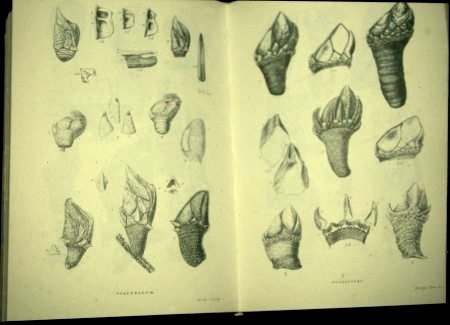 |
| From Darwin's books on barnacles (web image capture) |
Darwin was, if anything, a careful and cautious person, and not much given to self-promotion. His works are laden with appropriate caveats including, one might surmise, careful defenses lest he be found to have made interpretive or theoretical mistakes. Yet he dared make generalizations of the broadest kind. It was his genius to see, in the overwhelming variation in nature, the material for understanding how natural processes, rather than creation events, led to the formation of new species. This was implicitly true of his struggle to understand the wide variation within and among species of barnacles, variation that enabled evolution, as he later came to see. Yet the same variation provided a subtle trap: it allowed escape from accusations of undocumented theorizing, but was so generic that in a sense it made his version of a theory of evolution almost unfalsifiable in principle.
But, in a subtle way, Mr Darwin, like all geniuses, was also a product of his time. I think he took an implicitly Newtonian, deterministic view of natural selection. As he said, selection could detect the 'smallest grain in the balance' [scale] of differences among organisms, that is, could evaluate and screen the tiniest amount of variation. He had, I think, only a rudimentary sense of probability; while he often used the word 'chance' in the Origin, it was in a very casual sense, and I think that he did not really think of chance or luck (what we call genetic drift) as important in evolution. This I would assert is widely persistent, if largely implicit, today.
One important aspect of barnacles to which Darwin paid extensive attention was their sexual diversity. In particular, many species were hermaphroditic. Indeed, in some species he found small, rudimentary males literally embedded for life within the body of the female. Other species were more sexually dichotomous. These patterns caught Darwin's attention. In particular, he viewed this transect in evolutionary time (our present day) as more than just a catalog of today, but also as a cross-section of tomorrow. He clearly thought that what we saw today among barnacle species represented the path that other species had taken towards becoming the fully sexually dichotomous (independent males and females) in some species today: the intermediates were on their way to these subsequent stages.
This is a deterministic view of selection and evolution: "an hermaphrodite species must pass into a bisexual species by insensibly small stages" from single organisms having both male and female sex organs to the dichotomous state of separate males and females (Desmond and Moore: 356-7).
But what does 'must pass' mean here? Yes, Darwin could array his specimens to show these various types of sexual dimorphism, but what would justify thinking of them as progressive 'stages'? What latent assumption is being made? It is to think of the different lifestyles as stages along a path leading to some final inevitable endpoint.
If this doesn't raise all sorts of questions in your mind, why not? Why, for example, are there any intermediate barnacle species here today? Over the eons of evolutionary time why haven't all of them long ago reached their final, presumably ideal and stable state? What justifies the idea that the species with 'intermediate' sexuality in Darwin's collections are not just doing fine, on their way to no other particular end? Is something wrong with their reproduction? If so, how did they get here in the first place? Why are there so many barnacle species today with their various reproductive strategies (states)?
Darwin's view was implicitly of the deterministic nature of selection--heading towards a goal which today's species show in their various progressive stages. His implicit view can be related to another, current controversy about evolution.
Rewinding the tape
There has for many recent decades been an argument about the degree of directedness or, one might say, predictability in evolution. If evolution is the selection among randomly generated mutational variants for those whose survival and reproduction are locally, at a given time favored, then wouldn't each such favored path be unique, none really replicable or predictable?
Not so, some biologists have argued! Their view is essentially that environments are what they are, and will systematically--and thus predictably--favor certain kinds of adaptation. There is, one might quip, only one way to make a cake in a particular environment. Different mutations may arise, but only those that lead to cake-making will persist. Thus, if we could 'rewind the tape' of evolution and go back to way back when, and start again, we would end up with the same sorts of adaptations that we see with the single play of the tape of life that we actually have. There would, so to speak, always be horseshoe crabs, even if we started over. Yes, yes, some details might differ, but nothing important (depending, of course, on how carefully you look--see my 'Plus ça ne change pas', Evol. Anthropol, 2013, a point others have made, too).
Others argue that evolution is so rooted in local chance and contingency, that there would be no way to predict the details of what would evolve, could we start over at some point. Yes, there would be creatures in each local niche, and there would be similarities to the extent that what we would see today would have to have been built from what genetic options were there yesterday, but there the similarity would end.
Induction, deduction, and the subtle implications of the notion of 'intermediate' forms
Stott's book, Darwin and the Barnacle, discusses Darwin's work in terms of the presumed intermediate barnacle stages he found. But the very use of such terms carries subtle implications. It conflates induction with deduction, it assumes what is past will be repeated. It makes of evolution what Darwin also made of it: a deterministic, force-like phenomenon. Indeed, it's not so different from a form of creationism.
This has deeper implications. Among them are repeatability of environments and genomes, at least to the extent that their combination in local areas--life, after all, operates strictly on local areas--will be repeated elsewhere and else-times. Only by assuming not only the repeatability of environments but also of genomic variation, can one see in current states of barnacle species today stages in a predictable evolutionary parade. The inductive argument is the observation of what happened in the past, and the deductive argument is that what we see is intermediate, on its way to becoming what some present-day more 'advanced' stage is like.
This kind of view, which is implicitly and (as with Darwin) sometimes explicitly invoked, is that we can use the past to predict the future. And yet we routinely teach that evolution is by its essential nature locally ad hoc and contingent, based on random mutations and genetic drift--and not driven by any outside God or other built-in specific creative force.
And 'force' seems to be an apt word here.
The idea that a trait found in fossils, that was intermediate between some more primitive state and something seen today, implies that a similar trait today could be an 'intermediate stage' today for a knowable tomorrow, conflates inductive observation with deductive prediction. It may indeed do so, but we have no way to prove it and usually scant reason to believe it. Instead, equating induction with deduction tacitly assumes, usually without any rigorous justification, that life is a deductive phenomenon like gravity or chemical reactions.
The problem is serious: the routine equating of induction with deduction gives a false idea about how life works, even in the short-term. Does a given genotype, say, predict a particular disease in someone who carries it, because we find that genotype associated with affected patients today? This may indeed be so, especially if a true causal reason is known; but it cannot be assumed to be. We know this from well-observed recent history: Secular trends in environmental factors with disease consequences have indeed been documented, meaning that the same genotype is not always associated with the same risk. There is no guarantee of a future repetition, not even in principle.
Darwin's worldview
Darwin was, in my view, a Newtonian in his view. That was the prevailing science ethos in his time. He accepted 'laws' of Nature and their infinitesimally precise action. That Nature was law-like was a prevailing, and one may say fashionable view at the time. It was also applied to social evolution, for example, as in Marx's and Engels' view of the political inevitability of socialism. That barnacles can evolve various kinds of sexual identities and arrangements doesn't mean any of what Darwin observed in them was on the way to full hermaphrodism or even later to fully distinct sexes...or, indeed, to any particular state of sexuality. But if you have a view like his, seeing the intermediate stages even contemporaneously, would reinforce the inevitabilistic aspect of a Newtonian perspective, and seemingly justify using induction to make deductions.
Even giants like Darwin are products of their times, as all we peons are. We gain comfort from equating deduction with induction, that the past we can observe allows us to predict the future. That makes it comfortingly safe to make assertions, the feeling that we understand the complex environment in which we must wend our way through life. But in science, at least, we should know the emptiness of the equation of the past with the future. Too bad we can't seem to see further.
Thursday, May 28, 2015
Discovering the "laws of life": where are we?
For several years, I've been in an off-and-on discussion about topics relevant to MT readers, with a thoughtful undergraduate student, named Arjun Plakett. He has now graduated, but we're still in at least occasional contact. He is a chemical engineering graduate, but is interested in the wider issues of science.
I mention this because Arjun recently brought to my attention an old, but thought-provoking and, I think, relevant book. It is by the late Milton Rothman, and called Discovering the Natural Laws (1972, reprinted by Dover, 1989). This book is a very interesting one, and I wish I had known of it long ago. It concerns the history by which some of the basic 'laws' of physics were shown to be just that: laws. And, while its specific topic is physics, it is very relevant to what is going on in genetics at present.
Rothman deals with many presumed laws of Nature, including Newton's laws of motion, conservation, relativity, and electromagnetisim. For example, we all know that Newton's universal law of gravitation is that the gravitational attraction between two objects, of mass M and N, a distance r apart, is
F = G MN/r^2
(the denominator is r-squared). G is the universal gravitational constant. But how do we know this? And how do we know it is a 'universal law'? For example, as Rothman discusses, why do we say the effect is due to the exact square (power 2) of the distance between the objects? Why not, for example, the 2.00005 power? And what makes G a, much less the, constant? Why constant? Why does the same relationship apply regardless of the masses of the objects, or what they're made of? And what makes it universal--how could we possibly test that?
The fact that these laws are laws, as Rothman details for this and other laws of physics, was not easy to prove. For example, what two objects would be used to show the gravitational law, where measurement errors and so on would not confound the result? The Earth and Moon won't do, despite Newton's use of them, because they are affected by the pull of the Sun and other planets etc. Those effects may be relatively small, but they do confound attempts to prove that the law is in fact a true, exact law.
A key to this demonstration of truth is that as various factors are accounted for, and measurement becomes more accurate, and different approaches triangulate, the law data become asymptotically close to the predictions of the theory: predictions based on theory get ever closer to what is observed.
In fact, and very satisfyingly, to a great approximation these various principles do appear to be universal (in our universe, at least) and without exception. Only when we get to the level of resolution of individual fundamental particles, and quantum effects, do these principles break down or seem to vary. But even then the data approach a specifiable kind of result, and the belief is that this is a problem of our incomplete understanding, not a sign of the fickleness of Nature!
Actually if a value, like G or the power 2 were not universal but instead were context-specific, but replicable in any given context, we could probably show that, and characterize those situations in which a given value of the parameter held, or we could define with increasing accuracy some functional relationship between the parameter's value and its circumstances.
But Mermaid's Tale is about evolution and genetics, so what is the relevance of these issues? Of course, we're made of molecules and have to follow the principles--yes, the laws--of physics. But at the scale of genes or organisms or evolution or disease prediction, what is its relevance? The answer is epistemological, that is, about the nature of knowledge.
Theory and inference genetics and evolution: where are the 'laws'? Are there laws?
When you have a formal, analytic or even statistical theory, you start with that, a priori one might say, and apply it to data either to test the theory itself, or to estimate some parameter (such as F in some setting such as a planet's orbital motion). As I think it can be put, you use or test an externally derived theory.
Rothman quotes Karl Popper's view that "observation is always observation in the light of theories" which we test by experiments in what Rothman calls a 'guess and test' method, otherwise known as 'the scientific method'. This is a hypothesis-driven science world-view. It's what we were all taught in school. Both the method and its inferential application depend on the assumption of law-like replicability.
Popper is most known for his idea that replication of observations never prove an hypothesis because the next observation might falsify it, but it only takes one negative observation to do that. There may be some unusual circumstance that is valid but you hadn't yet encountered. In general, but perhaps particularly in biomedical sciences, it is faddish and often self-serving to cite 'falsifiability' as our noble criterion, as if one has a deep knowledge of epistemology. Rothman, like almost everyone, quotes Popper favorably. But in fact, his idea doesn't work. Not even in physics! Why?
Any hypothesis can be 'falsified' if the experiment encounters design or measurement error or bad luck (in the case of statistical decision-making and sampling). You don't necessarily know that's what happened, only that you didn't get your expected answer. But what about falsifiability in biology and genetics? We'll see below that even by our own best theory it's a very poor criterion in ways fundamentally beyond issues of lab mistakes or bad sampling luck.
We have only the most general theories of the physics-like sort for phenomena in biology. Natural selection and genetic drift, genes' protein-coding mechanisms, and so on are in a sense easy and straightforward examples. But our over-arching theory, that of evolution, says that situations are always different. Evolution is about descent with modification, to use Darwin's phrase, and this generates individuals as non-replicates of each other. If you, very properly, include chance in the form of genetic drift, we don't really have a formal theory to test against data. That's because chance involves sampling, measurement, and the very processes themselves. Instead, in the absence of a precisely predictive formal theory, we use internal comparisons--cases vs controls, traits in individuals with, and without, a given genotype, and so on. What falsifiability criterion should you apply and, more importantly, what justifies your claim of that criterion?
Statistical comparison may be an understandable way to do business under current circumstances that do have not provided a precise enough theory, but it means that our judgments are highly dependent on subjective inferential criteria like p-value significance cutoffs (we've blogged about this in the past). They may suggest that 'something is going on' rather than 'nothing is going on', but even then only by the chosen cutoff standard. Unlike the basic laws of physics, they do not generate asymptotically closer and closer fits to formally constructed expectations.
What is causal 'risk'?
We may be interested in estimating 'the' effect of a particular genetic variant on some trait. We collect samples of carriers of one or two copies of the variant, and determine the risk in them, perhaps comparing this to the risk in samples of individuals. But this is not 'the' risk of the variant! It is, at best, an estimate of the fraction of outcomes in our particular data. By contrast, a probability in the prediction sense is the result of a causal process with specific properties, not an empirical observation. We usually don't have the evidence to assert that our observed fraction is an estimate of that underlying causal process.
Collecting larger samples will not in the appropriate sense lead asymptotically to a specific risk value. That's because we know enough about genes to know that an effect is dependent on the individual's genomic background and life-experience. Each individual has his/her own, unique 'risk'. In fact, the term 'risk' itself, applied to an individual, is rather meaningless because it is simply inappropriate to use such individual concepts in this context, when the value is based on a group sample. Or, put another way, the ideas about variance in estimates and so on just don't apply, because individuals are not replicable observations. The variance of group estimates are different from what we might want to know about individuals.
These are the realities of the data, not a fault with the investigators. If anything, it is a great triumph that we owe to Darwin whatever his overstatement of selection as a 'law' of nature, that we know these realities! But it means, if we pay attention to what a century of fine life science has clearly shown, that fundamental context-dependence deprives us of the sort of replicability found in the physical sciences. That undermines many of the unstated assumptions in our statistical methods (the existence of actual probability values, proper distributions from which we're sampling, replicability, etc.).
This provides a generic explanation for why we have the kinds of results we have, and why the methods being used have the problems they have. In a sense, our methods, including statistical inference, are borrowed from the physical sciences, and may be inappropriate for many of the questions we're asking in evolution and contemporary genetics, because our science has shown that life doesn't obey the same 'laws' at the levels of our observation.
Darwin and Mendel had Newton envy, perhaps, but gave us our own field--if we pay attention
Rothman's book provides, to me, a clear way to see these issues. It may give us physics envy, a common and widespread phenomenon in biology. I think Darwin and Mendel were both influenced indirectly by Newton and the ideas of rigorous 'laws' of nature. But they didn't heed what Newton himself said in his Principia in 1687: "Those qualities of bodies that . . . belong to all bodies on which experiments can be made should be taken as qualities of all bodies universally." (Book 3, Rule 3, from the Cohen and Whitman translation, 1999) That is, for laws of nature, if you understand behavior of what you can study, those same laws must apply universally, even to things you cannot or have not yet studied.
This is a cogent statement of the concept of laws, which for Newton was "the foundation of all natural philosophy." It is what we mean by 'laws' in this context, and why better designed studies asymptotically approach the theoretical predictions. But this principle is one that biomedical and evolutionary scientists and their students should have tattooed on so they don't forget. The reason is that this principle of physics is not what we find in biology, and we should be forced to keep in mind and take seriously the differences in the sciences, and the problems we face in biology. We do not have the same sort of replicability or universality in life unless non-replicability is our universal law.
If we cannot use this knowledge to ferret out comparable laws of biology, then what was the purpose of 150 years of post-Darwinian science? It was to gain understanding, not to increase denial. At least we should recognize the situation we face, which includes stop making misleading or false promises about our predictive, retrodictive, or curative powers, that essentially assume as laws what our own work has clearly proven are not laws.
I mention this because Arjun recently brought to my attention an old, but thought-provoking and, I think, relevant book. It is by the late Milton Rothman, and called Discovering the Natural Laws (1972, reprinted by Dover, 1989). This book is a very interesting one, and I wish I had known of it long ago. It concerns the history by which some of the basic 'laws' of physics were shown to be just that: laws. And, while its specific topic is physics, it is very relevant to what is going on in genetics at present.
 |
| Source: my copy's cover |
Rothman deals with many presumed laws of Nature, including Newton's laws of motion, conservation, relativity, and electromagnetisim. For example, we all know that Newton's universal law of gravitation is that the gravitational attraction between two objects, of mass M and N, a distance r apart, is
F = G MN/r^2
(the denominator is r-squared). G is the universal gravitational constant. But how do we know this? And how do we know it is a 'universal law'? For example, as Rothman discusses, why do we say the effect is due to the exact square (power 2) of the distance between the objects? Why not, for example, the 2.00005 power? And what makes G a, much less the, constant? Why constant? Why does the same relationship apply regardless of the masses of the objects, or what they're made of? And what makes it universal--how could we possibly test that?
The fact that these laws are laws, as Rothman details for this and other laws of physics, was not easy to prove. For example, what two objects would be used to show the gravitational law, where measurement errors and so on would not confound the result? The Earth and Moon won't do, despite Newton's use of them, because they are affected by the pull of the Sun and other planets etc. Those effects may be relatively small, but they do confound attempts to prove that the law is in fact a true, exact law.
A key to this demonstration of truth is that as various factors are accounted for, and measurement becomes more accurate, and different approaches triangulate, the law data become asymptotically close to the predictions of the theory: predictions based on theory get ever closer to what is observed.
In fact, and very satisfyingly, to a great approximation these various principles do appear to be universal (in our universe, at least) and without exception. Only when we get to the level of resolution of individual fundamental particles, and quantum effects, do these principles break down or seem to vary. But even then the data approach a specifiable kind of result, and the belief is that this is a problem of our incomplete understanding, not a sign of the fickleness of Nature!
Actually if a value, like G or the power 2 were not universal but instead were context-specific, but replicable in any given context, we could probably show that, and characterize those situations in which a given value of the parameter held, or we could define with increasing accuracy some functional relationship between the parameter's value and its circumstances.
But Mermaid's Tale is about evolution and genetics, so what is the relevance of these issues? Of course, we're made of molecules and have to follow the principles--yes, the laws--of physics. But at the scale of genes or organisms or evolution or disease prediction, what is its relevance? The answer is epistemological, that is, about the nature of knowledge.
Theory and inference genetics and evolution: where are the 'laws'? Are there laws?
When you have a formal, analytic or even statistical theory, you start with that, a priori one might say, and apply it to data either to test the theory itself, or to estimate some parameter (such as F in some setting such as a planet's orbital motion). As I think it can be put, you use or test an externally derived theory.
Rothman quotes Karl Popper's view that "observation is always observation in the light of theories" which we test by experiments in what Rothman calls a 'guess and test' method, otherwise known as 'the scientific method'. This is a hypothesis-driven science world-view. It's what we were all taught in school. Both the method and its inferential application depend on the assumption of law-like replicability.
Popper is most known for his idea that replication of observations never prove an hypothesis because the next observation might falsify it, but it only takes one negative observation to do that. There may be some unusual circumstance that is valid but you hadn't yet encountered. In general, but perhaps particularly in biomedical sciences, it is faddish and often self-serving to cite 'falsifiability' as our noble criterion, as if one has a deep knowledge of epistemology. Rothman, like almost everyone, quotes Popper favorably. But in fact, his idea doesn't work. Not even in physics! Why?
Any hypothesis can be 'falsified' if the experiment encounters design or measurement error or bad luck (in the case of statistical decision-making and sampling). You don't necessarily know that's what happened, only that you didn't get your expected answer. But what about falsifiability in biology and genetics? We'll see below that even by our own best theory it's a very poor criterion in ways fundamentally beyond issues of lab mistakes or bad sampling luck.
We have only the most general theories of the physics-like sort for phenomena in biology. Natural selection and genetic drift, genes' protein-coding mechanisms, and so on are in a sense easy and straightforward examples. But our over-arching theory, that of evolution, says that situations are always different. Evolution is about descent with modification, to use Darwin's phrase, and this generates individuals as non-replicates of each other. If you, very properly, include chance in the form of genetic drift, we don't really have a formal theory to test against data. That's because chance involves sampling, measurement, and the very processes themselves. Instead, in the absence of a precisely predictive formal theory, we use internal comparisons--cases vs controls, traits in individuals with, and without, a given genotype, and so on. What falsifiability criterion should you apply and, more importantly, what justifies your claim of that criterion?
Statistical comparison may be an understandable way to do business under current circumstances that do have not provided a precise enough theory, but it means that our judgments are highly dependent on subjective inferential criteria like p-value significance cutoffs (we've blogged about this in the past). They may suggest that 'something is going on' rather than 'nothing is going on', but even then only by the chosen cutoff standard. Unlike the basic laws of physics, they do not generate asymptotically closer and closer fits to formally constructed expectations.
What is causal 'risk'?
We may be interested in estimating 'the' effect of a particular genetic variant on some trait. We collect samples of carriers of one or two copies of the variant, and determine the risk in them, perhaps comparing this to the risk in samples of individuals. But this is not 'the' risk of the variant! It is, at best, an estimate of the fraction of outcomes in our particular data. By contrast, a probability in the prediction sense is the result of a causal process with specific properties, not an empirical observation. We usually don't have the evidence to assert that our observed fraction is an estimate of that underlying causal process.
Collecting larger samples will not in the appropriate sense lead asymptotically to a specific risk value. That's because we know enough about genes to know that an effect is dependent on the individual's genomic background and life-experience. Each individual has his/her own, unique 'risk'. In fact, the term 'risk' itself, applied to an individual, is rather meaningless because it is simply inappropriate to use such individual concepts in this context, when the value is based on a group sample. Or, put another way, the ideas about variance in estimates and so on just don't apply, because individuals are not replicable observations. The variance of group estimates are different from what we might want to know about individuals.
These are the realities of the data, not a fault with the investigators. If anything, it is a great triumph that we owe to Darwin whatever his overstatement of selection as a 'law' of nature, that we know these realities! But it means, if we pay attention to what a century of fine life science has clearly shown, that fundamental context-dependence deprives us of the sort of replicability found in the physical sciences. That undermines many of the unstated assumptions in our statistical methods (the existence of actual probability values, proper distributions from which we're sampling, replicability, etc.).
This provides a generic explanation for why we have the kinds of results we have, and why the methods being used have the problems they have. In a sense, our methods, including statistical inference, are borrowed from the physical sciences, and may be inappropriate for many of the questions we're asking in evolution and contemporary genetics, because our science has shown that life doesn't obey the same 'laws' at the levels of our observation.
Darwin and Mendel had Newton envy, perhaps, but gave us our own field--if we pay attention
Rothman's book provides, to me, a clear way to see these issues. It may give us physics envy, a common and widespread phenomenon in biology. I think Darwin and Mendel were both influenced indirectly by Newton and the ideas of rigorous 'laws' of nature. But they didn't heed what Newton himself said in his Principia in 1687: "Those qualities of bodies that . . . belong to all bodies on which experiments can be made should be taken as qualities of all bodies universally." (Book 3, Rule 3, from the Cohen and Whitman translation, 1999) That is, for laws of nature, if you understand behavior of what you can study, those same laws must apply universally, even to things you cannot or have not yet studied.
This is a cogent statement of the concept of laws, which for Newton was "the foundation of all natural philosophy." It is what we mean by 'laws' in this context, and why better designed studies asymptotically approach the theoretical predictions. But this principle is one that biomedical and evolutionary scientists and their students should have tattooed on so they don't forget. The reason is that this principle of physics is not what we find in biology, and we should be forced to keep in mind and take seriously the differences in the sciences, and the problems we face in biology. We do not have the same sort of replicability or universality in life unless non-replicability is our universal law.
If we cannot use this knowledge to ferret out comparable laws of biology, then what was the purpose of 150 years of post-Darwinian science? It was to gain understanding, not to increase denial. At least we should recognize the situation we face, which includes stop making misleading or false promises about our predictive, retrodictive, or curative powers, that essentially assume as laws what our own work has clearly proven are not laws.
Thursday, August 7, 2014
Water, water everywhere, and then some drops to drink: Comet 67P/Churyumov-Gerasimenko, and the Life-Dust rationale
This week comes the news that a European spacecraft probe called Rosetta has gotten into an interesting triangular orbit around a comet named 67P/Churyumov-Gerasimenko, that itself is in orbit around our sun. This is quite a technical and engineering feat that's interesting in its own right, because getting there required about 10 years, over 6 billions of miles of travel, orbiting around the sun to use solar and planetary gravity to give it a sling so it didn't have to use its on-board power. And there are still technical challenges yet to come.
Rosetta will orbit 67P and take all sorts of pictures and measurements, and then, remarkably, will send down a landing craft to probe even deeper. It will find out how much ice is on the comet and what other material it may contain, presumably including carbon. That's been a primary part of the news releases. But why carbon, and what's so important about carbon as opposed to some other sorts of compounds? Herein lies the hype and at least an apparent major rationale for doing this since, after all, we know from various sources what comets are basically made of. As put today by the BBC's report, "The mission aims to add to knowledge of comets and their role in ferrying the building blocks of life around the early Solar System."
This sounds interesting and like a nice justification for a many-billion Euro adventure. Astrophysicists will learn at least some new things about the structure and composition of this particular rock. But will 67P tell us much about anything other than itself, that we don't know already directly and indirectly about the trillions of other comets in the cosmos? I say this because the idea that we'll be discovering the origin of Earth-life's materials seems a rationale as flimsy as, say, a clump of damp dust.
I know very little cosmology, but one thing I think I do know, if current science is at all correct, is that the "building blocks of life" did indeed come from comets and other space-dusty rocks and detritus. What we have long known is that water, carbon, and all the other complex molecules of life (and, for that matter, of rocks, seas, weather and the Earth entire) came from 'outer space'. Where else could they have come from?
These molecules are formed in processes called nucleosynthesis, that occur inside stars. The cosmos had none of it at the time of the Big Bang. Only when stars form, exist for a while, then explode in death, does this material get scattered into space. Then, due to gravity and possibly other factors such as molecular adherence these molecules, essentially space dust, coalesce into larger and larger clumps, rocks that become captured in orbit around new-forming or existing stars. All that you're made of was in turn made in some former, no-longer-existing star, long before our Sun came into existence.
The Earth, and everything on it that life is made of, got here by collapsing and accretion from space-blown material. The stuff of 67P is just like what we already think we know was the source of similar molecules on earth. Whether they got here during the original accretion, or by space-fall thereafter, it's the same kind of process. We know the Earth is hit from time to time by such space missiles. The bottom line is that everything that's here got here from space. The only somewhat relevant, but in that sense not so very important question is how much carbon and water came after the Earth existed as a big rock, and how much was part of Earth's formation.
We know with reasonable certainty that life didn't arise until there was enough water and carbon etc. here for biomolecules to form. We know roughly when that was (3-4 billion years ago, in a 4.5 billion-year old Earth). If these vital molecules were here at Earth's beginning, than life arose only when things had cooled down enough, and perhaps water had eroded enough minerals and carbon and so on from solid rock, etc. If the cosmic rain was responsible for some or even most of the water here (which seems very unlikely, given how prominent water is all over the universe), that tells us little that's different.
Pro-science or a science spoil-sport?
So is such a mission worth its cost when there are things to do with public funds other than to develop sky toys for scientists to play with? We are in favor of science--good science, properly represented. But science should tell less puffed-up stories, and the public should be better-informed.
In this case, better-informed would be to be told that (unless cosmological theory is missing something important today, which is not what the press releases suggest) all Rosetta is doing is poking around in one sample of the stuff we were made by, that all came from space, as did the Earth itself. If even knowing that, we still want to spend the funds on what are really little more than costly real-life video games, great!
For those of us without a major disease and who have shelter, security, and enough to eat, this is interesting stuff to watch, not more costly than cable TV subscriptions (maybe less, depending on your channel line-up). But to hype this as is being done, gives the impression that Earth got here by some other means than gravitational accretion of former star detritus. That's misleading, bad science. Why is such need felt by the scientists (or the institution's PR office) to give it such spin? Is it that they realize that without the spin they'd have no funding? If so, then the public is being bilked. If not, then let's have real science from these experts.
Here's something much more interesting
To be fair, some of what we get from our space cadets really is interesting for more than a "Wow, how did you manage that?" factor. Yesterday also, NASA (perhaps not wanting to be upstaged by the Europeans?) released this image of a near-perfect hexagonal pattern, referred to as a 'storm', on Saturn's north pole region:
The NYTimes has a wonderful video narrated by Dennis Overbye showing this formation along with other features of Saturn. It's a curious formation, a fluid aspect of the north pole's weather.
As a former meteorologist myself, I find this very interesting. Spacecraft first found this many years ago, but we only get an occasional direct look. The curious aspect of the pattern, is that it's a hexagon rather than more sinuous wave such as we get here in Earth's weather (and seas, for that matter). How can fluid dynamics generate such a rigid-appearing, angular form on a basically spherical surface? Is something on Saturn alien to our own planet? Different physics?
In fact, the report says that physicists have now generated similar patterns in the lab, identifying the conditions that are responsible and showing that nothing strangely unearthly is going on in our sister planet. Still, seeing these far-off things close-up for the first time has lead to learning, and is captivating--even if, as in 67P, it doesn't show us anything alien to our experience here at home.
These images from far away evoke an emotional awe: there truly is, way out there and so far beyond, more of what we see right here. It exists, all alone and cold and dark, perhaps known to other creatures, yet the same as what we have here. Little ice crystals, rock dust, shapes we recognize that we might find in our own back yard.
These thoughts reinforce the amazing, remarkable fact that there really do seem to be laws of Nature, that what we can see nearby applies way out there where we can hardly catch glimpses--a point Isaac Newton stressed. Very much to think about. Good science really does tell us about the nature of the world, in ways no other means has yet been able to do. We puny humans, blobs of stuff that evolved from space-stuff, have figured this out! That's a thought of cosmic proportions.
 |
| From the European Space Agency Rosetta project |
Rosetta will orbit 67P and take all sorts of pictures and measurements, and then, remarkably, will send down a landing craft to probe even deeper. It will find out how much ice is on the comet and what other material it may contain, presumably including carbon. That's been a primary part of the news releases. But why carbon, and what's so important about carbon as opposed to some other sorts of compounds? Herein lies the hype and at least an apparent major rationale for doing this since, after all, we know from various sources what comets are basically made of. As put today by the BBC's report, "The mission aims to add to knowledge of comets and their role in ferrying the building blocks of life around the early Solar System."
This sounds interesting and like a nice justification for a many-billion Euro adventure. Astrophysicists will learn at least some new things about the structure and composition of this particular rock. But will 67P tell us much about anything other than itself, that we don't know already directly and indirectly about the trillions of other comets in the cosmos? I say this because the idea that we'll be discovering the origin of Earth-life's materials seems a rationale as flimsy as, say, a clump of damp dust.
I know very little cosmology, but one thing I think I do know, if current science is at all correct, is that the "building blocks of life" did indeed come from comets and other space-dusty rocks and detritus. What we have long known is that water, carbon, and all the other complex molecules of life (and, for that matter, of rocks, seas, weather and the Earth entire) came from 'outer space'. Where else could they have come from?
These molecules are formed in processes called nucleosynthesis, that occur inside stars. The cosmos had none of it at the time of the Big Bang. Only when stars form, exist for a while, then explode in death, does this material get scattered into space. Then, due to gravity and possibly other factors such as molecular adherence these molecules, essentially space dust, coalesce into larger and larger clumps, rocks that become captured in orbit around new-forming or existing stars. All that you're made of was in turn made in some former, no-longer-existing star, long before our Sun came into existence.
The Earth, and everything on it that life is made of, got here by collapsing and accretion from space-blown material. The stuff of 67P is just like what we already think we know was the source of similar molecules on earth. Whether they got here during the original accretion, or by space-fall thereafter, it's the same kind of process. We know the Earth is hit from time to time by such space missiles. The bottom line is that everything that's here got here from space. The only somewhat relevant, but in that sense not so very important question is how much carbon and water came after the Earth existed as a big rock, and how much was part of Earth's formation.
We know with reasonable certainty that life didn't arise until there was enough water and carbon etc. here for biomolecules to form. We know roughly when that was (3-4 billion years ago, in a 4.5 billion-year old Earth). If these vital molecules were here at Earth's beginning, than life arose only when things had cooled down enough, and perhaps water had eroded enough minerals and carbon and so on from solid rock, etc. If the cosmic rain was responsible for some or even most of the water here (which seems very unlikely, given how prominent water is all over the universe), that tells us little that's different.
Pro-science or a science spoil-sport?
So is such a mission worth its cost when there are things to do with public funds other than to develop sky toys for scientists to play with? We are in favor of science--good science, properly represented. But science should tell less puffed-up stories, and the public should be better-informed.
In this case, better-informed would be to be told that (unless cosmological theory is missing something important today, which is not what the press releases suggest) all Rosetta is doing is poking around in one sample of the stuff we were made by, that all came from space, as did the Earth itself. If even knowing that, we still want to spend the funds on what are really little more than costly real-life video games, great!
For those of us without a major disease and who have shelter, security, and enough to eat, this is interesting stuff to watch, not more costly than cable TV subscriptions (maybe less, depending on your channel line-up). But to hype this as is being done, gives the impression that Earth got here by some other means than gravitational accretion of former star detritus. That's misleading, bad science. Why is such need felt by the scientists (or the institution's PR office) to give it such spin? Is it that they realize that without the spin they'd have no funding? If so, then the public is being bilked. If not, then let's have real science from these experts.
Here's something much more interesting
To be fair, some of what we get from our space cadets really is interesting for more than a "Wow, how did you manage that?" factor. Yesterday also, NASA (perhaps not wanting to be upstaged by the Europeans?) released this image of a near-perfect hexagonal pattern, referred to as a 'storm', on Saturn's north pole region:
 |
| Photographed from the top of Saturn. From NASA |
As a former meteorologist myself, I find this very interesting. Spacecraft first found this many years ago, but we only get an occasional direct look. The curious aspect of the pattern, is that it's a hexagon rather than more sinuous wave such as we get here in Earth's weather (and seas, for that matter). How can fluid dynamics generate such a rigid-appearing, angular form on a basically spherical surface? Is something on Saturn alien to our own planet? Different physics?
In fact, the report says that physicists have now generated similar patterns in the lab, identifying the conditions that are responsible and showing that nothing strangely unearthly is going on in our sister planet. Still, seeing these far-off things close-up for the first time has lead to learning, and is captivating--even if, as in 67P, it doesn't show us anything alien to our experience here at home.
These images from far away evoke an emotional awe: there truly is, way out there and so far beyond, more of what we see right here. It exists, all alone and cold and dark, perhaps known to other creatures, yet the same as what we have here. Little ice crystals, rock dust, shapes we recognize that we might find in our own back yard.
These thoughts reinforce the amazing, remarkable fact that there really do seem to be laws of Nature, that what we can see nearby applies way out there where we can hardly catch glimpses--a point Isaac Newton stressed. Very much to think about. Good science really does tell us about the nature of the world, in ways no other means has yet been able to do. We puny humans, blobs of stuff that evolved from space-stuff, have figured this out! That's a thought of cosmic proportions.
Monday, March 12, 2012
An apt description of how life works: slop! Part III
Is life sloppy or not? Our last two posts discussed reasons to think it is, that it's orderly in many ways, but not so precise as to be characterized by laws like those of physical sciences. Yet, if we're just molecules interacting, how can life not be just as law-like? And isn't its law, or at least one of its laws, that evolution works by making every trait tightly adapted to its circumstances, just as Darwin argued and as many if not most life scientists (including those with scant real evolutionary training who plow the seas of biomedical genetics) routinely say it is?
Many years ago, I was doing some epidemiological research in Panama. During a break in data collection, I took a stroll along a path that wound up into the rain-forested hills out of the small town where we were working. I was watching parrots flying across the searing tropical sun overhead, and the lush tropical vegetation, which I'd never seen before, when I stopped to look at a butterfly sitting on a nearby leaf. Admiring its black eye and curvy antenna, I moved to get a closer look, which made the butterfly dart off....backwards!
Well, it didn't really fly backwards, and in fact it was I who was thinking backwards. I'd been tricked by a 'false' eye spot on its hind wing, thinking that was the head end. It was a remarkable example of the effect of protective coloration, and I felt like the predatory bird that such eye spots had evolved to trick, so that the butterfly could live to mate another time. At the time, I did not question the explanation, so impressed was I by my gullibility. Evolution in action!
Then, a few years ago, I had a somewhat kindred experience. Walking a long a path on the south rim of the Grand Canyon, I noticed a butterfly that landed on the sandy path. Its coloration was remarkably like that of the stones and sand. I could hardly see it, til it then flew off. Again, I mused, this is just what the textbooks say about one of the most clear-cut examples of adaptation.
But I've thought about these experiences since, and wondered how accurately they reflect the dogma of evolution as it is so often held, explicitly or implicitly. For example, while I did see the effectiveness of protective coloration in these two instances, I also did, after all, see the butterflies. I wasn't completely fooled. For the moment let's assume that the standard argument for protective adaptation is correct, even though it's based on our human abilities to recognize patterns, not those of the actual predators the butterflies have to deal with.
In the first case, had I been a predator, I'd have missed that butterfly. But I'd not have been tricked a second time! Likewise, while I marveled at the mottled butterfly largely hidden on the sunlit sandy path, I did after all, see it. Had I been hungry, I'd have had my meal.
Sill, one can see the potential that protective coloration gives the prey so that at least sometimes it will escape being eaten and live to reproduce. Even if it's not perfect protection, if it raises fitness just a tad, over the long haul it could represent a force-like, systematic genetic advantage that would work as Darwin said and as any biologist with physics-envy could want.
But then I wondered why most species in my surrounds did not have protective coloration. If it's so force-like and obvious, why are most birds and beasts easily seen? Why hasn't protective coloration worked so perfectly, as in a sense a Darwinian point of view would hold, that the ecosystem breaks down because predators can't find anything to eat? Or, put another way, why is each species' adaptations, whatever they be, different? Why isn't an ecosystem just one huge mottled pattern of camouflage?
Well, the Darwinian fundamentalist argument would say that each species has its own adaptations or it wouldn't be here. That is not much different from saying "God made it that way", except that an adaptationist (that is, one who assumes that every trait must be the result of systematic natural selection) says that there is a physical reason for the traits that relates to its having out-competed other variants in its past. Our job in science is just to find out what the reason was.
So some species, the story goes, fly irregularly in a way that distracts the pursuing bat or bird, or makes it hard to catch. Some have protective coloration. Some only come out at night. Some herd together so predators have a hard time finding which one to pursue and end up missing all of them, except maybe the elderly who are past reproduction anyway (and don't cost the prey species any fitness). Some species taste bad so birds avoid them while others taste good but mimic their bitter contemporaries. Some run fast or fly or climb to escape predators, while others freeze and appear dead to avoid detection. And so on.
Or, because species move around and environments change, some non-camouflaged butterflies might do well to become so, but are recent immigrants from a zone where they didn't need camouflage or perhaps had it in that environment. Of course, they'll now have to undergo adaptation in their new environment if they're to survive and persist there.
Why are there so many kinds of sparrows, or grasshoppers, or grass just in my back yard? The idea that each has its own specific 'niche' sounds good, but is often hard to accept, even just on the face of it.
Now, within each of these stories would be sub-stories of how the individual aspects of the traits mentioned evolved, piece-meal, over long time periods. Think how many changes it makes to make a bird out of a non-flying reptile. Or just to mold and color a butterfly's wing to give it the right sort of eyespot and antenna-like tail shape. And similar ad hoc, or perhaps better described as post hoc, stories need to be told about how the predator hones its detection and pursuit skills so it doesn't just starve into extinction first.
The gist of the point here is that each story is so different that it becomes in a way self-fulfilling in terms of overall adaptation arguments. One can, literally, always concoct some adaptationistic story about every trait in every species in every environment. That is the sense in which evolution is either essentially tautological or so ad hoc as not to reflect the kind of law-like rigor we see in physics.
The strange fact is that at some level these stories seem to be true!
Even if each story is in essential ways completely true--and many of them seem so plausible that one needn't doubt their truth--living nature is much more pixillated and less unitary in its evolution: each story is of the here and now, the factors and forces changing over time and place. Each story is different and indeed is changing all the time. That is an essence of an evolutionary principle. It is, in a sense, the common basis of evolutionary theory. It isn't controversial at all. But it is very far from the kinds of forces we see in physics and chemistry, or the precision of mathematics.
The problem is that most of these stories cannot directly be confirmed. Among other reasons, whether you're eaten, or catch prey, is highly probabilistic--has a high level, even a fundamental, component of chance. Since the difference at any given time between most genetic variants related to some aspect of the evolutionary race are usually very slight, having their purported effect over thousands of generations, the difference at the gene level can be essentially undocumentable: we could not, perhaps even in principle, detect the differences with samples that we could actually obtain.
For the same reason, the outcomes themselves are also unpredictable even in principle. This is so even if one assumes, as many biologists explicitly or implicitly do, that nothing in our makeup or genomes is without function, and natural selection detects all functional variation (a key point in Darwin's own thinking). But that is an assumption and it makes adaptation explanations often unfalsifiable and to a great extent just stories empty of scientific content.
In fact, referring back to our series on whether probability exists, it is impossible in such a probabilistic world to show that something in life has exactly zero effect, or indeed to show that small effects are different from zero. That means that much of our supposedly force-like story can't be confirmed except by using subjective judgments about statistical results in our studies--and that directly implies that Nature isn't doing what we say it's doing either.
Even if every aspect of the stories were true, and even if demonstrably so, it means that much in life is unique and that any law that applies is itself going to have to be ad hoc, different for each pixel at every time. Indeed, and perhaps strangely, this is the essence of life, and is squarely within evolutionary theory if we but think carefully about it. But that's very different from laws like gravity or the ideal gas law. The foundations of modern science include repeatability and the similarity of observations underlying a law of nature. But life is all about local, contingent, accumulating dissimilarity.
Causation in life is a kind of spectrum, with some causes so systematic and obvious that classical theory applies very well to anybody's satisfaction, and that fact is indeed the addictive hook that makes us think it will apply everywhere. But they are the relatively rare exceptions to the general, more pixillated story, where the story seems to fit but really isn't nearly so clearly observed.
In that latter sense, the laws of life are about difference and things not being exactly repeatable. That's why I can spot a camouflaged butterfly....but only sometimes.
Wednesday, March 7, 2012
An apt description for how life works is: Slop! Part I
From Darwin's time to the present, theories advanced to explain the nature and evolution of life have generally attempted something that is law-like, precise, mathematical, and universal. But they all have essentially failed--not as apt descriptions of aspects of life or instances of evolution, but as generalizations with the kind of precision expected of 'science'.
Genetics, being molecular, strikes many as the underlying domain where the precise laws of life occur. If molecules and energy are the fundamental constituents of all of existence, then this must be so about life as well. It seems to many to be a reasonable deduction that whole organisms must therefore be complex embodiments of the diktats of their genomes. What is written in the DNA is often treated, even despite some casual caveats to the contrary, as written in stone: your fixed destiny!
But upon close examination this is just not how things generally are. The causal aspects of life comprise a spectrum, a panorama ranging from very strong causation that largely fits the dreams of simple theoretical biology, to a large amount (we would say certainly the majority) of causation that is aggregative, cooperative, weak, statistical and hence probabilistic, and for which we do not have rigorous theory of the kind that chemists do.
In fact, since life began just as some sort of bubbling chemical reaction in the primeval 'soup', it has become 'life' rather than just a chemical reaction, because it developed sequestered regions (that eventually became cells, organs, organisms, and species) that internally had various interactions but became both isolated and different from other such regions. The patterns of difference were generated by the evolutionary processes whose key characteristics include that it has no plan, and no pre-set direction. There is no theory for what will evolve, only some generic processes.
At the level of individual molecules, molecule A interacts with molecule B just as is taught in chemistry class. There is no violation, that we know of, of the laws of chemistry just because the molecules are found in a living cell. Molecules are molecules. The same individual biochemical reactions can in fact be produced in the proverbial test tube, and those of us in life science research achieve such miracles routinely every day. But there are so many different types of molecules, at different concentrations, times, and locations even within a single cell, that the net results are not so simple. They don't just add up like the sums of the prices on your grocery list.
For one thing, there are always chance aspects to whether two molecules will bump into each other or interact (as taught in chem class). But things are not uniformly distributed even within a cell, the way they are in class. Unlike a soup, there's nobody to stir them to make them mix evenly. Life is in a sense about not mixing evenly. So a very large number of probabilistic aspects of chemistry are relevant to the net result.
The overall result is different from a simple sloshing solution for very key reasons that go beyond just differences in concentration of ingredients. This is that living reactions are hierarchical: what happens now depends on what happened just before, which depends on what happened just before that, in a chain that goes back 3.8 billion years of continuous contingencies! Some individual reactions are, again as they teach in chem class, reversible. But the hierarchy from conception to death, or differentiation of cells from one state to the next, is typically not reversible (for example, making stem cells from other types of cells is a form of such reversal, but engineered from the outside, not by the cell itself).
Any major biological function is a mix of such hierarchies with their own complexities, time relationships, and contingencies. In some situations there are ways of going back, but in many this is not the case. In particular, it's generally not the case with evolution: commitments get made, hierarchies get established, and they are too interwoven for Nature to do much backpedaling. But the origin of these complex, hierarchical wefts and warps was haphazard in that, unlike a human weaver, it had no pattern or future use in mind (it had no mind!). Hierarchies build up over time, that become too complex to be viable if they were to 'try' to reverse course.
Then why do things seem so orderly -- so tempting to develop nice, neat equations for life the way Einstein had a ridiculously simple equation for the entire universe (e=mc^2)? Or the simple formula for water (H2O), so simple that we can tell where in the vastness of space water may exist just by knowing the formula? The reason, in a phrase, is that while life is sloppy in the above ways, it is divided into units with enough members, and the members are closely related enough, that there are what can be called 'central tendencies'. Individuals who are each a mix of huge numbers of components, like molecules of a certain kind, or copies of a protein coded by some gene, each variable but only up to an extent, can themselves vary among each other, but only up to an extent. Humans vary, but not enough to ever be confused with rabbits. Body temperature varies but only within a recognizable mammalian range (and when too far off, we can understand why it is a 'disease').
So, orderly slop is the order of the day for much of life. The orderliness is rather loose, not at all like the orderliness of water molecules, the speed of light, or the pull of gravity. It follows general principles generally, and at various levels follows basic physical and chemical principles rigidly. But life is an evolutionary phenomenon based on divergence and difference. It is not like a crystal that may grow, but only within very constrained bounds.
This is why, unsatisfying as it may seem to someone suffering from physics envy, the laws of life are frustratingly elusive--even if there are such 'laws'. And yet, if one stops expecting and starts understanding, life is very orderly and understandable, taken on its own terms. That's what makes it life!
What one would expect, and what one sees very clearly, is that the soup became slop: very organized in some ways, wholly consistent with the laws of physics and chemistry, but not orderly and rule-following in the way of the physical sciences. Tomorrow we'll offer some general principles, that we think go a long way toward explaining -- and predicting -- the orderliness as well as the slop in life.
Friday, February 24, 2012
Claiming more? Show it! Faster than a speeding neutrino!
Marcello Truzzi, sociologist and founder or co-founder of a number of organizations investigating extraordinary claims, is said to have coined the phrase, "Extraordinary claims require extraordinary proof." Carl Sagan popularized this phrase as "Extraordinary claims require extraordinary evidence." And so it is with the recent claim that neutrinos can exceed the speed of light, the proverbial c in e=mc^2.
We posted about this remarkable claim when it first came out (here), and then when the same group claimed to have replicated their own results (here), and of course the story was all over the web. As it should have been, because if true, it would have overturned one of the most robust theories in physics. The finding was not only extraordinary, it was revolutionary. (Ethan Siegel's blog, Starts With a Bang, has a bunch of very fine, accessible and detailed explanations of the whole story as it has unfolded.)
Flaws in the experiment are now being reported. Here's the piece in Nature, but it's also everywhere -- like on the BBC. Science Insider broke the news, and Siegel explains the possible alternative scenarios here.
The same group, OPERA, that made the original finding is now identifying their likely errors. As the Nature piece explains it:
Oops.

Though, the BBC tells the story differently. As they tell it, OPERA says there's another possible explanation, which has to do with "the oscillator used to produce the events time-stamps in between the GPS synchronizations. These two issues can modify the neutrino time of flight in opposite directions." The BBC says that tightening the connection would increase the apparent already ultra-fast speed, while fixing the oscillator would slow it down. That is, either they are more right, or they know why they're wrong.
So, apparently, within the group there's still hope of a revolution. They'll keep us posted. And while they work on tightening up experimental conditions, a group at Fermilab in Illinois and a group in Japan are hoping to test this themselves.
While we leave this to the physicists to sort out, there are still some lessons to be learned for the rest of us. The speed of light is a given in physics -- it has been tested without serious challenge for a century, and any suggestion that it can be exceeded must be met with skepticism. There are simply too many direct experiments, and zillions more indirect ones, that seem consistent with the theory. Were he alive today, Marcello Truzzi would surely have written the neutrino results up in his journal, The Zetetic (The Skeptic).
We don't have the same kinds of laws in Biology, as a rule, but evolution and the nature of genes are aspects that seem to come about as close to fundamental theory as we currently can get. And there are important lessons to learn about life at large, compared with what we learn from the ultra-tiny neutrino.
Whether the speed of light is actually 100.000000000000% constant in every 'vacuum' and every part of the universe, apparently has to do with various theoretical issues or explanatory frameworks that are beyond what we know anything about. However, it is close enough and a robust enough finding that we can argue about whether a neutrino can violate this law at all. Any deviation, no matter how tiny, will grab major headlines and be good for the physics professor business!
We are not qualified to say whether a quadzillionth of a percent deviation from the proverbial c, will change much that is of even theoretical importance. Does every single last photon always stream along at exactly the same speed all the time? That kind of constancy would be basically unprecedented in the word of even science's everyday life. What if it simply showed that c is not an eternally totally fixed value but that photon-travelers, like neutrinos, sometimes hustle, sometimes dawdle a tiny tad?
Be that as it may, we have little if anything that is anywhere near so precise, exact, and universal about life or evolution. The proof of this is how easily--routinely, even--professors and their reporter-acolytes proclaim essentially revolutionary, major, dramatic, or transformative new findings.
A new fossil often is claimed to entirely overturn everything we said we knew about human evolution, or so the media and the discoverer will have you believe (as we have commented recently in MT). A fossil found sucking its thumb would be argued to completely revolutionize our understanding of the evolution of thumbs (and depending on its age at death, perhaps also about the length of childhood in our ancestors!).
In contemporary genetics, which is Gee!Wash in GWAS, first the idea that would revolutionize everything was that common variants cause common disease; then that to a great extent the same gene variants cause the same disease in all populations; then it was rare variants are the culprits to be discovered with wholegenome sequence; then epigenetics; then copy-number variation; then gene regulatory networks. The chain of 'omics' revolutions is, so far, endless. Medicine will be revolutionized by being genomically personalized.
We are truly learning a lot about life, but the major changes in views claimed for each new finding or paper shows clearly that we simply do not have our theoretical 'neutrinos'. Our knowledge is too easy to 'revolutionize' by the next technology that comes down the pike, to be considered theoretically very sound knowledge.
Now, physicists will be melodramatic about whatever is found in those little hyper-travelers, just as biologists are about how every new genetic variant they discover that will guarantee immortality. And, not least of the physicists' worries in all this is whether it will affect their funding. They have their sick side just as we do: that finding out truth will determine whether we can keep our jobs--even though our jobs are, supposedly, to find out truth!
The educated public, and scientists ourselves, need to realize and acknowledge how very far we are from physics-like understanding of life. And given that, and the topsy-turvy claim-laden recent history of genetics, medical genetics, and evolutionary biology, there should be some slowing down, taking stock, and tempering of our claims. When we are this far from absolute truths, and no really sound underlying theory, we have no business over-promising, much less being in such a frenzied (fund-seeking-based) race.
Perhaps it's time for some medicine for our ailment: some sanctions for claiming too much, and not acknowledging the depth of our own loose connections. Or some accountability for real progress in (say) curing disease, rather than the moving target of promises not met. This is because if we had some accountability or didn't rush for headlines and snow-jobs at every turn, we might temper our thoughts as well as our claims, and spend more time and effort understanding how multiple, variable, hard-to-measure causal elements worked together, and varied, in relation to biological traits normal and disease, and their evolution.
We face very challenging and legitimate issues in biology, both to understand evolution and to bring about major biomedical advances. We should be able to make much better progress if we knuckle down more intensely to understand the complexity of life's complexity, rather that slicing and dicing it up into this or that one-size, large-scale, comprehensively enumerative ('omic') style approach that essentially promises to turn complexity into simplicity. We know the professional pressures that push us in the latter direction, and we all feel them, and we inculcate new members of the guild into that environment. But nobody seems to be resisting these pressures.
Basically, like physicists, we should own up to our rather large array of loose connections. Until we do, there is something well-known that's Faster than a Speeding Neutrino. It is the speed with which biologists rush to call a press conference to announce their latest Discovery.
We posted about this remarkable claim when it first came out (here), and then when the same group claimed to have replicated their own results (here), and of course the story was all over the web. As it should have been, because if true, it would have overturned one of the most robust theories in physics. The finding was not only extraordinary, it was revolutionary. (Ethan Siegel's blog, Starts With a Bang, has a bunch of very fine, accessible and detailed explanations of the whole story as it has unfolded.)
Flaws in the experiment are now being reported. Here's the piece in Nature, but it's also everywhere -- like on the BBC. Science Insider broke the news, and Siegel explains the possible alternative scenarios here.
The same group, OPERA, that made the original finding is now identifying their likely errors. As the Nature piece explains it:
...according to a statement OPERA began circulating today, two possible problems have now been found with its set-up. As many physicists had speculated might be the case, both are related to the experiment’s pioneering use of Global Positioning System (GPS) signals to synchronize atomic clocks at each end of its neutrino beam. First, the passage of time on the clocks between the arrival of the synchronizing signal has to be interpolated and OPERA now says this may not have been done correctly. Second, there was a possible faulty connection between the GPS signal and the OPERA master clock.The Science Insider story writes that if the group does the equivalent of rebooting their computer -- simpler, actually; just tightening the connection between the fiber optic cable that connects to their GPS receiver -- that one fix would add those missing 60 nanoseconds back to the neutrino travel time.
Oops.

Though, the BBC tells the story differently. As they tell it, OPERA says there's another possible explanation, which has to do with "the oscillator used to produce the events time-stamps in between the GPS synchronizations. These two issues can modify the neutrino time of flight in opposite directions." The BBC says that tightening the connection would increase the apparent already ultra-fast speed, while fixing the oscillator would slow it down. That is, either they are more right, or they know why they're wrong.
So, apparently, within the group there's still hope of a revolution. They'll keep us posted. And while they work on tightening up experimental conditions, a group at Fermilab in Illinois and a group in Japan are hoping to test this themselves.
While we leave this to the physicists to sort out, there are still some lessons to be learned for the rest of us. The speed of light is a given in physics -- it has been tested without serious challenge for a century, and any suggestion that it can be exceeded must be met with skepticism. There are simply too many direct experiments, and zillions more indirect ones, that seem consistent with the theory. Were he alive today, Marcello Truzzi would surely have written the neutrino results up in his journal, The Zetetic (The Skeptic).
We don't have the same kinds of laws in Biology, as a rule, but evolution and the nature of genes are aspects that seem to come about as close to fundamental theory as we currently can get. And there are important lessons to learn about life at large, compared with what we learn from the ultra-tiny neutrino.
Whether the speed of light is actually 100.000000000000% constant in every 'vacuum' and every part of the universe, apparently has to do with various theoretical issues or explanatory frameworks that are beyond what we know anything about. However, it is close enough and a robust enough finding that we can argue about whether a neutrino can violate this law at all. Any deviation, no matter how tiny, will grab major headlines and be good for the physics professor business!
We are not qualified to say whether a quadzillionth of a percent deviation from the proverbial c, will change much that is of even theoretical importance. Does every single last photon always stream along at exactly the same speed all the time? That kind of constancy would be basically unprecedented in the word of even science's everyday life. What if it simply showed that c is not an eternally totally fixed value but that photon-travelers, like neutrinos, sometimes hustle, sometimes dawdle a tiny tad?
Be that as it may, we have little if anything that is anywhere near so precise, exact, and universal about life or evolution. The proof of this is how easily--routinely, even--professors and their reporter-acolytes proclaim essentially revolutionary, major, dramatic, or transformative new findings.
A new fossil often is claimed to entirely overturn everything we said we knew about human evolution, or so the media and the discoverer will have you believe (as we have commented recently in MT). A fossil found sucking its thumb would be argued to completely revolutionize our understanding of the evolution of thumbs (and depending on its age at death, perhaps also about the length of childhood in our ancestors!).
In contemporary genetics, which is Gee!Wash in GWAS, first the idea that would revolutionize everything was that common variants cause common disease; then that to a great extent the same gene variants cause the same disease in all populations; then it was rare variants are the culprits to be discovered with wholegenome sequence; then epigenetics; then copy-number variation; then gene regulatory networks. The chain of 'omics' revolutions is, so far, endless. Medicine will be revolutionized by being genomically personalized.
We are truly learning a lot about life, but the major changes in views claimed for each new finding or paper shows clearly that we simply do not have our theoretical 'neutrinos'. Our knowledge is too easy to 'revolutionize' by the next technology that comes down the pike, to be considered theoretically very sound knowledge.
Now, physicists will be melodramatic about whatever is found in those little hyper-travelers, just as biologists are about how every new genetic variant they discover that will guarantee immortality. And, not least of the physicists' worries in all this is whether it will affect their funding. They have their sick side just as we do: that finding out truth will determine whether we can keep our jobs--even though our jobs are, supposedly, to find out truth!
The educated public, and scientists ourselves, need to realize and acknowledge how very far we are from physics-like understanding of life. And given that, and the topsy-turvy claim-laden recent history of genetics, medical genetics, and evolutionary biology, there should be some slowing down, taking stock, and tempering of our claims. When we are this far from absolute truths, and no really sound underlying theory, we have no business over-promising, much less being in such a frenzied (fund-seeking-based) race.
Perhaps it's time for some medicine for our ailment: some sanctions for claiming too much, and not acknowledging the depth of our own loose connections. Or some accountability for real progress in (say) curing disease, rather than the moving target of promises not met. This is because if we had some accountability or didn't rush for headlines and snow-jobs at every turn, we might temper our thoughts as well as our claims, and spend more time and effort understanding how multiple, variable, hard-to-measure causal elements worked together, and varied, in relation to biological traits normal and disease, and their evolution.
We face very challenging and legitimate issues in biology, both to understand evolution and to bring about major biomedical advances. We should be able to make much better progress if we knuckle down more intensely to understand the complexity of life's complexity, rather that slicing and dicing it up into this or that one-size, large-scale, comprehensively enumerative ('omic') style approach that essentially promises to turn complexity into simplicity. We know the professional pressures that push us in the latter direction, and we all feel them, and we inculcate new members of the guild into that environment. But nobody seems to be resisting these pressures.
Basically, like physicists, we should own up to our rather large array of loose connections. Until we do, there is something well-known that's Faster than a Speeding Neutrino. It is the speed with which biologists rush to call a press conference to announce their latest Discovery.
Monday, November 21, 2011
Light still cannot be shed on a speeding neutrino?
A while ago there was the report that neutrinos may be able to travel faster than the speed of light, an ultimate no-no in science. That's worse than DUI or speeding on a highway. As we posted a while back, it violates not just some local ordinance, but a century-old prohibition that should hold true anywhere in the universe!
Now, the same lab has reported that they've replicated the experiment, again finding the neutrino to be committing its crime, flying faster than a pepperoni pizza disappears in a frat house. Some say that a different lab will have to do this, because maybe the perps are not the neutrinos but the lab set-up. This is serious business!
The Laws of Nature simply do not allow anything to travel faster than the speed of light (even a cosmic cop car). Indeed, going faster would be hard to document ordinarily because light must be used to track the damn thing flying by, and light can't catch something that goes even faster. We don't know if neutrinos produce the equivalent of a sonic boom from an object exceeding the speed of sound. Nor do we know what makes light (much less neutrinos) actually go anywhere. But apparently they (light photons, anyway) are so ever dissatisfied with where they are that they cannot stop zipping away, and for some strange reason, they only go in high gear.
There can be no violation of a Law of Nature
Of course, there can be no violation of a Law of Nature. That's because a Law of Nature by definition is something that cannot be violated--anywhere, any time. So if the neutrino is doing what is reported, it is not violating a Law of Nature. Instead, we simply had been misreading the 'Law'. We'll have to revise our theories of physics. Of course, it is our notion that such laws exist, but it would be strange if there were no universal principles in the universe!
If we've misunderstood things, there will be some other factor, force, or basic principle that we will have to identify that explains what we now know. Since so much has seemed consistent with the speed of light being constant and maximal, in global experiments around the world, the new factor may apply only under very unusual circumstances, or else why didn't we sense its existince? It could also be that now we know to look carefully, we'll find that the implications are much broader than just such rarities, and will fill in or modify other things that were difficult to explain in the past, Einstein notwithstanding.
This experience can apply to any field. Biology is the same. We may think we have principles analogous to 'laws', or at least that are fundamental to all of life. But at present we find few principles that don't have exceptions. Those who argue explicitly or in practice that, in essence, evolutionary biology and genetics have now revealed the basic principles of life (even if we have yet to learn scads of details), are perhaps making rather bold claims.
Beyond the current misbehavior of neutrinos, if the history of science teaches us anything it is that there will always be (or, at least, has always been) surprises around the corner: fundamental new discoveries that force major changes in what we thought we knew.
As we have said before, this reality makes it hard to interpret problematic results, such as the incompleteness of GWAS studies, or the difficulty in testing evolutionary adaptation stories. The arguments about these things, including statements by us and those dropping comments here on MT, are all based on the value of some generally agreed-on parameter such as the strength of genetic causation, the amount of natural selection, or the probability of a disease for people with a given genotype.
Even in our most vehement disagreements about such things, we don't argue that the explanatory elusiveness is due to some unknown, as yet undiscovered factor or principle. This is very strange, given that all the evidence shows the near inevitability of some transformative discovery at some point in the future. Why don't we invoke Factor X (biological 'dark matter') to make our point?
The obvious answer is that we would not be constrained in what kind of Factor X we might invent, and we could always be able to invent one that would perfectly satisfy our point of view in a dispute about the facts. Science is supposed to be the quest to understand the true causal nature of Nature, staying within things that are material and testable. So, while we know that Factor X's are likely to be discovered, we're generally not allowed to invoke them, even in principle, although some examples that come close to that do exist, such as fudge factors like Planck's constant in physics (or string theory in general?).
In biology, genes were invoked before anybody had the foggiest idea what they were, and some viewed them as made-up metaphysical notions. But that notion was specific and led to experiments that, in fact, showed that they exist. We're allowed to include factors such as statistical 'noise', that quantify deviations from our theory and the actual data, but they assume something like random irrelevancies such as measurement errors. Statistical noise thus isn't a fudge factor invoked as being anything real, and in a way is an open-ended excuse for clinging to an explanation that doesn't quite fit the data.
The likelihood that fundamental factors or principles do exist but that, like some items of clothing, are unmentionable, puts us in a bind--like trying to track a speeding neutrino that is traveling faster than the light we have to use to track it.
This prohibition is at the core of science, and is necessary, but it's very weird!
Now, the same lab has reported that they've replicated the experiment, again finding the neutrino to be committing its crime, flying faster than a pepperoni pizza disappears in a frat house. Some say that a different lab will have to do this, because maybe the perps are not the neutrinos but the lab set-up. This is serious business!
 |
| xkcd |
There can be no violation of a Law of Nature
Of course, there can be no violation of a Law of Nature. That's because a Law of Nature by definition is something that cannot be violated--anywhere, any time. So if the neutrino is doing what is reported, it is not violating a Law of Nature. Instead, we simply had been misreading the 'Law'. We'll have to revise our theories of physics. Of course, it is our notion that such laws exist, but it would be strange if there were no universal principles in the universe!
If we've misunderstood things, there will be some other factor, force, or basic principle that we will have to identify that explains what we now know. Since so much has seemed consistent with the speed of light being constant and maximal, in global experiments around the world, the new factor may apply only under very unusual circumstances, or else why didn't we sense its existince? It could also be that now we know to look carefully, we'll find that the implications are much broader than just such rarities, and will fill in or modify other things that were difficult to explain in the past, Einstein notwithstanding.
This experience can apply to any field. Biology is the same. We may think we have principles analogous to 'laws', or at least that are fundamental to all of life. But at present we find few principles that don't have exceptions. Those who argue explicitly or in practice that, in essence, evolutionary biology and genetics have now revealed the basic principles of life (even if we have yet to learn scads of details), are perhaps making rather bold claims.
Beyond the current misbehavior of neutrinos, if the history of science teaches us anything it is that there will always be (or, at least, has always been) surprises around the corner: fundamental new discoveries that force major changes in what we thought we knew.
As we have said before, this reality makes it hard to interpret problematic results, such as the incompleteness of GWAS studies, or the difficulty in testing evolutionary adaptation stories. The arguments about these things, including statements by us and those dropping comments here on MT, are all based on the value of some generally agreed-on parameter such as the strength of genetic causation, the amount of natural selection, or the probability of a disease for people with a given genotype.
Even in our most vehement disagreements about such things, we don't argue that the explanatory elusiveness is due to some unknown, as yet undiscovered factor or principle. This is very strange, given that all the evidence shows the near inevitability of some transformative discovery at some point in the future. Why don't we invoke Factor X (biological 'dark matter') to make our point?
The obvious answer is that we would not be constrained in what kind of Factor X we might invent, and we could always be able to invent one that would perfectly satisfy our point of view in a dispute about the facts. Science is supposed to be the quest to understand the true causal nature of Nature, staying within things that are material and testable. So, while we know that Factor X's are likely to be discovered, we're generally not allowed to invoke them, even in principle, although some examples that come close to that do exist, such as fudge factors like Planck's constant in physics (or string theory in general?).
In biology, genes were invoked before anybody had the foggiest idea what they were, and some viewed them as made-up metaphysical notions. But that notion was specific and led to experiments that, in fact, showed that they exist. We're allowed to include factors such as statistical 'noise', that quantify deviations from our theory and the actual data, but they assume something like random irrelevancies such as measurement errors. Statistical noise thus isn't a fudge factor invoked as being anything real, and in a way is an open-ended excuse for clinging to an explanation that doesn't quite fit the data.
The likelihood that fundamental factors or principles do exist but that, like some items of clothing, are unmentionable, puts us in a bind--like trying to track a speeding neutrino that is traveling faster than the light we have to use to track it.
This prohibition is at the core of science, and is necessary, but it's very weird!
Friday, February 4, 2011
Laws of nature? Can social science find them?
Nature has published a list of the 10 most pressing questions in social science, as determined by a symposium of social scientists who met last April to collect ideas and propose the list. These questions will, they hope, drive social science research for decades to come.
So here's the social science road map.
We can't say that we actually understand all of these -- number 6, for example. What is it that we don't understand about how humans create knowledge? The anatomy and physiology of creativity, learning and speech? The role of cultural context in inspiration? Not sure.
But, we'd say that a lot is already known about some of the others. Number 1, how to induce people to look after their health. You know what they are talking about here -- not how to get rich people to be more careful when they ski to avoid breaking their legs, or how to prevent their yachts from capsizing. Yes, effective health education is a problem. But really, which segments of society are most likely to smoke and be overweight? Not the rich. The obvious solution is to give more money to the poor. Improve their standard of living, and their health will follow.
And number 2, how do societies create effective and resilient institutions, such as governments? Aren't repressive regimes effective at what they do? Wasn't Saddam's government effective in many ways? Electricity was on more hours of the day, a lot more oil got pumped out of the ground than the post-Saddam government has managed to do. But we're pretty sure that's not what the list-makers had in mind.
And number 4, how to reduce the skill gap between whites and blacks. Better funding for schools in poor neighborhoods would be one way. Unless the unstated assumption is that whites are genetically predisposed to be better skilled.
This list strikes us as largely about what might be called 'bourgeois' concerns of the here and now (and upper-middle class) in a way that the list of mathematics challenges can't be, or a list of, say, unanswered questions in biology wouldn't be. That doesn't make these questions irrelevant by any means, but they are a kind of we-they list of current issues, reflecting assumptions and perspectives of the people asking them.
These applied social engineering questions are analogous to pharma or agribusiness objectives of using genetics to make drugs or crops that work, or, by their sales, satisfy the companies, or whatever. If social science is to actually make progress in understanding human nature, rather than simply re-inventing the questions whenever something crops up, we think more attention should be paid to the basics. For example, does life follow tractable 'laws' and if so how they are to be understood and applied to specific questions, across the spectrum of life, like the nature of thistle burrs or the nature of lipid metabolism? If there are such laws, do we know them? can we know them? can they help us account for societal structures?
The social sciences should be at the core of our understanding of ourselves. But they need to come up with a better list of questions before that can happen.
The 'top ten' approach was inspired by a list of 23 major unsolved questions compiled by the mathematician David Hilbert in 1900. The Hilbert problems helped to focus the attention of mathematicians throughout the following century. "He laid out the road map for twentieth-century math," says Nick Nash, a vice-president at General Atlantic, an investment firm based in Greenwich, Connecticut. "What if we had a road map for other disciplines?"
So here's the social science road map.
Social science lines up its biggest challenges
Top ten social-science questions:
1. How can we induce people to look after their health?
2. How do societies create effective and resilient institutions, such as governments?
3. How can humanity increase its collective wisdom?
4. How do we reduce the ‘skill gap’ between black and white people in America?
5. How can we aggregate information possessed by individuals to make the best decisions?
6. How can we understand the human capacity to create and articulate knowledge?
7. Why do so many female workers still earn less than male workers?
8. How and why does the ‘social’ become ‘biological’?
9. How can we be robust against ‘black swans’ — rare events that have extreme consequences?
10. Why do social processes, in particular civil violence, either persist over time or suddenly change?
We can't say that we actually understand all of these -- number 6, for example. What is it that we don't understand about how humans create knowledge? The anatomy and physiology of creativity, learning and speech? The role of cultural context in inspiration? Not sure.
But, we'd say that a lot is already known about some of the others. Number 1, how to induce people to look after their health. You know what they are talking about here -- not how to get rich people to be more careful when they ski to avoid breaking their legs, or how to prevent their yachts from capsizing. Yes, effective health education is a problem. But really, which segments of society are most likely to smoke and be overweight? Not the rich. The obvious solution is to give more money to the poor. Improve their standard of living, and their health will follow.
And number 2, how do societies create effective and resilient institutions, such as governments? Aren't repressive regimes effective at what they do? Wasn't Saddam's government effective in many ways? Electricity was on more hours of the day, a lot more oil got pumped out of the ground than the post-Saddam government has managed to do. But we're pretty sure that's not what the list-makers had in mind.
And number 4, how to reduce the skill gap between whites and blacks. Better funding for schools in poor neighborhoods would be one way. Unless the unstated assumption is that whites are genetically predisposed to be better skilled.
This list strikes us as largely about what might be called 'bourgeois' concerns of the here and now (and upper-middle class) in a way that the list of mathematics challenges can't be, or a list of, say, unanswered questions in biology wouldn't be. That doesn't make these questions irrelevant by any means, but they are a kind of we-they list of current issues, reflecting assumptions and perspectives of the people asking them.
These applied social engineering questions are analogous to pharma or agribusiness objectives of using genetics to make drugs or crops that work, or, by their sales, satisfy the companies, or whatever. If social science is to actually make progress in understanding human nature, rather than simply re-inventing the questions whenever something crops up, we think more attention should be paid to the basics. For example, does life follow tractable 'laws' and if so how they are to be understood and applied to specific questions, across the spectrum of life, like the nature of thistle burrs or the nature of lipid metabolism? If there are such laws, do we know them? can we know them? can they help us account for societal structures?
The social sciences should be at the core of our understanding of ourselves. But they need to come up with a better list of questions before that can happen.
Thursday, January 6, 2011
Old dirt, new dirt, old water, new water and Laws of Nature
 |
| Thomas Malthus |
This book says that way before Malthus (who you can friend here), even the classic Romans "exuded confidence that human ingenuity would solve any problems. Cicero crisply summarized the goal of Roman agriculture as to create 'a second world within the world of nature.' " That's exactly the way technophiles, representatives of science, industry, capitalism, and the status quo argue today: not to worry, technology will solve all problems!
But like every aspect of complexity in Nature, how right would Malthus have to be to be basically right, and if he's 'mainly right' or 'right in the long run', is his principle a basic principle of Nature? What kind of evidence would one need to determine if he was 'right' or not? Let's think about this briefly.
 There are about 7 billion people alive today, uncountably more than in Malthus' time, much less the time of the ancient civilizations whose dirty habits may have led to their collapse. Agricultural yield may have petered out here and there due to erosion, salt deposits, and the like. But worldwide there's far more crop acreage than back then and far more yield per acre. Instead of dealing always with new dirt from recent growth and new water from rain, we're now living on old dirt (vegetable matter called 'oil') and old water (pumped up from wells). But we're doing fine, so Malthus must have been not slightly but massively wrong!
 |
| Dust bowl, Keota, Colorado 1939 |
Wait a doggone dirty minute! If many aspects of science are right, climate change, erosion, and our dependency on fossil-fuel for fertilizer to replace lost topsoil, and on big machines to grow and transport food, will lead us predictably into horrendous Malthusian collapse! That's why so many are concerned with humans' degradation of the earth, clearing of tropical rainforest (whose soil, thin already, will quickly disappear), and why so many are saying to Eat Local. And, of course, many are saying as they have been for a while, that there are just too many humans.
Malthus himself was aware of technical advances, but his view was that if technology improved yield, population would grow to catch up and eventually to pass the new capacity. Montgomery's book basically argues that latter point, and that most civilizations have fallen into decay because of their dirty habits.
Whatever one might say about Malthus, his 'law' was certainly not unexceptionable like the law of gravity, or the ideal gas law, or Ohm's law about electricity. But then what was it? Is it a law of Nature at all? Do such laws have exceptions? Is it a kind-of-maybe generalization about Nature, beneath which there might be some law(s) acting that we don't know about?
Where complexity reins, and observations we make are incomplete on the scale of the events we're trying to understand, what are the criteria we should maintain for understanding, for developing theory, without which science would not be science?
These issues are not just down and dirty, or digging the gossipy society dirt. They also apply to other sciences in which slow non-steady change has to be interpreted if we are to understand both the nature of Nature and the future we and our descendants will face.
Wednesday, December 2, 2009
Einstein meets Newton, or Diabetes and the Theory of Relativity
Isaac Newton was one of the founders of modern science. He helped promulgate the idea of formal Laws of Nature, that Nature was law-like in that everywhere and every time the same fixed principles were at work, like the totally deterministic Law of Universal Gravitation. Because the Law worked everywhere and was deterministic, it worked at the smallest possible level, such as in time or space. That's why Newton could formulate natural law in terms of the calculus or, rather, that's why Newton developed what we call calculus. And this worked in part because space and time were absolutes. In that sense, causation was absolute as well.
Charles Darwin was clearly a product of the Newtonian age. He repeatedly wrote about natural selection as if it were at Law of Nature -- one Nature, indivisible, with Liberty and Justice for all. Justice here, would be the realization of your inherent fitness.
But life is not necessarily like that. Einstein spoiled Newton's party by showing, so to speak, that things were not absolute but only had meaning in terms relative to each other.
In evolution, we usually frame natural selection in relative terms -- this variant at a gene does better than that one does in this particular population and time. We could also view evolution in more absolute terms: this species or population, as a whole, does better today than it did yesterday. Usually this would refer to population expansion which would come at the expense of some other species, so would be relative in that sense.
In genetics, we tend to want to be Newtonian/Darwinians. We want genes to cause things in a rigorously predictable, law-like way. Thus we think of genetic variants as having inherent fitness value. And the important area of biomedical genetics is GWASh in such deterministic thinking.
But life's not like that! There is, for starters, a substantial number of 'known' disastrous disease-associated variants in humans that are normal in other vertebrates (one estimate is that 10% of our 'disease' mutations are like that). In fact, it's true even within our own species: in every individual whose whole genome sequence has been published to date, there are many 'disease' alleles, though the person is unaffected as of his current age.
And then there's the environment, which geneticists pray to Newton will go away! Genes have their effect in context, a point so obvious that it's easy to ignore if it's bad for business.
An area of Finland had the world's highest recorded risk of heart disease. But over a 20 year period, change of diet was the major factor in reducing heart disease mortality in Finland by something like 65% (that's no typo!).
And a new paper in The Lancet on diabetes, comparing outcomes in progression to diabetes in at-risk adults reports that "intensive lifestyle intervention" was significantly more effective in preventing diabetes than medication or placebo.
We've talked of Newton and Einstein, and how causation is relative. But even Einstein hungered for Newtonian lawlike deterministic Nature. And along came quantum mechanics.....
Subscribe to:
Posts (Atom)