Nothing is juicier than Victorian murder mysteries. If you don't know Wilkie Collins, who largely invented the detective story, you're in for a treat (The Moonstone, The Woman in White, Armadale). And then there was the real mystery, and the real detective story--perhaps the first true one involving a detective, and a great read, The Suspicions of Mr Wicher. Great summer reading, if nothing else! And of course, it all led to the one and only Sherlock Holmes.
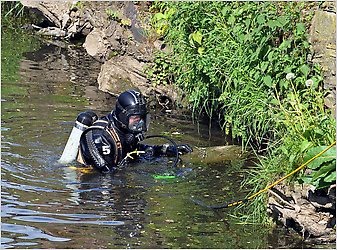
Well, apparently a 40 year-old British PhD student doing his dissertation on Victorian murders (they'll give a PhD for almost anything, it seems), has tried to practice what he preached. At least, so says the news NYTimes story. This pathetic sod--if the story is true--boldly did in some prostitutes. The image at left, from the story, a cop searching for bodily remains, looks like the first scene in a BBC mystery series.
Connection to evolution and genetics?..... Well, humans are herd animals, not competing to be the best as much as competing to conform. So, read about murder, commit murder. Or, how about this: Unsolved murders (Jack the Ripper was one of this guy's 'research' subjects) were done by big alpha males (they weren't caught, after all) so this guy's trying to be one himself--doing what some, at least, would claim is evolution's bidding. Or, like much of developmental biology, cells are led by their context to do themselves in or to instruct other cells to do that--cyto-murder!
Or, maybe there's no connection, and this was just a slow news day.
Science last week published a cautionary tale--"Natural and Sexual Selection in a Wild Insect Population"--about the limits of observations made in the lab, but in fact it suggests limits to what 'everyone knows', as well. The paper was accompanied by a commentary by Marlene Zuk.
The authors, R. Rodríguez-Muñoz et al., point out that most studies of reproductive success among invertebrates are carried out in the lab, while those on vertebrates more often take place in the field. They set out to compare observations of reproductive success, and therefore determinants of fitness, among crickets in the field with conventional wisdom gained from observations in the lab.
Although poorly understood in their natural habitats, cricketshave become an important laboratory model system, revealingcomplex forms of sexual selection whereby females choose betweenmales according to their songs, males fight, femalesmanipulate sperm from several males to favor unrelated males, and females lay eggs faster when mated to dominant males. However, although we now have many insights into the behaviorand physiology of crickets in the laboratory, we have almostno idea how important these various aspects are in the insects’natural habitat. This discrepancy is a cause for concern: Laboratorysituations remove some sources of selection that may be veryimportant in wild populations and may create new pressures;for instance, it may be that males that sing more get more matesin the lab, but in the field such males may die younger.
Rodríguez-Muñoz et al. set up a series of motion-activated cameras to monitor the comings and goings of these flightless burrow-dwelling field crickets (Gryllus campestris, as pictured in the drawing above), and confirmed paternity with DNA testing, in this way following 2 generations of crickets. They labeled each cricket, and noted each one's behavior, including fights between males, who won and who lost, as an indicator of dominant or subordinate behavior.
Perhaps surprisingly, they found that mating success didn't necessarily correlate with reproductive success, or number of offspring. And they found some inconsistencies between what theory predicts and what they actually observed.
They report greater variance in reproductive success among males than among females, which is consistent with current theory, but this wasn't because males had more mates than females, as they found no difference in variance in number of mates between the sexes. Crickets of both sexes who had more lifetime mates had more offspring--this was true even for females that used only sperm from the single ejaculate of one male, even if they had multiple mates (this was confirmed by DNA testing).
Reproductive success was also correlated with size and lifespan--larger, longer-lived individuals of both sexes left more offspring. Among males, dominance and the 'interaction between size and singing activity' were predictive of mating success (smaller males who sang more had more mating opportunities), but offspring number was predicted by the interaction between size and singing (again, smaller males had more offspring when they sang more), and longevity and singing, but not by dominance. This is contrary to what has been found in the lab, where dominant males have greater numbers of offspring--and contrary to long-standing theory about the fitness effects of dominance behavior applied to vertebrates and invertebrates alike.
Long-standing theory also predicts that singing and size are sexually selected traits that demonstrate higher genetic quality, and that, therefore, larger males who sing a lot will have more offspring than their smaller quieter neighbors. However, in this population of crickets at least, these traits don't seem to be indicators of genetic condition, or if they are, they don't necessarily lead to increased fitness, or more descendants.
So, dominance, size, singing activity, number of mates, all of which are assumed to be either directly or indirectly correlated with reproductive success, are not predictive of either mating success or number of offspring in these crickets. Indeed, and this is perhaps the most startling finding of this study (at least to those interested in documenting a genetic basis for behavior), most crickets left no offspring at all. As Zuk says,
Contrary to theory, or at least to common assumptions aboutanimal behavior and ecology, was the discovery that the vastmajority of individuals, whether male or female, did not successfullyreproduce at all. Although males are often acknowledged to playa high-stakes, high-risk game with many losers, conventionalwisdom has it that virtually all females, even those in relativelypoor condition, should be able to eke out at least one or twoyoung; this disparity underlies, for example, the Trivers-Willardeffect on sex ratio, in which mothers in poor conditionare predicted to favor daughters over sons because even low-qualityfemales are expected to be able to reproduce. Yet none of thefemale G. campestris and only a couple of the males had morethan 10 surviving offspring and most had none, despite the ability of females to lay scores of eggs.
Rodrîguez-Muñoz et al. conclude that most of their laboratory observations are upheld in the field. But there's a lot of "contrary to theory" in this story. And--this is our conclusion, not theirs--it seems that Nature can fine-tune those traits that are supposed to indicate genetic quality or that attract mates as much as She wants to, but none of that will guarantee reproductive success. No matter how fine their song or how many fights they win, most crickets don't reproduce at all.
As we have written a number of times, when it comes to evolutionary success, chance and good luck have the upper hand more often than many of us like to think. And extrapolation from current observations, lab or field, to the evolutionary scale of thousands or millions of generations, in different ecological and physical habitats, is usually too risky to justify the lack of circumspection in so many evolutionary scenarios eagerly advanced by evolutionary behaviorists.
Ever since the papers were published by White’s team in Science last fall, we’ve been waiting for the public debate to unfold and now it's well underway with two Technical Comments in Science last week.
The first paper questions the phylogenetics and functional morphology of Ardipithecus (to be discussed in a later, separate post) and the second, by Cerling, Levin et al., questions the paleoenvironmental interpretations for the creature from Aramis, Ethiopia. Both were published alongside rebuttals by White’s team.
Let’s talk about habitats first…
White’s team originally claimed that Ardipithecus habitats ranged from woodland to forest patches and that, “…early hominids did not evolve in response to open savanna or mosaic settings.”
“So what?” you might be asking.
Well, it's a big what! If Ardipithecus is indeed an early biped, then bipedalism did not evolve in a grassy place, but rather a wooded one.
Ever since the 1960s, the prevailing hypothesis, known as the “savanna hypothesis,” has more or less been used to explain the evolution of human-ness.
Savanna-living, according to the savanna hypothesis, is what separated hominins—the exclusively human branch on the evolutionary tree—from the other African apes. Moving about on the ground, rather than in the trees, was a selective force in the evolution of bipedalism. And, of course, there are all of the other evolutionary ramifications of a shift towards savanna ecology. So if Ardipithecus did not live in a savanna, then this is some major evidence refuting the savanna hypothesis. But if White’s team is wrong, then the hypothesis lives on.
Well, what’s a savanna? It’s actually much broader than “grassland” and can include wooded aspects as well. Here is how the United Nations Scientific and Cultural Organization (UNESCO) classifies and defines African vegetation (as summarized in Cerling et al.):
1.Grassland is land covered with grasses or other herbs, either without woody plants or the latter not covering more than 10 per cent of the ground. (What people call “savanna.”)
2.Wooded grassland is land covered with grasses and other herbs, with woody plants covering between 10 and 40 per cent of the ground. (Also what people call “savanna.”)
3.Scrub woodland has a canopy height less than 8 m, intermediate between woodland and bushland. As proportions of bushes, shrub, and grasses increase, woodlands grade into bushland/thickets or wooded grasslands (above). (Savanna-ish)
4.Woodlands have trees with canopy heights of 8 to 20 m; their crowns cover at least 40% of the land surface but do not overlap extensively. Woodland ground layer always includes heliophilous (sun-loving, C4) grasses, herbs/forbs, and incomplete small tree and shrub understories.
5.Closed woodlands have less continuous canopies and poorly developed grass layers.
6.Forests have continuous stands of trees with overlapping crowns, forming a closed, often multistory canopy 10 to 50 m high; the sparse ground layer usually lacks grasses.
Okay, first of all, both teams (both Cerling et al. and White et al.) agree that open savanna grassland was not the environmental context of Ardipithecus. In other words, number 1 is out.
However, White’s team says that the conditions at Aramis were between numbers 4-5, but Cerling and Levin’s group prefer 2-3 which include a patchy riparian forests set within a dry, savanna landscape.
[What’s at stake here is the issue of interconnectivity: Could a hominin move from tree to tree through the forest canopy without coming down to the ground, or not? In choices 5 and 6 above, it could, but in 1-4, it couldn’t.]
Researchers on both sides of this debate address the gamut of information used to piece together the scene...
Some Major Sources of Paleoenvironmental Evidence
Stable carbon isotopes in paleosols (ancient soils)
Oxygen isotopes of mammalian tooth enamel used to determine paleoaridity
Carbon isotopes in mammalian tooth enamel
Relative abundance of phytoliths (microscopic silica particles from plants)
Relative abundance of micromammal fossils
Vertebrate species: types of birds, large and small mammals, gastropods and fossil wood preserved in association with Ardipithecus.
Vertebrate morphology: For example, Browsers (tree and shrub eaters) vs. Grazers (grass eaters)
Geology and taphonomy of fossil assemblage (How the fossils got there)
However, Cerling and Levin’s team emphasize the importance of 1-4, while White’s team emphasizes 5-8.
Regarding 1-4, there is a fundamental disagreement between the two camps over what samples, both ancient and modern, to include in the analyses. Both have used the same data, but with different comparison data or on different scales (regional vs. small-scale habitat) and have come to very different conclusions.
White et al. end their rebuttal with a comment on the implications of their results on the savanna hypothesis.
“The vision of apes trekking bipedally between increasingly isolated forest patches has maintained its allure across decades of research. The repeated discovery of obligatorily bipedal, megadont Australopithecus in later open habitats erroneously reinforced this notion of bipedality’s beginnings. It was perhaps inevitable that proxy records reflecting global shifts in carbon isotope values would be postulated as the missing piece of the puzzle of hominid origins (22).”
That sounds a little like a dig at Cerling’s team’s work, citing their 1997 Nature paper. But I could just be overly sensitive to these things. Anyway, White et al., continues…
“By focusing too coarsely on the regional environment, Cerling et al. seem to overlook evidence that differentially and consistently links Ardipithecus to a woodland habitat and thereby distinguishes it ecologically from Australopithecus. We contend that compared with Ar. ramidus, Australopithecus was more ecologically flexible, probably ranged more frequently and further into the open environments that Cerling et al. term “tree or bush savanna,” and evolved remarkably distinct and highly derived dietary and locomotor adaptations to this end.After assessing the totality of the pertinent environmental and ecological evidence, we concluded that Ar. ramidus preferred the more wooded habitats among the available spectrum in the regional geography: “...the integration of available physical and biological evidence establishes Ar. ramidus as a denizen of the closed habitats along this continuum”. The Aramis evidence is not easily accommodated by an environmentally deterministic view that involves globally shrinking forests spawning savanna-striding hominids. We contend that this narrative is now undermined by the totality of data from 4.4-Ma Aramis. These rich, diverse data are spatially and chronologically intimately associated with Ardipithecus, thereby providing an unparalleled view of the early hominid niche within the larger geographic setting.”
Until others can grasp the “totality of data” from 4.4-Ma Aramis in a similar way, I suppose this new view of early hominin evolution will remain something to “contend” rather than something for others to readily see and accept.
References
Thure E. Cerling, et al. Science 328, 1105-d (2010); Comment on the Paleoenvironment of Ardipithecus ramidus.
Tim D. White, et al. Science 328, 1105-e (2010); Response to Comment on the Paleoenvironment of Ardipithecus ramidus.
I learned some amazing things from the movie Splice that I thought readers of the MT would want to know. Here goes.
1. Scientists have god-like skills, but no common sense.
Movie Lesson: In order to make a Hollywood movie about genetics here is what you need to do: Have your hip, young, attractive, brilliant scientists-slash-lovers know how to do everything and anything that has to do with biology or chemistry in a lab—quantum to organism—including (and this is the whole point of the film) how to create a living breathing VertebrateStew-Human hybrid.
Except, make it so those brilliant young scientists can't tell whether their monster is dead.
Life Lesson: The universe hates moral and ethical lapses just as much as when you forget the fundamentals.
2. Humans have powerful DNA and it's completely unique.
Movie Lesson: When you’re just splicing together the genomes of a bunch of nonhuman vertebrate species, the result is a blobby appendage-less mass of writhing veiny flesh. Basically what you get is a 30-pound eyeless blobfish impersonating a caterpillar. [The pros can do this better than me: Time.com’s Mary Pols described the blobs as, “what might happen if an elephant foot and a freestanding penis could reproduce.”]
However, when our lab-coated Adam and Eve team adds human DNA to this genomic cocktail, guess what happens? Forbidden Fruit Cocktail: arms, fingers, legs, toes, ears, roughly 1300 ml between those ears, rudimentary language skills, come-hither peepers, perky breasts, forehead cleavage, a pointed tongue, a stinging tail, etc, etc…
Life Lesson: Humans and their powerful DNA are “completely unique.” (To borrow a cringe-worthy phrase, albeit out of context, that was uttered in the movie.)
Movie Lesson: Exploit common misunderstandings about evolution in order to appeal to the general audience which is assumed to hold those misunderstandings . For example, in two separate scenes, talk about your monster “evolving” rapidly through its development from a ginormous air-breathing tadpole to a fierce, and *fierce*, angel.
Life Lesson: Real evolution isn’t exciting enough for the masses, but antiquated and misguided assumptions about evolution are absolutely captivating! Also, 21st century Americans aren’t satisfied unless there is a healthy undercurrent of Old Testament balanced out by a healthy overture of S-E-X.
If you enjoy attending the kind of movie where the outro earns peals of absurd laughter, ironic applause, and outbursts like, “What the *expletive* was that?” then I recommend you see Splice.
One of the fundamental principles of life, which we've written about from time to time and include a lot about in our book, is chance. It's everywhere, from the randomness of which genes we inherit from each parent, to being the unlucky fish that get caught in the shark's maw as it sweeps through a school with an open mouth.
Another aspect of chance is sloppiness, which is also found everywhere. Echolocating bats are notably imprecise in their discrimination among prey, error-prone transcription of DNA into RNA is routine--it has been estimated, in fact, that perhaps 3% of a cell's energy is used to correct transcription errors.*
The environment presents us with the unpredictable, too, in the form of phenomena like hail storms or hurricanes, unusual heat or cold, volcanoes, etc., as well as the regular, predictable fluctuation of the seasons. (Of course, as Ken is a former meteorologist, he's inserting the self-defense caveat here that weather forecasting is not entirely unpredictable in the short run, though many details are, and weather may never be predictable very many days in advance--but then, for organisms other than humans, and then only recently, this is irrelevant).
Chance is so ubiquitous that being able to adapt to chance effects--within limits, of course; no amount of adaptiveness will help that fish escape being that marauding shark's dinner--is a characteristic of life that had to have evolved very early because all organisms can do it to some degree. The lineages that couldn't disappeared long ago.
Errors and chance are found at the molecular level, too. It has been known for decades that only a small fraction of DNA is transcribed into messenger RNA and translated into proteins, and it was thought that the 98% of the genome that wasn't transcribed was 'junk', detritus from evolutionary trial and error. But recently, unexpected transcripts from non-coding DNA have been reported by a number of labs, leading to speculation about the actual role of all that 'junk DNA'. A recent paper in PLoS Biology by van Bakel et al., accompanied by a commentary, addresses this question. van Bakel et al. describe these excess transcripts this way:
Dubbed transcriptional “dark matter”, the “hidden” transcriptome, or transcripts of unknown function (TUFs), the exact nature of much of this additional transcription is unclear, but it has been presumed to comprise a combination of novel protein coding transcripts, extensions of existing transcripts, noncoding RNAs (ncRNAs), antisense transcripts, and biological or experimental background. Determining the relative contributions of each of these potential sources is important for understanding the nature and possible biological function of transcriptional dark matter.
To address the question of what these are, van Bakel et al. compared the usual method for identifying transcripts (tiling arrays) to a "single- and paired-end RNA-Seq" method, and found that the RNA-Seq method identified many fewer unexpected, or 'dark matter' transcripts (reminding us that high-powered technology can be error-prone, too). Most of the transcripts were identifably from intronic regions, suggesting that they were perhaps "fragments of pre-mRNAs", and were associated with open chromatin, that is, segments of DNA that are open for business, ready to be transcribed.
We conclude that analysis of data from tiling arrays leads to vast overestimates of the proportion of transcriptional dark matter. However, the mammalian transcriptome does contain thousands of unannotated transcripts, exons, promoters, and termination sites.
That is, they still found enough unidentified stuff to write home about, maybe 2% of the transcripts they analyzed. While that is considerably less than the dark matter that's given rise to so much speculation, it still suggests that even after 3 billion years, DNA copying enzymes make mistakes. As Richard Robinson says in the PLoS commentary,
The emerging picture of RNA polymerase is of an inherently imprecise, not to say promiscuous, copyist, one whose output includes some mistakes along with lots of valuable product. In this view, most dark matter transcripts are not signals emerging from a hidden universe within the genome, but instead simply the noise emitted by a busy machine.
If these latest results bear out, it will mean that at least some of the enthusiasm in recent years for the idea that there is a huge unknown realm of DNA functions uninvolved with direct protein expression may not be completely warranted, and that our standard ('old-fashioned'?) theory, including the error-proneness of the system, may be pretty accurate after all.
-----------------
*Kurland, C., and J. Gallant. (1996). "Errors of heterologous protein expression." Current Opinion in Biotechnology 7(5):489-493.
The NYTimes has a good story on a family in Colombia that is affected with multiple generations of severe dementia--Alzheimer's Disease. This family is a large, localized and hence accessible family affected by what they refer to as 'La Bobera', a term generally referring to a kind of foolishness, which this affliction certainly is.
The locals have attributed this to various mystical sources, but the scientifically determined cause is known. The family is transmitting a specific genetic change in a gene called Presenillin1, which codes for a neural membrane protein, and has been shown in other studies to be responsible for cases of AD. The Times story is about attempts to impose medical preventive measures for those who have inherited the mutation. Hopefully, it will go well.
This family resembles another famous South American story, that of Huntington's Disease in extended families in the Maracaibo region of Venezuela. There, too, the genetic cause is known but there is no effective treatment yet available.
HD is always, or at least almost always, due to a particular kind of mutational change in a specific single gene. This has been known for about 20 years. The mutation can easily be detected, the disease strikes later in life as a rule, and yet there is still no effective treatment and, importantly, no gene-therapy kind of treatment.
AD is more complex in that many different genes are known that can affect AD risk, but not all cases can be accounted for in terms of specific genes, much less specific mutations. Some of the molecular and physiological changes in the brain have been identified but, as in HD, there's no miracle preventive or treatment.
Single-gene diseases, or clear-cut single-gene subsets of more complex diseases should provide optimal material in which to show that gene-based knowledge can lead to prevention (other than by selective abortion) or treatment. They are only subsets of the whole, usually small subsets, but they are at least truly genetic, unlike many complex disorders (as we've posted about many times).
It is sobering to realize that we've known about another single-mutation disease, that is very common, and affects very accessible tissues, for about 60 years. That's sickle cell anemia. The sobering aspect is that there is still no reliable and no gene-based treatment or preventive.
Does this mean that gene therapies are vain hopes? Nobody knows, but technology is powerful when there is a clear problem to be solved, so we think this is a place for heavy research investment in genetics--unlike the massive investment being made to enumerate the hundreds of genes that contribute to risk of complex, chronic diseases like heart disease, where environmental prevention could already be highly effective.
Hopefully, gene based therapies will result from the study of the clearly genetic subset of devastating diseases like AD and HD.
Did the stress of 9/11 lead to increased male fetal loss? A new paper by Tim Bruckner et al., which is making a splash in the press (e.g., on radio and in print), makes the case that it did, indicating that 'communal bereavement' does happen, and that male fetuses suffer for it. They don't know why this might be, but they are sure it must have an adaptive advantage (as they might say: mustn't everything?).
Although the biological mechanism remains unclear, male fetuses appear more sensitive than female fetuses to maternal corticosteroids produced after the twentieth week of gestation. This elevated stress reactivity apparently jeopardizes the viability of males in utero. Consistent with the theory of natural selection, humans may have conserved this male fetal sensitivity to maximize the mother’s total yield of grandchildren.
The authors looked at fetal death statistics for pregnancies over 20 weeks from 2006 through 2001 (of which it's estimated that only 20 - 30% are actually reported) and found that the number of deaths of male fetuses was higher than expected in September 2001. However, relative to the total number of pregnancies, the numbers were very small indeed (in the hundreds).
Now, the authors also cite reports in the literature that suggest that major pollution events or economic downturns are correlated with male fetal loss as well, which means that the effect--if it's real--could be confounded. And indeed, in the study population Bruckner et al. used for their analysis, more than half of the mothers had a high school or lower education level, suggesting that economic stressors would be chronic for these women. If the reported effect on sex ratio is real, why isn't the sex ratio among poor women always skewed more in favor of girls, then?
It's also interesting that the authors don't report an increase in the total number of later-term miscarriages, just the sex ratio. It's hard to believe that an effect of stress that's strong enough to skew the sex ratio wouldn't increase the number of miscarriages as well. To determine whether there was an increase in total fetal deaths, we looked at reported vital statistics and see no increase in miscarriages in either 2001 or 2002. If the effect of communal bereavement is as the authors report, this strikes us as unexpected. Indeed, this would reflect an increase in male fetal deaths but with no increase in total deaths, there must have been a corresponding decrease in female deaths. Or, a trivial effect of 'communal bereavement' on fetal deaths.
According to demographic theory, there are typically more males conceived than females, more boys born than girls, and higher male fetal death rate in general. One explanation for this is that the Y-bearing sperm are lighter and hence swim faster than X-bearing sperm (the X is a much larger and hence heavier bit of baggage to carry). But risk of death for male embryos is higher in the best of times. At birth, the sex ratio is about 107:100, but male infants die at a higher rate than females so--the theory and some data go--the sex ratio is about even at puberty when matings start.
But, this brings us to the evolutionary importance of this paper. While claiming such significance, the authors cite just one paper on this, a 1973 Trivers and Willard paper in Science that argued that natural selection favors deviations away from equal parental investment in boys and girls, "rather than deviations in sex ratios per se." But this is based on a model applied primarily to deer. They say it's complicated in humans, and suggest that in humans the "sex ratio at birth correlates with socioeconomic status." They also suggest that differential mortality takes place early in pregnancy, and that it's chronic poor maternal condition that makes the difference.
Now, whether or not the Trivers and Willard model has held up over 40 years we don't know because we don't know that literature, but it clearly doesn't apply to the Bruckner et al. paper. It's not surprising though that an adaptive explanation for the finding--itself so tenuous--is tenuous at best, but it's not unusual that the authors try to claim one anyway. In addition, there is a large literature on an increase in sex ratio--more boys per birth--after traumas like war; the sociobiological explanation has been that this allows a society to make up for valiant heroes lost in combat; whether this idea has stood the test of time we can't say.
The problem here is the usual one of making claims that may be plausible, but go far beyond the data, and the data are inconsistent. But if you simply must have an evolutionary reason, then of course you can always make one up. The problem is that these things are so often empty of seriously rigorous content.

 PhD student doing his dissertation on Victorian murders (they'll give a PhD for almost anything, it seems), has tried to practice what he preached. At least, so says the news NYTimes story. This pathetic sod--if the story is true--boldly did in some prostitutes. The image at left, from the story, a cop searching for bodily remains, looks like the first scene in a BBC mystery series.