Showing posts with label nasa. Show all posts

Wednesday, September 30, 2015

Does Mark Watney dream of red potatoes?

Puh-tay-toe
Puh-tah-toe


Before we get down to business ...


As commander of this blog post, I order you to read The Martian by Andy Weir before you even watch the trailer for the upcoming movie. If you watch the trailer before you read the book you will ruin your life. Plain and simple. I can't even imagine what horrible things will happen to you if you see the whole movie without reading the book first.


Do not deprive yourself of this head trip. There is just no way this film will walk you through this astronaut's brain like the book does. Movies can be wonderful, but this is one of those reading experiences (of which there are infinitely finite) that cannot be matched on screen. 


You'll notice that I'm not linking the movie trailer here. I'm not even pasting a picture of Matt Damon in this post, knowing full well that it will get me more clicks and will beautify this screen, because I don't want anyone looking at any of that until they've read the book. If you're really hearing me, stop reading this blog post and don't come back until you've read the book. Do you read me? Over.
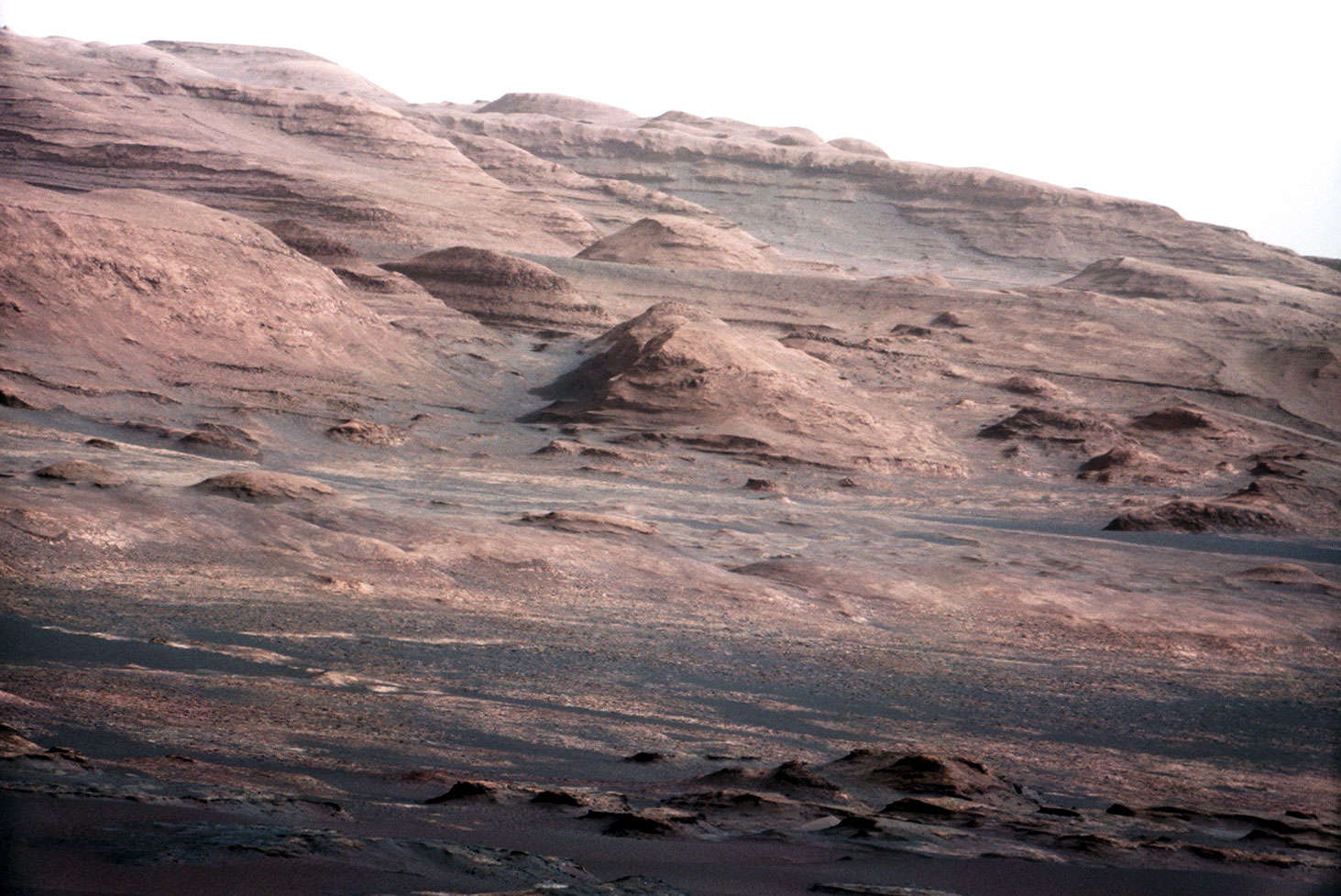


Layers at the base of Mount Sharp (source)
With the movie  The Martian opening this Friday, many people will soon be familiar with Mark Watney and his incredible ordeal. 

This is not a book review. I'm done with those for the time being. The last one I did turned out to be a bit of a disaster.  


I just have a few thoughts about Mark Watney's Martian diet that need to escape through my fingers and out onto your computer screens.


To survive on Mars and to think his way to salvation, he eats a lot of venison, kale, and blueberries.


Psych! He eats a lot of potatoes. You know, the "problem" food that causes disease. The food that so many trademarked diet plans avoid, like the Paleo Diet. 


There was some pre-made, pre-packaged NASA fare for Watney, but no way would it last as long as he needed if he was to try to get off Mars. So he actually grew potatoes. A shitload of them. With a shitload of astronaut shit as fertilizer. 


The whole spirit of the book is one that inspires us to think our way out of problems. To remember that possibility is a state of mind. To be skeptical of our inner skeptics who speak of impossibilities. And it's with that skepticism that I wonder about those potatoes.


Let's forget our questions about soil volume, nutrients, and moisture  (mostly because I don't know how to usefully critique the thorough explanations that Watney provides for his decisions about these things). 


And let's drop the question that drove me crazy until the very end of the book when Watney finally explained that he was microwaving the potatoes and thereby getting more calories from them than he would by eating them raw. Given all the calorie-calculations he ran through while sciencing, the chance that Watney might be eating raw potatoes was slowly killing me (and, potentially, him). 


Now I'm curious about something more fundamental: would potatoes grow the same on Mars as they do on Earth given the gravity's different? Could Watney's Earth botany translate as well as it did on Mars?


His training and thinking might not translate well on Mars if we're talking about making a different kind of tot. I'm fond of this paper hypothesizing how difficult it might be to extend the evolution of our own species, extra-terrestrially. Earth's gravity may matter a whole lot to human reproduction, especially those earliest stages of development. 


link to paper

We're not potatoes, sure, but potatoes aren't yeast. Given that there's less gravity on Mars, can we assume that sciencing all those Earth potatoes in Martian conditions is as straightforward as Watney makes it sound?


I don't think anyone knows the answer to this, however, tons of anyones (like Andy Weir) have more informed guesses than I do. Indeed, it is possible to grow spuds on the space station. So maybe my gravitational question lacks gravitas.  


(That groaner was for you, Mark.)


But one thing is for sure. In The Martian, as in life on Earth, a diet based primarily on potatoes fueled a human for quite some time. Maybe not all humans could handle this, and maybe not all humans could be as extraordinarily brilliant while eating mostly potatoes for so many cold and lonely days. But the potato industry has got to be thrilled. 


Not only is one of humanity's best (fictitious) members existing as one of humanity's best members thanks to potatoes, but the food's public image got a separate but related boost recently. Potatoes, and other similar carbohydrate sources, might have been crucial to our lineage's brain evolution. 


Anthropologists have known for a good while now that "underground storage organs" or USOs, like potatoes past and present and many other species, have probably been a big deal during the last several million years of human evolution. But a recent review paper in the Quarterly Review of Biology argues, based on up-to-the-minute cross-disciplinary findings, that cooked starches were crucial to the evolution of our big glucose-sucking, calorie-burning brains. Here's the paper's abstract:


source (and see Zimmer's write up)

So, Paleo dieters and potato-haters of the world, you have just been publicly flogged by both science fiction and science faction. What do you do now?


Well, if you haven't read The Martian, I'll plug it one last time. 


When you're on about page two you might be cursing me. By then I was cursing the book and everyone who liked it. I nearly gave up at the start for reasons to do with the style of writing (gasp! a blog! Ugh!) and my narrow-minded expectations of astronauts, but I'm so glad I dominated my inner bigot and turned the page. All the pages. To the last page. In solidarity with my new favorite Martian blogger, I'm moved to thank you for reading this gasp! a blog! Thank you. Now get to reading Watney's.


P.S. If you can't access the two articles I reference, email me and I'll send them to you: holly_dunsworth at uri.edu

Wednesday, July 15, 2015

Wowee! Worth the wait!

Well, a flood of dramatic new discoveries, a veritable inundation, is about to begin.  The first bit, though only slightly tantalizing, was that strange view of Pluto (the one-time planet), that the New Horizons space studio sent back, showing a big blurry mudpie.

Next, we've seen the surface covered with vortices and the Mysterious 4 black spots down around the bottom.  Unless we're wrong, such vortex patterns have been seen earlier by probes to more nearby planets and have been explained basically in meteorological terms.  From what we read, Pluto has an atmosphere, and as far as we know the swirls could perhaps be related to the effect of its moons. Interesting, and of course new knowledge about a specific space object, but not in itself jolting.

Much if not all of what we have seen so far is a confirmation, by very sophisticated technologies, of the well-established principles of classical physics (and, perhaps, relativity or quantum mechanics if they had any role in engineering the project).  Confirmation is nice but of course we have decades of space adventures and telescopes that have clearly shown that this is how Nature is.  Any deviation would be real news!  In any case it is an exquisite bit of high-class engineering.

Here is a figure from the BBC story that is being used to fill up some media space:


Yesterday came the first real bit of jolting news:  The planet, or that is, once-a-planet, is about 30 km bigger in diameter than was thought, if we understood the news story we read (one of many reporting on this, including this one).  This earth-shaking surprise now tells astronomers, apparently, something about how much ice is in the tea there.  Let's not just treat this with attempts at levity, but be precise.  Pluto's diameter is (precisely) 2370km.  This startling new estimate, to an extent similar to Darwin's discovery of evolution, shakes the previous estimated range of 2300 to 2400 to its very core (the estimate's, not Pluto's core).  It means Pluto is more ice and less rock than had been thought.  Actually, the high precision of the previous estimate, however it was made more indirectly, seems more impressive to us.

A disinterested party (that is, a member of the New Horizons team) is quoted as saying "It looks like somebody painted it for a Star Trek episode."  Why this is the most exciting fact since Star Trek is at least mildly perplexing.  And that this now confirms that Pluto is the "undisputed giant" of the solar system (the biggest, at least, if not the heaviest), is about as stunningly important to know.

The New Horizon craft was due to pass by Pluto yesterday, as we understand it, assuming the ground-control and on-board instructions work well, which seems to be the case so far we'll soon see the relatively close-up photos.  We are told that the pass-by will be fast, and too distant to see whether there are any people on Pluto, but given the previous photo of a swirling clouds, we might not be able to see them waving to the ET flying by their corner of the universe, even if they're there: they'll either be hidden beneath the swirling clouds overhead, or living in the water.

Even that disappointment won't spoil the value, or at least the fun, of this visitation.  After 3 billion miles and 9+ years of travel, and who knows what cost, presumably the revised diameter is enough to guarantee a party (here on earth).  Whatever other mind-blowing facts emerge will just be more bonus material to fill the media and hyperbolizing pages.

Of course, toys for engineers to get breathless about is nothing new.  If they weren't kids at heart, they would probably have gone into some more mundane field.  What's 'out there' is certainly fascinating and thought-provoking, and the technical science seems obviously first-rate.  And the news media do, after all, have blank spaces to fill every day with stories that will attract readers, because that's their business.  Every extra kilometer 3 billion miles away means an extra page-inch here on Earth, and it's undoubtedly better than having to report on nasty dispiriting things like ISIS beheadings, or even more celebrity gossip than is already the daily fare (or debates about whether Bill Cosby did it or not).

Why snicker rather than cheer at a time like this?
We have to acknowledge that one of our themes on MT is the way in which public resources are spent on research, the way priorities are set, the way universities are currently funded, and the way so much in our culture is organized on the 'business model'.  We personally have no influence or leverage, of course, but our voice is aimed at expressing a less selfish view of how society should operate. Science is best done without the ulterior motive of getting attention or funding.  Stable funding, based on some realistic sense of priorities relative to serious human needs--and there are serious needs aplenty to be addressed--would be a far better way to encourage exploration of the world, even if the research funds per researcher were less, and there was less Splash involved.  This could be achieved, but by unity rather than intensified, destructive competition as so much of it is today.  Science can't be 'efficient' in the business sense, if it is to be the best science.  Things already understood aren't 'science'.  But it could be more effective than it is under the current modus operandi.

We can of course be accused of constant whinging, but at least we have no conflict of interest in trying to urge improvement in our cultural way of doing things.  We also understand that the bloated university establishment, the bloated news media that need their daily fill of stories, the commercial vested interests, the government agency vested interests, and so on, are all part of the integrated system we have now.  It has not been made in anyone's interest to hold the system to account. The Fourth Estate is failing badly, partners more than skeptics, but so is society for failing to fund universities in the public interest, and politicians for using science-excitement in demagogic ways (going along with miracle health promises, and so on) to get elected.

According to what we have seen on the New Horizons Wikipedia page, this project has cost about $600 million.  One can debate whether that is a lot or a little relative to competing science or other national priorities.  Not everyone will agree, but we think there are a lot more mundane than plutane things to which our national resources should be put.  Building bridges over rivers rather than highways to planets would be one example.  Too many people, even in our own country, have more need for daily bread than daily feed from the news media.  Yes, of course, this is politics of science rather than the science itself.

Cutting back on projects like the Pluto mission would cost some people their jobs, but there is plenty to do for ones with their skills.  Fixing bridges, rails, and so on isn't quite as exciting, but at least a given job doesn't take nine years.  And unlike these dinky space rovers, actual people get to ride on trains and cars!

Societies always have elements of questionable priorities and resources going to in-groups, because there are always competing self-interests.  But societies, like at least some space probes, can have course adjustments, too.

Monday, April 28, 2014

Cover of Science, and a cover-up?

The 18 April issue of Science has a nice artist's rendering of the planet Kepler-186f, about which we recently blogged.  We pointed out how every time a new 'habitable'  planet is found by NASA, its PR machine makes sure the eager news media trumpet its dramatic news.  What could be better than a fake image (that is, an artist's rendering, totally imaginary) on the cover, a realistic not impressionistic painting.  Could one suggest that that is misleading?

April 18 cover of Science

On page 229, the blurb about the Cover, which repeats the painting, says that the discovery of Kepler-186f 'confirms' that Earth-sized planets exist around other stars.  Of course, we recently had some similar claims or 'confirmations' of something like 750 specifically-identified 'habitable' planets.  So what this actually confirms, a skeptic might allege, is that Science needs cover material.

To milk this even further, there is a Commentary about this major discovery.  So what does it say?  In a very nice figure, it lists three basic attributes that would be needed for this planet to be (as their heading says) a "Place Like Home".  Oh wait!  We left out a word!  The heading actually says "No" place like home!  This planet is of the right size, for those of us dreaming of going to a planet on which the various resort locations are within a Boeing 747's range for holiday package trips.  And it is in the temperature-defined 'habitable' zone, which means there could be water and hence beach resorts to go to.  But, sad to say, it is not orbiting a proper sun-like star!  No tans!

And, sad to say, even the authors of the Commentary raise several scenarios by which even this juicy find might be so spookily misbehaved in various ways as not to allow life as we know it (or, perhaps, even as Bella Lugosi knew it).  So, when you get right down to it....forget it!  But these caveats, well, they're rather buried under the covers of the evocative imagery.

Even the Commentary itself also says rather passively "Unfortunately, the planet is too far away from Earth for follow-up studies.  However, researchers hope it heralds many similar worlds soon to come."  Well, if NASA gets continued funds for this Hollywood-like exercise.  And is the very phrasing designed to lure gullible readers of Science (or of NASA releases) to think that next time--soon!, we'll find one we can visit?

In our recent post we guesstimated that if they're as common and easy to find as recent reports out of NASA suggest, then there must be billions of such planets in our galaxy alone, and many trillions of them out there in the universe.  A year or so ago we mused about what travel to r even communication with a closer (22 LtYr) planet would actually imply.

Worthy science doesn't need to be blared to the public in misleading ways. Because then it's not science, it's advertising or entertainment.

Thursday, June 23, 2011

The Twilight Zone, Part II: Is there life out there in space?

This is the second in our 3-part series on the idea of ETI (extra-terrestrial intelligence), and the theories and ideas that astronomers and cosmologists have typically advanced.  We're specifically triggered to do this by an article we referred to yesterday, by Howard Smith in the latest American Scientist.  See Part I for more on the source, and for background.

Within his area of expertise, Smith makes many valuable points about why he believes that either there is no intelligent life 'out there', or why even if there is it's moot to talk about because we'll never detect it.  However, we think he is typical of astronomers who seem to feel no restraint in leaving their own field, which they know about, to speculate very naively about evolution,  for reasons we'll discuss below.  But let's briefly consider his more robust points about ETI first.

First, he's only talking about 'intelligent beings'.  Micro-organisms that can't communicate with us are irrelevant.  If there's only 'primitive life' out there, for all intents and purposes we're still alone -- the life he's interested in has to have something equivalent to a radio technology with which to send signals.

That life has to be close enough to Earth to allow a signal to get here, or for ours to get there, before the universe ends.  It has to be within the 'cosmic horizon', the constraint being how far light can travel within the age of the universe.  Since the universe is expanding and distances are getting larger, this further restricts the possible planets from which signals can reach us.  And distant signals of course represent not life as it exists now, but life as it existed perhaps eons ago when the signals were sent, so we may never catch up with ETI in anything like real time.  But this means that that distant life would have evolved a lot sooner than life on Earth.

And that distant planet has to be stable, that is its host star must be a stable size, with stable enough radiative output to have given life time to evolve, and of the right age -- not too young that life didn't have time to evolve, and not too old that the star's luminosity, which increases with time, isn't too great to have overwhelmed and destroyed the planet (many of these criteria might in fact be called the Goldilocks criteria).

The planet's orbit must be just right vis à vis its star, planetary mass must be "massive enough to hold an atmosphere, but not so massive that plate tectonics are inhibited, because that would reduce geological processing and its crucial consequences for life."

And the planet must "contain elements needed for complex molecules (carbon, for example), but it also needs elements that are perhaps not necessary for making life itself but that are essential for the environment that can host intelligent life: silicon and iron, for example, to enable plate tectonics, and a magnetic field to shield the planet's surface from lethal charged winds from its star."

But now, Smith works out some--indeed many--of his calculations from what seems to be an evolutionary point of view.  Life has to start and then evolve to become intelligent.  Here, let's take for granted that we know what 'intelligent' means.

In a nutshell, Smith asks how many planets have liquid water.  How many have ample carbon.  How many would be in systems where gravitational and other forces tilt the planet at an angle so it has seasonality of climate.  How many have physical and gravitational properties that will lead to an atmosphere.  How many have radioactive cores or other means by which they have plate tectonics to shift around the hardened crust and renew or recycle needed elements for life.  How many would have the billions of years needed for intelligence to evolve, which has to do with the age of their solar systems.  How many would circle around only one star rather than two, so their gravitational status was stable and so they did not have long cycles of being too hot or too cold.  In how many could DNA evolve and function, leading to intelligent beings.  And so on.

It all sounds sensible and of course the questions are relevant.  But what they ask in essence is: how many planets are just like earth and their life like earth-life? But that is far off the central question--are we alone in the universe?

The criteria he uses are post hoc--they say this is how earth-life evolved, and so this must be how other life has to evolve, so let's see how likely it is that just the same conditions exist elsewhere.

Playing the infinity game we discussed in Part I, one could say that if the universe is infinite, then the same conditions must exist (infinitely many times!) in the universe.  But if the universe is finite--even no matter how big and how numerous its stars--then things become different.  That's because if you multiply guesstimates of the probabilities of all the just-like-earth conditions, the net probability of all of them being true will become infinitesimally small.  Then, even if there is a planet that's just-like-earth, the likelihood of being contemporaneous (in the galactic communication sense) with us would be so small as to lead to the conclusion--his conclusion--that we better take care here because we're the only here there is.

Of course there is no way to know how different among these earthy planets conditions could be and still be compatible with life, and again the issue is probabiltity of earthy viability times the number of existing space-objects that could in principle, host life. If the product is greater than one, then the statistical expectation is that there is at least one such planet somewhere.

On the other hand, this is exceedingly naive evolutionary thinking.  Astronomers should stick to their telescopes.  The core facts of evolution as a process are divergence from shared origin and adaptive change.  There are also some other basic aspects of earthly life that Smith doesn't mention, but that are the main points in our book The Mermaid's Tale, such as the sequestering of interacting but semi-independent units, combinatorial information transfer (signaling), and so on.

There is no reason that life elsewhere has to 'evolve' in the way we understand from what happened here on earth, but let's not quibble about that.  Even then, there is no prior reason to think life must be based on water, or carbon (some have suggested that life, even earth like life, could be based on silicon, for example), or be restricted to particular temperatures (after all, we have Inuit and Saharan nomads, even under our own conditions), or that evolution would have a DNA or any other information-inheritance basis--lamarckian inheritance of some form might evolve on some planet somewhere, for example.  There is no reason evolution would take 4 billion years to become 'intelligent', nor that our kind of intelligence or ideas about communication would evolve.

Even if we accept the two core premises, there is simply no way to work out how or how long intelligence would take.  In a sense the whole point of evolution is that it works under the conditions it finds, and would work in its own way under what to us here would be harsher conditions, or more variable conditions, than Smith considers to preclude life.  We can't rule out non-earthlike chemical bases for life, other than for earthlike 'life'.  Natural selection can work in ways we may not know if, if inheritance is different, for example.  It's not that hard to think of other ways.

If  life does exist elsewhere does it have to be 'intelligent' in our sense to count?  Is the ETI question really about earth replicate life--that would and would want to communicate with the likes of us in the way we (currently) do it?

We think his article is very interesting and useful, but we also think it reveals the cardboard caricature  of life and evolution that (as we repeatedly harp in MT) is so widely prevalent outside of a rather limited range even of biologists.

In addition to these ideas, there is the possibility that even if ETI exists, it is so aggressively acquisitive of resources and so on that it destroys itself quickly, reducing the likelihood that two such sources would exist at similar enough times and stages to be able to detect each other.

There are many reasons that ETI may not exist at all, or if it does that we'll never detect it.  The conclusion that we're all alone--for all practical purposes--seems rather sound.  Even if one were to suppose that English-speaking life existed, say, a thousand light-years away (that is, nearby in space terms), it would take more than 2000 years to exchange a single message by electromagnetic means (actually more, because of the delay in reading and responding, and the rapid expansion of the universe), assuming neither our nor their life did not destroy itself in the interim (or theirs had not ended before their message got here).  2000 years is the time since the Roman Empire.  How long would it take even to find out, to within a reasonable accuracy, just where the ETs were (and they us) so that travel could be planned or messages accurately directed. So even if somebody does claim to have discovered ETI in their telescopic data, don't let NASA talk you into voting for a big budget increase.  Indeed, why allow NASA even the expensive sport of SETI, when lots of us here in the US don't even have health care?

So, we're with Smith in saying:  let's take care of what we have, instead of yearning for companionship we can't provide for each other!

There are a couple of other fascinating sides to this story that we'll pursue in Part III.

Friday, December 24, 2010

Slinging it further -- the arsenic bacteria saga continues

Well, we're not gone traveling yet -- and the arsenic bacteria saga continues.   Naturally enough, for a paper whose publication was preceded by such hype -- and followed by such immediate, justified skepticism.  Today's Science has an interview with Felisa Wolfe-Simon, the principal author of the paper that made such a splash a few weeks ago, and engendered such immediate skepticism, for many reasons, including that the experiment was inadequately controlled.  In brief, Wolfe-Simon is exhausted, and still hoping to collaborate with others who can confirm, or not, the findings she reported.  But being a true-blooded product of our culture, naturally she defends her results (graduate schools must train people to say a lot of things, but never "I was wrong!").

We won't go into any detail about the arguments here, because that's already being done much better elsewhere than we could do but we did want to include links here to some of that give-and-take, since we did post on the subject when the paper first came out.  Microbiologist Rosie Redfield's posts on  her blog, including the most recent very detailed response here, and reader comments, are of particular interest, as she goes point by point through the original paper, as well as the authors' attempts to answer skepticism, which they do here.

So far, without the additional carefully done experimental results that doubters are hoping to provide and/or analyze, it looks to us as though, at best, the jury is still out on these arsenic bacteria, and at worst, the original experiments were poorly carried out, poorly interpreted, and poorly reviewed.

And, as we said when we originally commented on this work, even if it were solid science, it doesn't say anything about life in space.  So NASA's Baloney campaign on its behalf should remain pilloried -- and it was NASA, not Wolfe-Simon who got the hype engine going on this one.  NASA seems to be good at engineering, but they should stay out of the basic biology business.  NSF should fund that.  'Astrobiology' is, if anything, a political wing of theirs, and Congress should remove its funding.  We know several good scientists who feed at that trough, but they'd still do good work funded in more conventional ways.  A truly disinterested panel could go through the current portfolio, transfer what's worthy to NSF, and put the rest to rest.

Science baloney is not new.  Legitimate as well as bogus scientists have long known that they can get ahead by dissembling, self-promotion, and puffing up their work in order to get attention, support, publication, or sales.  It's always up to the community to purge and self-police.   These days, the media (including many journals and even funding agencies) flood us with such puffery.  That we will not likely restrain over-claims should not stop us from resisting it, in the name of good science.

Saturday, December 4, 2010

Arsenic and Old News?

Alien life!!
"Arsenite...[incorporates into DNA] in the place of phosphate in the nucleotides during the synthesis of DNA."  

You've seen this story all over the web in the last few days.  Alien life!  Life on other planets!!  NASA is revived!   Mars men get ready, 'cause here we come!

But, in fact, is that really the story?

The report was published in Science Express this week and written about in the NYT  -- and everywhere else you look:
Scientists said Thursday that they had trained a bacterium to eat and grow on a diet of arsenic, in place of phosphorus — one of six elements considered essential for life — opening up the possibility that organisms could exist elsewhere in the universe or even here on Earth using biochemical powers we have not yet dared to dream about.
 “There is basic mystery, when you look at life,” said Dimitar Sasselov, an astronomer at the Harvard-Smithsonian Center for Astrophysics and director of an institute on the origins of life there, who was not involved in the work. “Nature only uses a restrictive set of molecules and chemical reactions out of many thousands available. This is our first glimmer that maybe there are other options.”
NASA, naturally enough, with its PR army always at the ready to instantly toot its own horn, didn't miss this juicy chance:
NASA-funded astrobiology research has changed the fundamental knowledge about what comprises all known life on Earth.
So some bacteria were artificially selected to eat arsenic.  What's the big deal here?  Is this a big deal?
Caleb Scharf, an astrobiologist at Columbia University who was not part of the research, said he was amazed. “It’s like if you or I morphed into fully functioning cyborgs after being thrown into a room of electronic scrap with nothing to eat,” he said.
Oh, that's it!  It is a big deal!  The bacteria morphed into cyborgs!  Or rather, the arsenic insinuated itself into the bacterial DNA, by replacing phosphates in some of the nucleic acids.  Is that a big deal?

That quote we started with?
It turns out that that quote with which we lead this post, in red, the one about arsenite incorporating into DNA, the big finding that NASA is touting, is from a paper published in 1980 -- 30 years ago -- about the health effects of arsenic and how and why it's so toxic. To humans.  Give humans enough arsenic and they die, but we can survive lower levels.  Kind of like bacteria.  And that 1980 paper cites a 1974 paper, Petres, J., D. Baron and I. Kunick, Untersuchungen fiber arscnbedingte VerKndenmgen der Nueleinsauresynthase in vitro, Derm. Mschr., 160 (1974) 724--729 -- ok, it's in German, but it's still knowledge that's out there.)


Something largely new, worth knowing--important, even!
It's long been known that Arsenic is chemically similar to Phosphorous and can substitute in many biomolecueles, like protein and DNA, and their reactions.  This is freshman chemistry.  It has also been known that the arsenic alternatives are less stable than those involving phosphorous in these compounds and reactions.

What this new study showed was that these particular bacteria, chosen because they had already adapted to a high-aresenic environment, could be induced by artificial selection pressure to incorporate arsenic into their basic biomolecules.  The study is a careful, sophisticated demonstration of this fact. The authors clearly state that the bacteria were already adapted--in the normal evolutionary way--to high-aresenic environment.  What they then did was gradually feed a serially transferred culture of these bugs to increasing concentrations of arsenic and little or no added phosphorous.  The bacteria that survived were able to substitute the arsenic for some, at least, of their biofunctions (including use to synthesize DNA).

This is worthy of publication in a major journal, and even newsworthy as showing the degree to which already adapted simple organisms can adapt further to a slowly changed environment.  It shows the potential power of evolutionary adaptation, and the degree to which life could, in some ways, function in an arsenic, phosphorous-deprived environment.

But this is not a new life form, any more than a giraffe is a new life form.  The idea that there is life that doesn't function exactly as we do is not new.  After all, we have found anaerobic life, life in extremely hot, cold, salty etc. conditions on Earth.  In most every way, these are ordinary bacteria and this is ordinary evolution followed by very carefully imposed artificial selection. 

Were they happy?
And those little bacteria?  They were much much happier when given phosphorus again after their arsenic bath.  As the authors say, the bacterium "is not an obligate arsenophile and it grew considerably better when provided with P" [phosphorus] -- which means that it would not have survived natural selection in the presence of both chemicals.

Indeed, this study doesn't provide a scrap of evidence that such forms could evolve into stable complex life forms de novo without the help of strong, intentional, teleological and hence totally non-Darwinian evolution.  Maybe it's possible, but this study shows nothing more than that bioreactions can occur, under some particular conditions, with the incorporation of arsenite in a complex cell already adapted to an arsenic environment.  We aren't chemists so can't say how much this study furthers, if not really revolutionizes, ordinary biochemistry.  The paper basically says nothing about life in NASA-land.   That was almost entirely PR hyperbole--the usual self-promotion (not, we note, by the authors in their paper, though they were funded by NASA).  

This paper can stand on its own legs as an interesting finding in biochemistry, or even a demonstration of the power of natural or artificial selection....but is there anything new here that wasn't already known in the 1974 German paper?  Perhaps the latter (we don't read German well enough to judge) was an in vitro reaction rather than one occurring in a whole organism.  If so, if this is a new finding about DNA synthesis in vivo, then responsible news media should just say that without all the ballyhooing and showmanship.

Do we know anything new about alien life?
As to alien life, what does this add?  Let's now assume that the study shows that, in principle, life could exist without phosphorous and with arsenic.  It has long been argued (wholly hypothetically, but let's not quibble about that either) that if there are billions of rocky planets in the universe (and, perhaps it's trillions, and perhaps there are many universes) and if even only a tiny fraction of those planets  have classical earth-life conditions, then just statistically there must be thousands of planets with life that has at least some similarities with our own.  That doesn't mean they use DNA with RNA intermediates, have brains or lipid cell membranes (or cells, for that matter).  But even assuming that is statistically possible, it may exist on at least some planets somewhere out there. The larger space is, the more of these there statistically would be, on the basis just of probability.  Of course such numbers games are fun, but prove nothing.

So what about the arsenic finding?  Suppose, say,  it doubled the fraction of planets that would have this additional life-possible make-up.  By playing the same numbers game, this would just raise the hypothetical number of planets with life on them by, say, a factor of two.  It doesn't change a single thing we've thought or known before.  Even if we assumed that the new result showed that arsenic could work.

It also doesn't raise by any serious amount the likelihood we'll find such planets, that we'll talk to the little green arseno-Men who live on them, or anything else.

Are we condemned to live in a world in which everything has to be boasted about, or turned into  entertainment?  Is it OK for science to be turned into fun in this way?  Or is it irresponsible? 

Science is interesting in its own right, and we know that, left alone, it will lead, if unpredictably, to increased and interesting knowledge, and improved standards of living.  But the hype-route obviously isn't working to make a population that's more deeply understanding of science.  It makes a population that (in the US) largely doesn't even 'believe' in evolution, and perhaps increasingly can't tell fact from fiction.

Monday, November 30, 2009

Water, water everywhere, ... for Astronauts to drink

Once upon a time science was about understanding our world. Alas, now it's another marketing ploy. We see this in genetics, and we are not the only ones who have noticed the phenomenon. Any finding is immediately turned into a genetic-counseling-for-sale event, or a plea for more grant money.

But heck, let's change tunes (and sciences) for at least a moment. NASA recently announced that their Moon bomb discovered 'copious' amounts of water, a whopping dozen 2-gallon buckets (i.e., about a small bathtub's worth), and one ebullient project scientist said "We practically tasted it with the impact." Unfortunately, even in the first stories about this, what the taste was, was the taste of money.

The stories basically focused quickly around the importance of this frozen-mircotub as the salvation of future Lunarnauts, NASA's next Gimme project, not on the legitimately scientifically interesting reasons for the water, the actual amounts, how it got to where it is, etc.

We're in a bottom-line society, where lobbying and advertising are indistinguishable from real work, and the scientists involved know this very well. Much about the events, and the excitement, is staged lobbying.

In genetics and, perhaps especially in biomedical research, the same is true: a prevailing ethic is that of lobbying. "Grantsmanship" is taught early on in graduate students' academic careers. That means how to strategize. It is routinely said, often glowingly or even gloatingly, by senior investigators that they apply for grants to do what they've already done (but not yet published), so they know they can later claim success.

This is lying! It is but the tip of the iceberg of questionable science ethics. Dissembling and over-stating is par for the course. But so what? As anthropologists we can say, truthfully, that this is simply how our particular culture manages its dispensing of research funds (public through government grants, or privately through investment decisions). Whether anyone likes it or not, all cultures have their ways, almost always not entirely in synch with their supposed rules and ethics, and if the system functions, then as long as its nature generally understood among the practitioners, which in this case it is, well, that's life!

But it is legitimate to ask, if scientists are trained from the graduate school crib to mislead, where does one draw the line? Even if the line of actual data forgery is very rarely crossed, how much waste in the system is due to these practices, that are at best dissembling? Under competitive pressure, and when a project addresses the vested interests of a funder (e.g., a drug company or biotech equipment maker, or a faculty member seeking grants, salary, or tenure), how much are we misled? It's a fair question: even if this is our 'system', it is always in order to try to make it live up to its nominal claims (in this case, that science is ruthlessly objective honesty).

People always complain about the state of society, and a century from now we (well, somebody then) will look back and say, almost certainly, that recent decades have been the most scientifically productive of knowledge of any time in history, human foibles and personal vanities notwithstanding. We'll know who won the lobbying tournaments, and we'll know the science that resulted. We'll know how many entrepreneurs left little footprint, and how many were truly major contributors. But that's no excuse to look the other way. And it doesn't mean resources and thinking can't be put to better uses for society at large.

But lest we be accused simply of undue cynicism, failing simply to recognize that culture is as culture does, we note that while the Moon landings of the distant past brought us major societal advances (as NASA repeatedly tells us), they mainly consisted of Teflon and Tang. Personally, while we do occasionally cook with Teflon pans, we prefer actual orange juice to robotic orange juice (probably, that makes us some kind of food weirdos).

But we can at least, and without reservation, rejoice in the fact that future astronauts will not have to take their Tang dry. Now there's progress!