Showing posts with label bipedalism. Show all posts

Wednesday, May 13, 2015

Just-So Babies

If you've ever watched a baby eat solid foods, that's DuckFace.

If you've ever seen a shirtless baby, that's DadBod.


Why are we so into these things, whatever they are, right now?


Because whether we realize it or not, they're babylike, which means they're adorable. And all things #adorbs are so #totes #squee right now for the millions (billions?) of social media users in our species. And if they're babylike, they're especially adorable to women and women are more frequently duckfaces than men. And women are increasingly open to embracing, maritally, the non-chiseled men of the world...who knew?


Well, anyone and everyone who's spent a damn second raising a baby, that's who. Especially those with mom genes.


Understanding babies, how they develop, and our connections to them while they do so is key to explaining just about everything, and perhaps literally eh-vuh-ray-thing, about humanity. 
How can I be so sure? Well aren't you?

We all know that the most attractive women are the ones that look like babies. 

source
And to help Nature out, makeup, lasers, and plastic surgery neotenize us temporarily or permanently, making our skin smooth, our eyes big, our lips pouty, our cheeks pinchable and rosy, and our noses button-y.

That stuff about beauty is common knowledge isn't it? We do these things to ourselves because of our evolved preferences for babies. We find them to be so extremely cute that this adaptive bias for babies affects much of the rest of our lives. Beauty is just the tip of the iceberg because, like I said, babies explain everything: DuckFace, DadBod, ...


And, yes, I do have more examples up my sleeve.


All that weight we gain while pregnant? You think it's to stockpile fat for growing a superhuge, supercharged baby brain both before and then after it barely escapes our bipedal pelvis?

Me and Abe, with hardly an inkling that there's still a whopping five more weeks ahead of us... suckers.
Or maybe I gained 20 pounds above and beyond the actual weight of the pregnancy so that I could protect my baby from calorie lulls from disease or food shortage, especially when those things happened more frequently to my ancestors.

Nope. And nope.


Pregnant women gain all that weight so that its lightning fast loss while lactating leaves behind a nice saggy suit of skin for the baby to grab and hold onto--not just on our bellies, but our arms and legs too. Our ancestors were dependent on this adaptation for quite a while, but over time mothers and infants became less dependent on it when they started crafting and wearing slings. Slings reduced selection on a baby's ability to grasp, you know.


Before slings, selection would have been pretty intent on favoring baby-carrying traits in both mothers and babies. For example, t
he way that our shoulder joints are oriented laterally, to the side, is unlike all the apes' shoulders which are oriented more cranially, so they're always kind of shrugging. You think we have these nice broad shoulders for swinging alongside us while running, for seriously enhancing our throwing ability, and, of course, for making stone tools? 

No. No. No.

All that's great for later in our lives, but our lateral facing shoulder joints are for being picked up and carried around while we're helpless babies. Our sturdy armpits are necessary for our early survival. And, biomechanically, those shoulder joints are oriented in the optimal way for carrying babies too. It's a win win. Combine that with the shorter hominin forearm, oh, and that itty-bitty thing called hands-free locomotion and it's obvious that we're designed to carry our babies and also to be carried as babies.


Bums come into play here too.


You probably think your big bum's for bipedal endurance running don't you? Or you might assume it evolved to give a stone-tipped spear a lot of extra oomph while impaling a wooly rhino hide.


Wrong. And wrong again.


Our big bums develop early in life because, like armpits, they build grab'n'go babies as well as well-designed grown-up baby carriers.

source
Bums plop nicely on a forearm and most certainly give babies and moms an advantage at staying together. Bums on moms (if not completely liquefied and fed to baby) steady her while holding such a load and also provide something for a baby slung on her back to sit on. Once babies lost the ability to grasp onto moms, babies' bodies had to adapt to be portable objects and moms bodies had to adapt to never drop those portable objects (at least not too far). No doubt big bums, like sturdy armpits, evolved before slings and home bases were ubiquitous in our species. 

Here's another one: The pregnancy "mask."


All those pigmentation changes that we describe as a side effect of the hormones are much more than that. Those new brown and red blotches that grow on a mother's chest and face, those are functional. They're fascinators. A mother's body makes itself more interesting and loveable for the busy, brainy baby on its way. Once we started decorating our bodies with brown and red ochre and pierced shell, bones and teeth, selection on these biological traits was relaxed. But they still persist. Why not? A human baby can't be over-fascinated, can it?


Oh, and fire. That was the best thing that ever happened to babies which means it was the best thing that ever happened to everyone living with babies. Quiet, serene, fascination, those flames... which also happen to process food for toothless babies whose exhausted, stay-at-foraging parents, would much rather swallow the food they chew up for themselves.


The baby also grows fascinators of its own. The big long hallux. Yep. Our big toe is long compared to other apes'. This is where you say it's an adaptation for bipedalism but you'd be only half right.


© naturepl.com / Ingo Arndt / WWF
The length makes it easier to reach with our mouths, as babies. And we teethe on that big toe. Imagine a world with no Sophies! That's what our ancestors had to deal with. Toes as teething toys doesn't seem so ridiculous when you remember that our long thumbs evolved for sucking.

Anyway, this long hallux was a bit unwieldy so thanks to a lucky mutation we stuck it to the rest of the foot and this turned out to work rather well for bipedalism.


Now that it's been a few minutes into this post, you must be sitting there at your computer thinking about boobs.


Yep, babies explain those too! The aesthetic preference for large breasts, by both males and females, is just nostalgia and allometry. You know how when you go back to visit your old kindergarten it looks so tiny compared to your memory? While you're a small human, you spend quite a lot of time with breasts, focused intently on them. But grow your early impression of breasts up in proportion to your adult body's sense of the world and, well, that's quite a big silicon kindergarten!


Your desires, your preferences, your tastes, your anatomy now, your anatomy when you were a baby... everything is babies, babies, babies. Even bipedalism itself.


Gestating a large fetus would not be possible if we were not bipedal. Think about it. All apes are bipedal to a significant degree. What pressured us into being habitual bipeds? Growing big fat, big-brained babies, that's what. Can you imagine a chimpanzee growing a human-sized fetus inside it and still knuckle-walking? I doubt the body could handle that. The spine alone! If you walk upright and let your pelvis help to carry that big fetus, you're golden. Obviously it worked for us.


I could go on forever! But I'll just give you one more example today. It's one you didn't see coming.


Women live longer than men, on average, and a large portion of that higher male mortality rate (at older ages) is due to trouble with the circulatory system. Well, it's obvious why. I'm looking at my arms right now and, complementing these brown and red fascinators, another part of my new mom suit is this web of ropy blue veins. Is this because my baby's sucked up all my subcutaneous fat from under my saggy skin, or... Or! Is it because my plumbing's stretched after housing and pumping about 50% more blood than normal by the third trimester. If my pipes are now, indeed, relatively larger for my blood volume and my body size then, all things being equal, that should reduce my risk of clogging and other troubles. Most women experience a term pregnancy during their lives. I'm sure this explains most if not all of the differences in mortality between men and women.


Like I said, that's just the start. And although I haven't provided evidence for many of the things I wrote, that shouldn't matter. These are just-so stories and they're terribly fun to think about. They're nothing close to approximating anything as lovely as Kipling's but they're what we humans do. If you're not a fan of today's post, hey, it's not like it passed peer review!

Monday, July 30, 2012

That [obstetrical dilemma] really tied the [human evolution] together. Part 1.

Some impressive colleagues and I* are about to have a paper published that pulls the rug out from under a classic paleoanthropological hypothesis/theory.

Scratch that. If we're gonna do this Lebowski theme right, I just have to say that our paper will have “micturated upon” an old beloved rug, I mean story.

Trust me. Our research did not come from a “shut the [bleep] up, Donny” dismissive sort of place nor did it come from a “the bums will always lose” holier-than-thou sort of place. Nothing like that.

It came from honest to goodness seeking to understand, man.

Here's the old beloved story:

The obstetrical dilemma (OD) hypothesis = Simultaneous selection for big-brained (or simply big) babies and bipedal locomotion caused a dilemma because while babies must be large, birth canals must remain small. The consequences of this dilemma, which are often called “solutions” and “tradeoffs,” include (1) difficult and dangerous childbirth with universal assistance due to the tight fit, (2) relatively underdeveloped, helpless, often termed “secondarily altricial” neonates compared to all other primates which are precocial, and (3) compromised or sub-optimal female locomotion, since (4) selection has favored sexual dimorphism in the human pelvis with females having not just relatively wider but absolutely wider dimensions of the birth canal.

Notice how--like the way that a nice oriental rug spiffs up a dumpy Los Angeles living room--the OD skillfully ties together many unique or fascinating phenomena in human evolution, such as human bipedalism, human encephalization, hellish human childbirth, helpless (i.e. hellish?) human babies, male-biased human athletic ability, and broad ladies' hips.

And we haven't proven this story wrong. But we have thrown some serious doubt on it, demonstrating how little of it holds up to current evidence.

“This is our concern, Dude.”

Way back in grad school, my wise advisor Alan Walker gave me a copy of Adolf Portmann's A Zoologist Looks at Humankind in which he argues against a pelvic constraint on human gestation and fetal growth (the OD). So that primed me to carry some doubt in this OD world.

Then later, in 2007, I was post-doc-ing with Nina Jablonski and immersed in the mammalian life history, energetic, and encephalization literature. It occurred to me that, Oh goodie! I’ll find out how selection could have shortened our gestation as we became encephalized but as selection also maintained our small birth canals for bipedalism.

And not only did I strike out all around. But, I mean, the mammalian life history literature looks as if there’s absolutely nothing constrained about human gestation length or the timing of birth. If anything it looks like we’re weirder in the other extreme… having slightly longer gestations than other primates and having relatively big babies. Leading up to birth we’re actually suped-up primates, not limited ones. That we're not particularly different in these terms, and definitely not limited, has all been known for decades. I was late to the party.

When you look at Bob Martin's work, and others' like it (below), you see that the size of the mammalian mother predicts the length of gestation and the size of the offspring.


Manger, PR. 2006. An examination of cetacean brain structure with a novel hypothesis correlating thermogensis to the evolution of a big brain. Biol. Rev. 81: 293–338. "Fig. 17. Allometric plot of the relationship between neonatal (Mbirth) and adult body mass (Mb) in three orders of eutherian mammals. The data used in this plot are derived from that given in Nowack (1999)."


These predictions hold even when you look across mammals that have single births or litters and note how this includes encephalized mammals, like whales, that don't even have bony birth canals!


Sacher GA, Staffeldt EF (1974) Relation of gestation time to brain weight for placental mammals: implications for the theory of vertebrate growth. Am Nat 18(963): 593-615....Using an equation that takes into account neonatal brain weight, litter size, and “brain size advancement” (neonatal brain weight ∕adult brain weight),they predicted the gestation length for species of animals with known gestation length. These few variables, which exclude any pelvic dimensions, were successful at predicting gestation length in the vast majority of species in their study, including humans and the cetaceans which lack constricting bony birth canals.


It seems so obvious that there's an energetic limit to what a pregnant mammal mother can do. And it seems so not obvious that humans are exceptional as the OD would have it. And this perspective was strengthened after I read Peter Ellison's book On Fertile Ground: A Natural History of Human Reproduction in my spare time in the field one summer, fitting in a few pages after each hot day of Proconsul hunting, after retiring each night in my canvas tent on Rusinga Island.


“This [hypothesis] will not stand, man.”

So with all this research out there showing how birth seems to be limited primarily by maternal metabolism, why this notion that we’re compromised by our pelves? Why this notion that we could or should keep babies in our wombs longer if it wasn't for bipedalism keeping our birth canals too small for gestating any longer, for growing bigger babies?

After all, there was Anna Warrener (now at Harvard) presenting her dissertation research at our annual conference showing how wide hips aren't so bad for locomotion. And she cited other papers with similar results!

So why hadn't the OD been reevaluated yet given all this stuff. I wasn’t sure. And to be honest, I thought it was so obvious, this disconnect, this weakness of the obstetrical dilemma hypothesis that after I completed my first draft of the manuscript in 2008, I decided not to do anything with it. It was so obvious, to me, that it became so absolutely ridiculously pointless to write about it. But once I mustered up the gumption to send the manuscript out to several close friends (like Ken and Anne!) for a read and none of those clever folks said it was ridiculous, that’s when I felt some encouragement. It wasn’t ridiculous, it made sense. I just happened to be the first person that my friends had known to put it together.

Or so I thought.

Here I was ready to put this idea out there and then one of my readers, Jeff Kurland, a brilliant and beloved professor from my grad school days at Penn State mentioned, “I'm pretty sure Terry Deacon presented this same thing at the AAPAs back in the 1980s or ‘90s.”

This is when your heart sinks because you just went to all that trouble only to find out that someone already beat you to it. Again, I went back to thinking that my ideas must be so obvious to everyone in the field now. But no searching came up with any Deacon pubs on the topic so I wrote to him directly and he confirmed that he hadn't published it, but he shared the manuscript that he'd stopped working on long ago. It fit with mine in many ways--this doubt of the certainty that the bipedal pelvis is limiting further gestation length and fetal growth--and since he'd presented it publicly, I asked if he'd like to be on the paper and he did. This is when your heart soars because someone so clever shares your thinking. This idea is not ridiculous! (Plus, even if he had published it already, my paper could have been a much updated contribution and still not pointless. Hopefully I would have understood that, or at least someone would have shaken some sense into me.)

“You’re out of your element, [Holly].”

Right around the same time as I was getting this nice feedback from colleagues and friends I spoke to another close colleague, Herman Pontzer, about it. He's known as the "energetics guy" among other things so I figured he was the perfect litmus. And it seemed fairly straight forward to him. Again, it's not ridiculous. Hooray! I wasn't crazy! Plus now I had this fully capable human being on board, ready to replace my stolen figures from other pubs, to make similar points but with updated data. And, even better, he could test this hypothesis about maternal energetics by plotting out the data from various data sources. All was falling into place.

"This is what happens when you [birth] a [baby] in the [pelvis]!" ... “A world of pain.”


As we were putting our story together, I joked to a brand new mother, "You know, there's no obstetrical dilemma." And got a sharp-tongued, Oh yes there is, honey. I just went through labor. Hell yes there is!

In future such discussions, I was always sure to add, "...it's all energetics. A mom gives birth when she does because she can't possibly give any more energy into growing that fetus." And some moms who hear that are like, Duh! I could have told you that! 

You cannot win. At least I could not. But it was still encouraging.

By this point, we (Anna, Herman, Terry and I) had joined forces with Peter Ellison and we submitted our paper to a major journal for review. And I'll be back with a little digest of that paper and some thoughts on it a bit later...

Update, Sept. 1, 2012: Here's the next post. 

****

*Feynman's "half-advanced and half-retarded potentials" describes us nicely, with me as the latter.

Thursday, May 10, 2012

We need another explanation for our big brains like we need a hole in the head


(source)
Something was definitely up, up top, once our bodies, down below, committed to walking and running upright.

It’s only after things got familiarly human in the locomotor anatomy--when we got long legs, non-grasping toes, and reconfigured butts--that brains started increasing beyond ape proportions.

For the first four or five million years of hominin evolution (from 7-2.5 million years ago) the story’s about bipedalism. For the last two and a half, it’s about encephalization. We've known this thanks to fossils for a while and genetic evidence is saying the same thing. It’s natural, then, for such a cerebral organism to wonder whether the two are connected.

As you hypothesize, you could go the technology route. Freed forelimbs, not necessary for locomotion, are free to be handy. O! the possibilities for hurling turds and building worlds! So that's one idea: Selection for a brainier hominin (both physically and cognitively) could occur only after the hands were habitually free to be freaky.

You could go the ecology route. Once our bodies committed to bipedalism our diet changed to include more meat, hominin body size increased, and geographic dispersal did too, no doubt aided by our more efficient bodies built for long distance travel. These characteristics, together, have been compared to those of scavenging and predatory carnivores. Regardless of how small or large a part meat played in our ancestors’ diets, there’s no denying that an ecological shift occurred in the early Pleistocene, with an increase in diet and habitat diversity, and that shift must have included new requirements of the brain.

Or, you could go the sociality route. As hominins relied more and more on cooperative foraging and parenting behaviors, etc, navigating social networks became key. Once complex speech and language arrived, then there would be new demands on the brain as well.

These pressures, requirements, demands, however you want to think of them, could be working in concert and at different times (e.g. technology plus socializing) over deep, geologic time and many many hominin generations. By "working," I mean contributing to the more-or-less sustained differential reproductive success of hominins with slightly larger brains. And because it’s the way that the fossil and archaeological records reveal behaviors over time, I tend to think of these three categories (technology, ecology, sociality) as describing the last 2.5 million years in the order I listed them. Technology was strongest earliest (starting with the Oldowan stone tools by 2.6 mya), and persisted. An ecological shift came along with that technological shift and then persisted. And of course social complexity came along with the technological and ecological shifts and then persisted.

These are some of the most mainstream hypotheses for encephalization (1) and they're implicitly or explicitly predicated on the prior evolution of bipedalism.

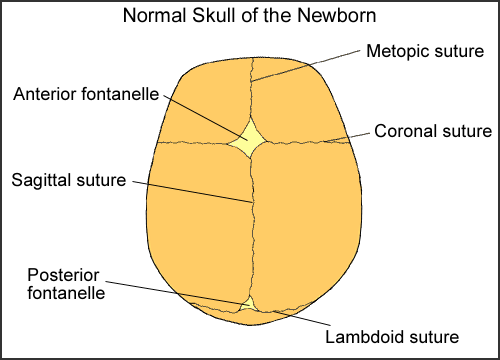
But now there's a new tie between big brains and walking upright--offered up in a  new paper just out in PNAS--and it's based in the human-, not ape-, like tendency to fuse the metopic suture later in life, to delay the close of what starts as a hole in the top of a baby's head known as its anterior fontanelle. The authors suggest that we need this hole in our head to exit our mother's bipedally-adapted birth canal safely and we also, as they suggest, need it to grow up to be an encephalized creature.

According to the authors, the "Taung child", an Australopithecus africanus kid (a member of a well-known bipedal hominin lineage) had an unfused metopic suture, left as an imprint on the fossil brain endocast.

Raymond Dart with the Taung child fossil.  http://en.wikipedia.org/wiki/File:Raymond_Dart_with_Taung.jpg 
Seven other australopith and Homo fossils are also described in the paper as having unfused metopic sutures. You might too! The odds are small, but since you started with a hole in your head as a baby, you could still be walking around with it unzipped.


To any chimps reading this, your metopic suture most likely closed just after birth and before your first deciduous molar erupted. But for 90% of humans (as reported in the paper), the suture closes later, after the eruption of the first deciduous molar. There’s a much slower fusion rate in humans than in chimpanzees.

However, to interpret the Taung child’s anatomy, things get a bit dicey, like things just love to get with hominin fossils. So often they can go either way: chimpy or humany.

Check out the figures below. A is for Pan troglodytes (common chimps) and B is for Homo sapiens. Those are frequencies of metopic suture fusion per dental age group. By listing them this way, instead of by chronological age, we're able to compare between two species that grow at different rates but share the same pattern of dental eruption. Chimpanzees grow up faster than us and experience earlier metopic suture fusion than us. Flipped around, humans grow up slower than chimps and experience delayed fusion of this suture compared to them. The Taung baby's dental age category is starred (*) at the "M1" stage in A and B. (The Taung child died at around 3.8 years of age, when its first permanent molar, M1, was erupted.)
Because it's more likely you'll find a human at that age (*) with an unfused metopic suture than a chimp, the researchers leaned toward calling the Taung child's state human-like, rather than ape-like. They backed that assertion up by listing seven other late Pliocene-early Pleiostocene hominins with unfused metopic sutures... it's a trend in the hominin lineage that begins with some australopiths, like the Taung child, they say.

"The presence of a still patent fontanelle and of a partially fused [metopic suture] in the Taung child, and the incidence of unfused [metopic sutures] in five adult and two other younger Australopithecus/ early Homo specimens is thus taken as evidence that a human-like pattern of late [metopic suture] fusion was already present in mid-to-late Pliocene gracile hominins."

Okay. Intriguing! But now we must explain!

[This is the part where, if you listen very carefully, you can hear the collective curmudgeonly groans from within and beyond the walls of paleoanthropology.]

Enter the new hypothesis for encephalization based on the late fusion of metopic sutures. The authors nod to two papers that offer "adaptively neutral" explanations for late metopic suture fusion but argue that the fossil evidence combined with the differences observed in chimps and humans beg for an adaptive explanation. (This tack is unsurprising given how paleoanthropology generally operates.)

The authors offer us three adaptive hypotheses to explain late metopic suture fusion:

1. Reorganization and expansion of the frontal neocortex (explains late metopic suture fusion)
Something about the changing and enlarging frontal cortex required changes to the cranial bones, how they form, grow, and fuse.

2. The difficulty of giving birth to large-headed neonates through birth canals that were reconfigured for bipedalism, the “obstetrical dilemma” (explains late metopic suture fusion)

The squishy neonatal head, thanks to the fontanelle,  "probably occurred in conjunction with refining the ability to walk on two legs," Falk (the lead author) said to the media. "The ability to walk upright caused an obstetric dilemma. Childbirth became more difficult because the shape of the birth canal became constricted while the size of the brain increased. The persistent metopic suture contributes to an evolutionary solution to this dilemma."

The trouble with this hypothesis as applied here is, although we know modern humans have a tight fit at birth now, there's little evidence for a tight fit between neonate and birth canal during australopith times.

And you can't help but wonder whether a squishy head was, or still is, required for successful birth. Do children suffering from craniosynostosis require a c-section to be born? Also, since the metopic suture fuses after chimpanzee birth, are we certain they aren't squishing their brains as they exit their relatively roomy birth canals? These questions may sound silly, but they're illustrating the built-in assumptions of the paper (or my ignorance about squishiness of baby heads).

The squishy head may be helpful during childbirth, but if it's occuring as early as australopith times, an adaptive explanation as a "solution" to an obstetrical dilemma is hard to swallow. That is unless DeSilva's estimates cited by the authors-- that australopiths had large neonates and tight fits at birth--are correct.

3. High early postnatal brain growth rates (explains late metopic suture fusion)
We know that humans have high rates of postnatal brain growth and this is what a lot of the news media picked up on: Your baby's head has gaps between the bones so the brain can grow like crazy after it's born to the gargantuan size of an adult human brain. As established in hypothesis #2, the need for the fontanelles in the first place is the crunch at birth thanks to the obstetrical dilemma, implying that without the pressure to be born small enough to escape the bipedal birth canal, we'd grow larger fetal brains in the womb.

So with this new paper we're presented with something even more fundamental than the notion that bipedalism as a necessary precursor for technological, ecological and social selection pressures for encephalization (as covered above): The tight fit at birth, caused by antagonistic selection for bipedal pelvic anatomy and large neonatal brains, created the selection pressure for a squishy neonatal head (which is facilitated by the fontanelles) and because of that roomy cranium, postnatal growth rates were able to ramp up in selective environments that favored encephalization.

So I'm left wondering, Do we need a hole in our head to be born successfully? Do we need a hole in our head to be encephalized? If the answer to both of those is yes, then what is a hole in the head doing in a hominin genus that may not have had much difficulty with childbirth and was hardly (if at all) encephalized? And, given the overlapping chimp and human fusion patterns, how can we be sure this feature on Taung is humany and not chimpy?

And, further, you can't (or at least I can't) help but wonder if there's a biomechanical/functional explanation for late metopic suture fusion, given how feeding behaviors and masticatory muscles put stress on the cranium. The skulls of australopiths and other hominins experienced stresses differently than chimpanzees. These differences may have begun as early as the nursing stage. Could this have anything to do with delayed fusion of the sutures? (here's just one study I found that addresses these kinds of questions)

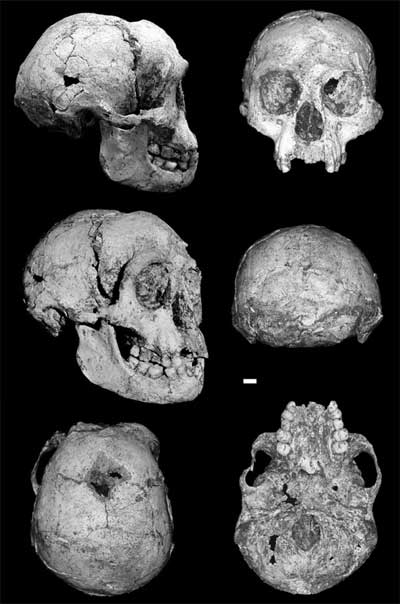
And finally, it's hard not to link Falk (the lead author) to her research on Homo floresiensis. The hobbit (LB 1) looks like it has a fontanelle, something the disease-hypothesis folks point out is consistent with their perspective, and that’s one reason why I assumed these authors are onto this topic.

But LB 1 is conspicuously absent from the laundry list of hominin fossils in the supplementary section. Either they're saving what they've got on metopic suture and fontanelle anatomy in H. floresiensis for an upcoming paper or they just didn't think it was worthwhile to include this specimen. After all,  the latest paper on hobbit anatomy claims that the hobbit's "fontanelle" isn't real. Peter Brown writes, "direct examination of the asymmetrical hole in the posterior frontal of LB1, supported by CT scans, clearly indicates that this is the result of post-mortem excavation damage and is definitely not an unfused anterior fontanelle." (2)

Good thing, because if the hole in LB 1's cranium is of biological and not of taphonomic origin, then who knows how anybody'd explain its adaptive significance in such a tiny-brained hominin.

But, going way back to Taung and the australopiths: They were, after all, bipedal and the big brain train had to pull out at some point!

And, stay tuned. I got a tip from one of the authors about a paper coming out soon that demonstrates how weak the obstetrical dilemma hypothesis is, for explaining fetal size and growth, given the current evidence and given what we know about maternal metabolism.

Notes
(1) Of course, these hypotheses don’t represent all of paleoanthropology. I just intended to cover the major bases. And you need to consider what many paleoanthropologists assume which is that brain tissue is expensive so something extraordinary must have kept up selection on its increasing size for the last 2.5 million years. The assumption is that if brains were cheap, everyone would have big ones, but I don’t buy that. I think it's clear that other species aren’t encephalized because they don’t have to be. They do just fine without big brains. We have a rather warped perspective on selection for encephalization, thanks to our presentism and our big brains.
(2) Thanks to K. Baab for the tip.

Friday, March 30, 2012

Forget bipedalism. What about babyism?


First, a little time travel experiment...

Here's a newspaper headline and blurb from 709,987 CE: 

Hominin fossils dated to 2,012 CE show arboreality


Artists have made a realistic reconstruction (above) of an early human species based on the anatomy of the latest fossil discovery in paleo-Alabama by a team of paleontologists. These primitive hominins were still climbing trees!

source
In yet another reconstruction of this primitive species (above), an adult forages for honey by scrambling nimbly up a tall tree trunk. 


In other paleontology news, a team of scientists determined that a Morrocan variety of domestic goat, from roughly the same primitive era, could adeptly climb small bush-like trees.
**
*A-hem*

I promise that's not sarcasm or postmodernism! That's just me trying to jossle you loose of some traditional assumptions and spark you to wonder about how we know what we know about the functional relationships between anatomy and behavior.

I'm thinking about this because of the latest and greatest news in the world of paleoanthropology, published this week in Nature and here's a nice video to bring you up to speed:


If this Burtele foot fossil represents a hominin, it's different enough in anatomy (and the functional interpretation of that anatomy) to be considered something separate from other hominins on record.

It's this whole other animal.

As of now, all hominins at this time in the mid Pliocene (the foot is dated to 3.4 mya) belong to the genus Australopithecus and are only known from sites in East and South Africa. Perhaps the Burtele foot is another species that is not A. afarensis (which supports long-existing arguments that there are two lineages at this time) or maybe this is an ancestor to the Paranthropus radiation that occurs in the early Pleistocene. Or maybe it's not even a hominin, because the foot is very ape-like. Moreso than any australopiths on record.

Chimpanzee displaying it's non-human-like hallux (big toe). 
Can we tell what this animal is? Without teeth and cranial bones--our gold standard for identification and distinction--can we surmise what kind of creature this Burtele foot belonged to?

For starters, if it's to be deemed a "hominin," we should determine what exactly about this foot is human-like.

In terms of metrics, the Burtele foot shares traits with humans but these are also shared by gorillas and sometimes chimpanzees and sometimes old world monkeys too. The striking similarities between human and gorilla feet have been known since the earliest comparative anatomy studies and it was only a matter of time before a new primitive fossil brought the problem to heightened prominence.

For the qualitative traits, more similarities appear to be shared with the famous "Ardi" skeleton from about a million years earlier in time (belonging to Ardipithecus ramidus) than with extant humans.

According to the paper, there appears to be few derived, hominin-specific features in this foot. And that's even if you are on board with calling Ardi a hominin. Granted, we expect more primitive hominins to share few of those traits with us and traits evolve mosaically, even within the foot. And granted, not all hominins contributed directly to our evolution, so we might find species on the hominin branches of the TOL that share no derived features with humans. Still, the case isn't very strong for this Burtele foot being a hominin.

One of the reported hominin-like traits has to do with the shape and orientation of the proximal phalangeal joint where it articulates with the second metatarsal head. This appears to indicate that the foot was experiencing more toe-off during walking, more like human walking than like ape walking since it's not the condition found in ape feet. This functional interpretation seems to be based on that made of Ardi's foot. Unfortuantely I don't think anyone's looked at the biomechanics of this joint in apes (and ape feet) as they walk bipedally, yet. (But I could be wrong!)

Also, although the degrees of torsion in the second metatarsal is ape-like, the torsion in the first metatarsal is more humanlike. (Torsion describes the orientation of the proximal joint surface relative to the orientation of the head. The Burtele foot's MT2 and MT4 are reported to have less torsion than that seen in African apes (where this is associated with a grasping orientation), yet are still significantly twisted compared to human metatarsals.)  The torsion in the big toe (hallucial metatarsal) is reported to be unlike that of African apes, and presumably more like humans? It's not clear. But the actual measure of the degree is not included in Table 1, nor is it demonstrated in the Supplemental section as implied. So we have to take their word for it. And by the look of the Burtele first metatarsal in the photos, that's probably not a problem.*

So there are some leads away from extant African apes and weak ones toward Ardipithecus and possibly extant humans, but what the paper demonstrates better than the hominin status of the Burtele foot is just how difficult it is to pin down hominin-ness.  We don't always know it when we see it.

For most of us and I assume the authors of the paper, this is what makes paleoanthropology so fun! But it's also why we fight.

That's not because we don't know how anatomy and behavior are linked in extant humans, apes, monkeys, etc... we seem to have a pretty good handle on that. At least big picture. The problems arise when you zoom in. Are chimpanzees really arboreal? Yes. Are they really terrestrial? YES. Same for gorillas.

So reconstructing an evolutionary scenario in which our hominin ancestors went from a state of arboreality to a state of terrestriality is not that simple. The Burtele foot describers definitely understand this. It's just the popular media that doesn't have the time or the inclination to get this. Hence my intro above.

But that intro up there with the futuristic newspaper wasn't purely reaction-against-media-reaction. It's also me reflecting on issues closer to home for paleoanthropologists.

Do primitive "arboreal" traits in hominin skeletons really correlate with arboreal behaviors? Or are they ancestral relics? We don't do much climbing anymore but we have all kinds of anatomy that links us to our tree-hugging relatives, and presumably to our shared tree-hugging ancestors.

So at what point do we recognize primitive traits as being only that? Why must all traits we observe in extinct animals be so USEFUL?

The answer is.... because that is the only way to go about these functional studies. By definition functional anatomy indicates FUNCTION. So we go in with a bias toward identifying function, NOT with an aim to identify primitive relic anatomy that just happens to work for the animal. The latter is so much harder to perceive although one might argue it's what our null hypothesis should be. It's easier to assume that if an animal has the anatomy, then it's functional and therefore it's "for" doing whatever it is that it does with that anatomy.

Who cares about these subtly different approaches to comparative anatomy and evolutionary reconstruction?

Well if you're trying to determine when bipedalism became habitual and when hominins stopped relying on trees for foraging, fleeing, socializing, and nesting, then it matters whether functional anatomy is function or whether functional anatomy is just hanging on. (pun intended) Welcome to the nightmare that is paleoanthropology!

So where does the Burtele foot leave us?
1. Looks like we've got a separate ape-y thing that's not Lucy's species (A. afarensis) living around the same time and place as Lucy and her ilk.
2. Looks like whatever this animal is it doesn't have the few derived features found in some australopith feet. (those are even debated...)

But speciation, co-habitation, and bushy hominin phylogenies aren't even the coolest part of this story.

The two distinct foot morphs offer another kind of insight.

Lemme show you.

First of all, what is arboreality and how much arboreality is enough to require specific grasping adaptations in the big toe?

We know that cercopithecines (like macaques and baboons) vary pretty widely in their degrees of arboreality and terrestriality, but regardless, they're good in the trees and they're good in the trees despite their short and diminutive big toes! Arboreal behavior can be accomplished via many different evolutionary processes revealed to us via skeletal anatomy.

Here are two baboons showing off their small big toes.


Baboons are considered to have terrestrial adaptations in their feet that are similar to those in humans like with their shorter phalanges, but they're also the opposite of humans with their short, not long big toe.  Like with arboreality, terrestriality works via many different evolutionary processes that are revealed via the skeletal anatomy...and this goes beyond primates. (The crux of it all for human evolutionary reconstructions is determining how bipedal terrestriality differs from quadrupedal terrestriality.)

Gibbons (apes) are super aboreal, but their locomotion biases grasping hands, not feet. However, their suspensory behavior does use the grasping big toes.

Here are some gibbon feet displaying their big big toes.


Here's a film showing a gibbon using its grasping big toe: http://www.arkive.org/bornean-gibbon/hylobates-muelleri/video-08a.html

Conclusion: The arboreal use of the strong grasping big toe is not necessarily about climbing or even walking on tree limbs;** it's probably more about suspension.  Suspensory behavior is typified by the gibbons, orangutans (many at least), and the rest of the apes and so is the grasping big toe. That's the strongest functional explanation for the ape's thumblike big toe.

Now, larger apes are not suspending as much with their toes. And they can get up into the trees just fine without grasping with their big toe.****

DeSilva (2008)
So think about who's doing much of the suspension particularly in African apes: Juveniles.


Suspending from vines and tree branches is one thing, but also, climbing trees with immature musculature is certainly helped by a grasping big toe.
And then of course, grasping not just trees and vines, but grasping mother is important as well.


Is there any way we can investigate this ontogeny-based hypothesis for a grasping hallux?

Let's consider the foot as a whole first, and then get back to the big toe as a grasping tool.

We can see whether foot size varies during ontogeny in different primates.

I have looked at the size of macaque (monkey), gorilla and chimpanzee (Pan) feet through ontogeny (granted, a cross-sectional sample, not a longitudinal one).***

Because macaques grow up faster than the two apes which share developmental pace, here's how I lined up the age groups (1-5; 1 = infants and 5 = adults) so that I could fairly compare growth among them.


And here are the results where I compared relative foot size during ontogeny (over age groups 1-5). Femur length was my measure for overall body size.


The box and whisker plots show you how macaques are born with big feet relative to body size, relative to adult proportions. The ontogenetic changes in proportions that they experience, over the age groups I've constructed, are significant according to the ANOVA.

By contrast, and granted I had small samples of chimp and gorilla infants ... those apes are born with adult foot size proportions which are small relative to what macaque infants are working with. Larger, more adult feet at birth contribute to macaques' relative behavioral precociality compared to young gorillas and chimpanzees who are relatively altricial. With those big feet macaques can better navigate a big world.

Chimps (and especially humans) are relatively behaviorally altricial at birth compared to macaques. Neurological development factors into this, but the small feet (in a big world) are also part of that altricial package.


Now, to bring this back around to grasping thumb-like big toes in apes!

During their longer periods of infant and juvenile dependency, gorillas and chimpanzees spend quite a bit of time clinging to mom. Big feet for body size would help cling to mother like with macaques. On a relatively small foot for body size--and in a relatively more dependent baby which is taking longer to achieve independence and is requiring more mother-infant care and bonding and learning--the thumb-like grasping big toe would come in handy (or footy).

(We've got some residual ability still...see here.)

In this scenario, the grasping hallux is an adaptation for surviving the earliest stages of life as a small footed more vulnerable, slower-developing, extensively dependent ape infant.

So what does this have to do with Pliocene hominins?

First of all, it means that morphology should be considered in an ontogenetic context so that our adaptive hypotheses and evolutionary reconstructions are as robust as possible.

And second of all, if you're basically a dedicated biped and you've got free hands to help carry your baby (rather than demand it hang on for dear life)  then selection for grasping ability in babies might be relaxed. Meaning that relaxed selection on grasping foot anatomy could have preceded any selection for all the derived features we associate with bipedalism. This isn't new territory. Most of us assume that bipedal behavior preceded the refined (as much as it can be considered refined) bipedal anatomy.

To sum up, at some point hominin infants lost the ability to cling to mother and at some point we lost our foot thumbs. These evolutionary events might be related.

What does this mean for Lucy and her kind (with their non-grasping feet) and for the Burtele foot's kind (with their foot thumbs)?

Lucy would have had to care for infants more intensely than the Burtele gang. These species would have had different mother-infant interactions.


Babyhood and motherhood...that's a whole lot more profound than straight up metatarsal anatomy.


*I was derided for not strongly-enough demonstrating claims like this in my one attempt at publishing fossil foot bone descriptions. I trust this was an oversight in moving information to the supplementary section or collateral damage due to some other editorial process. Or it's my inability to read this paper properly!
**Wunderlich (1999) measured metatarsal head pressure during walking on the ground and a pole (branch) in chimps and found that the peak pressures for MT1 were higher on the ground than on the pole. And that's not just absolutely, but relative to to the other MTs.
***Dunsworth HM. 2006. Proconsul heseloni feet from Rusinga Island, Kenya. Doctoral dissertation, Pennsylvania State University.
****Correction: should have better worded what I see as a diminished role of the grasping big toe, not the elimination of it.


"Bless the blog. Nothing else like it."

Note on the missing images: Apologies for the now dead links to once-adorable images! When I originally posted this piece, I didn't know how to best post images that could potentially disappear in the future from their source sites. 

Thursday, October 22, 2009

Ignoring the Aquatic Ape Hypothesis

Humbled by the previous post, here's my contribution to this week's discussion on what science is and is not...


After the umpteenth friend sent me the link to Elaine Morgan’s TED Talk about the Aquatic Ape Hypothesis (AAH), I finally watched it today and I thought I'd share a few things that have been on my mind since last April.


That’s when the annual meetings of the American Association of Physical Anthropologists were held in Chicago. As usual, I heard many fascinating talks including one where I was accused of ignoring the Aquatic Ape Hypothesis.


It wasn’t just me. The speaker admonished the entire ballroom for ignoring the “best idea in science,” which explains uniquely human traits by hypothesizing that they evolved during an aquatic phase of our past. The AAH was first described in an article in New Scientist by Alister Hardy in 1960 and has been championed ever since by Elaine Morgan in her books and most recently in her piece in New Scientist.


The speaker explained how years ago he read about the hypothesis, fell in love with the "best idea in science," and then went to graduate school to work on it - not a wise framework for a research talk. You’re not supposed to be outwardly infatuated with your hypothesis. By doing so, the speaker removed a healthy amount of objectivity from his research. The audience was now suspicious, which was a shame for the presenter's sake because this was one of the few times someone had actually attempted to test the AAH. (The study measured locomotor efficiency of people walking in water. Yes, there are theoretical problems with this, but if done from an objective point of view, and with a well-designed study, it could be useful.)


Sure, you’ve got to be dedicated to asking the questions and to finding the best possible evidence to answer those questions. Why else would you toil away? But once you admit your personal bias toward one particular outcome, no one will take your results as seriously as you would like. They may even dismiss them out of hand. They may ask, how can we be sure that this person did not throw out all the data that falsified their idea?


Science can't move forward very well if we have to repeat everything that everyone does. So system checks, like upholding objectivity and enduring peer-review, are built into the scientific process to make sure knowledge advances effectively.


After celebrating a laundry list of scientific progress (e.g. realizing the heliocentric solar system, discovering the DNA molecule, walking on the moon), the speaker expressed his frustration with the paleoanthropological community. With all the time we have spent trying to explain the evolution of bipedalism, he asked us, why haven’t we found the answer to “why”? (Elaine Morgan took the same tack about human "nakedness" in her latest New Scientist piece linked above.)


My answer to his challenge is that it's not our failure, but the constraints on historical sciences. We will probably never know why the first apes walked upright. We will only come closer to knowing as we figure out what anatomical and genetic changes occurred, and in what sequence, during the process. With increasing knowledge about the paleoenvironments in which hominins lived, we will understand better the selective pressures they experienced, but it will be difficult to link these definitively to the origin of bipedalism (especially since it's just a continuum anyway... other primates already use bipedal postures and behaviors so what separates the first bipeds from those other guys isn't a whole lot!).


Paleoanthropology is not rocket science where you can control events in the present or future. We face an entirely different challenge: reconstructing events that happened millions of years ago. Do you think that some creature who lands on the moon millions of years from now and finds the astronaut bootprints and asks "why?" will guess that the answers are "because it was neat and to collect rocks and to put up a flag and to hit a golf ball (miles and miles and miles) and to beat the Russians, etc..."?


The how of moonwalking would be tough to piece together. But the why might be downright impossible to fully understand. And so far according to the evidence we’ve got to work with, the how of bipedalism is coming together but the why is pretty slippery.


Supporters of the AAH, like the presenter at the conference and like Morgan, are fond of claiming that the scientific community’s critical reaction is actually some sort of visceral, emotional, inexplicable, unfounded tantrum.


Here is one way of testing whether the problem that scientists have with the AAH is scientific or just some collective bias. What if somebody presented another idea, not the AAH, the way that the AAH has been presented? What if I presented something like this?


It’s mind boggling that nobody has figured out what the earliest ape looks like. Some of you think Proconsul is one, but others think it’s a monkey. What’s wrong with you? Well, when I read Alan Walker’s interpretation of Proconsul being an ape, it inspired me to apply to graduate school to work with him so that I could prove that Proconsul was an ape. So I did my dissertation on the feet and hindlimbs of some new fossils from Rusinga in order to show everybody what a great idea Alan Walker had about Proconsul being the earliest ape and not a monkey. Here’s what I did. And here are my results. Clearly Proconsul is an ape. Any questions?*


Would you like it if I had made a presentation like that? If your answer is no, then, along with a majority of the audience, some of whom were quite vocal, you probably wouldn’t have liked the AAH presentation that I heard at the conference.


The AAH gets much more play in pop culture than it does in classrooms or professional meetings. The audience’s charmed reaction to Elaine Morgan’s lovable personality during her TED Talk explains much of the AAH appeal.


I don’t intend to write a thorough or even partial critique of the AAH. John Langdon has offered one and there is an enormous website dedicated to critiquing it (both linked in 'Further Reading' below). But there are some points in Morgan’s TED Talk that are worth discussing here. Morgan lists five human traits that, according to comparative anatomy and behavior, support the AAH. (Morgan's evidence is in bold; my comments are in italics.)


All hairless mammals are aquatic or have aquatic ancestors, except for burrowing animals like the naked mole rat. What about elephants and rhinos you ask? New discoveries and interpretations of the fossil records for elephants and rhinos support her claim. Morgan lists pigs that wallow as part of her rule linking nakedness and water, but hardly anyone would suppose that selection for wallowing drove fur loss in pigs. And what about hairless cats and dogs? We managed to make them from a non-aquatic ancestor. Morgan says that people can always find exceptions to the rules in arguing against the AAH and I admit that I’m guilty of that. However, making hominins to be the only aquatic primate is a pretty big exception. So which is it: do we follow general patterns or do we take exception where it fits our preferred explanation?


Nonhuman primates walk bipedally to cross bodies of water or to feed while standing in water. They also walk or stand bipedally to do many other things on land, including threatening, mating, foraging, practicing vigilance, carrying things, and throwing.


Humans have a fat layer under the skin that is unique among monkeys and apes and is like whale blubber. Some other explanations for our fat layer have to do with feast/famine survival adaptations and with supporting our large expensive brain, particularly during infancy when growth is intense.


Humans can hold their breath on purpose and the only other animals, she says, that do this are diving animals and diving birds. She links this to speaking ability in humans (not the other animals) and it’s not clear which comes first, speaking or controlled breathing/diving. I’m sure it’s explained on one of the websites.


Humans have a “streamlined” body. Morgan asks us to imagine what a gorilla might look like diving into the water. This is supposed to illustrate how silly that sounds and, thus, how made-for-water we are. No one can deny that this is charming.


Next Morgan says that paleoanthropologist Philip Tobias, science philosopher Daniel Dennett, and naturalist Sir David Attenborough have all “come over” to the AAH. Although I do not doubt her claims, nor know what their positions are, I have noticed a pattern in what I have read on the internet; if anyone acknowledges any one of the AAH arguments, then they can be considered a convert. And when the hypothesis covers the full spectrum of hypothetical ancestors from fully aquatic all the way down to occasional aquatic forager, and this ancestor could have existed, seemingly, at any point along the hominin lineage, well that's a broad enough net to catch nearly every reasonable person.


This “us” and “them” perspective seems to be what's feeding Morgan’s beef with science - its metamorphosis into what she calls a “priesthood”.


From this perspective, it’s somebody else's fault that a hypothesis is weak, instead of first assuming that the hypothesis itself is flawed. Sure, people are vectors of science, but when a hypothesis doesn’t hold weight, it doesn’t mean then that the “priesthood” is out to get the hypothesis or its creator. If you're reminded of the Intelligent Design movement here, you're not alone.


Maybe someone clever could come along and change the fate of the AAH and Morgan is right to say so. However, in the meantime, a person must participate in the scientific process before they can criticize and analyze the evaluators (who haven’t had much to evaluate with the AAH).


Science is no different from most social animal play: You have to obey the rules to participate in the game. Then, if you don’t provide a feasible test or actually test a hypothesis, well, you’re going to sit the bench for a while. Everyone feels ignored until they score, or at least until they get on base.


*In the feet, Proconsul looks like both monkeys and apes, which is what you might expect to find in something that existed so close to the evolutionary divergence between monkeys and apes.


~~Thanks to Kevin Stacey for his terrific input.~~


Further reading


Langdon, John H (1997). Umbrella hypotheses and parsimony in human evolution: a critique of the Aquatic Ape Hypothesis. Journal of Human Evolution Vol:33 Pages:479-494


A website dedicated to critiquing the Aquatic Ape: http://www.aquaticape.org/


A website dedicated to supporting the Aquatic Ape (where you can find Hardy’s original paper): http://www.riverapes.com/