In the sad way that science has become ever more bourgeois, Nature, itself now largely a checkout- counter mag, has a feature editorial on plagiarism (p 435, 28 March 2019). The author, Debora Weber-Wulff, seems to specialize in sleuthing academic verbal cheaters, as if it is a new profession in itself. She goes over the various software developed to detect plagiarism in professional and student papers, and evaluates them and the detection problem itself. Commercial, profiteering, competing software--more than one--to detect academic cheaters!
The commentary mentions strategies that authors use to get multiple pubs on the same subject, and even seems to suggest that publishing an article from or part of your doctoral dissertation is a kind of plagiarism (who in recent memory has searched for or found, much less read doctoral theses after the defense?).
And now, the most bourgeois thing of all, in my opinion, is that there are conferences on academic integrity, and even they have their own plagiarism as the author relates! And as part of the new class system even in esoteric academia, she notes that those that were detected were "demoted" to mere posters. Surely I've mis-read this commentary. Surely!
Somehow, this seems just another routine story about academic life. Since it's basically gossipy, it takes place of honor in Nature. It's a kind of 'how-it's-done' review, as if cheating was as common as, say, making espresso. Can you imagine that such a thing would largely have been unthought of not many decades ago? It's true. I was there (and I didn't plagiarize!).
There must always have been some plagiarism, since there are always rogues. There have long been rewards to publish much the same paper in several different places, to reach different audiences in the days before web-searching. But it was likely much easier to detect real plagiarism, which was doubtlessly far less prevalent in the old days. At least that was my experience in my particular old days. There was no need for competing companies to profiteer by selling plagiarism-detecting programs! That almost institutionalizes cheating as a cat-and-mouse part of modern careerism, and a commentary like Weber-Wulff's that describes plagiaristic ploys almost helps one do it!
One, if not the main, reason for this situation is that far less was being published, less often, in fewer journals, and by far fewer players in a given academic arena. The players were much better known to each other, far fewer published more than an article now and then, and most readers knew the relevant literature (and each other). The pace was less. The Malthusian academic overpopulation didn't exist, so the competition was less (even if there were of course Big Egos competing). Publishers were mainly non-profit, careers less intensely grant-dependent (and grants were easier to get). The competition was more about ideas and actual substantive impact, and far less about academic score-counting (citations, publication counts, impact factors). Less pressure to survive, and less pressure to cheat. No first-semester graduate seminars on 'grantsmanship'.
....and no need for Nature to have a feature commentary on how to catch academic cheaters.
UPDATE:
Just after this was posted, a commentary appeared in Nature on a major academic fraud case:
https://www.nature.com/articles/d41586-019-01032-w?utm_source=twt_nnc&utm_medium=social&utm_campaign=naturenews&sf210300477=1
If we really want to encourage honor and honesty in science, we need to look not at the science but at the science culture, the money-driven, competitive, frenetic area--and Nature and its proliferating for-profit satellite publications is a culpable part of the problem. We need to cool down the temperature of the research industry. But to me that requires reducing the amount of selfish gain available--to investigators, journals, universities, equipment suppliers--the academic-industrial complex to pick up on Dwight Eisenhower's long-ago warning about military's similar excesses.
But where is the will to do this?

Showing posts with label nature. Show all posts
Showing posts with label nature. Show all posts
Wednesday, April 3, 2019

Tuesday, September 30, 2014
Notes for a late-summer's day.....
Well, it's a slow day, one of the last of warm ones for the year and I'm about to go for a bike ride, but before I go there are a few little things I'll quickly comment on.
One is the banner headline in the 12 September Science about a huge aquatic dinosaur, proclaiming "Giant dinosaur was a terror of Cretaceous waterways!" The Hollywood image of a massive terror is illustrated in the story; see below. Wow! One need not doubt that this was a nasty beast and a terror to its predators. But this is purportedly a science journal, not a Hollywood ad vehicle. Most species have predators that prey on them, and for those species, the predators are surely terrors. In this case, those relatively few species big enough to be seen by and yet not so agile as to escape from the giant dinosaur would be those experiencing terror. And, in fact, this huge predator of the waterways probably left the vast majority of waterway species alone and was not a terror for them at all! The same applies to the Cretaceous as to any period in the history of life.
We can wonder at how such a huge monstrosity of a species could evolve, much less swim, given the energetic, thermal, and mechanical challenges of being that big, not to mention of finding enough to eat. But we don't need the melodramatic drawing to make the point (after all, what was found were bones, not the flesh). We may learn from the history this shows, but could do without the histrionics.
Next on the list is the dramatic cover of Nature on 18 September. This figure reports results that use genomic sequence data to argue that modern Europeans carry genes from three different ancestral populations. The massive author list is another characteristic of modern science whereby if you as much as walk by the office where someone is working on the paper and ask what they're doing then you qualify as an author and can report to your Chair and Dean that you have a cover article in Nature.
The story reports that genetic data on modern European variation and from some ancient DNA sources suggests a melding of people migrating (or gene-flowing) in from three basic areas, a northern or Siberian, a more expected western European, and a Middle Eastern source. Taking place millennia ago, and/or over millennia, the result is that Europeans do not constitute a standing discrete 'race', but are a mix, the result of population history.
There is absolutely nothing wrong with this paper(as far as we can tell). But note that the cover illustrations (this is, after all a science journal) are again artist's reconstructions of our supposed distant ancestors, not the data themselves. This is taking reifying liberties with the science, something Nature does on a regular basis both with illustrations and catchy-cute pun-laden story ads on their covers.
One can and we think should ask why, unless this is just more Hollywood and advertising, this is in any way a Nature cover story. Interesting as it is, it is no breakthrough of modern science (the issues and evidence have been building for decades--yes, decades). This story should be in a specialist journal (like the Am. J. Physical Anthropology), where before our marketing age it would have been. There, it would be seen by other anthropologists with expertise in human migration history, vetted for other interpretations if any, and would have become part of our knowledge of human origins, and material for textbooks. But it just doesn't warrant being splashed as if it is some sort of innovative discovery. Again, the nature of science has changed, and one can ask why we have moved in this pop-sci direction, and whether that's good.
Are we just too, too stodgy? Probably. But isn't the translation of science to videographic presentation a pandering to a bourgeois culture that is bored with details? Will it grab people and draw them into science? Even if it does the latter, which it may well, doesn't it give the impression that the daily work of science is exciting, and the technical demands of doing good science minimal? Or is it mainly a way to employ graphic artists and sell magazines? Of course, this is how our culture works in the Advertising Age, so the answer is probably moot.
Anyway, back out to the bike path and garden, on a day too nice to think about anything very technical, enjoying fall before it passes, and (today at least) getting out before our town is overrun with drunken football fans.
One is the banner headline in the 12 September Science about a huge aquatic dinosaur, proclaiming "Giant dinosaur was a terror of Cretaceous waterways!" The Hollywood image of a massive terror is illustrated in the story; see below. Wow! One need not doubt that this was a nasty beast and a terror to its predators. But this is purportedly a science journal, not a Hollywood ad vehicle. Most species have predators that prey on them, and for those species, the predators are surely terrors. In this case, those relatively few species big enough to be seen by and yet not so agile as to escape from the giant dinosaur would be those experiencing terror. And, in fact, this huge predator of the waterways probably left the vast majority of waterway species alone and was not a terror for them at all! The same applies to the Cretaceous as to any period in the history of life.
 |
| Artist's imagination, from the Science article, from their website |
We can wonder at how such a huge monstrosity of a species could evolve, much less swim, given the energetic, thermal, and mechanical challenges of being that big, not to mention of finding enough to eat. But we don't need the melodramatic drawing to make the point (after all, what was found were bones, not the flesh). We may learn from the history this shows, but could do without the histrionics.
Next on the list is the dramatic cover of Nature on 18 September. This figure reports results that use genomic sequence data to argue that modern Europeans carry genes from three different ancestral populations. The massive author list is another characteristic of modern science whereby if you as much as walk by the office where someone is working on the paper and ask what they're doing then you qualify as an author and can report to your Chair and Dean that you have a cover article in Nature.
 |
| Nature cover, 18 September 2014, from their website |
There is absolutely nothing wrong with this paper(as far as we can tell). But note that the cover illustrations (this is, after all a science journal) are again artist's reconstructions of our supposed distant ancestors, not the data themselves. This is taking reifying liberties with the science, something Nature does on a regular basis both with illustrations and catchy-cute pun-laden story ads on their covers.
One can and we think should ask why, unless this is just more Hollywood and advertising, this is in any way a Nature cover story. Interesting as it is, it is no breakthrough of modern science (the issues and evidence have been building for decades--yes, decades). This story should be in a specialist journal (like the Am. J. Physical Anthropology), where before our marketing age it would have been. There, it would be seen by other anthropologists with expertise in human migration history, vetted for other interpretations if any, and would have become part of our knowledge of human origins, and material for textbooks. But it just doesn't warrant being splashed as if it is some sort of innovative discovery. Again, the nature of science has changed, and one can ask why we have moved in this pop-sci direction, and whether that's good.
Are we just too, too stodgy? Probably. But isn't the translation of science to videographic presentation a pandering to a bourgeois culture that is bored with details? Will it grab people and draw them into science? Even if it does the latter, which it may well, doesn't it give the impression that the daily work of science is exciting, and the technical demands of doing good science minimal? Or is it mainly a way to employ graphic artists and sell magazines? Of course, this is how our culture works in the Advertising Age, so the answer is probably moot.
Anyway, back out to the bike path and garden, on a day too nice to think about anything very technical, enjoying fall before it passes, and (today at least) getting out before our town is overrun with drunken football fans.
Tuesday, December 27, 2011
Mars and Venus: thoughts on the nature and evolution of (sssh!) sex. Part I
In the wake of the revelation of alleged repeated sexual assault on young boys by a big boy who was a football player and legendary coach here at Penn State, we mused about what it all meant. An important part of that story was how the event released all sorts of other allegations of child sexual abuse, by men and women, and figures suggesting that a sixth to as much as a quarter of both men and women had been sexual abused as children.
That the issue expanded in this way could in part be a common phenomenon of the expansion of definitions to include more than gross physical abuse, copycat claims and the like. But even if that were partly true, still the prevalence of adult offenders is rather astonishing. Sexual abusers are not just very rare deviants, but part of the 'normal' (that is, usual) distribution of sexual behavior--so that child sexual abuse is apparently a common form of violation of law and publicly proclaimed standards.
This is not any sort of defense of child abuse, and we won't rehash our commentary here. But the point is that there is much more variation in sexual, or perhaps more properly put, gender-related behavior than is generally acknowledged.
Today's post was triggered by a thoughtful commentary by Andrew Barron and two co-authors, in the December issue of BioEssays, itself a thoughtful journal. The article is about how we are--or aren't--appropriately educating undergraduates about what is actually known about sex and gender and associated behaviors. As the authors put it:
The authors further state that
They go on to discuss how we could improve education by properly presenting what is now actually known about sexual behavior, sexual selection, and related topics. Most books cling to the simple ideas of classical Darwinism and their expanded theoretical treatment from a mathematical and selectinonist perspective often called 'evolutionary psychology' or 'behavioral evolution'.
There is the problem, according to Barron et al., of too rigid a separation of the sexes and much too rigid dichotomization of behavior that, within and among species, is far more variable, plastic, and less stereotypical than is the usual treatment--or caricature--that is offered. Not so long ago, Joan (once Jonathan) Roughgarden wrote a book, Evolution's Rainbow: Diversity, Gender, and Sexuality in Nature and People, similarly intended to debunk simplistic Darwinian treatments of sexual selection. We mention Joan née Jonathan because Roughgarden can be viewed as having personal, political, and experience-based, as well as scientific interests in a less rigid view of sexual identity and behavior. Points of view are rarely totally disinterested, and that might be expected to be a major aspect of a subject such as this.
In a somewhat similar vein, Barron et al. argue (and cite supporting literature) that "biological sex (and its associated traits)" are in fact "a fundamentally plastic reaction norm." They cite Kinsey research showing "significant and consistent variation in sexual behavior," and argue that too often sex and gender (sex-related behavior) are equated when they really are far less rigidly stereotypical in humans and in other species.
To the extent that they are on target, this is a problem because a rigid dichotomization of what is actually more overlapping and variable will lead to social definitions that categorize people, lead to laws setting legal limits and punishments, and restrictions on personal freedoms that are cultural reflections of mistaken biology.
Someone with strong selectionist views such as are common among evolutionary psychology or behavioral evolution may feel that these authors have overstated the amount variation, and that things are actually more dichotomous than Barron et al. allege or have similar reactions to Roughgarden's book. We are not expert in this area and we are less sanguine about adaptive explanations that are so common and, we feel, weakly supported but too strongly argued in evolutionary psychology. That difference aside, however, the point here is that if one wants to understand sex and gender behavior in our own society (forgetting strutting peacocks and bright red male cardinals), we would do well to understand what is actually going on in Nature, rather than what our culture considers 'right', 'normal', or 'pathological.'
Barron et al.'s point is that education is doing a disservice to the variation that exists. They identify areas of sex and behavior that they feel should be included in modern college courses on the subject that would properly reflect the variation seen in Nature. Their concern is biological factors (not just cultural ones in humans) that affect sex and gender beyond the mechanics and genetics of reproduction. An example is the controversy over the genetic causation of homosexuality ('gay' genes). They find that psychology texts do a better job of this but that most anthropology and especially biology texts fail their test.
But what does this have to do with sexual abuse of children? In Part II we'll return to a point we made in our initial Sandusky-related blog-post.
That the issue expanded in this way could in part be a common phenomenon of the expansion of definitions to include more than gross physical abuse, copycat claims and the like. But even if that were partly true, still the prevalence of adult offenders is rather astonishing. Sexual abusers are not just very rare deviants, but part of the 'normal' (that is, usual) distribution of sexual behavior--so that child sexual abuse is apparently a common form of violation of law and publicly proclaimed standards.
This is not any sort of defense of child abuse, and we won't rehash our commentary here. But the point is that there is much more variation in sexual, or perhaps more properly put, gender-related behavior than is generally acknowledged.
Today's post was triggered by a thoughtful commentary by Andrew Barron and two co-authors, in the December issue of BioEssays, itself a thoughtful journal. The article is about how we are--or aren't--appropriately educating undergraduates about what is actually known about sex and gender and associated behaviors. As the authors put it:
Research over the last decades has stimulated a paradigm shift in biology from assuming fixed and dichotomous male and female sexual strategies to an appreciation of significant variation in sex and sexual behaviour both within and between species. This has resulted in the development of a broader biological understanding of sexual strategies, sexuality and variation in sexual behaviour. However, current introductory biological textbooks have not yet incorporated these new research findings.
The authors further state that
Darwin’s strict view of male and female roles most likely reflected the social constraints of his time, yet these stereotypic assumptions have influenced evolutionary and biological research for decades. Darwin characterised males as competitive and eager in the pursuit of females, while females were described as passive, coy and choosy. Darwin’s theory of sexual selection has been enormously influential and still enjoys tremendous research discourse.
They go on to discuss how we could improve education by properly presenting what is now actually known about sexual behavior, sexual selection, and related topics. Most books cling to the simple ideas of classical Darwinism and their expanded theoretical treatment from a mathematical and selectinonist perspective often called 'evolutionary psychology' or 'behavioral evolution'.
There is the problem, according to Barron et al., of too rigid a separation of the sexes and much too rigid dichotomization of behavior that, within and among species, is far more variable, plastic, and less stereotypical than is the usual treatment--or caricature--that is offered. Not so long ago, Joan (once Jonathan) Roughgarden wrote a book, Evolution's Rainbow: Diversity, Gender, and Sexuality in Nature and People, similarly intended to debunk simplistic Darwinian treatments of sexual selection. We mention Joan née Jonathan because Roughgarden can be viewed as having personal, political, and experience-based, as well as scientific interests in a less rigid view of sexual identity and behavior. Points of view are rarely totally disinterested, and that might be expected to be a major aspect of a subject such as this.
In a somewhat similar vein, Barron et al. argue (and cite supporting literature) that "biological sex (and its associated traits)" are in fact "a fundamentally plastic reaction norm." They cite Kinsey research showing "significant and consistent variation in sexual behavior," and argue that too often sex and gender (sex-related behavior) are equated when they really are far less rigidly stereotypical in humans and in other species.
To the extent that they are on target, this is a problem because a rigid dichotomization of what is actually more overlapping and variable will lead to social definitions that categorize people, lead to laws setting legal limits and punishments, and restrictions on personal freedoms that are cultural reflections of mistaken biology.
Someone with strong selectionist views such as are common among evolutionary psychology or behavioral evolution may feel that these authors have overstated the amount variation, and that things are actually more dichotomous than Barron et al. allege or have similar reactions to Roughgarden's book. We are not expert in this area and we are less sanguine about adaptive explanations that are so common and, we feel, weakly supported but too strongly argued in evolutionary psychology. That difference aside, however, the point here is that if one wants to understand sex and gender behavior in our own society (forgetting strutting peacocks and bright red male cardinals), we would do well to understand what is actually going on in Nature, rather than what our culture considers 'right', 'normal', or 'pathological.'
Barron et al.'s point is that education is doing a disservice to the variation that exists. They identify areas of sex and behavior that they feel should be included in modern college courses on the subject that would properly reflect the variation seen in Nature. Their concern is biological factors (not just cultural ones in humans) that affect sex and gender beyond the mechanics and genetics of reproduction. An example is the controversy over the genetic causation of homosexuality ('gay' genes). They find that psychology texts do a better job of this but that most anthropology and especially biology texts fail their test.
But what does this have to do with sexual abuse of children? In Part II we'll return to a point we made in our initial Sandusky-related blog-post.
Tuesday, May 31, 2011
Another F-word of Evolution
I already fingered “fittest” and “favored” as f-words of evolution and here’s a third: forwards.
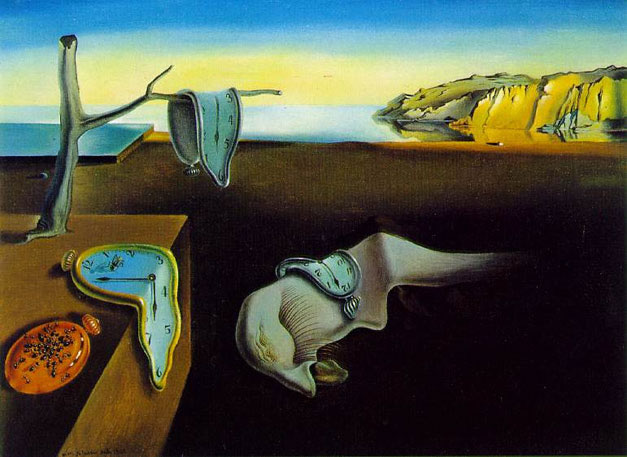
You don’t hear this one as much, but the concept infiltrates and sabotages much of our evolutionary thinking, limiting our understanding of nature, and, worse, leading us down that dangerous path to apathy, hate, and violence.
Here's the trouble with forwards and evolution.
Time goes forwards. It's singular and linear. You might call it an arrow (like Carroll) or persistent (like Dali), but you wouldn’t call it progressing or progressive. That is, a minute now isn’t any better than a minute 30 minutes ago. A minute now isn't an improvement over a minute 30 billion minutes ago.
This is a very simple, value- and progress-free understanding of forwards that isn't transferred onto biological evolution.
Instead, with biology we equate forwards, or the passage of time, with progress but this is a biased view of nature.
Time goes forwards. Complexity requires time. Okay.
Yet, onward-and-upward-ness is our invention. It's a cultural notion, that we can't help but project onto nature. And if you see traits changing through time as each phase being better than the next, as being a part of some cosmic progress, then you’re falling into a dangerous trap.
While you're trapped by forwards-thinking, you might assume that:
(a) prior states of traits were worse than present ones
(b) losing a trait is bad
(c) traits that are not as complex/large/fast/furry/slimy/etc as in prior states are somehow lacking
(d) present traits that resemble earlier versions are somehow lacking, in other words, "primitive" traits are valued less than derived ones.
The last one can rear its ugly head when we naively or carelessly use our completely acceptable evolutionary jargon to describe human variation: Some people are derived at trait X, while others are "primitive."
(Can you call it an f-word if it starts with a p? Because "primitive" might need to get censored from evolution-speak too.)
While you're trapped by forwards-thinking, you might refer to early hominids as “proto-humans” implying they’re an imperfect draft or prototype and that they're not quite perfect or human. If this is true, then we’re proto-Pauls.
Try this. Get in your DeLorean, and set the dashboard to 50 million years ago. Make sure your flux capacitor is engaged and then drive 88 mph down your street and... Voila! You're back in time. Now, are all the animals drooling all over themselves, barely able to eat, walk, or do whatever it is that they do?
Of course not. They’re getting along just fine.
Evidence? Look around you in the year 2011. Nothing would be hunky dory now if nothing was hunky dory in the past.
Yet, 50 million years ago is full of half-baked, inadequate organisms like “proto-whales” and “proto-lemurs” and “proto-bears.” That’s because we have few ways to describe them in such a way that links them to their present-day relatives. They're ancestors or relatives to present day species and we can make those links thanks to some traits they share in their anatomy. But they're not prototypes of anything. They're not anticipating anything. They're not becoming anything. They're just anything--like you and me today are anything.
While you're trapped by forwards-thinking, you might even use the non-term “devolution” to describe the loss of a trait, or the decay of a trait or the decline of a trait. But that’s just evolution. Forwards/backwards, new versions/reversions, gains/losses... All that's just regular old evolution with our biased, value-laden vocabulary (and our aversion to reversion) draped over it. Thinking there's a backwards in nature is just backwards thinking.
We all fall into the forwards-thinking trap. We all have trouble escaping our linear, progressive, goal-oriented thinking. It’s difficult to step out of our present perspective and our culture while we absorb the evidence for evolution. Of course, it's hard... We're complex!
But there are lots of organisms that we wouldn't call complex that are just fine at doing their simple things. Furthermore, there are lots of traits within complex organisms that haven’t changed over millions of years because they’re fine just the way they are. DNA is just one example. Not only have there been myriad additions to organismal complexity during the span of Life on Earth, there have also been myriad losses of functioning
tr aits as well.
That certainly doesn’t sound like nature is progressing towards a goal or even just towards ever-increasing complexity for complexity’s sake.
Just because we consciously create increasingly complex technology ... just because we marvel at complex systems... just because we appreciate and even strive for complexity…just because we celebrate forwards-thinking... and just because we teach and reinforce goal-oriented behavior... that doesn’t have any bearing on what matters in nature.
Nature cannot strive for, marvel at, celebrate or appreciate, remember?

In nature, there's no forwards or backwards. Nature just is. What works works. What doesn’t doesn’t.
Some of it’s beautiful and some of it’s brutal, but nature has no idea.
Beautiful and brutal and forwards-thinking are ours.
Thanks to nature.
You don’t hear this one as much, but the concept infiltrates and sabotages much of our evolutionary thinking, limiting our understanding of nature, and, worse, leading us down that dangerous path to apathy, hate, and violence.
Here's the trouble with forwards and evolution.
Time goes forwards. It's singular and linear. You might call it an arrow (like Carroll) or persistent (like Dali), but you wouldn’t call it progressing or progressive. That is, a minute now isn’t any better than a minute 30 minutes ago. A minute now isn't an improvement over a minute 30 billion minutes ago.
This is a very simple, value- and progress-free understanding of forwards that isn't transferred onto biological evolution.
Instead, with biology we equate forwards, or the passage of time, with progress but this is a biased view of nature.
Time goes forwards. Complexity requires time. Okay.
Yet, onward-and-upward-ness is our invention. It's a cultural notion, that we can't help but project onto nature. And if you see traits changing through time as each phase being better than the next, as being a part of some cosmic progress, then you’re falling into a dangerous trap.
While you're trapped by forwards-thinking, you might assume that:
(a) prior states of traits were worse than present ones
(b) losing a trait is bad
(c) traits that are not as complex/large/fast/furry/slimy/etc as in prior states are somehow lacking
(d) present traits that resemble earlier versions are somehow lacking, in other words, "primitive" traits are valued less than derived ones.
The last one can rear its ugly head when we naively or carelessly use our completely acceptable evolutionary jargon to describe human variation: Some people are derived at trait X, while others are "primitive."
(Can you call it an f-word if it starts with a p? Because "primitive" might need to get censored from evolution-speak too.)

While you're trapped by forwards-thinking, you might refer to early hominids as “proto-humans” implying they’re an imperfect draft or prototype and that they're not quite perfect or human. If this is true, then we’re proto-Pauls.
Try this. Get in your DeLorean, and set the dashboard to 50 million years ago. Make sure your flux capacitor is engaged and then drive 88 mph down your street and... Voila! You're back in time. Now, are all the animals drooling all over themselves, barely able to eat, walk, or do whatever it is that they do?
Of course not. They’re getting along just fine.

Evidence? Look around you in the year 2011. Nothing would be hunky dory now if nothing was hunky dory in the past.
Yet, 50 million years ago is full of half-baked, inadequate organisms like “proto-whales” and “proto-lemurs” and “proto-bears.” That’s because we have few ways to describe them in such a way that links them to their present-day relatives. They're ancestors or relatives to present day species and we can make those links thanks to some traits they share in their anatomy. But they're not prototypes of anything. They're not anticipating anything. They're not becoming anything. They're just anything--like you and me today are anything.
While you're trapped by forwards-thinking, you might even use the non-term “devolution” to describe the loss of a trait, or the decay of a trait or the decline of a trait. But that’s just evolution. Forwards/backwards, new versions/reversions, gains/losses... All that's just regular old evolution with our biased, value-laden vocabulary (and our aversion to reversion) draped over it. Thinking there's a backwards in nature is just backwards thinking.
We all fall into the forwards-thinking trap. We all have trouble escaping our linear, progressive, goal-oriented thinking. It’s difficult to step out of our present perspective and our culture while we absorb the evidence for evolution. Of course, it's hard... We're complex!
But there are lots of organisms that we wouldn't call complex that are just fine at doing their simple things. Furthermore, there are lots of traits within complex organisms that haven’t changed over millions of years because they’re fine just the way they are. DNA is just one example. Not only have there been myriad additions to organismal complexity during the span of Life on Earth, there have also been myriad losses of functioning
tr
aits as well.That certainly doesn’t sound like nature is progressing towards a goal or even just towards ever-increasing complexity for complexity’s sake.
Just because we consciously create increasingly complex technology ... just because we marvel at complex systems... just because we appreciate and even strive for complexity…just because we celebrate forwards-thinking... and just because we teach and reinforce goal-oriented behavior... that doesn’t have any bearing on what matters in nature.
Nature cannot strive for, marvel at, celebrate or appreciate, remember?
In nature, there's no forwards or backwards. Nature just is. What works works. What doesn’t doesn’t.
Some of it’s beautiful and some of it’s brutal, but nature has no idea.
Beautiful and brutal and forwards-thinking are ours.
Thanks to nature.
Wednesday, April 13, 2011
A healthy change for health research....or just day dreaming?
The problem, and a suggested solution
A commentary in the March 31 issue of the journal Nature has taken on the challenge of what to do about the NIH, the research behemoth that couldn't--couldn't deliver on its promise, despite decades of public largesse. (And no, we're not criticizing Nature this time!) The commentary is by the President of Arizona State University, Michael Crow, and suggests ways to take a huge operation that isn't doing its job in proportion to its funding, and reform it so it might. Crow has done some other program turnarounds, including a serious reorganization at ASU, which gives him credibility in writing such a commentary.
NIH spends way more than anybody else on health research (on this planet, at least), but Americans have worse health and longevity, consistently and by many different measures, than many other countries.
Of course, as we note regularly here on MT, the system is a System, interlaced with stubborn vested interests, from NIH's bureaucracy of portfolio-protecting officials and institutes, to investigators dependent on NIH grants regardless of whether anybody's health is improved or not, to universities (dare we say Dr Crow's included?) that hunger for the grants and the overhead which gives their administrators sustenance, to journals and news media who need 24/7 stories to sell, to the biotech industry that feeds on technology-glamorized research, to doctors who like or feel empowered by hi-tech tools and tests (some of which actually work, of course!), to social scientists and epidemiologists who do endless studies to evaluate and re-evaluate the health care system, to politicians who can preen themselves by playing the fear card ("I support research to help your health, so vote for me!").
A more radical solution
How to dislodge such a system and get back to science that works towards basic understanding of the world in a less self-interested way, and make health research about health, is not an easy question. Crow suggests that his ideas are radical, but one doubts that they are nearly radical enough, because truly radical change would have to undercut the bloat in self-proclaimed 'research university' 'research' activities.
Moving agencies like the Genome Institute to NSF would perhaps help. NSF budgets are typically lower, and their grants pay less or no faculty salary, so tech-hungry investigators and overhead-hungry universities would object. Many investigators at the NIH trough are paid on grants, not by their universities, a corrupt system that should never have been allowed to begin 30 or 40 years ago, so that it became vital to so many of us today. But that salary dependency leads to wasteful, often dissembling research, in part because of the very understandable need always to have external funding--can't blame investigators for wanting to be paid!
Moving genetics research to NSF would force it to focus on real scientific problems, not ones based on exaggerated or even disingenuous promises of health miracles. It would force NIH to do research on things that mattered to health (shocking idea!). Some of that would certainly involve genes, for traits that really are 'genetic', but most would involve less glamorous, non-tech, boring things like nutrition and lifestyle changes (not research about such changes, as we already largely know what would deliver the most health for the buck, and that research, soft to begin with, leads to nothing but the claimed need for more follow-up studies). NIH budgets for research could be greatly pared down with no loss.
If lifestyle changes were made, then diseases that are seriously genetic would be clearer, and they would be the legitimate targets of properly focused genetic research. Meanwhile, researchers with reasonable ideas could do basic research funded by NSF---but, with less money available, they (we) would have to think more carefully, and not assume we'll always have a huge stream of funding, or that just more tech or more data meant better science.
Universities would have to phase in a strange policy of actually paying their faculty, would have to provide at least modest lab-continuity support to allow investigators to think before they wrote grant applications, and universities would have to scale-down, gradually having fewer faculty, more stress on actual teaching (another shocking idea!), less dependency on grant overhead, and less emphasis on 'research' (much of which demonstrably goes nowhere).
This could be good for everybody. Science would be less frenetically and wastefully competitive. The competition could be more about ideas, less about money and publication-counts. Such changes could, in principle, put science back toward a path more closely connected to understanding nature, than to feeding Nature. And the journals, including Science and Nature, could phase out the gossip columns (which, in the current careerist system, we naturally read hungrily--they are probably read far more than the science articles themselves) and get back to reporting rather than touting science in a way more closely connected to their articles' actual import.
Of course, the current system feeds many, and that is probably what it is really about. So dream-world reforms are unlikely to happen, unless simply forced not by thoughtfulness but by a plain lack of funds.
A commentary in the March 31 issue of the journal Nature has taken on the challenge of what to do about the NIH, the research behemoth that couldn't--couldn't deliver on its promise, despite decades of public largesse. (And no, we're not criticizing Nature this time!) The commentary is by the President of Arizona State University, Michael Crow, and suggests ways to take a huge operation that isn't doing its job in proportion to its funding, and reform it so it might. Crow has done some other program turnarounds, including a serious reorganization at ASU, which gives him credibility in writing such a commentary.
 |
| From Crow, Time to rethink the NIH, Nature 471:569 |
This model for discovery and application in health care is failing to deliver. A 2009 report4 found that the United States ranked highest in health spending among the 30 countries that made up the Organisation for Economic Co-operation and Development (OECD) in 2007, both as a share of gross domestic product and per capita. In fact, the country spent 2.5 times the OECD average (see 'Big spender'). Yet life expectancy in the United States ranked 24th of the 30 countries... And on numerous other measures — including infant mortality, obesity, cancer survival rates, length of patient stays in hospital and the discrepancy between the care of high- versus low-income groups — the country fares middling to poor.And it's not that these other countries exploit our research results better than we do ourselves. To a great extent it's because our research isn't bureaucratically designed to improve health but to foster the interests of peer-reviewed research. Crow suggests reorganizing and simplifying to have as much research attention paid to actual improvements to health as to basic science. With accountability built in to the system, which is not the case now. He'd like to see a new NIH restructured around just three institutes, a fundamental biomedical systems research institute, a second institute focused on research on health outcomes, "measurable improvements in people's health" (fancy that!), and a third "health transformation" institute, whose funding would be contingent on success.
Of course, as we note regularly here on MT, the system is a System, interlaced with stubborn vested interests, from NIH's bureaucracy of portfolio-protecting officials and institutes, to investigators dependent on NIH grants regardless of whether anybody's health is improved or not, to universities (dare we say Dr Crow's included?) that hunger for the grants and the overhead which gives their administrators sustenance, to journals and news media who need 24/7 stories to sell, to the biotech industry that feeds on technology-glamorized research, to doctors who like or feel empowered by hi-tech tools and tests (some of which actually work, of course!), to social scientists and epidemiologists who do endless studies to evaluate and re-evaluate the health care system, to politicians who can preen themselves by playing the fear card ("I support research to help your health, so vote for me!").
A more radical solution
How to dislodge such a system and get back to science that works towards basic understanding of the world in a less self-interested way, and make health research about health, is not an easy question. Crow suggests that his ideas are radical, but one doubts that they are nearly radical enough, because truly radical change would have to undercut the bloat in self-proclaimed 'research university' 'research' activities.
Moving agencies like the Genome Institute to NSF would perhaps help. NSF budgets are typically lower, and their grants pay less or no faculty salary, so tech-hungry investigators and overhead-hungry universities would object. Many investigators at the NIH trough are paid on grants, not by their universities, a corrupt system that should never have been allowed to begin 30 or 40 years ago, so that it became vital to so many of us today. But that salary dependency leads to wasteful, often dissembling research, in part because of the very understandable need always to have external funding--can't blame investigators for wanting to be paid!
Moving genetics research to NSF would force it to focus on real scientific problems, not ones based on exaggerated or even disingenuous promises of health miracles. It would force NIH to do research on things that mattered to health (shocking idea!). Some of that would certainly involve genes, for traits that really are 'genetic', but most would involve less glamorous, non-tech, boring things like nutrition and lifestyle changes (not research about such changes, as we already largely know what would deliver the most health for the buck, and that research, soft to begin with, leads to nothing but the claimed need for more follow-up studies). NIH budgets for research could be greatly pared down with no loss.
If lifestyle changes were made, then diseases that are seriously genetic would be clearer, and they would be the legitimate targets of properly focused genetic research. Meanwhile, researchers with reasonable ideas could do basic research funded by NSF---but, with less money available, they (we) would have to think more carefully, and not assume we'll always have a huge stream of funding, or that just more tech or more data meant better science.
Universities would have to phase in a strange policy of actually paying their faculty, would have to provide at least modest lab-continuity support to allow investigators to think before they wrote grant applications, and universities would have to scale-down, gradually having fewer faculty, more stress on actual teaching (another shocking idea!), less dependency on grant overhead, and less emphasis on 'research' (much of which demonstrably goes nowhere).
This could be good for everybody. Science would be less frenetically and wastefully competitive. The competition could be more about ideas, less about money and publication-counts. Such changes could, in principle, put science back toward a path more closely connected to understanding nature, than to feeding Nature. And the journals, including Science and Nature, could phase out the gossip columns (which, in the current careerist system, we naturally read hungrily--they are probably read far more than the science articles themselves) and get back to reporting rather than touting science in a way more closely connected to their articles' actual import.
Of course, the current system feeds many, and that is probably what it is really about. So dream-world reforms are unlikely to happen, unless simply forced not by thoughtfulness but by a plain lack of funds.
Friday, March 25, 2011
The Zen of GWAS: the sound of one hand clapping
So we've come to this: Nature is applauding the latest genomewide association study (GWAS) on schizophrenia as "welcome news" because it is "zeroing in on a gene" to explain this devastating disease whose etiology has been frustratingly elusive for so long (Hugh Piggins, "Zooming in on a Gene"). Many authors have found 'hits' by mapping, but most of them, if not perhaps all, have not been replicable. The largest recent study we know of, prominently published (Nature, 2009), estimated that hundreds of genes contribute to schizophrenia. Piggins does acknowledge that GWAS have been much criticized for explaining so little, but, he says, this one's different (well, at the very least, it'll sell more copies of Nature).
Speaking of copies, rare copy number variants (CNVs) have been found to be associated with schizophrenia and other neurodevelopmental disorders including autism. The operative word here being 'rare'. Copy number variants are generally large (1000 basepair or greater) genomic insertions or deletions, that, by definition, vary widely among individuals. They're either inherited from a parent who carries the CNV, or arise anew. When CNVs were first recognized, it was thought that they would be found to be associated with many diseases, but the most common CNVs seem to not be disease-related at all. After all, genomes evolve largely by segment duplication.
So given how Nature touts this result, we thought we must have misread, surely. But, no, the paper confirms:
But the authors go on to discuss the gene (VIPR2) at the identified chromosomal locus that they think might be causative, and conclude, in what may be the Oversell of the Century to date:
 You may not have heard of this infamous gene, so for your edification, it's name is Vasoactive intestinal peptide receptor 2 (hence VIPR2). The ultra high plausibility of this Major Gene for--what was it? schizophrenia--is made clear by the sites in which it is expressed: the uterus, prostate, smooth muscle of the GI tract, seminal vescicles, blood vessels, and thymus. Wiki adds as an afterthought that VIPR2 is also expressed in the cerebellum (whew! A narrow escape chance for relevance?).
In fact, here's a section from GenePaint showing VIPR2 expression in a 14.5 day mouse embryo. The gene is expressed where you see the darker blue -- the snout, the vertebrae, the ribs and lungs.... Not in the brain, but then this is only one stage in development, so it's relevance to brain function can't be ruled out.
But from the evidence, targeting this for therapy might ease digestion and calm the nerves.....including those in the genitals. (So maybe schizophrenia is a sex problem, after all.)
We thought and thought what would be the right way to characterize this stunning discovery. A supernova of genetics? Darwin redux? The sting of the VIPR2? No, those images are too pedestrian. We needed to go much deeper, to something with much more profound imagery, to capture what has just been announced.
Of course, it's possible that we've missed something in the story that is far more important than our impression has been. It's always possible since we're no less fallible than the next person.
Nonetheless, based on our understanding of the story, we thought, well, Zen Buddhism is about as profound as it gets, in human thought and experience. So we decided that the clamour of this new finding, the glory of GWAS, was the roaring sound of one hand clapping. Listen very, very (very) carefully, and you, too, may be able to hear it!
Speaking of copies, rare copy number variants (CNVs) have been found to be associated with schizophrenia and other neurodevelopmental disorders including autism. The operative word here being 'rare'. Copy number variants are generally large (1000 basepair or greater) genomic insertions or deletions, that, by definition, vary widely among individuals. They're either inherited from a parent who carries the CNV, or arise anew. When CNVs were first recognized, it was thought that they would be found to be associated with many diseases, but the most common CNVs seem to not be disease-related at all. After all, genomes evolve largely by segment duplication.
So given how Nature touts this result, we thought we must have misread, surely. But, no, the paper confirms:
Here we performed a large two-stage genome-wide scan of rare CNVs and report the significant association of copy number gains at chromosome 7q36.3 with schizophrenia. Microduplications with variable breakpoints occurred within a 362-kilobase region and were detected in 29 of 8,290 (0.35%) patients versus 2 of 7,431 (0.03%) controls in the combined sample.That's 0.35%, as in 3 schizophrenics per thousand. That's a signal so weak that even a smoke alarm couldn't detect it. So, what's the real import of this finding? Nothing new at all -- schizophrenia is a complex disorder, or suite of disorders, that is multigenic, and/or has multiple different causes. Like most other complex diseases, as has been shown over and over.
But the authors go on to discuss the gene (VIPR2) at the identified chromosomal locus that they think might be causative, and conclude, in what may be the Oversell of the Century to date:
The link between VIPR2 duplications and schizophrenia may have significant implications for the development of molecular diagnostics and treatments for this disorder. Genetic testing for duplications of the 7q36 region could enable the early detection of a subtype of patients characterized by overexpression of VIPR2. Significant potential also exists for the development of therapeutics targeting this receptor. For instance, a selective antagonist of the VPAC2 receptor could have therapeutic potential in patients who carry duplications of the VIPR2 region. Peptide derivatives and small molecules have been identified that are selective VPAC2 inhibitors, and these pharmacological studies offer potential leads in the development of new drugs. Although duplications of VIPR2 account for a small percentage of patients, the rapidly growing list of rare CNVs that are implicated in schizophrenia indicates that this psychiatric disorder is, in part, a constellation of multiple rare diseases. This knowledge, along with a growing interest in the development of drugs targeting rare disorders, provides an avenue for the development of new treatments for schizophrenia.
 You may not have heard of this infamous gene, so for your edification, it's name is Vasoactive intestinal peptide receptor 2 (hence VIPR2). The ultra high plausibility of this Major Gene for--what was it? schizophrenia--is made clear by the sites in which it is expressed: the uterus, prostate, smooth muscle of the GI tract, seminal vescicles, blood vessels, and thymus. Wiki adds as an afterthought that VIPR2 is also expressed in the cerebellum (whew! A narrow escape chance for relevance?).
In fact, here's a section from GenePaint showing VIPR2 expression in a 14.5 day mouse embryo. The gene is expressed where you see the darker blue -- the snout, the vertebrae, the ribs and lungs.... Not in the brain, but then this is only one stage in development, so it's relevance to brain function can't be ruled out.
But from the evidence, targeting this for therapy might ease digestion and calm the nerves.....including those in the genitals. (So maybe schizophrenia is a sex problem, after all.)
We thought and thought what would be the right way to characterize this stunning discovery. A supernova of genetics? Darwin redux? The sting of the VIPR2? No, those images are too pedestrian. We needed to go much deeper, to something with much more profound imagery, to capture what has just been announced.
Of course, it's possible that we've missed something in the story that is far more important than our impression has been. It's always possible since we're no less fallible than the next person.
Nonetheless, based on our understanding of the story, we thought, well, Zen Buddhism is about as profound as it gets, in human thought and experience. So we decided that the clamour of this new finding, the glory of GWAS, was the roaring sound of one hand clapping. Listen very, very (very) carefully, and you, too, may be able to hear it!
Friday, February 11, 2011
The human genome birth month
Ten years ago this week, Nature and Science published results of the first pass at sequencing the human genome. And now Nature and Science are feting the event with commentaries from people who were central to the initial effort, as well as assessments of where we are now. Science in fact will have 4 issues celebrating the birth month of the human genome sequence, not just a single issue. We will blog about a few of these commentaries in the next few days.
A News Focus from the Feb 4 issue of Science asks how all we've learned in the last 10 years is being translated into clinical practice. Titled "Waiting for the Revolution", the message is that if physicians saw some practical use for genetic information, they'd be using it, but they don't and they aren't. One consistent message from those who defend the commitment of time and money on genetic research is that it's early days yet, and we can't expect miracles overnight. The practical use of genetics that genetics enthusiasts frequently cite is sequencing of tumors to allow an informed choice of treatment.
There are a few noted clinical decisions that can be made based on genetic analysis, but they are far fewer than had been hoped (or promised) 10 years ago. The amount of genetic information that can be collected on any individual continues to far outweigh its usefulness for disease prediction or clinical applicability. For example, should individuals with a history of deep-vein blood clots be tested for known genetic risk factors, factor V Leiden and prothrombin gene variants? According to the News piece,
But let's say they find genes for whatever their favorite disease (an outcome that isn't at all guaranteed). In what sense will that help prevent or treat it? Does it really matter as a rule? If you just eat better, exercise and don't smoke, your risk of heart attack will drop by far more than even the most enthusiastic gene-O-hyper can claim. Enthusiasts will say that genetics will transform medicine to target treatment, itself based on molecular technologies, to each individual's particular risk. The truth will be a mix, and each person has his or her own view on where the balance, and the distribution of resources, should lie.
Stepping back, we can say that it's always true that most work in a field is pedestrian, unremarkable, journeyman-like but not spectacular. A century (or more) later we may remember the 'genius' but forget the unheard-of peons in a given field. Our era is distinguished by its materialistic greed and immodesty, but is otherwise the same as it's always been. There will be expensive trails of cow-droppings, but there will also be gains, some of them important. They may or may not correlate to the bravado of those today who boast about their successes, lobby for funds, and so on. Most of our work will be tiny, incremental, incidental, or irrelevant.
A century from now there may or may not be blogs in which reflection can be seen to look back on the early 21st century to point out where the remarkable insights were. But we can be sure that then, as now, there will be both the remarkable minority, and the pedestrian majority.
A News Focus from the Feb 4 issue of Science asks how all we've learned in the last 10 years is being translated into clinical practice. Titled "Waiting for the Revolution", the message is that if physicians saw some practical use for genetic information, they'd be using it, but they don't and they aren't. One consistent message from those who defend the commitment of time and money on genetic research is that it's early days yet, and we can't expect miracles overnight. The practical use of genetics that genetics enthusiasts frequently cite is sequencing of tumors to allow an informed choice of treatment.
There are a few noted clinical decisions that can be made based on genetic analysis, but they are far fewer than had been hoped (or promised) 10 years ago. The amount of genetic information that can be collected on any individual continues to far outweigh its usefulness for disease prediction or clinical applicability. For example, should individuals with a history of deep-vein blood clots be tested for known genetic risk factors, factor V Leiden and prothrombin gene variants? According to the News piece,
Both genes influence such clotting. People who have had such clots should be treated with anticoagulants anyway, regardless of genetic status, the panel concluded. And in a second group—relatives of people who have had clots but who themselves have not—the panel judged that it would be too risky to treat preemptively with anticoagulants (which can cause hemorrhaging) based on genetic status alone.And the same is true for many other conditions. Treat it when it happens, but preventive treatment is not useful, or is even risky, so genotyping is an unnecessary added cost. Researchers have been looking for genes for diabetes for decades, with little success, for example. A colleague of ours recently told Ken that although he's been working in the field of heart disease and lipid research genetics for decades, focusing on ApoE (one of the best candidate genes that has been studied ad nauseum), he still cannot put any of the knowledge about ApoE into his internal medicine practice.
But let's say they find genes for whatever their favorite disease (an outcome that isn't at all guaranteed). In what sense will that help prevent or treat it? Does it really matter as a rule? If you just eat better, exercise and don't smoke, your risk of heart attack will drop by far more than even the most enthusiastic gene-O-hyper can claim. Enthusiasts will say that genetics will transform medicine to target treatment, itself based on molecular technologies, to each individual's particular risk. The truth will be a mix, and each person has his or her own view on where the balance, and the distribution of resources, should lie.
Stepping back, we can say that it's always true that most work in a field is pedestrian, unremarkable, journeyman-like but not spectacular. A century (or more) later we may remember the 'genius' but forget the unheard-of peons in a given field. Our era is distinguished by its materialistic greed and immodesty, but is otherwise the same as it's always been. There will be expensive trails of cow-droppings, but there will also be gains, some of them important. They may or may not correlate to the bravado of those today who boast about their successes, lobby for funds, and so on. Most of our work will be tiny, incremental, incidental, or irrelevant.
A century from now there may or may not be blogs in which reflection can be seen to look back on the early 21st century to point out where the remarkable insights were. But we can be sure that then, as now, there will be both the remarkable minority, and the pedestrian majority.
Monday, January 10, 2011
Bumble-brain? Not at all. It's the bees knees!
Well, here's a story we learned about thanks to Holly. It's the report of an experiment to see whether bees could be taught to do Sudoku puzzles. Sounds rather zany, and in fact that's a bit beyond the achievement reported in the story. But it's on the mark when it comes to our arrogance about the specialness of our own species...and our supposed intellectual superiority over all of otherwise-automaton Nature.
Children in a primary school in southern England wanted to know if bees were as smart as humans. With some help from scientists, they set up an experiment. Bees were given a choice of colored 'flowers', some of which contained sugar-water, the others salt-water. Could they learn spatial and color relationships in order to home in on the good stuff?
By arraying sources of 'nectar' in 4x4 panels of small tubes ('flowers'), each with a color made visible by light shining through colored filters, the bees were tested to see if they had a color preference, or could recognize that the nectar (sugared tubes) were in a 2x2 array within the 4x4 panel. The bees quickly and correctly recognized the array geometry and most of them had a color preference as well. Controls were done to see whether it was the array, the relative density of nectared tubes, or the color that were determinative. The clear result was that the bees did in fact learn these sophisticated challenges. They were neither searching randomly nor dumbly, nor hard-wiredly. They could learn and remember subtle things. It is not a stretch to say that they were thinking.
Whether the Blackawton Primary School investigators (8 to 10 years old) can now teach the bees to do Sudokus, only time will tell, though if determination and enthusiasm are the key, they've got it knocked. But the study, simple enough but in a way unique, reinforces the idea that these pin-headed flying creatures are not just a knot of pre-programmed neural connections.
As we quoted in an August 2009 post about ant brains, Darwin himself marveled at these abilities in his book Descent of Man:
 We have not only the arrogance of our powers over other aspects of Nature, but also the limitations of perspective that come with our size, abilities, lifespans, and conscious self-awareness. Naturally, we interpret things through the lenses of these limitations. Even our instrumentation, powerful though it be, is directed and has been developed by us from within these same limitations.
It may not be in our immediate interest to think that fish feel pain, or that ants or birds, dogs or monkeys, can think. But in ways we should be seriously aware of, the evidence shows that it's so. We can at present only speculate about the mental experience ants may have (say, related to our own consciousness), but as scientists and as citizens (or school-children), we should be aware of what is known from facts, not just from our own prejudices.
Among all else, here's a demonstration that real science can be done by ordinary people, who can then learn not just about the methods and modes of scientific thought and investigation, but also a respect for the truth about Nature, relative to our mythologies. Legitimate investigation can be fun as well as informative, and without being trivialized. It's an important lesson in an era when, in the US in particular, we need a revival of serious science education (that is, not the kind of superficial Gee-Whiz! material that loads up Hollywood, television, and some magazines like Nature and Science (!)).
 |
| Fig 1 from the paper in Bio Letters |
By arraying sources of 'nectar' in 4x4 panels of small tubes ('flowers'), each with a color made visible by light shining through colored filters, the bees were tested to see if they had a color preference, or could recognize that the nectar (sugared tubes) were in a 2x2 array within the 4x4 panel. The bees quickly and correctly recognized the array geometry and most of them had a color preference as well. Controls were done to see whether it was the array, the relative density of nectared tubes, or the color that were determinative. The clear result was that the bees did in fact learn these sophisticated challenges. They were neither searching randomly nor dumbly, nor hard-wiredly. They could learn and remember subtle things. It is not a stretch to say that they were thinking.
Whether the Blackawton Primary School investigators (8 to 10 years old) can now teach the bees to do Sudokus, only time will tell, though if determination and enthusiasm are the key, they've got it knocked. But the study, simple enough but in a way unique, reinforces the idea that these pin-headed flying creatures are not just a knot of pre-programmed neural connections.
As we quoted in an August 2009 post about ant brains, Darwin himself marveled at these abilities in his book Descent of Man:
...the wonderfully diversified instincts, mental powers, and affections of ants are notorious, yet their cerebral ganglia are not so large as the quarter of a pin's head. Under this view, the brain of an ant is one of the most marvelous atoms of matter in the world, perhaps more so than the brain of man.
 We have not only the arrogance of our powers over other aspects of Nature, but also the limitations of perspective that come with our size, abilities, lifespans, and conscious self-awareness. Naturally, we interpret things through the lenses of these limitations. Even our instrumentation, powerful though it be, is directed and has been developed by us from within these same limitations.
It may not be in our immediate interest to think that fish feel pain, or that ants or birds, dogs or monkeys, can think. But in ways we should be seriously aware of, the evidence shows that it's so. We can at present only speculate about the mental experience ants may have (say, related to our own consciousness), but as scientists and as citizens (or school-children), we should be aware of what is known from facts, not just from our own prejudices.
Among all else, here's a demonstration that real science can be done by ordinary people, who can then learn not just about the methods and modes of scientific thought and investigation, but also a respect for the truth about Nature, relative to our mythologies. Legitimate investigation can be fun as well as informative, and without being trivialized. It's an important lesson in an era when, in the US in particular, we need a revival of serious science education (that is, not the kind of superficial Gee-Whiz! material that loads up Hollywood, television, and some magazines like Nature and Science (!)).
Wednesday, May 5, 2010
First 2010 Misrepresentation of the Year Award Goes to Nature

Compare the authors' actual title of their report to the cover's:
"Genome, epigenome and RNA sequences of monozygotic twins discordant for multiple sclerosis."
This is a representative, scientifically responsible title for the paper. There is a difference between genomes from MS patients and 'the MS genome.' What the authors report is the complete sequencing of the genomes of one discordant pair of identical twins (where one twin has MS and the other doesn't), and gene expression differences between 3 sets of discordant identical twins. They discuss issues of data accuracy and replicability, and they find no genetic signature that can explain the discordance.
- Is the story well-done work? Yes, we're not experts but it seems to be
- Is the science valid? Yes, it seems to be
- Have the authors explained MS? No, but they don't claim to have done so
- Have they found the MS genome? No and they don't claim that either
- Have they identified which genome is 'the' MS genome? No
- Have they shown that there is such a thing as 'the' MS genome? No
- Is the story an important contribution to the understanding of MS? That's debatable
The twins did not show replicable discordance at the immune system (HLA) genes, or other genes, that previous mapping and other studies had shown are likely contributors to MS risk. The twins varied a lot in terms of DNA sequence (presumably, somatic mutation) and gene expression levels--but in a way that could be attributable to their MS discordance.
This is another installment in the Life is Complex Department. We said above that this may not be an important contribution, because there are so many possible reasons why the authors didn't find what they hoped to find. That would not be their fault, and indeed, their work shows some of the many reasons why these kinds of data are problematic (sequencing errors, difficulty replicating expression levels, and so on). Perhaps they should have known this would have been the case from other similar kinds of studies (such as comparing genomes of cancer and normal tissue from the same person).
They confined their gene expression comparisons to a very confined set of sites -- necessarily, given current sequencing methods -- but that means that in no sense was this study exhaustive. It could be said that this was a premature use of new technology. But that's not our issue here!
The idea was a clever one, but perhaps built too much on hope against what we know about disease complexity. In general, one would be surprised if a clear result had been found, because these twins did not even have the suggested risk genotypes at those candidate genes, and because a genetic signature for MS has been so elusive before now.
Perhaps identical twins are not as good a comparison as they seem on the surface, since we know that stochastic and somatic changes can be responsible for many differences during life (that's what the cancer studies show).
Perhaps twins that did carry the suspected HLA or other risk genotypes, but who are nonetheless discordant for MS, would provide a more cogent comparison. Discordance in them would suggest that something else--perhaps environmental pathogen exposure or somatic mutation in other genes in one of the twins--was responsible.
The etiology of MS remains mysterious and this was one way to take a shot at a discovery.
But multiple sclerosis is no joking matter. The Nature cover is a kind of cruel disservice to those who suffer from MS, or their loved ones, by suggesting that the genetic cause had been found, with the obvious innuendo that a cure is just round the corner. Why else the cover story in Nature??
Their kind of misrepresentation is what diverts resources to inefficient or even lost causes. In fact, in no way has 'the' MS genome been found, nor is it defensible to suggest that there is such a singular thing. And only half the studied people were affected. Maybe the affected twin experienced somatic genetic changes, while the unaffected twin reflected the inherited 'resistant' or 'normal' genome of the pair?
It's not the authors but the journal that is responsible for the misrepresentation. It was a shot in the dark, perhaps, that had no business as a cover story. We hope that research will not be discouraged as a result--that is, that the authors' lack of positive findings does not lead to their work being thought of as 'negative' (if the bait-and-switch of the journal cover leaves hopeful readers deflated when they see the real story).
Nature has been quite successful at its attempt to match the quality standard of People magazine, and we assume that will continue, as they're pros and they know how to reach their market. Their naked savage and 'ancient' Khoisan genome cover of a couple of months ago ran this one a close second, and we wrote about that at the time. Though we're sure they would deserve it, we want to keep these Misrepresentation Awards one per customer per year, so we hope Nature (but not People) will wait for its next one til 2011.
Friday, May 1, 2009
GWAS on my mind
There's a classic blues song Georgia on My Mind that is ironically appropriate. The current Nature has two reports of mapping studies of autism traits (and there is reference to a third study published elsewhere). The study gained a lot of attention (or was given a lot of hype, depending on your view of these things). It isn't the first such story to get attention. These studies are treated as if they are major findings, and tend to reinforce the idea that GWAS are a powerful approach to understanding the genetics of complex disease. Despite the evidence, we can't seem to get GWAS off our mind.
Of course 'major' is a subjective judgment but after filtering the rhetoric in the media, and looking at what the actual papers and authors say, it turns out that, as before, these new findings account for less than 1% of autism cases (and such estimates are often upwardly biased for various statistical reasons). And the genes were known before as potentially relevant. And the different studies did not find the same genes.
This is par for the course, unfortunately, because autism is a sadly damaging disease both to the persons affected and those who care about them. One doesn't want to dismiss any findings that might materially help. But as even the authors of one of the studies pointed out in comments to the media (e.g., here), this is further evidence that GWAS are a fading tool, though that is not how the news media portrayed the result.

The sad fact is that in autism, as in many other diseases, there is plenty of generic evidence for genetic risk factors playing some role (because the disorder seems to cluster somewhat in families), yet the prevalence has grown rapidly only in a recent few decades. Yes, there is the lingering question of whether prevalence has actually risen, or just the probability that a child will be diagnosed with one of a broadened spectrum of disorders, but prevalence has continued to rise rapidly even in the last few years, while the definition of the spectrum has been the same, which makes it seem less likely that rates are simply reflecting increased or altered diagnosis. This shows that even if there are gene-environment interactions, the trait is preponderantly due to environmental factors--unfortunately, despite all sorts of guesses and wild guess, the factors are not yet known.
GWAS and other mapping approaches held out hope to many, and even to some extent to skeptics, that diseases like autism for which there was no good physiological understanding could reveal genes, and hence mechanisms that would lead both to understanding and eventually to treatment. But this hope really hasn't been borne out.
The current typical response (and that of the authors of these studies) is that we need larger studies of various genetic sorts. As we've said a few times in this blog, and as even some GWAS proponents believe, that is most likely to mean much more work to find much less, and unlikely to really crack the problem. Larger studies will in principle find rarer things, but that only works if the increase in study size isn't accompanied by even greater risk heterogeneity (an improved signal to noise ratio). Even complete DNA sequence can't automatically pull the rabbit out of the hat, because the more DNA examined the more variable sites one will find.
Since it is likely that much of what we're looking for is regulatory, and we don't yet know very well how to identify such sequences, we'll be awash in DNA data with no clearer biological picture. There are some subtle points afoot here. They have to do with the statistical nature of these studies. It's possible in principle that even with densely-marked GWAS no marker will have detectably strong association with the true causal site (or, worse, sites) in a chromosome region. Full DNA sequence would in principle include the site(s) directly, but the plethora of data may well obscure it. Generally, if individual signal is strong enough to be breakthrough-generating, we should have seen it by now.
So, each new study like these recent ones presses home the dual points: large association studies simply do not seem to be the way to understand these complex traits, and instead we need some clever person to show us a better way.
We need to get GWAS off our mind (though it doesn't seem likely to happen any time soon). Being negative about GWAS may seem unseemly. But it is an attempt to be constructive. These problems are so worth studying that they are worth studying right rather than just studying again and again in the same unsatisfactory way.
Of course 'major' is a subjective judgment but after filtering the rhetoric in the media, and looking at what the actual papers and authors say, it turns out that, as before, these new findings account for less than 1% of autism cases (and such estimates are often upwardly biased for various statistical reasons). And the genes were known before as potentially relevant. And the different studies did not find the same genes.
This is par for the course, unfortunately, because autism is a sadly damaging disease both to the persons affected and those who care about them. One doesn't want to dismiss any findings that might materially help. But as even the authors of one of the studies pointed out in comments to the media (e.g., here), this is further evidence that GWAS are a fading tool, though that is not how the news media portrayed the result.
The sad fact is that in autism, as in many other diseases, there is plenty of generic evidence for genetic risk factors playing some role (because the disorder seems to cluster somewhat in families), yet the prevalence has grown rapidly only in a recent few decades. Yes, there is the lingering question of whether prevalence has actually risen, or just the probability that a child will be diagnosed with one of a broadened spectrum of disorders, but prevalence has continued to rise rapidly even in the last few years, while the definition of the spectrum has been the same, which makes it seem less likely that rates are simply reflecting increased or altered diagnosis. This shows that even if there are gene-environment interactions, the trait is preponderantly due to environmental factors--unfortunately, despite all sorts of guesses and wild guess, the factors are not yet known.
GWAS and other mapping approaches held out hope to many, and even to some extent to skeptics, that diseases like autism for which there was no good physiological understanding could reveal genes, and hence mechanisms that would lead both to understanding and eventually to treatment. But this hope really hasn't been borne out.
The current typical response (and that of the authors of these studies) is that we need larger studies of various genetic sorts. As we've said a few times in this blog, and as even some GWAS proponents believe, that is most likely to mean much more work to find much less, and unlikely to really crack the problem. Larger studies will in principle find rarer things, but that only works if the increase in study size isn't accompanied by even greater risk heterogeneity (an improved signal to noise ratio). Even complete DNA sequence can't automatically pull the rabbit out of the hat, because the more DNA examined the more variable sites one will find.
Since it is likely that much of what we're looking for is regulatory, and we don't yet know very well how to identify such sequences, we'll be awash in DNA data with no clearer biological picture. There are some subtle points afoot here. They have to do with the statistical nature of these studies. It's possible in principle that even with densely-marked GWAS no marker will have detectably strong association with the true causal site (or, worse, sites) in a chromosome region. Full DNA sequence would in principle include the site(s) directly, but the plethora of data may well obscure it. Generally, if individual signal is strong enough to be breakthrough-generating, we should have seen it by now.
So, each new study like these recent ones presses home the dual points: large association studies simply do not seem to be the way to understand these complex traits, and instead we need some clever person to show us a better way.
We need to get GWAS off our mind (though it doesn't seem likely to happen any time soon). Being negative about GWAS may seem unseemly. But it is an attempt to be constructive. These problems are so worth studying that they are worth studying right rather than just studying again and again in the same unsatisfactory way.
Monday, April 6, 2009
Every scientist since yesterday.....
One objective of science is to unlock Nature's 'secrets', and there is a natural hunger to be among those who see most deeply what others have not seen before. That's why our culture properly respects our Newtons and Darwins (and why there are priority squabbles). But (and as priority squabbles show), we have to lobby and promote our ideas to get them both recognized and accepted.
When we do that, especially if there has been financial investment in our ideas, we naturally tend to be defensive about them. We can easily back ourselves into a conceptual corner in doing so. Being wrong is not what our ethos is all about. Defending dated ideas is not good for science, but it is largely the way science actually works, until a better idea forces earlier ones off the stage. This was a central point in Thomas Kuhn's analysis of scientific 'revolutions' (like the Darwinian one of which we're the beneficiaries).
But being wrong and having only imperfect knowledge is part of the game. As put in a cogent quote in a very fine recent biography of Ernst Haeckel by Robert Richards (The Tragic Sense of Life, 2009, U Chicago Press), 'every scientist since yesterday' has been wrong. If there's a lesson here for all of us, it would--or at least should--be to be more humble in promoting our favorite ideas. They are all wrong, in one way or another.
Unfortunately, imperfection is the gap that opponents of science itself often use as a wedge to dislodge an understanding of the world from its empirical foundations. In this case, I've been barraged with a listserv of messages from a group of people (mainly scientists of various kinds) who support a theological interpretation of life by hammering away at the imperfections, and excessive claims, of evolutionary biologists. They use various arguments, but mainly the false syllogism that because evolutionary biologists don't know everything, they must be wrong about evolution....and therefore some God-based explanation must be right.
In genetics and evolution there are many unknowns, and we tend to minimize them (except those that help us in a grant application), and overstate or oversimplify our own particular worldviews. We are doubtlessly wrong in many ways, but it is not true that every scientist since yesterday was completely wrong, and there can be little doubt that we understand Nature much better today than we did yesterday.
Life is a tough subject to study, and we should be more careful about what we don't know and the range of plausible explanations for our phenomena. But it is also true that what we don't know is not evidence for some specific alternative theory, religious or otherwise. Scientific theories may always be underdetermined--more than one explanation being consistent with the available facts, but there is nonetheless likely to be some truth out there, and it must be compatible with those same facts. We should do our best not to shun or exclude alternative ideas, while at the same time defending the nature of science as an imperfect attempt to understand Nature that needs to have a coherent operating framework.
It is, in fact, remarkable that blobs of protoplasm, called 'humans', could have evolved to have even the level of ability to understand Nature that we have. Since every scientist since yesterday has been wrong in one way or another, the Aristotelian kind of argument that we evolved to have a correct intuitive understanding of Nature does not account for our species' abilities. Indeed, we evolved by doing what we needed to do, so it is likely that we would have cognition at least consistent with the relevant subset of the nature of Nature. Beyond that is the remarkable fact that, fallible though we are, the evolution of general problem-solving ability has led us to go so deeply beyond the specifics of our past survival challenges.
Subscribe to:
Posts (Atom)