Showing posts with label microbiome. Show all posts

Tuesday, May 3, 2016

On shouting, "SEED MY BABY WITH MY VAGINAL MICROBES!"

Co-authored by Emily Pereira, Anthropology major, University of Rhode Island

When I was pregnant, the human microbiome was hot. And news about the microbiomes of newborns was even hotter, at least to my eyes and ears because I was on the verge of having one.

This was in 2014. Studies were starting to find that babies born via c-section have different microbiomes than babies born vaginally. These findings were being interpretively linked to health problems down the road. 

Here’s a write-up of one study of a few 4-month-olds that I came across while pregnant: “Infant gut microbiota influenced by cesarean section and breastfeeding practices; may impact long-term health”


And today studies continue to pop-up that find differences in baby microbial composition and then suggest those differences may be linked to future health problems. For example, here’s a recent one from 2016 in JAMA Pediatrics: 
“CONCLUSIONS AND RELEVANCE The infant intestinal microbiome at approximately 6 weeks of age is significantly associated with both delivery mode and feeding method, and the supplementation of breast milk feeding with formula is associated with a microbiome composition that resembles that of infants who are exclusively formula fed. These results may inform feeding choices and shed light on the mechanisms behind the lifelong health consequences of delivery and infant feeding modalities.”
These discoveries about c-sections seem important because microbes are now famous for being linked to all kinds of health troubles. 

According to the American Microbiome Institute... 
“studies are finding that our bacteria (or lack thereof) can be linked to or associated with: obesity, malnutrition, heart disease, diabetes, celiac disease, eczema, asthma, multiple sclerosis, colitis, some cancers, and even autism.”
And of course many of those same things have been epidemiologically traced back to birth by c-section. Here’s a report on one study, “published in the British Medical Journal, [that] found that newborns delivered by C-section are more likely to develop obesity, asthma, and type 1 diabetes when they get older.”

Another found that, “people born by C-section, more often suffer from chronic disorders such as asthma, rheumatism, allergies, bowel disorders, and leukaemia than people born naturally."

One can’t help but assume it’s all connected. If microbes are to blame for this list of problems and if c-sections are too and if c-sections are causing babies to have different microbiomes, then the following conclusion seems like a no-brainer: we need to be wiping c-sected babies with their mother’s vaginal juices.

So although I did basically nothing to prepare for a c-section (d’oh!), I imagined that if my childbirth came to surgery, that it would be really easy to avoid the risks to my baby's health by simply wiping him down with something soaked in my lady fluids.

I had even caught wind of a trial of this procedure, written-up somewhere, and so I mentioned it to my OB at a prenatal visit. She said she’d heard of it and that there was a term for it but the term escaped her. The idea excited her, but it wasn’t even remotely close to being part of regular clinical practice yet. Remember, this was summer 2014. Sensing it was too soon and out of reach, I changed the subject of conversation. Yet, I continued to believe that someone would just help me out with the whole vaginal swabbing thing if need be. It seemed simple enough. No biggie.

At the time, I didn’t Google around for tips or instructions so I don’t know what the Internet was offering up to would-be mothers/vaginal-microbe believers like me. But today it’s quite easy to find encouragement to D-I-Y transform your kid’s c-sected microbiome into a naturally-born one.

Here, let Mama Seeds explain:
“In the event of a c-section, be proactive. Mamas, we know this recommendation is not without its “icky-factor," but WOW it makes perfect sense when you think about it, and some believe it will be a standard recommendation in the future. Here goes: if your baby is born via c-section, consider taking a swab of your vaginal secretions and rubbing it on your baby’s skin and in her/his mouth. I know, ick. But when babies traverse the birth canal, they are coated in and swallowing those secretions/bacteria in a health-promoting way, so all you’re doing is mimicking that exposure. Don’t be afraid to ask your midwife or OB to help you collect the vaginal swabs—or do it yourself, if you’re comfortable. You have all the available evidence on your side.” - Michelle Bennett, MD is a full-time pediatrician, a Fellow of the American Academy of Pediatrics, a mother of two, and a founder of Mama Seeds.
Like I said, I didn’t have Mama Seeds. But I didn’t need Mama Seeds. While I was being wheeled into emergency cesarean surgery, I still shouted “SEED MY BABY WITH MY VAGINAL MICROBES!”

The reaction from the hospital staff? There was no reaction and, surprise surprise, there was no artificial seeding of my baby’s microbiome.

And that’s good. That’s how it should have gone down because my request was not based on scientific thinking. I hope you'll forgive me. I was pregnant. I wasn’t myself.

Slowly I’m becoming myself again, though, and thanks to a keen student, Emma Pereira, this post’s co-author, I’ve learned quite a bit about the science behind whether I should have seeded my newborn with my vaginal microbes. And the answer to anyone who’s wondering is a resounding NO. At least for now.

Here’s why.

1.   We don’t know if it’s necessary. Despite the increasing numbers of studies, no one to our knowledge has looked longitudinally at the microbiomes of humans born via c-section to find out if the changes detected (in very small samples) early on in these studies actually last, let alone if they can be causally linked to differences in health. It seems like the money and the technology is there to identify (via genetic sequencing) myriad microbial species, but the time and energy just isn’t there to do much else. So, although there is a growing literature, the dots aren’t connected yet. A graphic may help explain what we've learned: 


2.  You could actually harm your baby. Because there is currently no known good to come of seeding one’s c-sected baby with one’s vaginal microbes, there can only be bad. Yes, authors of this study published recently in Nature Medicine took a bunch of gauze that had been sitting in the mother’s vagina for an hour and swabbed 4 babies for a duration of about 15 seconds right after their birth by c-section and then found a significant difference in their microbiome at 30 days-old compared to babies who weren’t treated.  The microbiome wasn’t identical to vaginally born babies, but at least it wasn’t identical to those poor c-sected controls who didn’t get swabbed, right? Well, maybe wrong. First, please revisit number 1. And, second, maybe causing a baby to have a c-sected microbiome is not worse than seeding a baby with genital herpes, which is a very real possibility in practice, outside of these early, highly controlled pilot studies. As reported in Should C-section babies get wiped down with vagina microbes?, “the procedure could unknowingly expose newborns to dangerous bugs, pathogens that babies born by C-section usually avoid. Group B streptococcus, which is carried by about 30 percent of women, can trigger meningitis and fatal septicemia... Herpes simplex virus can lead to death and disability in newborns. And chlamydia and gonorrhea can cause severe eye infections.”

So, again, as of right now, there is no reason to seed one's c-sected baby with one's vaginal microbes. And there are very good reasons not to! 

We think that the temptation to blame the rise of numerous complex health problems to something as simple (and easily knowable) as the way we’re born is similar to the temptation to reduce these very same complexities to what’s coded in the genome. For some people, maybe even many, it may turn out to be this simple! But we’re far from knowing whether that’s true. 

Spare your baby from meddling with his microbes until the evidence is there. 

Tuesday, April 22, 2014

Microbiomes and complexity

Obesity -- the more we know, the less we seem to know -- or, at least, the more complicated it gets.  But, have heart!  Because this is turning out to be true of much of biology.  The more we learn about cellular mechanisms, how genes work, gene networks, the effects of medications, the relationship between diet and disease, the effects of environmental exposures on risk, and so much else, the better we understand that reductionist science is not necessarily the best way to explain cause and effect.  Why are some people obese and some aren't, why can't a single genetic variant often explain much, why do some people benefit from a given medication and some not, can we predict who will get which disease, and so forth?  It's complicated. But absorbing that message can be the first step towards better understanding.

A piece in the April 17 Science, "Microbiome: A Complicated Relationship Status" by Sarah Deweerdt. elucidates this well. "Nothing is simple about the links between the bacteria living in our guts and obesity," Deweerdt writes.  Studies comparing the gut microbiome of obese people with that of thin people have shown marked differences between them.  Indeed, researchers have shown that "...microbial genes sort the lean from the obese with 90% accuracy, whereas looking at human genes yields the right answer only 58% of the time."

Of course, this isn't predictive, it's the microbiota of individuals who are already obese.  Whether obesity is caused by obesity-related gut flora or gut flora are a by-product of obesity isn't yet known, though a number of experiments with mice, including this one ("The gut microbiota as an environmental factor that regulates fat storage", Bäckhed et al., PNAS, 2004), suggest that gut flora might in fact be causal.  A 2014 study of the effects of pre- and probiotics on lipid metabolism and weight suggests the same, as do a number of others in the intervening decade. Of course, even if that's the case, genomic and microbial and other environmental factors interact: none is 'the' cause by itself.

To test the causal relationship, Bäckhed et al. transferred the microbiota of obese mice to the guts of germ-free mice (born by Caesarian section into sterile environments).  Despite eating less than before the transfer, and expending more energy than the germ-free controls, the recipient mice showed a 60% weight gain by two weeks after receiving the microbiota from the obese donors.  However, they never actually became obese themselves.  And we wonder if this is specific to the strain of mice they used: how would results compare if tested comparably on many other laboratory strains?

Bäckhed et al. report direct evidence of metabolic responses to the presence of the new gut flora, including increased hepatic production of triglycerides and increased monosaccharide uptake from the gut, and "increased transactivation of lipogenic enzymes... The liver has at least two ways of responding to this augmented delivery of calories: increasing inefficient metabolism (futile cycles) and exporting these calories in the form of fat for deposition in peripheral tissues."

That is, Bäckhed et al. suggest, resident gut microbes help us efficiently store calories, but in the calorie-rich environment that western grocery stores and other food provisioners create, over-efficiency can lead to obesity.  

The "thrifty genotype" becomes the "thrifty microbiome"
It should not be ignored that this is the same argument that Jim Neel used in 1962 to explain the evolution of genetic predisposition to diabetes ("Diabetes Mellitus: A 'Thrifty' Genotype Rendered Detrimental by 'Progress'").  His idea was that genes and pathways for storing energy in pre-modern times to take people through times of famine become disease risks in our time of plenty.  But this paper has been cited, and 'thrifty' rhetoric used without much restraint, even after Neel basically acknowledged that the idea was oversimplified and didn't apply to the major adult-onset diabetes epidemic.  It's highly likely that the thrifty microbiome idea will prove to be overly simplified as well.  

The microbiome is a hot item these days.  Though, unlike 'the' human genome, no one has ever suggested that there is 'a' single microbiome, which means that the recognition of complexity has been there from the start, as it should have been in the genome project.  Nonetheless, we have to be careful not to bestow too much credit for depth of insight on  the microbiome bandwagon:  reductionist explanations for what the microbiome can explain are tempting, perhaps especially by the media.  So, it's nice to see Deweerdt giving attention to its complexity.  

Indeed, Deweerdt cites researchers who believe that microbiota can only be considered to be part of a causal chain with respect to obesity.  What we eat influences the bacteria in our gut, and that in turn may influence our weight.  Germ-free mice, for example, didn't gain weight on a sugar-laden diet, suggesting that if sugar is obeseogenic, it's the bacteria in the gut that make calories available from the carbohydrates that we can't.  And gut bacteria can digest other components of what we eat that we ourselves can't, again increasing the number of calories we metabolize from certain foods.  

As far as we know, no one is claiming that if the thrifty microbiome idea is valid, it will be the whole story behind obesity, even in a single individual.  To date, to be sure, the mouse results aren't being replicated in humans, and fecal transplants aren't causing weight loss.  But even if to some extent gut flora are involved in regulating weight gain or loss, some forms of obesity really will turn out to have a fairly simple genetic explanation, even if that will vary between people, and some really will be due to energy imbalance (more energy consumed than expended).  And, there will be other explanations as well, perhaps even including a role for inflammation which is turning out to be involved in many diseases and disorders, as well as a combination of all of the above, even in single individuals.  

And the possible involvement of microbes only pushes the question back a step.  E.g., where do these obesity microbes come from, and are some people more susceptible than others?   

The more we learn, the more complicated it gets.  

Monday, March 10, 2014

Chewing the antibiotics-make-us-fat story

A piece in the New York Times yesterday, "The Fat Drug" by Pagan Kennedy, asks whether antibiotics are making us fat.  As far back as 1948 people knew that antibiotics could make animals grow faster, bigger and fatter. Even after more than a half-century, it still isn't wholly clear why the 'sub-therapeutic' doses given to animals cause them to gain weight, though there is some thought that perhaps they kill off the animals' gut flora, thus allowing all calories consumed to go directly into growth of the host. But Kennedy (and others, including a September 2013 paper in Nature) suggests that the same thing could be happening to us.

Some ethically questionable studies were done way back in the 1950's to test this, Kennedy reports.  Schoolchildren in Guatemala were fed antibiotics everyday for a year, and a doctor in Florida carried out the same experiment on a group of mentally disabled children; they did indeed grow larger.

This isn't a surprise really.  But the piece also raises a few questions that it doesn't answer, because few of us are consuming antibiotics daily.  First, could there possibly be a direct link between consumption of antibiotic-laced meat and obesity?  About this Kennedy says,
Of course, while farm animals often eat a significant dose of antibiotics in food, the situation is different for human beings. By the time most meat reaches our table, it contains little or no antibiotics. So we receive our greatest exposure in the pills we take, rather than the food we eat.
Antibiotics in meat
But I'm not sure what the evidence is for this.  Animals are eating 'sub-therapeutic doses' -- in fact, so are we, given that residual antibiotics are often found in meat.  I've tried to find evidence as to what kind of effect the amount we consume in meat might have, but have found nothing, though it's possible that cooking it before we eat it will denature the antibiotics so they don't do anything.  So, how little we consume, or how much it might take to produce the same effects in us as in food animals isn't clear, at least to me.  (The effects of antibiotic usage in food on antibiotic resistance in people are another matter, and fairly clear, but not part of this particular issue.)

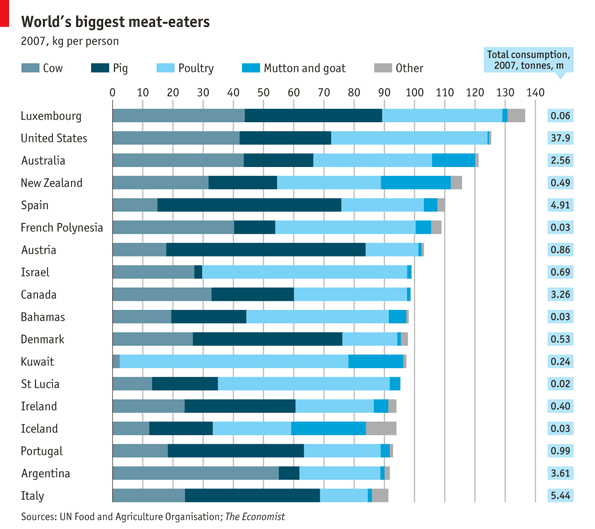
So here's a very crude test of the effect of eating meat laced with antibiotics.  Consider the following:  Americans now eat more meat per capita than anyone but Luxembourgians.

Meat consumption, 2007; UN Food and Agriculture Association, in The Economist

We use more antibiotics by kilogram of meat produced than any other country.

Antibiotics by kg of meat produced; Source


And the prevalence of obesity in the US is higher than anywhere in the world.


Obesity rates, 2009; The Economist
So, the US has the highest rates of obesity, and the highest rates of antibiotic usage in meat, and nearly the highest meat consumption rates.  Does this mean, then, that the antibiotics we're consuming in our meat are causing us to become obese?  It sure looks like it.

Until you look at obesity rates in the countries that are just below the US in the amount of antibiotics we use in animals -- Greece, Netherlands, France, Spain, with obesity rates all over the map.  And, while the correspondence between countries isn't great among these charts, countries with the highest obesity rates that are also on the antibiotic usage chart don't have among the highest usage rates.  So this crude attempt to answer the question of whether antibiotics in the meat we consume are making us fat seems to point to no, though certainly not definitively.

What about prescribed antibiotics?
But, I really like the question, not only because it might have explained the obesity epidemic, but because it doesn't immediately assume a genetic cause.  But we can still steer away from genetics and ask the question as Kennedy did -- is it the antibiotics we're giving our children to treat things like ear infections that's responsible for obesity?

According to Kennedy, mice fed high calorie diets and antibiotics in one study gained a lot more weight than mice fed the same food minus the antibiotic, the controls.  We aren't mice, and we aren't pigs, but it does start to sound like there might be a connection.

But if so, what would the dosage have to be?  There must be a significant difference between being fed even sub-therapeutic doses of antibiotics daily and having a therapeutic dose once or twice a year (I haven't been able to find an actual figure for average antibiotic use in the US, so this is a guess, but I'd bet it's not too wild).  And, we don't know whether there's a particularly at-risk age of antibiotic use -- does it have to be in childhood, or would adult users be at risk as well?

So, dosage and timing would seem to be important questions to answer, as well as context (as our friend Charlie Sing would remind us).  Would there be particular lifestyles or diets that increase risk of antibiotic-induced obesity?

Finally, the August Nature paper on the 'microbiome' and obesity reports that obese people have different gut flora than thin people.
Low richness of gut microbiota has been reported in patients with inflammatory bowel disorder (IBD), elderly patients with inflammation and in obese individuals, but the differences of richness within these groups or among non-obese individuals were not previously detected. As the composition of the gut microbiota seems to be rather stable over long periods of adulthood, its richness may well be a characteristic feature of an individual. In mice, the richness seems to be affected by repeated antibiotic treatments, and host genetics could also have a role. 
The suggestion seems to be that antibiotics could be responsible for the difference.  But, it's very premature to conclude from this paper that antibiotics cause obesity, because, for one thing, it's not clear whether the richness of the gut flora preceded obesity, or is a consequence.  And, certainly the drug/obesity connection isn't going to sidestep the question of a genetic influence for long.  Geneticists know very well how to keep their share of the pie.  They've been doing it for years:  "Yes, of course, the rapid change in disease X rates is due to environment, but that's because some people have genes that make they hyper-responders.  So we need to do genome mapping to find these few sensitive genotypes!"  Unfortunately, mapping for most of the common diseases, like obesity or diabetes or asthma or autism or you-name-it -- or even just human stature -- has been justified on the 'a few sensitive hyper-responding-genes-are-responsible' argument......and all have shown no evidence for that.  Instead, it's clear that environmental changes really are responsible for many major risk changes, not unlucky genotypes.

Anyway, the antibiotics/obesity connection in humans is an intriguing idea, but there's still a lot we don't know.

Tuesday, May 21, 2013

Microbiomes R Us -- another form of science marketing

The microbiome hits the big time 
A piece by food writer/journalist Michael Pollan, "Some of My Best Friends Are Germs", was the cover story of the New York Times magazine on Sunday.  Pollan says the interest he developed in fermented foods while he was writing his latest book -- beer, kimchi, cheeses -- naturally led into an interest in the fermentation that goes on in our large intestines with the help of resident microbes, and this led him to think generally about the interaction between microbes and us.

The current estimate is that microbial cells in and on our body outnumber our own cells ten to one.  The Human Microbiome Project, funded by the NIH, as yet another Big Science do it all and think about it later investment, was launched in 2008 with the goal of sequencing the microbes in the nasal passages, oral cavities, skin, and the gastrointestinal and urogenital tracts of a fairly small sample of men and women.  The project was completed last spring with sequences from samples from more than 240 people (completed means the authors can now go to the press and demand even more money because 'more research is needed' before we understand anything.....).

But, that's not the end.  In a drive to document the microbiome of America, The American Gut Project will sequence your microbiomes for $99.  It's an open source, open access project which allows participants to compare their data with data from people around the world. 

Why?  Because the microbiome is the new genetics.  Forget (our own) genes, the idea is that we are who we are, healthy or sick, because of the microbes we share our bodies with. Well, of course, it's the microbes' genes, so it's really just more genetics.  As Pollan puts it,
To the extent that we are bearers of genetic information, more than 99 percent of it is microbial. And it appears increasingly likely that this “second genome,” as it is sometimes called, exerts an influence on our health as great and possibly even greater than the genes we inherit from our parents.
Our microbiome may make us fat or keep us thin, predispose us to diabetes or heart disease or asthma and allergy. And, the microbiome apparently influences our immune system and trains it in how it responds to the world, and may be responsible for the increase in autoimmune diseases in the West. Indeed, Pollan writes of "an impoverished 'Westernized microbiome'" -- some researchers suggest that the microbiota in our gut should be restored to look more like the microbiomes of people who eat less processed food and take fewer antibiotics (and, by the way, are more likely to die early of infectious diseases than we are). 

But, happily for us, changing our second genome is going to be a lot easier than changing our first one.  We do it all the time, through our diet, the medicines we take, the people (and their microbes) we come into contact with.  Happily for Big Pharma and Big Food, once we know which microbes are best for us, they'll be able to sell you any number of products to reverse these changes and reduce your chances of getting all those diseases geneticists have been trying to find the causes of for so long.  You'll have personalized microbiomalgenomic medicine.  Enough to put another smile on Francis Collins' funds-securing face!

There has been a lot of talk lately about 'fecal transplants' which are just what they sound like -- the transfer of fecal bacteria from healthy people into the colons of unhealthy people, primarily people with Clostridium difficile infections, intestinal infections resistant to antibiotics.  And yes, there is a lot of information on the web for those who want to learn to do this kind of self-medicating at home.  

Overpromising yet?
Pollan (whose qualifcation for writing this piece is that he is a food journalist whose writing sells well) says a few times that people involved in researching the microbiome don't want to make the same mistake that geneticists did with the Human Genome Project, overpromising the extent to which their work will lead to the cure for everything that ails us.  But, if as Pollan claims, the microbiome community is actually talking about the Grand Unified Theory of Chronic Disease, there's apparently a fine line between hype and overpromising -- not to mention borrowing from physics' line that is used to justify Hadron.  And there are certainly plenty of 'probiotic' options in the grocery store these days, so someone's jumping the bandwagon. 

All satire aside, the point isn't that we doubt that there's a connection between microbes, health and disease.  Nor that there are indeed lots of nuggets of grain in the bin being described.  Instead, it's that these are early days yet, and the whole approach to this project is already sounding too reductionist for words.  Not only are microbiome researchers in danger of mimicking the genome project with overpromising to over-enumerate, but also by reducing everything to their favorite microbe (for 'microbe' we used to read 'gene'). The bugs for ability to play the bass or baseball, score well on IQ tests, or tolerate abuse with equanimity may be right around the corner.

Enough Just-So stories yet?
Indeed, the Just-So storytellers are already out in full force. Why are there complex carbohydrates in human breast milk, if babies can't digest them?  As Pollan puts it, "Evolutionary theory argues that every component of mother's milk should have some value to the developing baby or natural selection would have long ago discarded it as a waste of the mother's precious resources." So, it turns out they are there for a particular gut bacterium that breaks them down and uses them.  
“Mother’s milk, being the only mammalian food shaped by natural selection, is the Rosetta stone for all food,” says Bruce German, a food scientist at the University of California, Davis, who researches milk. “And what it’s telling us is that when natural selection creates a food, it is concerned not just with feeding the child but the child’s gut bugs too.”
And, we evolved this commensurate relationship with microbes because they evolve so much faster than we do, so can quickly evolve mechanisms to cope with new kinds of toxins in our environment and so forth.

And, the bacterium that causes ulcers and perhaps some stomach cancers, Helicobacter pylori, is an endangered species, writes Pollan.  But his informants tell him it shouldn't be.  H. pylori also has beneficial roles to play in our stomachs -- preventing acid reflux by regulating acidity, for example, which Pollan suggests they do to render the stomach inhospitable to competing microbes, or regulating levels of an appetite hormone -- and because they do these good things, they should be nurtured rather than killed off.  Why do they do both good and bad?  Well, they do the bad stuff when we're middle-aged or older, so Pollan's informant suggests "this microbe’s evolutionary role might be to help shuffle us off life’s stage once our childbearing years have passed."

Of course, among other curious aspects of this scenario, how something evolved to kill us off once we're no longer contributing genes to the human gene pool is not explained. In order for this to work, the fitness of the microbe that could do this would have to be increased by killing us, its host, and it doesn't work that way.

Stripping it down to the truth
Again, fine, it seems quite likely that our microbiome does make contributions to our health and disease.  That's interesting enough.  For various theoretical reasons, rapidly dividing microbes do present interesting evolutionary challenges, and there's no doubt that we, and our genomes, must respond successfully if we are to persist.  If infection, broadly defined, has early negative effects because of the host's genotype, then selection favoring the bacteria, and likewise selection favoring human resistance can both be strong.  Culture and climate and habits also contribute to this potentially very dynamic evolutionary mix.  Infectious diseases with strong effect on survival, like malaria and HIV and others have clearly demonstrable effects of this kind.

But that is not the same as invoking specific selective stories for complex, ephemeral, varying fluxes of bacteria, which must coexist as well as keep a host alive so they can stay alive.  It's not the same as inventing pat, closed Just-So stories about how this or that effect must have evolved, and it involves no subtleties that we know are applicable, including the range and mobility of humans, modes of transmission,  population size and so on.  We have had a difficult time, and often unsuccessful, in working out clear-cut examples of natural selection at work in humans, though our evolved defenses against malaria (which is not caused by bacteria but involve many relevant evolutionary issues) may be the best one. 

So why can't researchers, writers, the rest of us just concentrate on figuring out how and when microbes are harmful or beneficial, without the hyperbole, the suggestion that microbes now do everything that genes did not long ago, and the made-up stories about how this all evolved? 

This whole microbiome thing needs to slow down and let the science catch up.

Monday, October 29, 2012

The microbiome: competition or cooperation, adaptation or adaptability?

We're just now getting around to blogging about a Perspectives piece in the Oct 12 Science called "Animal Behavior and the Microbiome" by Vanessa Ezenwa et al. It's an overview of current thinking about the role microorganisms play in animal behavior.  The Human Microbiome Project documenting the extent of such organisms in humans, and the essential role these guys play in human health and disease, has found that the genes in the trillions of microorganisms with which we share our bodies outnumber ours by 100 to 1.

Since at least some of these are necessary for life, one offshoot of learning about this is to ask what 'the' human genome really is.  Most bacteria we know of, like the ones in our gut, have to do with rather prosaic, if vital, physiology such as digestion.  These are interesting and important, but they don't involve more sensitive issues such as our personal identity -- our behavior.  The role of microbes in animal behavior is just beginning to be understood, and it may be more profound than had been thought. 

Kudzu bug; Wikipedia
For example, as described in the paper, "the Kudzu bug (Megacopta cribraria), an agricultural pest, is born without any symbionts (species with which both have a mutually necessary affiliation for survival). After birth it acquires a specific symbiont from bacterial capsules left by its mother. If these capsules are removed, the bugs show dramatic wandering behaviors, presumably to search for symbiont capsules left with nearby eggs."

Or, bumble bees acquire gut microbiota either through contact with nest mates or by feeding on feces containing the microbiota required by the gut. Bees without these microbiota were more susceptible to a bumble bee parasite, Crithidia bombi. Fruit flies that share the same diet-acquired microbiota are much more likely to mate with each other than with those that don't.  And then there's the zombie ant, infected by killer fungi, and the rats -- and cat ladies -- infected by Toxoplasma gondii, both of which we described here.  The examples go on and on.

But what does the recognition that we don't go through life alone mean for the usual understanding of social context, ecosystems and the evolution of behavior?  It's tempting to suggest that these are examples of exquisitely fine-tuned co-evolution, and the usual darwinian interpretation would be that every organism is out for itself, selfishly hijacking another's gut, brain, feces, nasal passages, skin, eyes, now manipulating their behavior -- any and everything -- to make a living.  And needing to out-compete all the other microbes fighting for the same territory.  But don't get too greedy or you'll kill your host and then you're in trouble too.  (Reminiscent of how humans feel about climate change -- we have to save the planet so we can continue to exploit it ourselves.) 

But this is rather a stretch, really, and depends on fitting the facts to a preconceived view of the purpose of organismal interactions (apply our take on why people believe microbes will be found on Mars here).  And that preconceived view is that life is all about selfishness, exploitation and competition.

But there's an alternative view, and that is that what this represents is cooperation, one of the fundamental principles of life that we've often written about here and in our book MT.  It's a principle that requires abandoning the long-held belief in the primacy of "survival of the fittest" because that very rarely happens.  A better description would be "failure of the frail" -- it's only the weakest organisms that can't reproduce; most everyone else does just fine.  Plus, much of survival depends to a large degree on luck and has nothing to do with genes or competition or your ability to outwit your neighbor.

So, this Russian doll kind of life-within-life-within-life that's being catalogued is an ongoing documentation of the centrality of cooperation in life.  There's surely some adaptation going on -- the bumble bee is better off without Crithidia bombi than with, but 10-20% of worker bees in hives in the field have been shown to be infected and bees have carried on; it's only now that they're bombarded with infection with multiple parasites and more that it's a problem.  But the bee did not evolve to be infected with gut microbiota to fight off C. bombi, the bee evolved with the ability to host gut microbiota and to fight off the parasite, however that happens. 

Further, some infection was survivable, and the parasite didn't need the bumble bee because it's an equal opportunity infector, infecting other insects.  This brings up another fundamental principle of life, and that's adaptability.  Because it's ubiquitous, we believe adaptability is a characteristic of life that was present very early in evolution. So, humans can't live without a gut full of microbiota, but the species that we host are widely variable, they change when we're ill or pregnant, we can kill them off in great numbers with antibiotics, can add more with probiotics or natural exposures, and we're fine.  The same has to be true for other organisms.

One can say that what's here has to work, or at least to have worked successfully enough in the past to be here today.  But that's only a part of the biology, and there has been a tendency to focus more on how that evolved via competition, than on the interactions themselves.  How cooperation works is turning out to be an elegant but complex business.  Even if Darwinian explanations are 100% correct -- and there are reasons to temper such a view -- understanding how such things work today is in itself a challenge, and a very interesting one at that.  Though, perhaps our very interest in it is because of some microbe in our brains, that makes us sympathetic to the lives of microbes...

Wednesday, May 9, 2012

Getting in each other's jeans....or genes?

Life, evolution, is about reproduction, how effectively we get into each other's jeans, so to speak.  As individuals, we may be independent most of the time, but we can't make a new individual alone.  To do that we must conjugate our genome with someone else's, and getting into their jeans is how we do that.

Or is it?

Perhaps we've been making a big evolutionary mistake
Maybe what is as important is how we and other species get into each other's genes.  Organisms--all of us--are collections of large numbers of cells descended from a single starting cell (the fertilized egg).  We tend to view ourselves as having one genome, and in that sense being a unitary, biological whole.  Evolutionary theory is about how collections of such wholes, the fertilized eggs of a population in a generation, change over time.

But increasing evidence shows several important facts.  First, each time a cell divides into two 'daughter' cells, mutations occur, and these are then transmitted to the next generation of daughter cells.  And, at the molecular level, the division of one cell into two, even forgetting mutations, is never exactly equal.  One gets more of one protein than the other, the other gets more mRNAs and so on. You are a huge collection of cells with such a branching history of variation from a single fertilized egg cell.

But our life is not just what happens to that set of cells.  Instead, as evidence is now showing more clearly, we are colonized by countless other cells--bacteria and other micro-organisms--and they, too, divide on and in us, accumulating mutations along the way.  And, more importantly, we are unable to live without them, nor they without us.  The simple classical and perhaps clearest example is our intestinal flora, that is responsible for vital aspects of our digestion and hence our survival.

A burgeoning area of investigation called microbiomics (every field needs a sexy label, of course), the study of the many different microbes that inhabit various parts of our bodies, is off and running.  This work is finding a wealth of relationships between us and others, so much so that researchers are suggesting that our genome can't in fact be fully understood on its own, but rather must be thought of as just one part of a larger genome that also includes the genes of all our colonizers.  Or from the microbes' perspective, their own and their host's genomes.

Many different common chronic diseases that for several decades have been thought to be due to wear-and-tear of long life and modern lifestyles, are being shown to involve genes involved in aspects of our immune systems. So in both regard to disease and to the microbiome of normal variation, our traits may be more 'infectious' than we had thought.  The term 'infection' implies the old idea that we're normally bug-free unless we are sick.  Instead, perhaps we are sick if we are bug-free!

Going further: what, after all, is an organism?  What is evolution about?
Maybe our entire concept of organism and its traits is biologically badly mistaken.  Perhaps metazoans really are often, or largely, a colony of cells with one genome plus adherent colonies of cells with other genomes.  Neither can do without the other.  They've evolved jointly.  Aberration in either can cause cell death.  When it's of the 'organism' we give it different name from when it's just of one of the cells.

We might call this 'coevolution' and perhaps it could lead to substantial rethinking about what we are, or what species are, or their evolution.  Or how we use our notion of organism to dichotomize vis-à-vis the 'environment', when basically they are more unitary?  The ultimate in co-operation.

Again, as with sex, we may have been misled by Noah's ark, Linnaeus, and Darwin into life science based on organism, when that is only one aspect of how things are organized.  The idea that Nature is composed of a series of distinct species, a legacy of classical thinking up to the present, is actually a large subject with much that is interesting and perhaps truly profound to think about.  We'll discuss it in a subsequent post.

Meanwhile, the idea of meddling in, or the responsibility to keep out of,  or delve into, each others' genes is not just something for Levi Strauss to consider.

Tuesday, December 6, 2011

Whose microbiome is it? Take an educated guess

Carl Zimmer's articles in the New York Times are usually a treat.  Indeed, he's one of the best science journalists around.  But his op/ed piece on Sunday told only part of the story.

Called "Our Microbiomes, Ourselves", Zimmer describes the efforts to sequence entire populations of microbes -- the microbiome -- in various orifices of the human body, and he considers the ethical questions this is bringing to light.  Long considered to be separate from us, recent understanding has shown that many bacterial species are vital to our survival.  The bacteria in our gut are the classic and best example: we can't live without them in our intestines because our digestion depends on it.  So they may have their own species name, but in a very real way, and evolutionarily as well as today, their genome is really our genome, too (and to some extent vice versa).

Zimmer proposes a scenario whereby the microbiome of someone's nostril is sequenced, and a unique microbe is identified, and found to have pharmaceutical uses, and industry goes on to make millions from the new drug that results.  If it was found in your nose, he asks, do you deserve a share of the profits?
It is a tricky question, because it defies our traditional notions of property and justice. You were not born with the germ in your nose; at some point in your life, it infected you. On the other hand, that microbe may be able to grow and reproduce only in a human nose. You provided it with an essential shelter. And its antibiotics may help keep you healthy, by killing disease-causing germs that attempt to invade your nose.
Welcome to the confusing new frontier of ethics: our inner ecosystem.
But, while the specific scenario might be new, the question of who profits from stuff going on in or coming out of other people's bodies certainly isn't.  As a recent book reminded us all, Henrietta Lacks' tumor cells have been used since the 1960's for various profit-making purposes, but she and her family got nothing from her unwitting donation of cells.  From best-selling books written about neurological case histories to clinical testing of new drugs to the reaping of cells for research, there's nothing new here.

Some bioethicists, Zimmer says, believe that people's private microbiomes should be kept private, just as people's genomes should be, because the microbiome may hold clues to future illness.  But, there's nothing new here, either.

And,
As scientists get to know the microbiome better, they are also looking for new medical treatments: after all, most antibiotics were first discovered in bacteria and fungi. Michael Fischbach, a biologist at the University of California, San Francisco, and his colleagues have discovered a wealth of promising druglike molecules made by microbes in human bodies.
Zimmer adds that microbiomes may be harvested from subjects in poor countries, because of their potential usefulness to pharmacology or to understanding disease risk.  But that's an old story, too -- pharmaceutical companies have been doing clinical trials in poor countries for decades because it's cheaper and there's less regulation.  And agribusiness has inflamed many countries for raiding them of commercially modifiable plants and then selling them at high cost to farmers, making them dependent on buying seeds annually, rather than beneficiaries of royalties.

Sequencing the microbiome of an entire town's sewage system might reveal a lot about the entire town's health, but, Zimmer asks, would permission be required from each person living in the town?
The microbiome poses another bioethical balancing act, between the interests of microbe hosts and the public at large. If scientists become too consumed with protecting the individuals they study, research on the microbiome could slow.
So, Zimmer poses some interesting questions about the ethics of microbiome research, but there's nothing new here.  The same questions of who owns what and who should profit apply to all biomedical research. And, we're willing to bet that, as usual, the answers will favor the researchers.

Wednesday, August 17, 2011

New findings in cancer research: Something old and something new

A story in the NY Times, a report from the annual meeting of the American Association for Cancer Research, suggests that cancer may be a different sort of disease than has been assumed.  It has been thought for several decades that cancer is a genetic disease, due to mutations that lead malfunctioning genes to cause a single cell to divide uncontrollably. The mutations cause the cell to divide rapidly, and at the same time, override the normal mechanisms that limit cell division.  One of the signature discoveries of the 1970s was that tumors in a person are usually clonal: they derive from a single 'transformed' cell.  That made cancer a 'genetic' disease at the cell level. 

Melanoma cells invading the brain
However, the story points out that recent discoveries have been complicating the picture with tangles of new detail. Cancer appears to be "even more willful and calculating than previously imagined", if you want to accept the usual hyperbole and anthropomorphizing. This story raises the possibility that there are additional mechanisms, including many kinds of RNA that are not the classical protein-coding parts of genes that textbooks (at least, out-of-date textbooks) describe as how the genome works (that is, not just due to misbehaving messenger RNA), as well as signals from the microbes that colonize our bodies.

Microbes comprise maybe 90% of the cells in our bodies, being integral to digestion, and other functions.  They need us and we need them, and this co-existence is maintained by communication between our cells and our resident microbes.  When this goes awry, our cells may be signaled to begin to divide; this aberrant signaling may be responsible for cancers of the digestive system -- the colon, stomach, and esophagus -- and perhaps other organs.

Another possibility is that segments of the non-coding DNA that makes up maybe 98% of our DNA may send aberrant signals that lead to uncontrollable cell division.  Pseudogenes, or remnants of gene duplication events long ago that on their own now have no function, or garbled function, may be one of the elements in non-coding DNA that incite uncontrollable cell division.

And finally, micro RNA may inhibit or alter the normal working of messenger RNA, disrupting normal cell signaling.  It has become apparent in recent years that micro RNA has a function in the regulation of much normal gene expression, but it seems that it could also be involved in the kinds of abnormal cellular functions that lead to cancer.  It's possible that pseudogenes interact with microRNAs to do this.

Well, these alternatives are clearly all possible, but unfortunately the story is the usual type of overkill and melodrama that we see every day in the media. Investigators making exaggerated claims of new discoveries, rather than simply reporting additional facts and mechanisms that are being found.  Contrary to the sense of the story, nothing in these new findings challenges the basic current idea about cancer, even as they make it clear that the usual approaches for finding genes 'for' cancer, such as genomewide association studies (GWAS), are generally not going to work. 

And indeed, there may be some mechanisms that cause cancer but do not alter DNA or create abnormal cells.  Instead, such mechanisms may simply induce genetically normal cells to respond to their environment in ways that are mistaken (relative to the survival of the organism).  These included some apparent context responses that should lead as a rule to many cells misbehaving in the same way -- polyclonal tumors, in which not all cells are derived from the same single misbehaving ancestral cell.  That was an older idea about cancer that hasn't had much credence for several decades.

Cancer is clearly a nasty problem for an organism, and one that involves evolution on the scale of one's individual lifetime, with some similarity to long-term evolution of species.  If cancer were to turn out to be polyclonal, it would make it more like infection, in which the body is occupied by descendants of many different infecting bacterial cells or viral particles.  Since the descendant cells of each founding cell will then undergo their own evolutionary history, attacking the tumor would become more difficult -- the tumor cells wouldn't share the same characteristics to the extent that a single clone of cells do.  The evolution will not be of a single tree of descent.

Viral cancers can be polyclonal if the virus independently transforms different cells in the individual, but this seems unusual.  Also, if only a small number of changes are required, and the person inherits one or more of them, and has many cells at risk of somatic mutations to generate the rest, there may be several independent tumors in the same person.  There are some examples of this.

But generally, the standard model of a mix of inherited variation that makes a cell less likely to respond normally, complemented by somatic mutations that finish the job of producing a single, badly programmed progenitor cell, seems basically safe.  Even if, as seems to be the case, we're finding new aspects of the genome and its behavior that are involved in the production of such a cell.

Thursday, June 30, 2011

More hype. The microbiome. Sigh.

For the last two decades, the answer to why we get sick, and how to prevent it was said to be in the genome.  The answer may have been elusive, always just out of our grasp, but once we had the whole genome sequence, or understood what non-coding DNA did, or had catalogued all common variants, or when we discovered variable copy number or epigenetic mechanisms like methylation, or had catalogued all rare variants, we'd have the answer.  And the hundreds of millions spent on the search would be justified, and we'd all live forever -- even if all the ethical and societal implications of this consequence were never thoroughly explored.

Some people understood pretty quickly after the human genome sequence was announced in 2003 that the promised answers were unlikely to be there, and so they broadened the search.  Maybe we'd be done if we understood the function of gene networks or everything in the cell or if we thought in terms like systems biology -- or any omic you cared to come up with, from the nutriome to the connectome to the microbiome.

And it's interesting about that microbiome, the cataloging of which is now well under way.  The BBC World Service radio program, Discovery, explores the issue this week.

The Human Microbiome Project webpage explains the project's mission:

  • This initiative will begin with the sequencing of up to 600 genomes from both cultured and uncultured bacteria, plus several non-bacterial microbes. Combined with existing and other currently planned efforts, the total reference collection should reach 1000 genomes.
  • The initiative will continue with metagenomic analysis to characterize the complexity of microbial communities at individual body sites, and to determine whether there is a core microbiome at each site. Pilot studies will implement shallow and then deep 16S rRNA sequencing, progressing into deep metagenomic sequencing. Several body sites will be studied, including the gastrointestinal and female urogenital tracts, oral cavity, naso-pharyngeal tract, and skin.

The second stage of the project will explore the relationship between the microbiome and disease, and at the risk of sounding like a broken record, we have to say, the leaders of the project interviewed by the BBC sound a whole lot like the leaders of the Human Genome Project did at the inception -- microbes are likely to explain everything, from heart disease to asthma to cancers and autism, arthritis, Alzheimer's and much more, even aggression (we wrote about that particular issue here, and here's a list of the demonstration projects already funded and underway).  And once we've got the microbiome from those 5 different tissue layers sequenced, we'll understand how.  And we'll be able to prevent the 'microbiome imbalance' that makes us sick.  Or, presumably, aggressive or whatever other undesirable behavior that imbalance might cause.  (Hmmm, that sounds like Galenic medicine in which you are well unless your humours are out of balance--only it's your microbiomic contents!)


Yes, of course some diseases are caused by single genes, and some diseases are caused by microbes, in any sense of the term, and more are sure to be found.  And those can be legitimate targets of technical medicine (or, we note, non-technical environmental or lifestyle modifications)  The problem is the way the hype machine is yet again rolled out to generate the promise that has gone into getting this project funded, and keeping it going.  Microbes are as unlikely to explain all disease -- and unwanted behavior -- as genes are, but the promises must be made so the money can be gotten and the work can go on.

To see that this not (just) another rant on our part, one can consider that the microbes that matter are those that interact directly or indirectly with our cells.  Pure fellow travelers neither hurt nor harm us. That means that their genomes are in many ways our genomes as well (and vice versa). We know empirically that our phenotypes are by and large complex--and we know that whether or not some of the genes that are contributing are in our cells or our microbiome's.  The major thing that can happen with the latter is that a nasty bacterium can reproduce (much like a cancer precursor cell), to have a major effect.  But for that same reason, we already know the ones that do that (bad E. coli strains, cytomegalovirus, etc.).  We have active, successful, major research programs to track them, look at their pathogenicity, and evolution relative to us as hosts.  There are real battles ahead in this area, and regular science will work--if we're lucky--in this context.  Otherwise, just as with GWAS, what we're promising to find is mainly likely to be the shifty complex of minor contributors.

We have allowed a Battle of the Omics to be waged by almost unrestricted acceptance of each omics claim.  Bloating and puffery are the current way of life.  Of course, the dust will eventually settle, but nobody will know what better might have been done with the money than waging this kind of unrestricted warfare.

Friday, January 1, 2010

Foul Mouthed Sweet Tooth


Happy 2010 from guest blogger Holly... Here's my New Year wish for everyone.

If you’re like me then you frequently find yourself reading articles about things that you know nothing about (which, unfortunately, describes the content of probably 99.99% of the things that I read). There are many explanations for such behavior. And why I clicked on, “The Bifidobacterium dentium Bd1 Genome Sequence Reflects Its Genetic Adaptation to the Human Oral Cavity,” needs a little bit of back story.

The last week of November I was hit with hemorrhagic E. coli.* I think my body pretty well expelled the bug on its own, but a strong dose of two different antibiotics made sure it was real dead.

Many people who’ve taken Cipro have experienced that notoriously unpleasant taste in their mouths. The flavor is difficult to describe, but ever since I finished taking the medicine, I’ve continued to have a foul tasting mouth and a foul mouth (ba dum bum bum). My dogs love the makeover (which was amusing for about five seconds), but I can’t bear to ask my husband if he’s noticed a difference. (Ego, 1: Scientific rigor, 0.)

Is this new taste a signal that my mouth’s ecosystem is different? My mind (I take no credit for this) imagines that the antibiotics killed off more micro-critters than just the E. coli and those that better survived are now more prevalent compared to their ancestors. Maybe the species that currently dominates my mouth, or its products, tastes different from the bacterial composition that I had before.

Since this shift in balance would have happened abruptly during the Cipro killing spree, it makes sense that my taste receptors are detecting it now – my brain would have ignorantly ignored a slow bacterial change just like it couldn’t detect my transformation from 2 cells to 32-year-old.

I’ve been popping mints, gargling, and flossing like a lumberjack, for a month now and this whole oral fiasco is why I was naturally drawn to this recent article,“The Bifidobacterium dentium Bd1 Genome Sequence Reflects Its Genetic Adaptation to the Human Oral Cavity.”

Bacteria. Adaptation. Oral Cavity. This is totally going to be about me! See, first I happened to watch Food Inc., in which they discuss hemorrhagic E. coli while I was recovering from hemorrhagic E. coli, and now just as there’s a bacterial coup in my oral cavity, I stumble upon new research on oral bacteria!** Is it going to identify the species that differentially survived antibiotics, ran rampant in my mouth, and ruined my breath?***

Well, it turns out that this article is not at all about me or my dilemma - despite the common themes which you'll read about below, I can't solve my bad breath mystery by simply reading about oral bacteria. But it’s still a good read for people with oral cavities, people with cavities in their oral cavities, people who are afraid of getting cavities, and people who are fascinated with evolution. It’s especially poignant if you’ve got a sweet tooth that has taken command of your life for the past few weeks like mine has.****

We’ve all got like 900 species of microbiota in our “oral biofilm.” Some of those species are more similar to what’s down the hatch than others. The genus Bifidobacterium is one group that has species living from the lips all the way down to the colon, and also in the vagina (although the article doesn't mention the vaginal species, only my brief internet search said so). You may recognize the genus Bifidobacterium because many of its species are considered “probiotics” and they are included in foods and food supplements to help with digestion, sometimes under the term “Bifidus.”

Most species in this genus are your friends. They’ve teamed up with your body so that they get what they want out of the food that you eat while at the same time they're helping you get what you need out of the food that you eat. It’s a win-win situation and all these microbiotic critters running around inside you (well, more like clinging desperately to your epithelial linings) are why you are more cells of them than you are cells of you.

Like many microbiota in your mouth, B. dentium (the focal species of the paper we're talking about here) is great at metabolizing carbohydrates and approximately 14% of the genes in its entire genome code for proteins that are involved in this process. How does this compare to human genes for metabolizing carbohydrates? I don’t know, but I’m guessing we have relatively fewer genes that are involved in carbohydrate metabolism and that by teaming up with other species which are essentially born to do this, our own system can afford to slack, functionally speaking. It’s a beautiful relationship. But it comes with some costs.

For example, although B. dentium helps with our digestive functions, it has evolved in such a way that it’s no longer just a friend. It’s also a pathogen!
B. dentium is by far the most popular Bifidobacterium to be associated with cavities on tooth crowns in both children and adults and those on the roots of adult teeth. By producing acid, it lowers the pH enough to cause teeth to demineralize. And it’s so good at surviving in this highly acidic environment that it that it can make a living like this, on our rotting holiday cookie-smothered teeth.

The whole genome sequence revealed that the intergenic regions of the B. dentium genome have more nucleotide differences than the protein-coding regions. Sound familiar? (Everything boils down to human vs. chimp, doesn’t it?)

The results of these differences found in the genome of B. dentium are (1) it can withstand low pH conditions (as mentioned above), (2) it can metabolize a wider range of stuff that we eat compared to what its cousins in the colon can metabolize (which makes sense considering the smorgasbord presented to B. dentium vs. what metaphorical crumbs make it down to the colon) and it can even live off our own saliva, and (3) it seems to be able to resist biocide better than its relatives (which was tested by growing B. dentium in mouthwash which sounds completely unethical).
Regarding that third point, B. dentium has a relative abundance of what are called “two-component systems (2CSs)” which are instances where protein-coding genes are essentially flanked by regulator genes, and this seems to be a surprise to the authors based on what is known about other bifidobacterial genomes. The implications of these numerous 2CSs are that they may be indicative of B. dentium’s “ability to sense dynamic environmental cues and to modulate appropriate physiological responses.” Perhaps this is what enables them to differentially survive despite our attempts to murder them with mouthwash (or, heh heh, during E. coli-cide? Hmmm?). Or at least, perhaps this is what enables them to not just tolerate but thrive in fluctuating habitat acidity. And what's even more exciting is that these adaptations may be linked.

Naturally we’re left to wonder: How long ago or recently did B. dentium originate? Did our behavior induce B. dentium to adapt this way through our diet and/or through our dental hygiene? Is it smart to ingest commercially sold probiotics if they contain species that can evolve to be opportunistic pathogens like B. dentium did or, worse, if they actually contain the pathogenic B. dentium and we just don’t know it?

Because it's the holidays, should we just forget about it and eat all the cookies and sweets that we want because we can't stop the evolution of our oral microbiota?

I like that idea. More cookies, please, and pass the biocide and the floss, thanks.

Starred Footnotes:
*No, hemorrhagic E. coli is not why I’ve been gone since mid November (apart from dropping comments on Anne and Ken’s posts). University life has kept me sufficiently busy and generally abloggish. But getting hemorrhagic E. coli certainly didn’t help. No, I don’t know where it came from. And no, I didn’t go to this doctor for treatment (amicably sarcastic emoticon).
** I believe this is what Oprah calls “The Secret.”
***Please do not take this opportunity to tell me that my breath was already ruined.
**** I used to think that a gold tooth was a sweet tooth and that it could actually taste sweets better than enamel teeth. This is because my uncle has a gold tooth and a sweet tooth, so naturally a 5-year-old me who had never seen or heard of either of those things thought that they were one in the same, and thought that a sweet tooth was a pretty neat trait to have. For much of my childhood I was incredibly jealous of every person I saw sporting a gold tooth.

Monday, August 31, 2009

Gutting it out

Only a small fraction of bacteria can be grown in laboratories; apparently nobody understands what they need in their environment well enough. This can be a problem for microbiologists trying to identify the bacterium causing a new infectious disease, but it also means that it has not been possible to know all of the little bugs to which we our bodies are willing or unwilling hosts. The same would be true for other animals, wild ones as well as our pets and farm species. We say 'willing or unwilling' because, of these pathogens, some are presumed to be harmless commensals, and others are necessary to our survival (such as the E. coli in our intestine, that we depend on for digestion, and similarly for other mammals such as grazers like cows and goats who need bacteria in their rumens to digest cellulose).

One of the characteristics of bacteria is that they can exchange structures (e.g., plasmids) that contain some actively used genes. This is where many if not all of the genes are that lead the bacteria to resist nasty things in their environments such as antibiotics that bacterial targets have evolved to protect themselves. A vulnerable strain of bacteria can acquire a gene that makes them antibiotic resistant. This is of course a very important current problem in farm animals and humans, driven by the amount of antibiotics we ingest. And farm animals are reservoirs of pathogens that can affect humans, so humans and the animals they live with are part of large bacterial-host ecosystems.

Since we can't culture most bacteria, our knowledge of who's where, and the characteristics of many bacterial species, has been quite limited. But DNA sequencing technology has opened the way to identifying our visitors. By extracting all the DNA from a sample of some tissue, fragmenting the DNA and sequencing the fragments, their owners can be identified, and their genetic makeup and function characterized. This is done by comparing the sequence fragments against all sequences currently known (in Genbank). Even if we don't identify an exact match, we can find a known species that is close enough to our tissue-sampled sequence to identify its place in the bacterial tree of life. Antibiotic resistance genes can be identified in the same way, too, since many are already known.

A new paper in Science (Functional Characterization of the Antibiotic Resistance Reservoir in the Human Microflora, Sommer et al., Aug 28, 2009, 1128-1131) reports on a detailed analysis of the antibiotic resistance genes found in the microbiome, the resident bacteria, of healthy individuals. The study was done in an effort to learn more about how antibiotic resistance genes are acquired by pathogens that infect humans.

This study found that, indeed, many of the resistance genes in multidrug resistant bacteria were acquired by lateral gene transfer--that is, the gene hopped into the pathogen on a plasmid from a different bacterium. Bacteria in the wild usually live in large communities of many different species, where they can promiscuously exchange plasmids, thus antibiotic resistance can spread rapidly.

The authors wondered if the extensive history of antibiotic use in humans might mean that microflora in the human gut might be a reservoir of resistance genes readily transferable to pathogens. They isolated DNA from saliva and fecal samples from two healthy individuals who had not taken antibiotics for at least a year, and sequenced fragments of bacterial DNA that were resistant to all the antibiotics they tested.

They found that there was some, but by no means complete overlap between the two people who were sampled, and that nearly half the resistance genes they identified in this way were identical to resistance genes in human pathogens. This doesn't tell them whether gene transfer went from the commensal microflora to the pathogen or vice versa, but Sommer et al. suggest that it's quite plausible that our gut microflora are a reservoir of resistance genes just waiting to jump into pathogens which are now controllable with drugs. The remaining genes, although not yet found in pathogens, were functional when transferred to E. coli, suggesting that if they do eventually find their way into pathogens, they will be active, although there seems to currently be a barrier to lateral gene transfer which isn't yet understood.

The authors conclude:
Many commensal bacterial species, which were once considered relatively harmless residents of the human microbiome, have recently emerged as multidrug-resistant disease-causing organisms. In the absence of in-depth characterization of the resistance reservoir of the human microbiome, the process by which antibiotic resistance emerges in human pathogens will remain unclear.
This study provides interesting ecological information about bacterial dynamics, and of course warns us that antibiotic resistance may be more complex, challenging, and difficult to predict than we have thought. It's evolution in action.