Showing posts with label direct-to-consumer genetic testing. Show all posts

Monday, November 5, 2012

Area Doctor Shatters Area Girl's Dream of Being Taller Than She Is. (A personal genomics parable)

March 15, 1993. Oviedo, FL - A sophomore at OHS who injured the soft tissue in her knee in a freak accident while warming up for the 4 x 100 meter relay at an area track meet on Friday night was told, by her doctor, that she is done growing.

X-rays of Holly Dunsworth's knee--part of routine injury diagnosis and plans for repair--showed that the growth plates in her proximal tibia and distal femur are fused. This indicated to the doctor that Dunsworth has completed growth and has reached her full stature, so he passed this information along to her.

"He said it so cavalierly, too," said Dunsworth. "I spent my whole life wondering how tall I'd grow to be, hoping and wishing I'd grow to be tall enough to really dominate on the basketball court. And my doctor didn't even warn me that he was about to deliver this dream-killing news, and he definitely didn't ask me if I even wanted to hear it in the first place."
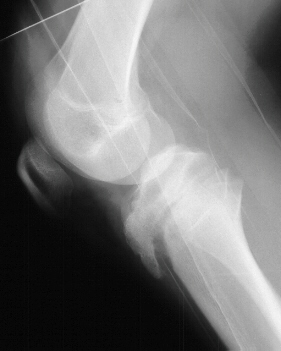
x-ray of human knee showing unfused growth plate of still-growing tibia (lower right bone). Source
The news was "even more devastating," said Dunsworth, than learning that her knee injury would most likely require surgical ACL (anterior cruciate ligament) reconstruction, meaning several months of recovery and probably a missed junior year of basketball.

"Sitting out a varsity basketball season just as I'm starting to be noticed by college recruiters is one thing," said Dunsworth, "but learning that I'll probably never be tall enough to play in the NBA or the Olympics is another. What should I dream now? What can I look forward to? I will never dunk. It's over. I wish the doctor would have kept my growth plates to himself."

When asked whether she expected to be much taller than her present 5'7" because she'd seen other girls continue to grow taller at her age, or whether it was because of her freakishly tall parents, Dunsworth said, "Oh no. Girls are pretty much full-sized by sophomore year. And my dad's 5'11" and my mom's 5'8". But I guess I just hoped I'd luck out. And now all that hope is gone, long gone. A big part of me is dead and I don't know how I'll fill this hole with anything good. I just don't know how I'll do it."

***
True story. Fake quotes. Thanks, The Onion, for the inspiring framework. Note that I did not work the word "cavalierly" into my verbal capacity until many many years later. (Fine, it was today.)  

Here's a look at one of the dreams that died that day:

***
If you follow this blog then you know that we talk about personal genomics quite a bit. My parable's not a perfect comparison for many reasons.  Obviously the cessation of growth is not equivalent to the cessation of life (death sentences, being how people can interpret genomic data) or even to the deterioration of health, as with the onset of disease. Further, my complete growth plate fusion was not probabilistic news, like so many of the genetic interpretations that companies like 23andMe provide.

But I thought it was important to share this sort of story where my identity and dreams were wrapped up in my biology and where a doctor delivered news of incidental findings about that biology (which deeply affected my identity and my dreams) without my consent or without even considering my feelings.

I had some rather ignorant notions about biology if I thought I could still grow taller past 16 years of age, especially given my parents' heights, but does it matter if you consider how fundamental those assumptions, however misguided, were to forming my identity? I never even stopped to consider whether I was done growing. It was always a hopeful mystery. Learning from a scientific authority that it was all over was harsh. It's culture, people, and it's not always rational but it's what we do. It's who we are.

On the other hand, culture changes with education. Humans will always have dreams, and I will always have dreams, but maybe my dreams would have been different in high school had I learned to ditch magical thinking in favor of the real evidence staring me in the face. Thanks to family history and to growth patterns of my classmates, it was obvious that I was done growing. I shouldn't have needed the doctor to tell me that! But I did. I needed the education. I needed to be enlightened.

I've been thinking about this story of mine because of what I've been reading about personal genomics and probability lately:
  1. What Your Doctor Isn't Telling You About Your DNA. (Time Magazine)
  2. John Hawks's recent reflections on things like the Time piece.
  3. Razib Khan's reaction to the Time piece
  4. Genetics textbook author Ricki Lewis doesn't want to see her genome
  5. If you're taking gene-based probabilities as certainties--the hullabaloo over Nate Silver's estimates  demonstrated that many do!--then there's potential for harm from participating in personal genomics.
***
Sure, a big part of the personal genomics dilemma is whether to make people worry about something they cannot prevent at our present level of knowledge (e.g. Huntington's, which 23andMe does not report).

But another big part of the personal genomics dilemma is whether to make people worry over nothing at all (e.g. higher estimated gene-based risk but the condition never ends up presenting).  This is the paradox of probabilistic medical data.  There was no such uncertainty or estimation about my fused growth plates, and since the news wasn't about how I could get sick or die, that's presumably why my doctor did not have to seek my consent to tell me this incidental finding of the radiography.

That I'm done growing is fact. That I have increased risk of breast cancer is fact-ish. It's a fact that I have certain SNPs or alleles or mutations associated with a specific type of breast cancer. That's certain.  Whether those alleles are meaningfully associated with breast cancer isn't. And what having those alleles means for me, Holly Dunsworth, isn't either. My risk for breast cancer might not be as high as 23andMe estimated (or it could be even higher, or it could be  lower). That estimate's not based on any data from my lifestyle and environment. It's only based on my genes in my spit--and only the genes that were genotyped. My report of increased breast cancer risk has got the potential to worry me over nothing. But it could also make me more vigilant so I can catch it early if it does occur.

I'm one of the many out there who wants to know everything about my genome that I can, even if interpreting much of it requires fancy brains to program fancy computers to estimate probabilities. I unlocked my Alzheimer's and Parkinson's reports on 23andMe and if they genotyped for Huntington's I'd have unlocked that too. I'd like to have all the information I can have. I hope risk estimates will improve over time. I'm optimistic like that, but (a) I understand very well that there is so much of our health, our lives, etc that we will never be able to predict no matter how much science learns about the genome and (b)  I have no idea how high a reported disease risk has to be to significantly worry me. Something is bound to kill me. If it's not all the confounders of old age, then hopefully it's molten lava or a black hole or chocolate. What's the big deal? We all die. I'm also pretty comfortable with some level of genetic determinism since genes figure greatly in how bodies work. It's not scary. It is what it is. Actually, it's brilliant. And it's even more amazing that it's a terribly difficult and sometimes impossible system to understand. If it wasn't so complex, all our little variations wouldn't have the wiggle room and the workarounds to function and to function well!

That earth-shattering news about my growth plates? I got over it. And pretty quickly. That hole inside my melodramatic, Holden Caufield-loving teenage heart? It was filled up with other dreams.

I wonder about all those people with life-threatening conditions and a shortened life expectancy. My grandfather was one of them, living some 40 years past his expiration date. I recently met an enchanting 70 year-old woman with a heart condition and an expiration date of 25 years old. She claims that it was her doctor's diagnosis (some might call it a death sentence) that gave her such a wonderful life, inciting her to cherish every moment and seek pleasure in ways that others do not or cannot.

But while deciding whether to see your genome and to receive the disease risk estimates calculated from it, how does anyone know they'll react like my joie-de-vivre'd friend? How does anyone know whether probabilities of disease-risk will be at least not misery-inducing and at best life-enhancing? Could there be a SNP for this charmed outlook on life/death that we could test for before we agree to learn what our disease genes say?

*wink*

And as for the new dreams that filled the empty hole in my soul where all the basketball dreams had died:  Maybe those new dreams were better dreams! I can certainly choose to describe my life in hindsight that way. And I do. They really were much better dreams. Similarly, I can choose to see my increased risk for breast cancer, psoriasis, age-related macular degeneration, rheumatoid arthritis, restless leg syndrome, exfoliation glaucoma, melanoma, esophageal squamous cell carcinoma, and stomach cancer (so says 23andMe) anyway that I choose.

For starters, ever met anyone afflicted with all those problems during their life? Right. That's really telling isn't it? And, of course, understanding even in theory how those risk estimates are made helps a great deal. And so does knowing that most of those conditions are already documented in my family history. And so does knowing that for some known conditions I could have new mutations that are hard to detect, or may never be detected. And so does knowing that those risk estimates don't incorporate my phenotype, lifestyle, or environment. And so does knowing that, just by being alive, my risks for obesity, coronary heart disease, and type 2 diabetes are still higher than my relatively increased risk for any of those aforementioned conditions.

Exercise, eat well, live right. My genes are my genes. And it is what it is. It's what I've got and it's good. Amen, awomen, amonkey.

And if this post wasn't a slam dunk, surely I'll have another shot. Because of how I'm built, I have no choice but to believe that I will.

Monday, July 23, 2012

Genomic medicine reality check

Dumping cold water on personalized genomic medicine
A news focus piece in last week's Science about cancer geneticist Bert Vogelstein is right up our alley. The piece begins, "Their lab helped reveal how faulty genes cause cancer, but Bert Vogelstein and [laboratory co-director] Kenneth Kinzler sometimes irk colleagues with their “reality check” comments on genomic medicine." Their point? Whole genome sequencing is not going to be useful for predicting who will and who won't get cancer. And they back this up with a study of disease risk in identical twins, described in an April Science Translational Medicine paper ("The predictive capacity of personal genome sequencing").

Vogelstein has long been interested in characterizing genes that are mutated in tumors, long ago identifying genes associated with the development of colorectal cancer. He and Kinzler when the latter was a student in Vogelstein's lab, showed how the slow accumulation of mutations in previously identified genes, including tumor repressor genes that no longer do their job when mutated, lead to tumor growth.

In the last decade, Vogelstein and Kinzler were the first lab to publish an extensive tumor exome sequence, all the coding regions of breast and colorectal cancers. They identified both known and novel genes involved in tumorigenesis. The work was done in the days before high-throughput sequencing was commonplace, however, and their work was criticized as not having been thorough enough or well-analyzed statistically. Though, their results were subsequently confirmed by others.

Whole genome tumor sequencing is much easier and more complete now, but Vogelstein and Kinzler don't see much more to be gained with it, and they've moved on. Their recent work has involved looking at identical twins to determine whether what they call the "genometype" would allow prediction of disease risk. That is, based on the assumption that monozygotic twins share essentially the same genotype, is it possible to predict risk of disease to a second twin if the first one has it? This of course depends on the extent to which the disease is genetically determined.
This basic observation, that monozygotic twins of a pair are not always afflicted by the same maladies, combined with extensive epidemiologic studies of twins and statistical modeling, allows us to estimate upper- and lower- bounds of the predictive value of whole-genome sequencing.
On the negative side, our results show that the majority of tested individuals would receive negative tests for most diseases. Moreover, the predictive value of these negative tests would generally be small, as the total risk for acquiring the disease in an individual testing negative would be similar to that of the general population.
The authors go on to point out that this is consistent with what has been found with GWAS -- many genes explain little risk. 
Thus, our results suggest that genetic testing, at its best, will not be the dominant determinant of patient care and will not be a substitute for preventative medicine strategies incorporating routine checkups and risk management based on the history, physical status and life style of the patient.
The story is different, they point out, for rare monogenic diseases, where whole genome sequencing has already been shown to be informative -- but then, so have association studies and the like.

Why the cold water is warranted
The first point one would make is that most genetic disease susceptibility seems to be due to what is known as the constitutive genome, that is, the DNA sequence you inherited when you were just a single cell, a fertilized egg. As they divide and divide during life, all your cells have a copy of the same genotype--almost. Each time they divide, some DNA copying errors are made, and the descendant 'daughter' cells are slightly different. Since you're made of billions upon billions of cells you have just as many different genotypes.

Most such somatic mutations are never seen clinically. Whether they help or harm, they're just in a single cell, and their effects are swamped by the sea of surrounding cells in the same tissue, that basically have your constitutive genotype at genes relevant to that tissue. If the constitutive genotype confers risk, then basically all cells in that tissue are at risk.

The difference with regard to cancer is that when a bad combination of mutations occurs in a single cell, it doesn't just die or stagger along doing no harm to you, but it proliferates, amplifying the signal of that mutation. It takes many different mutations to transform a cell from normal to cancerous. This is why cancer risk is poorly predictive from your constitutive genotype: most of the changes that lead to disease occur somatically in this or that cell until a bad combo arises in one of billions of cells.

So you'd think at least looking at the tumor cells would show what mutations were important. To some extent that's true, and though it isn't much use in predicting cancer (since the mtuations are found after you already have cancer!), this may provide ideas on how to target the cancer cells. The problem with even that is that a cancer in a single person is continually evolving, rapidly accumulating even more mutations, so that not all cells in the same tumor are cancerous for the same reasons.

You'd have to sample many different parts of the tumor to identify the different variants. And some recent studies have done just that, and shown that different secondary tumors--descendants of the primary tumor, within one patient's body--are genetically different. In part, at least, this is what enables cancer to metastasize, to colonize different parts of the body from the tissue they started in.

But if cancer is therefore not well predicted from your constitutive genome, one might expect that diabetes and heart disease would be predictable because they aren't the same kind of proliferating disorder. But despite what the genome-selling companies would like you to believe, that is turning out not to be true, either, and we have discussed this countless times before, in the context of GWAS and other studies.

Evolutionary implications
This is all consistent with evolution as well. The same genomic complexity that makes your traits, but makes finding single genes 'for' the trait difficult, is exactly what means that natural selection is not working very closely on one or a small number of specific genes. If GWAS can't find causal genes for a trait, even if you have the trait, natural selection can't do that either.

This means that traits can evolve adaptively via natural selection in the way Darwin explained, without this being very tractably understood at specific single genes, and indeed the indirect genomic effects of selection that is merely screening traits is what led causation to be so complex in the first place.

There are many parallels between what happens among cells in your body, and individuals in a species, and Ken wrote about that in 2005 in Trends In Genetics, where he discussed ways in which diseases other than cancer might be caused by somatic mutations whose effect could somehow be amplified so you would notice it at the organism level. Diseases like epilepsy were examples discussed there.

Causation may be genetic in the trait or evolutionary sense, but the specific genotypes that are responsible may be difficult or impossible to detect, or so variable among cases and individuals that by and large it's not worth taking that approach--something roughly consistent with what Vogelstein was saying in the story about him.

Friday, June 15, 2012

Direct-to-consumer racism?

Ken and I have often cautioned here on MT and elsewhere that society may be flirting with a new era of eugenics with our new genetic technologies that claim to be able to assess our ancestry and our risk of disease or other traits.  More ominous are these new technologies coupled with current attitudes about genetic determinism.  History shows the horrors that the misuse of science in this way have been visited on millions of people.  This could be a legitimate concern even if scientists, today, unlike the past, would  cringe at the thought of such uses of their work.  But are we wiser, kinder, and gentler than our benighted forebears, or is vigilance just as needed now as ever?

A story in this week's Nature, "Genome test slammed for assessing 'racial purity', is a case in point, suggesting that this isn't just hysteria on our part. A genetic diagnosis company in Hungary, licensed to do genetic testing for health purposes, has certified a far right member of the Hungarian parliament to be free of Roma or Jewish heritage.  The company scanned 18 loci for variants that they say are at higher frequency in Roma and Jewish populations.  They produced certification of the candidate's pure Hungarian ancestry in time for the election, which this candidate went on to win.  How much the certification had to do with the win, who knows, but that's not the point. 

Nature reports that the company argues on its website that it “rejects all forms of discrimination, so it has no right to judge the purpose for which an individual will use his or her test result, and so for ethical reasons it could not have refused to carry out the test."  Even so, many in Hungary have reacted negatively -- the government has condemned this misuse of genetic testing, Hungary's Medical Research Council secretary says it's "professionally wrong, ethically unacceptable -- and illegal," a Jewish member of the company's board resigned. 
“The council’s stand is important,” says Lydia Gall, an Eastern Europe and Balkans researcher at civil-rights group Human Rights Watch, who is based in Amsterdam. In Hungary, “there have been many violent crimes against Roma and acts of anti-Semitism in the past few years”, she says. Politicians who try to use genetic tests to prove they are ‘pure’ Hungarian fan the flames of racial hatred, she adds.
It's important to note that the testing did not precede the racial hatred, but it does serve to feed the frenzy.  This is why we have so often cautioned that scientists need to be very careful about the kinds of uses for which they use or advocate genetic testing.  Not long ago similar ancestry testing was proposed for screening immigrants to the UK--for national 'security' purposes.  Sound familiar?  It's just what the British eugenicists were up to 85 years ago. 

The problem is that when the horse is out of the barn, it's too late.  So, indeed, it's a very delicate and difficult issue, but there are arenas into which scientists should not tread -- or not without some clear and controlling societal agreement on what can and cannot be investigated.  


Friday, February 17, 2012

First we were snapped, now we're SNP'd

I got a grant from my university to purchase genotyping kits and analysis with 23andMe for all 130 of my biological anthropology students this semester.

Can of annelids
I know what you're thinking: CAN OF WORMS!

But maybe that's not what you're thinking at all.  Because if you follow this blog you may be familiar with how poorly we understand the causal relationships between genes and so many of our emotionally- and socially- and politically-charged behaviors, disease risks, and causes of death. That is, at least for the genes we know about. And what's a 'gene' these days anyway? It's not necessarily restricted to a stretch of nucleotides.

But it's only nucleotides, or more specifically SNPs (single nucleotide polymorphisms; pronounced "snips"), that 23andMe analyzes. They genotype thousands of SNPs that vary in people including those that link us to our relatives around the world, to interesting phenotypic traits (like whether our pee stinks when we eat asparagus), and to diseases and risks of developing diseases (like diabetes and Alzheimer's).

Ah, there it is...CAN OF WORMS!

But can a DNA test tell you that you're going to die? No, you know that already. Struggling with death is a part of life and certainly not a topic new to college classrooms.

But if wild classroom worms make you squirm beyond your comfort zone, then this definitely is not the right curriculum for you to implement. On the other hand, if you're like me and you believe that opening cans of worms is an often awkward but crucial part of your job then... okay...you're with me. Still, maybe you're wondering about the disease risk information? That's still pretty harsh, right?

It can be. Which is why I told the students that agreeing to 23andMe's terms of service is basically acknowledging that you are willing to be traumatized and that you can't blame anyone but yourself  for choosing to go through with it.

Some didn't. It's completely voluntary. Students who do not want to send in their saliva for analysis can make a demo account and still participate fully and still earn an A in the course. They can also opt out of seeing disease risk results (and only see ancestry data) when the results come back to them.

Totally on board with being traumatized, many took the codes home with them to order their spit kits on-line. They did this despite the small chance that peering into their genome may show them evidence to suggest that their father did not father them.

Wait. What?

Yes. That really is possible... THE KING OF THE WORMS!

http://scienceblogs.com/zooillogix/2008/05/giant_blue_earthworms_and_frie.php
Part of what students have to do this semester is form a 'plan of action.' That's what I've called their assignment where they predict what their SNPs will  hold and where they explain what they will do if they find out they're at high risk for a disease or even, yes, that they might not be related to their father. (This discovery doesn't require paternal DNA. Since half of your genome is from your father, and since a few traits are pretty simple, the rare participant with the rare SNP can deduce that they did not get their DNA from their father who doesn't show the trait in question.)

But like I said, regardless of the high risk that they'll learn of risks,  most students will still spit in the tube and send it off.  And I believe this will be true not just of my students but this generation at-large in just a few  short years (or less).

The cost is already ridiculously low compared to just a few years ago. With about 200 of your dollars and up to eight weeks of your patience, 23andMe can do what just recently took thousands or even millions of dollars not to mention years to accomplish. And the price just keeps dropping. Once it's low enough, everyone will be having large portions of their genome analyzed, with just a click of the mouse and a spit in a tube and a stamp in the mail. That's it. And most of those people who have or who will participate in such a thing would not have the support of an entire college course, their peers, the faculty and the stellar guest experts (ethics, counseling, law, adaptation, geographic variation, disease risk variation, and the Personal Genome Project) that are coming to visit us in April.

The personal genome can of worms is already open. This curriculum may be cutting edge but it really is just about going along for the ride, but with eyes wider open than the dude in his mom's basement on his brother's old laptop with his dad's credit card.

We're pioneers of introspection and explorers of identity, much like the first folks to be photographed. We all take for granted seeing snaps of our person; soon we'll take for granted seeing SNPs of our personal genome.

First humans to be snapped: Boulevard du Temple by Daguerre, 1839 (wikipedia)


Some of the students involved in this curriculum started a terrific blog. Check it out!  

Friday, August 13, 2010

Fear for sale? Are DTC genetic testing companies selling anything else?

Direct-to-Consumer Genetic Testing
Two opinion pieces appear in this week's Nature (here and here) on the problems facing the direct-to-consumer genetic testing industry.  These are companies, such as 23andMe, deCodeMe, or DNA Direct, that sell estimates of the likelihood of a consumer having a genetic disease or trait.  Obviously, what is on offer, and what people mainly want to know about, is what to be afraid they might get.  Fear for sale is not too far off the mark for this industry.

The industry has been growing fast, as more and more genes 'for' traits and diseases are published, but legal and scientific questions about what these companies have to offer abound.  
The burgeoning, but virtually unregulated, direct-to-consumer (DTC) genetic-testing industry faces some serious changes in the United States. In a series of hearings last month, the US Food and Drug Administration (FDA) hinted that it will impose new regulations on companies selling such tests. The agency has also sent letters to test makers, as well as to one maker of the gene chips on which many such tests rely, saying that the firms are not in compliance with its rules.
In addition, the Government Accountability Office (GAO) last month unveiled the findings of its year-long investigation into the scientific validity, safety and utility of the gene tests used by the industry. The report called some of the tests misleading, pointing out inconsistencies in the results they provided, as well as some companies' shady marketing practices.
Not all companies have been found to have shady marketing practices, or to intentionally mislead, but many of the other issues pertain to all of these companies because they pertain to both the science and the product they sell.  Indeed, it can be argued that the probabilistic nature of these tests means that they all mislead, even if unintentionally, especially as so few people have a good sense of what probability means.

Regulation
Genetic-testing services are proliferating fast. In 1993, tests were available for about 100 diseases. By 2009, the number was almost 1,900. Some forms of testing are major advances in the diagnosis of certain conditions, such as Rett syndrome and types of brittle bone disease. The clinical utility of others — such as the high-throughput genotyping that is widely offered by companies that sell tests directly to consumers — is debatable.
The problems with these companies are multiple, some having to do with the marketing of tests, and some with the quality of the testing and the test results themselves.

According to the FDA, these companies are performing medical tests and marketing medical devices without a license, and this needs to be corrected.  There's no doubt that's how many people view these tests, and how they interpret the results.  As such, the FDA believes it should regulate these companies as it regulates any company selling medical devices or medical tests.  The FDA has recently brought this to the attention of many of these companies -- here is the letter sent to 23andMe on this subject in June, e.g..   

But, many observers believe that the way the testing is done also needs to be regulated to standardize DNA sequencing results, for example, and otherwise assure that results are valid.  So, that's also something that's under consideration.  According to the Nature piece, less than 1% of DTC genetic testing is regulated in the UK, and the proportion is low in the US as well.

Science 
While regulatory and legal issues are real and must be thrashed out, a deeper and thornier issue has to do with the science -- the actual causal connections (if and where they exist) between DNA sequence differences and a particular disease or other trait, and the assumption that we have accurate knowledge of those connections, which is usually far from the case.

If you send your DNA to 3 of these companies, you'll get not only risk estimates for 3 different sets of diseases and traits, but estimates you're given for the same diseases can differ.  Yet isn't there just one truth out there?  The  problem arises because the study results these companies are basing their estimates on can vary considerably, depending on who's included in the study, how the trait is defined and so forth, and which results the company chooses to use to calculate their own estimates will determine the estimated risks they send to you.  Further, there are often in fact no correct answers when it comes to complex diseases -- your risk of type 2 diabetes, or heart disease or stroke is genetic and environmental, and your particular genetic component is unique to you, and exposure patterns are always changing, which all means it can't be necessarily be accurately predicted from a pool of other people's genes.

Different genes and different alleles contribute to risk in different populations, and in every individual.  And, risk of complex diseases is due to the contribution of more genes than have yet been identified, or even that will ever be identified for you.  Even if all the genes that contribute to risk of type 2 diabetes could be identified for your neighbor, or even your parents!, the list won't be the same for you.

And this is before we even begin to consider the environmental contribution to your risk of disease, and this can be very elusive.  One example is risk of breast cancer in women with BRCA1 or 2 mutations -- mutations which confer some of the highest risk of cancer known.  Risk is very different depending on whether a woman was born before 1940 or after, because of changes in exposure to environmental risk factors.  And, we can't predict future environmental risk factors, so it's impossible to know what gene by environment risk will be going forward, which is what these companies in effect are doing.  Yet recent history very, very clearly shows that secular trends in risk, which must be due to lifestyle exposure differences, frequently make huge differences in risk.

The solution?
Most results of DTC genotype testing amount in some way to fear for sale.  That may not be the companies' intent, but it's not unfair to describe them in this way, because it's increasingly unlikely, as more data accumulate, that anyone will be given a no-worry clean bill of genetic health.  Everyone is at risk for something!  Especially if the criteria for expressing risk are not particularly major or definitive.

And, as we've said, the risks they are selling are mainly pretty elusive.  But when it comes to real and substantial risk, we've already got a system, called genetic counseling, for estimating risk for hundreds of known single gene disorders.  These are genes for which risk and predictability are extremely high, and that are primarily pediatric disorders like Tay Sachs or cystic fibrosis, though Huntington's, which strikes in adulthood, is another example.  Prediction of these disorders has long been done by genetic counselors, who are trained to predict risk (which, with these disorders, is fairly simple to do, as they generally follow Mendelian rules of inheritance) and to inform and counsel people about their risk.  They work in closely integrated ways with clinics, physicians, and medical schools.  Counselors are professionals who are tested, regulated, and must keep up their license with regular education.  So, where risk is actually definable, we've got no need for DTC testing. 

If genetics was still in the business of finding genes that follow Mendelian rules, they'd just be added to the list of traits that genetic counselors understand and counsel about.  But, largely driven by the profit motive it must be said, the genes these days being identified 'for' complex diseases by and large have individually small effects, effect estimates vary considerably by study, and they are simply not now, or probably never will be useful for accurately predicting your risk of complex disease.

So, how the DTC genetic testing industry does its testing is one question, and the FDA is trying to decide how to regulate this.  Whether the industry has anything of real value to sell you is another question entirely.  That's the rub.