Here's an interesting piece from The Atlantic from July 17. "Could the Penn State Abuse Scandal Happen Anyplace Else? Definitely." It's an interview with Chris Gavagan who was involved in making a documentary of sexual abuse in sports called "Coached into Silence" and his answer is a resounding yes. What happened here at Penn State was a classic case of pedophilia, the enabling of pedophilia, and the covering up of pedophilia to protect the institution and the people who should have been protecting the kids. Nothing unique here.
The relevance to MT, besides that we live and work here, is that more and more is being published to document the high prevalence of pedophilia, including stories about its purported prevalence in other athletic programs. If a high fraction, like 1 in 4 or 6, of children experience some sort of sexual abuse at the hands of adults, then not only do we have a social problem, but we have to re-think some of the commonly held views about a central area of biology: sex, and its relation to gender.
We've posted on this before. Sex in terms of chromosome number (XX and XY) varies, with a non-trivial fraction of the population having some different number of X and/or Y chromosomes. Or, they have mutational variants in their chromosomes that lead to unusual physical or reproductive traits. While most people are XX or XY and most have the genital and other bodily manifestations associated with the normal genotypes, there is variation and whether or what aspects one wishes to characterize as, for example, 'disease' is somewhat subjective. An evolutionary viewpoint would say that if the variant prevented successful reproduction it was dysfunctional or, in our cultural terms, 'disease'.
But that's not so clear, because many people have normal appearing chromosomes and normal appearing plumbing but bear no children despite having normal heterosexual relations. How do we characterize that? Here we tend to assume something psychological or cultural, and most of the time we'll allow it to be 'normal'. You are not 'diseased' if you stay single, marry but choose not to reproduce (or simply don't end up having children despite trying), or become a nun or priest. Or your tendency to honor monogamy, and so on.
Or, we have reasons in some instances to say that you have a physiological 'problem' or 'anomaly', that affects your sexual preference, behavior type ('gay' personality), or you look unusual for your sex, and so on. This will be attributed largely to your genes, which then could be argued to mean that you may have the plumbing but you really aren't 'male' or 'female'.
Then some would argue that for cultural or physiological reasons you are of a normal 'sex' but a different-from-typical 'gender'. Your behavior makes you act differently than you would for someone of your sex. Homosexuality would be one such variant. But stereotypical homosexual behaviors--call them gender behaviors if you will--are not always associated with homosexuality. Clearly there is variation and it's far from dichotomous. There is not just one set of two distinct genders, and what one wishes to call abnormal or 'diseased' is subjective to a great extent.
Pedophilia seems to be an example. Pedophiles have normal plumbing, are not gay, but prey on children (sometimes same-sex and sometimes opposite sex). The 'ped' part is what's different and doesn't put you in one of the other classes--it seems to be a class of its own. Psychologists apparently find that this is as ingrained as sexual preference, and is resistant to attempts to change it. It is, somehow, born of the person's 'genes' or their interaction with early environments in unclear but clearly complex ways.
Now, if pedophiles are so common that 1/4 of all children experience their assault, clearly most pedophiles also marry and reproduce. So are they 'diseased' in ways other than by social definition? And, yes, pedophilia is an entry in the DSM (the Diagnostic and Statistical Manual of Mental Disorders).
This is a legitimate question since the age of 'consent' varies greatly among human cultures. In turn that means that what we've been treating as a rare disorder is part of a continuum of variation that's not so rare at all.
What this would imply both about the biology of sex and gender, and about its evolution, is that we've been far oversimplifying the reality. As is our usual wont, here we'll point out that with such complex and gradual variation, there won't likely be a single gene 'for' the trait, like pedophilia, nor a variant that isn't also found in 'normal' people. It's an aggregate genotypic effect, of variants at many genes, interacting with environments--even if the result, like pedophilia, is built-in to the person when s/he is an adult.
So triggered by this scandal here at Penn State, and the facts it is evoking nationwide (along with the prior stimulus of the Catholic church and scout problems), this should force biologists to think more about the nature of sex and gender--so much at the heart of successful reproduction in a species, and at the same time, so variable.

Showing posts with label Sandusky. Show all posts
Showing posts with label Sandusky. Show all posts
Wednesday, July 18, 2012

Friday, July 13, 2012
Who pruned the Prunus?
We're writing as members of the Penn State community, which as about everyone knows by now has been shaken by a scandal because of a prominent member of our athletic department who turned out to be a serial child molester.
Now, a specially commissioned report on what happened, chaired by Louis Freeh, the FBI's former Director, has been released. There have been prior leaks, plus other available testimony, about how reports of sightings of the molester at work were, or weren't, properly dealt with.
Penn State as a whole has been taking the rap for this, as if one rogue in the way-beyond-control Athletic Department represented how the rest of us behave. In relation to child molestation, abuses by one isolated individual in our isolated Athletic Department facilities (far on the edge of campus) aside, the rest of the faculty are truly innocent.
But the University as a whole? That's a different story!
The fall of the poor cherry tree (genus Prunus)
George Washington, our country's founding idol, is said to have been truly an honest person. As a child, he has been said to have been so honest that when his father confronted him about a cherry tree that had been chopped down on their property, little Georgie said "I cannot tell a lie, father, you know I cannot tell a lie! I did cut it with my little hatchet.'' We don't know if he was taken to the woodshed by his father, in reward for his valiant confession.
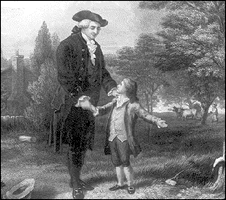
This is relevant because it reflects something about our society that isn't as savory as our first President's forthcoming nature. As the Freeh report loomed, everybody who could be, should be or anticipated being named in the report has been manoevering the spin-apparatus to make sure nobody thinks they knew anything or failed to act properly. Our former President and his lawyers are making sure we all know he didn't know any more than a newborn babe, despite clear record, even before the report was released, that something of some sort was known to him.
Other former administrators, indicted for perjury, are making sure we all know that they would never, ever look the other way at serious offenses like child abuse. And how could you even think that the trustees and university lawyers knew anything!
The university has been offering pre-emptively consoling meetings with victims and the solace of monetary compensation for stresses they may have experienced because somebody (else) may have done something they shouldn't (because the University wouldn't tolerate such antics!).
We're even seen pre-emptive imaging-preserving manoevering by the deceased. Joe Paterno can't speak for himself, but his family are making moves and publicity bleats to ensure us that he would never have looked the other way. How his family would know about something they didn't witness is not clear, unless they've been at some unpublicized seances.
The Freeh report, as neutral before-hand as one can ask, we think, sees it differently: There was a cherry tree here, it did get chopped down, and the report identifies who did it but tried to wriggle out of responsibility.
Like one, like all: see no evil, do no evil
It's not just here at this particular university. It's become the American way: nobody seems to be guilty of anything, ever. From disingenuous spinning, and in this case pre-spin-spinning, including pervasive advertising and image management, from individual to organization, this is a nation of angels!
We occasionally hear a myth that confession is good for the soul. Not many, say like the person we'll not name in this image (whom some might assume has a soul), are able to say even if reluctantly as this guy seems perhaps to be thinking about saying, "Well, OK, I must confess..."

If confession is good for the soul, our good souls apparently don't feel they need it.
Sadly, the denouement may not leave everyone unbesmirched. The administrators being fingered have generally lived highly honorable and decent lives, as officials, President, and Coach. Their achievements need to be recognized as we keep all of this in balance. We all make mistakes (though we'll rarely admit it!).
But the underlying problem, that of excessive attention to image and 'brand, over substance, is more serious and was pervasive around here--we have been noting it for years, unrelated to anything to do with the child-abuse case.
While it's too bad to be administered by so obsessively risk-averse an attitude, that it won't make reforms, it's not unique to Penn State. There is, for example, a well-documented national malaise in higher education that nobody dares address directly, essentially because to do anything about it we'd all have to change our ways, and tuition income could be jeopardized. Many of a school's prominent faculty are not teaching as much as students paying tuition or their parents may have expected from the recruiting brochures they get. Our stress on research is arguably far out of proportion given its actual contribution to our overall responsibility to the public we serve. We are looking the other way at a different kind of abuse, student-abuse: we are tacitly pressured to entertain, and are not providing rigorous enough education nor one that--in the market mentality we think makes us so smart and insightful about how to do things--is tied to the product we are 'selling'. We admit students many of whom are not prepared for, able, or interested in high-level academic learning (and the work that is required by them--and us, to bring it off). We boast that bowl wins--sports--increase admission applications as if that's a good reason to apply here (but it's good for business!). We talk about 'student-athletes' (a legalism used strictly to avoid problems with how we exploit them), but not about 'student-customers'.
The lowered academic standards is a national problem; administrators from department Heads to Deans to the main office, know the situation very well, yet no serious action seems to be taking place. We talk the 'academics' talk but we don't walk the walk. Institutions daren't jeopardize their image, brand, athletic department income, nor lose faculty to other institutions if we insisted on fulfilling a more responsive mission.
It's worse and more general than just that, too. The finger of responsibility, in our society at large, never points to many who deserve it and are at the core of our disingenuousness: the advertising industry, scandal and hype-hungry media, PR firms, lawyers, and politicians who will sell whatever they can gain by selling. We tolerate this, so we're all in it together.
This is relevant because SanduskyGate was just one manifestation of the consequences of this attitude that happened to escape into the public eye. Indeed, even now it seems likely, but unfortunate, that we'll encyst SanduskyGate as if it were an isolated problem, to protect the rest of the university--and to avoid having to address the deeper problem of which this was but a sorry instance. The problem of risk aversion in the face of real problems was something many of us here have been pointing out over the years of our recent administration's tenure.
This protective, restricted-acknowledgment attitude is going to be reinforced as trials and more expensive PR brand control seem inevitable. We'll all be making sure that this was done by somebody else, and that you realize we have halos and gossamer wings. Just like George Washington.
The only thing is, the story of Georgie's confession isn't true.
Now, a specially commissioned report on what happened, chaired by Louis Freeh, the FBI's former Director, has been released. There have been prior leaks, plus other available testimony, about how reports of sightings of the molester at work were, or weren't, properly dealt with.
Penn State as a whole has been taking the rap for this, as if one rogue in the way-beyond-control Athletic Department represented how the rest of us behave. In relation to child molestation, abuses by one isolated individual in our isolated Athletic Department facilities (far on the edge of campus) aside, the rest of the faculty are truly innocent.
But the University as a whole? That's a different story!
The fall of the poor cherry tree (genus Prunus)
George Washington, our country's founding idol, is said to have been truly an honest person. As a child, he has been said to have been so honest that when his father confronted him about a cherry tree that had been chopped down on their property, little Georgie said "I cannot tell a lie, father, you know I cannot tell a lie! I did cut it with my little hatchet.'' We don't know if he was taken to the woodshed by his father, in reward for his valiant confession.
This is relevant because it reflects something about our society that isn't as savory as our first President's forthcoming nature. As the Freeh report loomed, everybody who could be, should be or anticipated being named in the report has been manoevering the spin-apparatus to make sure nobody thinks they knew anything or failed to act properly. Our former President and his lawyers are making sure we all know he didn't know any more than a newborn babe, despite clear record, even before the report was released, that something of some sort was known to him.
Other former administrators, indicted for perjury, are making sure we all know that they would never, ever look the other way at serious offenses like child abuse. And how could you even think that the trustees and university lawyers knew anything!
The university has been offering pre-emptively consoling meetings with victims and the solace of monetary compensation for stresses they may have experienced because somebody (else) may have done something they shouldn't (because the University wouldn't tolerate such antics!).
We're even seen pre-emptive imaging-preserving manoevering by the deceased. Joe Paterno can't speak for himself, but his family are making moves and publicity bleats to ensure us that he would never have looked the other way. How his family would know about something they didn't witness is not clear, unless they've been at some unpublicized seances.
The Freeh report, as neutral before-hand as one can ask, we think, sees it differently: There was a cherry tree here, it did get chopped down, and the report identifies who did it but tried to wriggle out of responsibility.
Like one, like all: see no evil, do no evil
It's not just here at this particular university. It's become the American way: nobody seems to be guilty of anything, ever. From disingenuous spinning, and in this case pre-spin-spinning, including pervasive advertising and image management, from individual to organization, this is a nation of angels!
We occasionally hear a myth that confession is good for the soul. Not many, say like the person we'll not name in this image (whom some might assume has a soul), are able to say even if reluctantly as this guy seems perhaps to be thinking about saying, "Well, OK, I must confess..."

If confession is good for the soul, our good souls apparently don't feel they need it.
Sadly, the denouement may not leave everyone unbesmirched. The administrators being fingered have generally lived highly honorable and decent lives, as officials, President, and Coach. Their achievements need to be recognized as we keep all of this in balance. We all make mistakes (though we'll rarely admit it!).
But the underlying problem, that of excessive attention to image and 'brand, over substance, is more serious and was pervasive around here--we have been noting it for years, unrelated to anything to do with the child-abuse case.
While it's too bad to be administered by so obsessively risk-averse an attitude, that it won't make reforms, it's not unique to Penn State. There is, for example, a well-documented national malaise in higher education that nobody dares address directly, essentially because to do anything about it we'd all have to change our ways, and tuition income could be jeopardized. Many of a school's prominent faculty are not teaching as much as students paying tuition or their parents may have expected from the recruiting brochures they get. Our stress on research is arguably far out of proportion given its actual contribution to our overall responsibility to the public we serve. We are looking the other way at a different kind of abuse, student-abuse: we are tacitly pressured to entertain, and are not providing rigorous enough education nor one that--in the market mentality we think makes us so smart and insightful about how to do things--is tied to the product we are 'selling'. We admit students many of whom are not prepared for, able, or interested in high-level academic learning (and the work that is required by them--and us, to bring it off). We boast that bowl wins--sports--increase admission applications as if that's a good reason to apply here (but it's good for business!). We talk about 'student-athletes' (a legalism used strictly to avoid problems with how we exploit them), but not about 'student-customers'.
The lowered academic standards is a national problem; administrators from department Heads to Deans to the main office, know the situation very well, yet no serious action seems to be taking place. We talk the 'academics' talk but we don't walk the walk. Institutions daren't jeopardize their image, brand, athletic department income, nor lose faculty to other institutions if we insisted on fulfilling a more responsive mission.
It's worse and more general than just that, too. The finger of responsibility, in our society at large, never points to many who deserve it and are at the core of our disingenuousness: the advertising industry, scandal and hype-hungry media, PR firms, lawyers, and politicians who will sell whatever they can gain by selling. We tolerate this, so we're all in it together.
This is relevant because SanduskyGate was just one manifestation of the consequences of this attitude that happened to escape into the public eye. Indeed, even now it seems likely, but unfortunate, that we'll encyst SanduskyGate as if it were an isolated problem, to protect the rest of the university--and to avoid having to address the deeper problem of which this was but a sorry instance. The problem of risk aversion in the face of real problems was something many of us here have been pointing out over the years of our recent administration's tenure.
This protective, restricted-acknowledgment attitude is going to be reinforced as trials and more expensive PR brand control seem inevitable. We'll all be making sure that this was done by somebody else, and that you realize we have halos and gossamer wings. Just like George Washington.
The only thing is, the story of Georgie's confession isn't true.
Subscribe to:
Posts (Atom)