I have just been re-reading Charles Darwin's autobiography. He wrote it with his son's encouragement shortly before the great man passed away in 1882, and was first published in 1887. I think he wrote it to tell his children and so on about his famous life. Yet as famous as he had become, he is as modest as one would expect from that exemplar of the best of humanity.
I encourage anyone in the life sciences, who doesn't presume to think s/he already knows everything, to read it, for reasons I'll suggest below. It has various versions, as his son Francis edited it a bit, redacting some personal family-related comments (these were later restored, but are unimportant here). You can find it here.
I thought that some of the things he said would be worth posting on a site like this. Darwin was right about many things, and even he was wrong about others (as, indeed, he himself freely says). But it is his thinking, his perspective, standards, reasons, and outlook that are important. So what follows are some quotes that I chose (easy to find by searching the ebook), with my reflections separated in italics and in blue. (Because there are many pithy quotes, I've split this into four successive posts):
"To my deep mortification my father once said to me, "You care for nothing but shooting, dogs, and rat-catching, and you will be a disgrace to yourself and all your family."
Darwin was an idler as a privileged young gentleman, but, to our great benefit, circumstances grabbed his attention and serious side. And he explains it thus:
"Looking back as well as I can at my character during my school life, the only qualities which at this period promised well for the future, were, that I had strong and diversified tastes, much zeal for whatever interested me, and a keen pleasure in understanding any complex subject or thing.
I mention this because later in life I wholly lost, to my great regret, all pleasure from poetry of any kind, including Shakespeare."
Darwin more than once admitted, or even bemoaned, his narrow focus and neglect of some of the finer things in life. Yes, he was successful, but this could be a lesson for us all: keep a balance!
"I almost made up my mind to begin collecting all the insects which I could find dead, for on consulting my sister I concluded that it was not right to kill insects for the sake of making a collection."
Even Darwin saw the evil in killing other living things just to gawk at them. We do it routinely, even including mammals (mice, etc.), but to salve our conscience (for those who have one) we get IRB approval first, to keep their suffering under at least some constraint and prevent our suffering from lack of a project to do.
"This was the best part of my education at school, for it showed me practically the meaning of experimental science."
He observed rather than simply conjectured, and his patience and eye for detail and for identifying the critical variables were at the root of his success.
"...but to my mind there are no advantages and many disadvantages in lectures compared with reading."
Ooops, professors! Some of us do need to hear a message live and have it explained. Darwin, though, had the drive, and patience, to study a subject in great detail. How many of us have that?
"At this time I admired greatly the 'Zoonomia;' but on reading it a second time after an interval of ten or fifteen years, I was much disappointed; the proportion of speculation being so large to the facts given.
....in after years I have deeply regretted that I did not proceed far enough at least to understand something of the great leading principles of mathematics, for men thus endowed seem to have an extra sense."
He reasoned in his own way, and did't really suffer by his non-numerical abilities. Maybe he was not misled by math's oversimplification and rigidity? Maybe we rely far too much on the latter, as a safer and quicker course to 'results', than patient, deeper thinking?
"During my last year at Cambridge, I read with care and profound interest Humboldt's 'Personal Narrative'."
"...science consists in grouping facts so that general laws or conclusions may be drawn from them."
If he was anything, it was a patient, careful sponge for detail. And reading stimulated his original thinking.
"I heard that I had run a very narrow risk of being rejected, on account of the shape of my nose! He was an ardent disciple of Lavater, and was convinced that he could judge of a man's character by the outline of his features; and he doubted whether any one with my nose could possess sufficient energy and determination for the voyage."
Here he's talking about having almost been rejected for the voyage that became the basis of his life's work by Fitzroy, the captain of the Beagle. Beware of hoaxes even in science! We see unwarranted speculative conclusions being asserted almost every week in the news media, and even in journals (though there, couched in dense professorialized terms!).
"The investigation of the geology of all the places visited was far more important, as reasoning here comes into play."
"Everything about which I thought or read was made to bear directly on what I had seen or was likely to see; and this habit of mind was continued during the five years of the voyage."
Again, his integrative detail-sponging patience and reasoning. No rush to conclusions (or to print). Indeed, he waited for 25 years before publishing his ideas on evolution, and only did so then when he was prompted by Alfred Russel Wallace's discovery of the same ideas.
"The sight of a naked savage in his native land is an event which an never be forgotten."
(Here he's writing of being in Tierra del Fuego. But he did not think of such people as inferior, as his experience later makes clear)
"Nor must I pass over the discovery of the singular relations of the animals and plants inhabiting the several islands of the Galapagos archipelago, and of all of them to the inhabitants of South America."
We know how important that set of observations was! The islands are still under close observation.
"But I was also ambitious to take a fair place among scientific men,— whether more ambitious or less so than most of my fellow-workers, I can form no opinion."
"...I am sure that I have never turned one inch out of my course to gain fame."
Ambition, yes--but egotism and show-boating, never: no rushing to the news media, no spin doctors!

Monday, September 10, 2018

Tuesday, September 4, 2018
What's causing the cataract epidemic?
Strangely, we seem to be in the midst of a cataract epidemic! It seems that everyone I know is having to have their lenses replaced, and I have been experiencing glare and other issues that suggest the same may be looming for me.
It is the personal experience that drew my attention to this epidemic. That is, I have seen no stories about this in Science or the public news media. That is very strange, since they seem to seize upon any even marginally interesting story. Yet this epidemic has not hit the headlines, at least not yet.
So what could be causing it? This is far, far from my area expertise, so I can only speculate in very generic terms. What has changed that might have epidemic consequences? Here are a list of candidate factors that may have changed recently enough to be responsible (but I confess it is just a guess-list):
This blog site is usually about genetic causation and its associated scientific issues, but once the question of the seeming neglect of a cataract epidemic struck me, I decided I should at least use Mermaid's Tale to air it. I would welcome any comments that raised original or even partly plausible explanations.
However, and finally, I must end by acknowledging that I have done no rigorous study of the cataract problem. Indeed, at my age, I should long ago have learned to avoid the temptation to talk to so many of my peers about it. It could frighten them. Before suggesting that it is a major epidemic, I should think about who I'm talking to.
It is the personal experience that drew my attention to this epidemic. That is, I have seen no stories about this in Science or the public news media. That is very strange, since they seem to seize upon any even marginally interesting story. Yet this epidemic has not hit the headlines, at least not yet.
So what could be causing it? This is far, far from my area expertise, so I can only speculate in very generic terms. What has changed that might have epidemic consequences? Here are a list of candidate factors that may have changed recently enough to be responsible (but I confess it is just a guess-list):
(1) Is it food? With processed and GMO animal and plant foods increasing their prevalence, widely and recently, as well as pollution of the seas from which seafoods come, an obvious suspect would be dietary. Junk foods and other such habits could have effects that are subtle but accumulate, with delayed-onset vision consequences. Dietary factors clearly are, after all, responsible for many 'modern' diseases.
(2) Is it viral or infectious? So many of us move around the country and, indeed, the world that any virus arising even in a remote part of the globe can rapidly spread. Air transport from tropical to temperate zones would be a major suspect, as would international transport of goods and so on. But what virus or infectious agent might be involved is unclear, nor do we know where a similar epidemic might be occurring, unreported.
(3) Is it recent environmental contamination, in air or water? It is impossible to ignore global air and water pollution as potential cataract causing factors--even if the mechanism itself is not known. After all, has it even been examined, given that the epidemic hasn't yet really been recognized? Air and water currents circulate widely around the world, which could make the causal source of the epidemic very distant from the consequences. It might not even be suspected. After all, the lens is a very special kind of tissue and a connection may be very strange relative to what the usual exposure-consequence studies look for, not to mention the statistical methods used which could be quite inapt.
(4) Or, being very cynical, could it be marketing or profiteering by the companies that make the gear and supplies that are involved? In that case, perhaps the idea that there is a real epidemic may be mistake--we would just be being told that there was. This subjective, cultural sort of factor would be vary difficult to document. After all, gear-makers do need to make sales of their gear.Overall, I am stunned at what seems to me to be an obvious but almost wholly unreported yet major epidemic that seriously threatens quality of life. As I must acknowledge in what is a speculative blog post, the whole story could be my ignorance of the literature. I am a geneticist, but I have seen no reason to think this could be genetic, since our population's genotypes have not changed in any substantial way in the recent decade or so. But if not genetics, then what? One must at least ask that question! Yet, strangely I think, the professional epidemiological literature seems to have ignored or even been unaware of the major epidemic, which from my point of view seems clear to me; such neglect is very hard to understand, since (again, to be rather cynical) epidemiologists are naturally eager for any Big Problem they can find to justify Big Studies.
This blog site is usually about genetic causation and its associated scientific issues, but once the question of the seeming neglect of a cataract epidemic struck me, I decided I should at least use Mermaid's Tale to air it. I would welcome any comments that raised original or even partly plausible explanations.
However, and finally, I must end by acknowledging that I have done no rigorous study of the cataract problem. Indeed, at my age, I should long ago have learned to avoid the temptation to talk to so many of my peers about it. It could frighten them. Before suggesting that it is a major epidemic, I should think about who I'm talking to.
Monday, September 3, 2018
Luigi Luca Cavalli-Sforza (1922-2018), worth remembering
Luigi Luca Cavalli-Sforza has died, at age 96. Who? I wonder how many readers of this blog, or in general how many anthropologists or human geneticists of less than middle-age, know who he was. We are not, these days, in the habit of crediting the past. But Luca, at least, is worth remembering--for those who remember him.
Born in Italy, Luca received his MD there and then, when WWII ended, studied population genetics with RA Fisher in England. He spent most of his career at Stanford, where he taught and did his creatively integrative and theoretical work on human variation and its evolution. He collaborated with many colleagues from around the world. He was, from my graduate-student years on, probably the leading human population geneticist in the world. He developed numerical methods for analyzing human allele-frequency variation and relating the pattern of that variation to global population history, relating that variation to other kinds of data. In particular, he was interested in the relationship of language patterns to genetics, and the causal relationship between cultural dynamics--such as the spread of agriculture--and genetic diversity, and he developed ways to analyze how the latter could be used to help reconstruct the former.
I was incredibly fortunate to have been able to spend a sabbatical in Luca's lab at Stanford, in the late '70s. I had no particular 'project' to work on but, typically for him, he hosted me anyway. It was enough for me to know that he and his associates were leaders in human population genetics, as a science per se, but also that they were so original and creative in relating genetic variation to cultural, language, and technological history. His was a synthetic view. He was technically original and advanced, but based on innovative and integrative thinking.
Luca wrote much, but his two most memorable and durable books, that encapsulated much or most of his interests are (1) The Genetics of Human Populations, with co-author Walter Bodmer (W. Freeman, 1970; and a subsequent watered-down version with author order reversed), and (2) the massive History and Geography of Human Genes, with P. Menozzi and A. Piazza (Princeton Press, 1994). Both are still available, I think, the former in a Dover reprint. The Genetics of Human Populations was a digestible, but sophisticated version of population genetics theory and method, suitable for understanding human origins, allele frequency variation, and evolution. Many anthropologists and others learned their trade from this book. The second book was the final word on traditional allele-frequency (rather than DNA sequence) based reconstructions of human global variation.


Luca worked on topics too numerous to go over here. But this is very well described by John Hawks' fine summary of Luca's work and Wikipedia: Luigi Luca Cavalli-Sforza provides references. For anyone even remotely interested in the history of anthropological genetics and its contribution to human evolution and culture history, it will be worth the effort to be familiar with these foundational contributions.
Luca was a central figure in the attempt to organize a worldwide, systematic sampling of human variation (called the Human Genome Diversity Project, or HGDP). That project never took place as such, because, economically it came into funding conflict with the Human Genome Project, to generate a sequence of a representative complete human genome, and, politically because scurrilous accusations were leveled against the HGDP by those who saw it as a project to categorize people exploitively, much as racism does; this was grotesquely false and opportunistically culpable on the part of jealous or ignorant critics and scandal-thirsty journalists. However, the stir provided NIH with a safe excuse not to fund the HGDP. Instead of a formal, globally systematic project, Luca used the heterogeneous blood-group and protein variation data already collected over many years by various investigators around the world, to show global patterns of human gene frequencies. His tome (#2 above) presented these data, much of which are still available. Luca and colleagues developed methods for analyzing the pattern in relation to historical or prehistorical (assumed) human demographic behavior.
As science history often goes, this approach was soon to be pre-empted by DNA sequencing technology, and individual genome sequences supplanted protein and antibody-based allele-frequencies as the primary data for studying human variation and evolution (Ken Kidd at Yale, and a lifelong colleague of Luca's and an organizer of the HGDP effort, has maintained a very useful site for allele frequency and other data). In this sense, historically, Luca's Big Volume was the last word on the earlier technology. But of course similar attempts to reconstruct not just history itself but to integrate that with other aspects of human existence--are actively being pursued by many people, and this can now be extended far back in time thanks to the ability to extract DNA from fossils. Nonetheless, in terms of the history of anatomically modern humans, the basic outlines in Luca et al.'s book, based on sample allele frequencies, I think still generally hold.
Ephemerality's children
I'm not sure how long Luca will be remembered. What I write here is a paean to a wonderful person and terrific scientist. But there is no single 'discovery' nor Cavalli-Sforza 'theorem' or the like, that will be, by being named for him, his lasting legacy. He was not a grandstander, didn't play to the media, and his students and colleagues are now very senior. The present formula in science has little interest in crediting the past (it's not good for careerism), and that generally also often means not reading its lore, either. As happens in science, on technology supplants prior ones, and DNA sequence and other 'Big Data' and 'omics clearly and rightly have co-opted the less informative data types of Luca's era. In some sense this does vitiate earlier methods as well as data. The new data have also enabled publication that is very technical, but in part for the public glamor of technology is less closely tied to deeper, integrative, thought. Nor was Luca the first to use population genetic data to look at human local or global history--studies of blood group variation, for example, well antedate his work, even if generally more crude in method and detail.
In that sense, Luca helped set the stage, but his timing was all wrong. Ah, well. Had he been starting now, with the technologies and database resources currently available, and the much more direct data of DNA sequence (and other 'omics), rather than allele frequencies from population samples, he would have made perhaps a more durable mark, and I suggest that he would have done so more deeply than was possible from the earlier data to which history limited his attention, and not in the hasty rush to print that is now so prevalent.
I fear these may be the hard realities of history. But thoughtfulness, intelligence and, not least, personal grace only come along sporadically.
Cavalli was a gem of his time.
(This post has been edited to make minor typological corrections)
 |
| Source: www2.unipr.it |
Born in Italy, Luca received his MD there and then, when WWII ended, studied population genetics with RA Fisher in England. He spent most of his career at Stanford, where he taught and did his creatively integrative and theoretical work on human variation and its evolution. He collaborated with many colleagues from around the world. He was, from my graduate-student years on, probably the leading human population geneticist in the world. He developed numerical methods for analyzing human allele-frequency variation and relating the pattern of that variation to global population history, relating that variation to other kinds of data. In particular, he was interested in the relationship of language patterns to genetics, and the causal relationship between cultural dynamics--such as the spread of agriculture--and genetic diversity, and he developed ways to analyze how the latter could be used to help reconstruct the former.
I was incredibly fortunate to have been able to spend a sabbatical in Luca's lab at Stanford, in the late '70s. I had no particular 'project' to work on but, typically for him, he hosted me anyway. It was enough for me to know that he and his associates were leaders in human population genetics, as a science per se, but also that they were so original and creative in relating genetic variation to cultural, language, and technological history. His was a synthetic view. He was technically original and advanced, but based on innovative and integrative thinking.
Luca wrote much, but his two most memorable and durable books, that encapsulated much or most of his interests are (1) The Genetics of Human Populations, with co-author Walter Bodmer (W. Freeman, 1970; and a subsequent watered-down version with author order reversed), and (2) the massive History and Geography of Human Genes, with P. Menozzi and A. Piazza (Princeton Press, 1994). Both are still available, I think, the former in a Dover reprint. The Genetics of Human Populations was a digestible, but sophisticated version of population genetics theory and method, suitable for understanding human origins, allele frequency variation, and evolution. Many anthropologists and others learned their trade from this book. The second book was the final word on traditional allele-frequency (rather than DNA sequence) based reconstructions of human global variation.
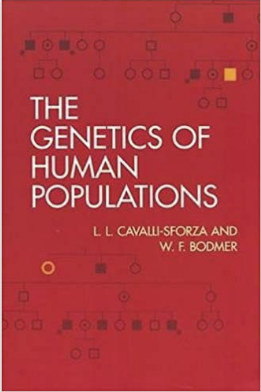

Luca worked on topics too numerous to go over here. But this is very well described by John Hawks' fine summary of Luca's work and Wikipedia: Luigi Luca Cavalli-Sforza provides references. For anyone even remotely interested in the history of anthropological genetics and its contribution to human evolution and culture history, it will be worth the effort to be familiar with these foundational contributions.
Luca was a central figure in the attempt to organize a worldwide, systematic sampling of human variation (called the Human Genome Diversity Project, or HGDP). That project never took place as such, because, economically it came into funding conflict with the Human Genome Project, to generate a sequence of a representative complete human genome, and, politically because scurrilous accusations were leveled against the HGDP by those who saw it as a project to categorize people exploitively, much as racism does; this was grotesquely false and opportunistically culpable on the part of jealous or ignorant critics and scandal-thirsty journalists. However, the stir provided NIH with a safe excuse not to fund the HGDP. Instead of a formal, globally systematic project, Luca used the heterogeneous blood-group and protein variation data already collected over many years by various investigators around the world, to show global patterns of human gene frequencies. His tome (#2 above) presented these data, much of which are still available. Luca and colleagues developed methods for analyzing the pattern in relation to historical or prehistorical (assumed) human demographic behavior.
As science history often goes, this approach was soon to be pre-empted by DNA sequencing technology, and individual genome sequences supplanted protein and antibody-based allele-frequencies as the primary data for studying human variation and evolution (Ken Kidd at Yale, and a lifelong colleague of Luca's and an organizer of the HGDP effort, has maintained a very useful site for allele frequency and other data). In this sense, historically, Luca's Big Volume was the last word on the earlier technology. But of course similar attempts to reconstruct not just history itself but to integrate that with other aspects of human existence--are actively being pursued by many people, and this can now be extended far back in time thanks to the ability to extract DNA from fossils. Nonetheless, in terms of the history of anatomically modern humans, the basic outlines in Luca et al.'s book, based on sample allele frequencies, I think still generally hold.
Ephemerality's children
I'm not sure how long Luca will be remembered. What I write here is a paean to a wonderful person and terrific scientist. But there is no single 'discovery' nor Cavalli-Sforza 'theorem' or the like, that will be, by being named for him, his lasting legacy. He was not a grandstander, didn't play to the media, and his students and colleagues are now very senior. The present formula in science has little interest in crediting the past (it's not good for careerism), and that generally also often means not reading its lore, either. As happens in science, on technology supplants prior ones, and DNA sequence and other 'Big Data' and 'omics clearly and rightly have co-opted the less informative data types of Luca's era. In some sense this does vitiate earlier methods as well as data. The new data have also enabled publication that is very technical, but in part for the public glamor of technology is less closely tied to deeper, integrative, thought. Nor was Luca the first to use population genetic data to look at human local or global history--studies of blood group variation, for example, well antedate his work, even if generally more crude in method and detail.
In that sense, Luca helped set the stage, but his timing was all wrong. Ah, well. Had he been starting now, with the technologies and database resources currently available, and the much more direct data of DNA sequence (and other 'omics), rather than allele frequencies from population samples, he would have made perhaps a more durable mark, and I suggest that he would have done so more deeply than was possible from the earlier data to which history limited his attention, and not in the hasty rush to print that is now so prevalent.
I fear these may be the hard realities of history. But thoughtfulness, intelligence and, not least, personal grace only come along sporadically.
Cavalli was a gem of his time.
(This post has been edited to make minor typological corrections)
Friday, August 17, 2018
I'm still mad about the Google Memo and David Brooks's column about it
In 2017 there was the Google Memo (When your memo's bad
theories give girls heebie jeebies ... That's Damore) and then David Brooks supported Damore in his New York Times column. So I pitched a reply to the New York Times
(rejected by silence) but never posted it here because I was department Chair
and [fill in the blank with your wildest dreams].
But it’s not too late to post my thoughts here, and they’re still fresh in my
frontal because I’m in the midst of some writing projects where I’m happily channeling my rage against the misuse of my beloved evolutionary thinking.
So, mermaids, here’s that response to Brooks. P.S. I’m on sabbatical, so pardon my fucking French
…
***
Dear Editor,
I write to you regarding
David Brooks’ column about the firing of ‘Google memo’ author Damore titled , “Sundar
Pichai Should Resign as Google’s C.E.O.” I offer some corrections
and context for Brooks’ innumerable readers.
There is no debate about human nature being either,
on one side, a blank slate or, on the other, evolutionary psychology. The debate pitting nature against nurture is long over and I tell all my students that anyone who says it's still a thing is mistaken. Everyone by 2017 agrees that genes + environment shape an individual human's behavior over their lifetime (if one must boil biological complexity down to two vague, enormously complicated variables and simple arithmetic).
What is more, the description of evolutionary psychology Brooks provides (genes + environment), while it may describe the perspective of many evolutionary
psychologists, is not a description of the field as implied. It describes what experts think across *many many* fields, including evolutionary biology,
anthropology, and genetics, even the humanities, where many researchers and scholars are not terribly fond of evolutionary
psychology, at least not with the simple, deterministic, overly-confident brand that folks like Damore and Brooks wave about.
By giving this particular brand of evolutionary psychology credit for what most
experts in many fields already believe, Brooks has elevated it to the
status that Damore did in the memo. Both Brooks and Damore are misleading their audiences about the state of science itself and it's ingenious because it helps them perpetuate the image they want to portray: that science is on their side. It is not.
And Brooks does it again when he quotes evolutionary
psychologist, Geoffrey Miller, as a sort of fact-check of Damore’s claims in the memo. Brooks' presentation of Miller's validation leads readers to believe that the empirical support for sex
differences is the product of evolutionary psychology. But these data are
the products of numerous fields, psychology being one and evolutionary being
the theoretical prerogative of some. I’m sure that every one of the scientists
and scholars who produced the empirical data to establish sex differences in
behavior and personality accept the reality of evolution, but evolutionary
psychology, especially this particular brand, is something different.
Most people who have really grappled with how evolution works appreciate its complexity. Unfortunately these usually do not include people with tremendous influence, like Brooks. And Brooks is smitten with some problematic takes on the evolution of sex and gender differences in behavior.
Could this ignorance, manipulation, or flat-out dishonesty--all with negative consequences for women and people of color--be what was so offensive about the ‘Google memo’ and Brooks’s column to the minds of many academics, instead of it being just some knee-jerk liberal reaction by leftist elites with weak, unscientific cognitive skills? Absolutely.
Evolution is true but it’s complicated and sticking to overly-simplistic and out-dated thinking makes it easy to bend to fit and justify one’s worldview. This is why racists think white people are the pinnacle of evolution. Darwin might have in the nineteenth century, but evolution in 2017 does not.
And it is really a shame that I
have to add something like this but it's *because* intelligent people like Brooks and
Damore don’t give enough fucks to think deeply about evolutionary biology, what it is and isn't, that they're able to empower their opinions with old, bad, weak, even untestable 'science.'
I wish I could say that in 2017 people, even the very
learned ones, were cautious about what they can and cannot claim about complex
phenomena. Here’s
to a more humble, more fun future where we can actually figure cool shit out.
Evolution is everyone’s origin story. But takes like Brooks’
and Damore’s drive people away from the thing that gives me so much meaning
and the thing I find so beautiful. So here I am. Sincerely,
Holly Dunsworth
Thursday, August 16, 2018
The Litella Factor: Changing the claimspace of science
We may be starting to see rationalizations and wiggle-words as investigators gradually inch away from many of the genomics-based claims, such as last year's slogan du jour that we're going to deliver 'precision' genomic medicine, or this year's that we'll find genomic causes of disease for 'All of Us'. Science, of all human subjects, should be objective about the world and not sloganeering even if to wangle ever more funding from the public. Many are by now quietly realizing not only that environments are important, which is nothing new though minimized by geneticists for a generation, but also that genomics itself is more complex, more variable, and less predictively powerful than has been so widely and often touted in recent years.
We've known the likely nature of genomic causal contribution complexity for literally a century (RA Fisher's 1918 paper is the landmark). The idea was a reasoned way to resolve what appeared to be fundamental differences between classically discrete Mendelian traits that took on only one or two states (yellow or green peas), and classically quantitative 'heritability' based traits that seemed to vary continuously (like height) and that as a result were presumed to be the main basis of Darwinian evolution. The former states seemed never to change, and hence to evolve, while selection could move the average values of continuous traits.
The resolution of these two seemingly incompatible views came from the idea that complex traits were produced by many individual 'Mendelian' genes, but each with a very small effect, was a major advance in our understanding of both heritable causation and the evolution of life: agricultural and experimental breeding confirmed this 'modern synthesis' of evolutionary genetics to an extensive and consistent if implicit degree for a century.
However, the specific genes that were responsible were largely implicit, assumed, or unknown. There was no way to identify them until large-scale DNA sequencing technology became available. What genomewide mapping (GWAS and other statistical ways to identify associations between genetic variants and trait variation) has shown is (1) that century-old model was basically right, and (2) we can identify many of the myriad genome regions whose variation is responsible for trait variation. This was given a real boost in public support by the fact that many diseases were familial and, even more, that if our diseases and other traits are genetic, we can identify the responsible genes (and, hopefully do something to correct harmful variants).
Phenotypes and their evolution (effects on health and reproductive success) are in this context usually based on the individual as a whole, not individual genes--say, your blood pressure's effect on you as a whole person. That is, the combinations of polygenic effects that GWAS has identified typically differ for each person even if they have the same trait measure. We have also found something that is entirely consistent with the nature of evolution as a population phenomenon. That is that much of the contributing genomescape for a given trait (like blood pressure) involves genome sites whose relevant variants have very low frequency or effects too small to measure with statistical 'significance', so that only a fraction of the estimated overall genetic contribution in the population (measured as the trait's 'heritability') is accounted for by mapping. All of this has been a discovery success that is consistent with what was the basic formal genetic theory of evolution, developed over the 20th century.
Great success--but.....
The very same work, however, has led to a problem. This is the convenient practice equating induction with deduction. That is, we estimate the risk effects of genomic sites from samples of individuals whose current trait-state reflects their genotype and their past lifestyle exposures. For example, we estimate the average blood pressure with sampled individuals with some particular genotype. That is induction. But then we make a prediction that we promise that from a new person's genotype we can, with 'precision', predict his/her future state. That is, we use this deductively to assume that the average from past samples is a future parameter--say, a probability p of getting some disease. That is essentially what a genotype-specific risk is.
But this is based on the achieved effects of the individuals' genotypes at the test and other genome sites as well as lifestyle exposures (mainly unmeasurable and unknown). We assume that similar factors will apply in the future, so that we can predict traits based on genome sequence. That is what (by assumption) converts induction to deduction. It rests on many untested or even untestable assumptions. It is a dubious port of convenience, because future mutations and lifestyle exposures, which we know are crucial to trait causation, are unpredictable--even in principle. We know this from clearly documented epidemiological history: disease prevalences change in unpredictable ways so that the same genotype a century ago would not have the same phenotype consequences today.
So, while genetic variation is manifestly important, its results are complexly interactive, not nearly the simple, replicable, additive, specific causal phenomena that NIH has been promising so fervently to identify to produce wonders of improved health. It's been a very good strategy for securing large budgets, and hence very good for lots of scientists, and perhaps as such--its real purpose?--it is a booming success. It did, one must acknowledge, document the largely theoretical ideas about complex genotypic causation of the early 20th century. But the casual equating of induction with deduction has also fed a convenient ideology that has not been very good for science, because science should shun ideology: in this case the idea of enumerable, essentially parametric causation is wrongly and far too narrowly focused.
Perhaps some realization is afoot
But now we're seeing, here and there, various qualifiers and caveats and soft, not fully acknowledged, retreats from genomics promises. Some light is being shown on the problems and the practices that are common today. Few if any are admitting they've been too strident, or wrong, or whatever, but instead are asserting their view as either what we all already know, or as a kind of new insight they are making etc. That is, claiming that things aren't so genomically caused is a claim of original insight and hence new or continued funding. No apologies, and no acknowledgments of those critics of the current NIH-promoted Belief System, who have been pointing these things out for many years--no offer of Emily Litella's quiet and humble recognition of a mistake: "Oh.....Never mind!"
How seriously should the quiet backtracking be challenged about this? Is it even fair to call the revisionists 'hypocrites'? We live and learn via science, so perhaps the claimscape change, though quiet and implicit, is a reflection of good science, not just expediency. Perhaps that is how science should be, reacting, even if slowly, to new knowledge and giving up on cherished paradigms.
One underlying aspect of modern science is not that we can accept wrong notions, but our hasty, excessive claims rushed to the public, the journals, and the funders. In a sense, this isn't entirely a fault of vanity but of the system we've built for supporting science. A toning down of claims, shunning those who claim too much too quickly, and much higher threshold for 'going public' would improve science and indeed be more honest to the public. A stone-age suggestion I've made (almost seriously) is that journals should stop publishing any figures or graphs (in the pages or on the cover) in color--that is, to make science papers really, really boring! Then, only serious and knowledgeable scientists would read, much less shout about, research reports (maybe some black-and-white TV science reporting should be allowed, too). At least, we are due some serious reforms in science funding itself, so that scientists are not pressured, for their very career survival, into the excessive claimscape of recent years.
In specific terms, I personally think that by far the most important reforms would be to limit the funding available to any single laboratory or project, to stop paying faculty salaries on grants, to provide base funding for faculty hired with research as part of their responsibilities, and decoupling relentless hustling for money from research, so that the science rather than the money would be in the driver's seat. Universities, lusting after credit score-count and grant overheads, would have to quiet down and reform as well.
The infrastructure is broad and altering it would not be easy. But things were once more sane and responsible (even if always with some venal or show-boat exceptions, humans being humans). But if such reforms were to be implemented, young investigators could apply their fresh minds to science rather than science hustling. And that would be good for science.
We've known the likely nature of genomic causal contribution complexity for literally a century (RA Fisher's 1918 paper is the landmark). The idea was a reasoned way to resolve what appeared to be fundamental differences between classically discrete Mendelian traits that took on only one or two states (yellow or green peas), and classically quantitative 'heritability' based traits that seemed to vary continuously (like height) and that as a result were presumed to be the main basis of Darwinian evolution. The former states seemed never to change, and hence to evolve, while selection could move the average values of continuous traits.
The resolution of these two seemingly incompatible views came from the idea that complex traits were produced by many individual 'Mendelian' genes, but each with a very small effect, was a major advance in our understanding of both heritable causation and the evolution of life: agricultural and experimental breeding confirmed this 'modern synthesis' of evolutionary genetics to an extensive and consistent if implicit degree for a century.
However, the specific genes that were responsible were largely implicit, assumed, or unknown. There was no way to identify them until large-scale DNA sequencing technology became available. What genomewide mapping (GWAS and other statistical ways to identify associations between genetic variants and trait variation) has shown is (1) that century-old model was basically right, and (2) we can identify many of the myriad genome regions whose variation is responsible for trait variation. This was given a real boost in public support by the fact that many diseases were familial and, even more, that if our diseases and other traits are genetic, we can identify the responsible genes (and, hopefully do something to correct harmful variants).
Phenotypes and their evolution (effects on health and reproductive success) are in this context usually based on the individual as a whole, not individual genes--say, your blood pressure's effect on you as a whole person. That is, the combinations of polygenic effects that GWAS has identified typically differ for each person even if they have the same trait measure. We have also found something that is entirely consistent with the nature of evolution as a population phenomenon. That is that much of the contributing genomescape for a given trait (like blood pressure) involves genome sites whose relevant variants have very low frequency or effects too small to measure with statistical 'significance', so that only a fraction of the estimated overall genetic contribution in the population (measured as the trait's 'heritability') is accounted for by mapping. All of this has been a discovery success that is consistent with what was the basic formal genetic theory of evolution, developed over the 20th century.
Great success--but.....
The very same work, however, has led to a problem. This is the convenient practice equating induction with deduction. That is, we estimate the risk effects of genomic sites from samples of individuals whose current trait-state reflects their genotype and their past lifestyle exposures. For example, we estimate the average blood pressure with sampled individuals with some particular genotype. That is induction. But then we make a prediction that we promise that from a new person's genotype we can, with 'precision', predict his/her future state. That is, we use this deductively to assume that the average from past samples is a future parameter--say, a probability p of getting some disease. That is essentially what a genotype-specific risk is.
But this is based on the achieved effects of the individuals' genotypes at the test and other genome sites as well as lifestyle exposures (mainly unmeasurable and unknown). We assume that similar factors will apply in the future, so that we can predict traits based on genome sequence. That is what (by assumption) converts induction to deduction. It rests on many untested or even untestable assumptions. It is a dubious port of convenience, because future mutations and lifestyle exposures, which we know are crucial to trait causation, are unpredictable--even in principle. We know this from clearly documented epidemiological history: disease prevalences change in unpredictable ways so that the same genotype a century ago would not have the same phenotype consequences today.
So, while genetic variation is manifestly important, its results are complexly interactive, not nearly the simple, replicable, additive, specific causal phenomena that NIH has been promising so fervently to identify to produce wonders of improved health. It's been a very good strategy for securing large budgets, and hence very good for lots of scientists, and perhaps as such--its real purpose?--it is a booming success. It did, one must acknowledge, document the largely theoretical ideas about complex genotypic causation of the early 20th century. But the casual equating of induction with deduction has also fed a convenient ideology that has not been very good for science, because science should shun ideology: in this case the idea of enumerable, essentially parametric causation is wrongly and far too narrowly focused.
Perhaps some realization is afoot
But now we're seeing, here and there, various qualifiers and caveats and soft, not fully acknowledged, retreats from genomics promises. Some light is being shown on the problems and the practices that are common today. Few if any are admitting they've been too strident, or wrong, or whatever, but instead are asserting their view as either what we all already know, or as a kind of new insight they are making etc. That is, claiming that things aren't so genomically caused is a claim of original insight and hence new or continued funding. No apologies, and no acknowledgments of those critics of the current NIH-promoted Belief System, who have been pointing these things out for many years--no offer of Emily Litella's quiet and humble recognition of a mistake: "Oh.....Never mind!"
 |
| "Oh.....Never mind!" YouTube from NBC's SaturdayNightLive |
One underlying aspect of modern science is not that we can accept wrong notions, but our hasty, excessive claims rushed to the public, the journals, and the funders. In a sense, this isn't entirely a fault of vanity but of the system we've built for supporting science. A toning down of claims, shunning those who claim too much too quickly, and much higher threshold for 'going public' would improve science and indeed be more honest to the public. A stone-age suggestion I've made (almost seriously) is that journals should stop publishing any figures or graphs (in the pages or on the cover) in color--that is, to make science papers really, really boring! Then, only serious and knowledgeable scientists would read, much less shout about, research reports (maybe some black-and-white TV science reporting should be allowed, too). At least, we are due some serious reforms in science funding itself, so that scientists are not pressured, for their very career survival, into the excessive claimscape of recent years.
In specific terms, I personally think that by far the most important reforms would be to limit the funding available to any single laboratory or project, to stop paying faculty salaries on grants, to provide base funding for faculty hired with research as part of their responsibilities, and decoupling relentless hustling for money from research, so that the science rather than the money would be in the driver's seat. Universities, lusting after credit score-count and grant overheads, would have to quiet down and reform as well.
The infrastructure is broad and altering it would not be easy. But things were once more sane and responsible (even if always with some venal or show-boat exceptions, humans being humans). But if such reforms were to be implemented, young investigators could apply their fresh minds to science rather than science hustling. And that would be good for science.
Wednesday, August 15, 2018
On the 'probability' of rain (or disease): does it make sense?
We typically bandy the word probability around, as if we actually understand it. The term, or a variant of it like probably, can be used in all sorts of contexts that, on the surface seem quite obvious and related to some sense of uncertainty; e.g., "That's probably true," or "Probably not." But is it so obvious? Are the concepts clear at all? When are they, actually, more than just informally and subjectively, meaningful?
Will it rain today? Might it? What is the chance of rain?
One of the typical uses of probabilistic terms in daily life has to do with weather predictions. As a former meteorologist myself, I find this a cogent context in which to muse about these terms, but with extensions that have much deeper relevance.
Here is an episode of a generally very fine BBC Radio 4 program called More or Less, whose mission is to educate listeners on the proper use and understanding of numbers, statistics, probabilities and the like. This episode deals, somewhat unclearly and to me quite vaguely, unsatisfactorily, and even somewhat defensively, about the use and interpretation of weather forecasts.
So what does a forecast calling for an x% chance of rain mean? Let's think of an imaginary chessboard laid over a particular location. It is raining under the black, but not under the white squares. There is nothing probabilistic about this. 50% of people in the area will experience rain. If I don't know where you live, exactly, I'd have to say that you have a 50% chance of rain, but that has nothing to do with the weather itself but rather with my uncertainty of where you live. Even then it's misleadingly vague since people don't live randomly across a region (they are, for example, usually clustered in some sub-regions).
Another interpretation is that I don't know where the black and white squares will be exactly, at any given time, but my weather models predict that in about half of the region, rain will fall. This could be because my computer models, necessarily based on imperfect measurement and imperfect theory, are therefore imperfect--but I run them many times, making small random changes in various values to account for that imperfection, and I find that among these model runs, 50% of the time at any given spot, or 50% of the entire area under consideration, experiences rain.
Or, is it that there is an imaginary chessboard moving overhead and so the 50% of the land will be under the black and hence getting rain at any given time, and thus that any given area will only get it 50% of the time, but every area will certainly get rain at some time during the forecast period, indeed every area will be getting rain half of the period? Then the best forecast is that you will get wet if you stay outside all day, but if you only run out to get the mail you might not? Might??
Or is it that my models are imperfect but theory or experience tell me that there is a 50% chance of any rain in the area--that is, my knowledge can tell me no more than that. In that case, any given place will have this guesstimated chance of rain. But does that mean at any given time during the forecast period, or at every time during it? Or is it that my knowledge is very good, but the meteorological factors--the nature of atmospheric motion and so on--only probabilistically form droplets that are large enough not just to be clouds but to fall to earth? That is, is it the atmospheric process itself that is probabilistic--at least based on the theory, since I can't observe every droplet.
If a rain-generating front is passing through the area, it could rain everywhere along the front, but only until the front has moved past the area. Thus, it may rain with 100% certainty, but only 50% of the specified time, if the front takes that amount of time to pass through.
I've undoubtedly only mentioned some of the many ways that weather forecast probabilities can be intended or interpreted as meaning. It is not clear--and the BBC program shows this--that everyone or perhaps even anyone making them actually understands, or is thinking clearly about, what these probability forecasts mean. Even meteorologists themselves, especially when dumbing down for the average Joe who only wants to know if he should carry his brolly with him, are likely ('probably'?!) unclear about these values. Probably they mean a bit of this and a bit of that. I wonder if anyone can know which of the meanings are being used in any given forecast.
Well, fine, everyone knows that nobody really knows everything about the weather. Anyway, it's not that big of a deal if you get an unexpected drenching now and then, or more often haul your raincoat to work but never need it.
But what about things that really matter, like your future health? My doc takes my blood pressure and looks at my weight, and may warn me that I am at 'risk' of a heart attack or stroke--that without taking some preventive measures I may (or probably will) have such a fate. That's a lot more important than a soaked shirt. But what does it mean? Isn't everybody at some risk of these diseases?Does my doc actually know? Does anybody? Who is thinking clearly about these kinds of risk pronouncements?
OK, caveats, caveats: but will I get diabetes?
In genomics 'precision' genomic medicine is one of the genomics marketing slogans of the day, the very vague (I would say culpably false) promise that from your genotype we can predict your future--that's what 'precision' implies. The same applies even if weaseling now would include environmental factors as well as genomic ones. And the idea implies knowledge not just of some vague probability, but by implication it means perfection--prediction with certainty. But to what extent--if any at all--is the promise, or can the promise be true? What would it mean to be 'true'? After all, anyone might get, say type 2 diabetes, mightn't they? Or, more specifically, what does such a sentence itself even mean, if anything?
We know that, today at least, some people get diabetes sometime in their lives, and even if we don't know why or which ones, that seems like a safe assertion. But to say that any person, not specifically identified, might become diabetic is rather useless. We want a reason--a cause--and if we have that we assume it will enable us to identify specifically vulnerable individuals. Even then, however, we don't know more than to say, in some sense that we may not even understand as well as we think we do, that not all the vulnerable will get the disease: but we seem to think that they share some probability of getting it. But what does that mean, and how do we get such figures?
Does it mean that among all those with a given GWAS! genotype, (1) a fraction f will get diabetes?(2) a fraction f will get diabetes if they live beyond some specified age? (3) a fraction f will get diabetes before they die if they live the same lifestyle diet as those from whom the risk was estimated? (4) a net fraction f will get diabetes, pro-rated year by year as they age; (5) a net fraction related to f will get diabetes, but that is adjusted for current age, sex, race, etc.?
What about each individual consulting their Big Data genomic counselor? Are these fractions f related to each individual as a probability p=f that s/he will get diabetes (conditional on things like items 1-5 above)? That is, is every person at the same risk?
Only if we can equate our past sample, from which we estimated f by induction to the probability p used by deduction to assert for each new individual might this, even in principle, lead to 'precision genomic medicine'. It is prediction, not just description that we are being promised. Even if we were thinking in public health terms, this is essentially the same, because it would relate to the fraction of individuals who will be affected in the future, because each person is exposed to the same probability.
Of course, we might believe that each person has some unique probability of getting diabetes (related, again, to the above items), and that f reflects the mix (e.g., average) of these probabilities. But then, we have to assume that all the genotypes and lifestyles and so on in the current group whose future we're offering 'precision' predictions is exactly like the sample from which the predictions were derived, that this mix of risks is, somehow, conserved. How can such an assumption ever be justified?
Of course, we know very well that no current sample whose future we want to be precise about will be exactly the same as the past sample from which the probabilities (or fractions) were derived. Obviously, much will differ, but we also know that we simply have no way to assess by how much it will differ. For example, future diets, sociopolitical, and other factors that affect risk will not be the same as those in the past, and are inherently unpredictable. So, on what meaningful basis can 'precision' prediction be promised?
Just for fun, let's take the promise of precision genomic medicine at its face value. I go to the doc, who tells me
I mean, what if there are no such true probabilities, because even if there were, not just knowledge, but also circumstances (cultural, not to mention mutations) continually change, and what if we have no way whatever to know how they're gonna change? Then what is the use of these 'precision' predictions? They, at best, only apply to a single, current instance. So what (if anything at all) does 'precision' mean?
It only takes a tad of thinking to see how precisely imprecise these promises all are--must be, except very short-term extrapolations of what past data showed, and extrapolations of unknown (and unknowable) 'precision'. Except, of course, the very precise truth that you, as a taxpayer, are going to foot the bill for a whole lot more of this sort of promises.
Unlike the weather, we don't have anything close to as rigorous an understanding of human biology and cultures as we do of the behavior of gases and fluids (the atmosphere). We might want to say, self-protectingly and more honestly modest, that our use of 'probability' is very subjective and really just means an extrapolated rough average of some unspecifiable sort. But then that doesn't sound like the glowing promise of 'precision', does it? One has to wonder what sort of advice would make scientifically proper, and honorable, use of the kind of probabilistic, vague, ephemeral evidence we have when we rely on 'omics approaches, or even when it's the best we can do at present.
In meteorology, it used to be (when I was playing that game) that we'd joke "persistence is the best forecast". This was, of course, for short range, but short range was all we could do with any sort of 'precision'. We are pretty much in that situation now, in regard to genomics and health.
The difference is, weather forecasters are honest, and admit what they don't know.
Will it rain today? Might it? What is the chance of rain?
One of the typical uses of probabilistic terms in daily life has to do with weather predictions. As a former meteorologist myself, I find this a cogent context in which to muse about these terms, but with extensions that have much deeper relevance.
Here is an episode of a generally very fine BBC Radio 4 program called More or Less, whose mission is to educate listeners on the proper use and understanding of numbers, statistics, probabilities and the like. This episode deals, somewhat unclearly and to me quite vaguely, unsatisfactorily, and even somewhat defensively, about the use and interpretation of weather forecasts.
So what does a forecast calling for an x% chance of rain mean? Let's think of an imaginary chessboard laid over a particular location. It is raining under the black, but not under the white squares. There is nothing probabilistic about this. 50% of people in the area will experience rain. If I don't know where you live, exactly, I'd have to say that you have a 50% chance of rain, but that has nothing to do with the weather itself but rather with my uncertainty of where you live. Even then it's misleadingly vague since people don't live randomly across a region (they are, for example, usually clustered in some sub-regions).
Another interpretation is that I don't know where the black and white squares will be exactly, at any given time, but my weather models predict that in about half of the region, rain will fall. This could be because my computer models, necessarily based on imperfect measurement and imperfect theory, are therefore imperfect--but I run them many times, making small random changes in various values to account for that imperfection, and I find that among these model runs, 50% of the time at any given spot, or 50% of the entire area under consideration, experiences rain.
Or, is it that there is an imaginary chessboard moving overhead and so the 50% of the land will be under the black and hence getting rain at any given time, and thus that any given area will only get it 50% of the time, but every area will certainly get rain at some time during the forecast period, indeed every area will be getting rain half of the period? Then the best forecast is that you will get wet if you stay outside all day, but if you only run out to get the mail you might not? Might??
Or is it that my models are imperfect but theory or experience tell me that there is a 50% chance of any rain in the area--that is, my knowledge can tell me no more than that. In that case, any given place will have this guesstimated chance of rain. But does that mean at any given time during the forecast period, or at every time during it? Or is it that my knowledge is very good, but the meteorological factors--the nature of atmospheric motion and so on--only probabilistically form droplets that are large enough not just to be clouds but to fall to earth? That is, is it the atmospheric process itself that is probabilistic--at least based on the theory, since I can't observe every droplet.
If a rain-generating front is passing through the area, it could rain everywhere along the front, but only until the front has moved past the area. Thus, it may rain with 100% certainty, but only 50% of the specified time, if the front takes that amount of time to pass through.
I've undoubtedly only mentioned some of the many ways that weather forecast probabilities can be intended or interpreted as meaning. It is not clear--and the BBC program shows this--that everyone or perhaps even anyone making them actually understands, or is thinking clearly about, what these probability forecasts mean. Even meteorologists themselves, especially when dumbing down for the average Joe who only wants to know if he should carry his brolly with him, are likely ('probably'?!) unclear about these values. Probably they mean a bit of this and a bit of that. I wonder if anyone can know which of the meanings are being used in any given forecast.
Well, fine, everyone knows that nobody really knows everything about the weather. Anyway, it's not that big of a deal if you get an unexpected drenching now and then, or more often haul your raincoat to work but never need it.
But what about things that really matter, like your future health? My doc takes my blood pressure and looks at my weight, and may warn me that I am at 'risk' of a heart attack or stroke--that without taking some preventive measures I may (or probably will) have such a fate. That's a lot more important than a soaked shirt. But what does it mean? Isn't everybody at some risk of these diseases?Does my doc actually know? Does anybody? Who is thinking clearly about these kinds of risk pronouncements?
OK, caveats, caveats: but will I get diabetes?
In genomics 'precision' genomic medicine is one of the genomics marketing slogans of the day, the very vague (I would say culpably false) promise that from your genotype we can predict your future--that's what 'precision' implies. The same applies even if weaseling now would include environmental factors as well as genomic ones. And the idea implies knowledge not just of some vague probability, but by implication it means perfection--prediction with certainty. But to what extent--if any at all--is the promise, or can the promise be true? What would it mean to be 'true'? After all, anyone might get, say type 2 diabetes, mightn't they? Or, more specifically, what does such a sentence itself even mean, if anything?
We know that, today at least, some people get diabetes sometime in their lives, and even if we don't know why or which ones, that seems like a safe assertion. But to say that any person, not specifically identified, might become diabetic is rather useless. We want a reason--a cause--and if we have that we assume it will enable us to identify specifically vulnerable individuals. Even then, however, we don't know more than to say, in some sense that we may not even understand as well as we think we do, that not all the vulnerable will get the disease: but we seem to think that they share some probability of getting it. But what does that mean, and how do we get such figures?
Does it mean that among all those with a given GWAS! genotype, (1) a fraction f will get diabetes?(2) a fraction f will get diabetes if they live beyond some specified age? (3) a fraction f will get diabetes before they die if they live the same lifestyle diet as those from whom the risk was estimated? (4) a net fraction f will get diabetes, pro-rated year by year as they age; (5) a net fraction related to f will get diabetes, but that is adjusted for current age, sex, race, etc.?
What about each individual consulting their Big Data genomic counselor? Are these fractions f related to each individual as a probability p=f that s/he will get diabetes (conditional on things like items 1-5 above)? That is, is every person at the same risk?
Only if we can equate our past sample, from which we estimated f by induction to the probability p used by deduction to assert for each new individual might this, even in principle, lead to 'precision genomic medicine'. It is prediction, not just description that we are being promised. Even if we were thinking in public health terms, this is essentially the same, because it would relate to the fraction of individuals who will be affected in the future, because each person is exposed to the same probability.
Of course, we might believe that each person has some unique probability of getting diabetes (related, again, to the above items), and that f reflects the mix (e.g., average) of these probabilities. But then, we have to assume that all the genotypes and lifestyles and so on in the current group whose future we're offering 'precision' predictions is exactly like the sample from which the predictions were derived, that this mix of risks is, somehow, conserved. How can such an assumption ever be justified?
Of course, we know very well that no current sample whose future we want to be precise about will be exactly the same as the past sample from which the probabilities (or fractions) were derived. Obviously, much will differ, but we also know that we simply have no way to assess by how much it will differ. For example, future diets, sociopolitical, and other factors that affect risk will not be the same as those in the past, and are inherently unpredictable. So, on what meaningful basis can 'precision' prediction be promised?
Just for fun, let's take the promise of precision genomic medicine at its face value. I go to the doc, who tells me
"Based on your genome sequence, I must advise you of your fate in regard to diabetes."I gather you, too, can imagine how to construct many different sorts of fantasy conversations like this, even rashly assuming that your doctor understood probability, had read his New England Journal regularly when not too sleepy after a day's work at the clinic--and that the article in the NEJM was actually accurate. And that NIH knew in sincerity what they were promising in the way of genomic predictability promises. But wait! The medical journals, and even the online genotyping scam companies--you can probably name one or two of them--change your estimated risks from time to time as new 'data' come in. So when can I assume case-closed and I (well, the Doc) really knows the true probabilities?
"Thanks, doc. Fire away!"
"You have a 23.5% chance of getting the disease."
"Wow! That sounds high! That means I have a 23.5% chance that I won't die in a car or plane crash, right? That's very comforting. And if about 10% of people get cancer, then of my 76.5% chance of not getting diabetes, it means only a 7.65% chance of cancer! Again, wow!"
"But wait, Doc! Hold on a minute. I might get diabetes and cancer, right? About a 7.65% percent chance of that, right?"
"Um, well, um, it doesn't work quite that way [to himself, sotto voce: "at least I think so..."].....that's because you might die of diabetes, so you wouldn't get cancer. Of course, the cancer could come first, but it would linger, because you have to live long enough to experience your 23.5% risk of diabetes. That would not be good news. And, of course, you could get diabetes and then get in a crash. I said get diabetes, not die of it, after all!"
I mean, what if there are no such true probabilities, because even if there were, not just knowledge, but also circumstances (cultural, not to mention mutations) continually change, and what if we have no way whatever to know how they're gonna change? Then what is the use of these 'precision' predictions? They, at best, only apply to a single, current instance. So what (if anything at all) does 'precision' mean?
It only takes a tad of thinking to see how precisely imprecise these promises all are--must be, except very short-term extrapolations of what past data showed, and extrapolations of unknown (and unknowable) 'precision'. Except, of course, the very precise truth that you, as a taxpayer, are going to foot the bill for a whole lot more of this sort of promises.
Unlike the weather, we don't have anything close to as rigorous an understanding of human biology and cultures as we do of the behavior of gases and fluids (the atmosphere). We might want to say, self-protectingly and more honestly modest, that our use of 'probability' is very subjective and really just means an extrapolated rough average of some unspecifiable sort. But then that doesn't sound like the glowing promise of 'precision', does it? One has to wonder what sort of advice would make scientifically proper, and honorable, use of the kind of probabilistic, vague, ephemeral evidence we have when we rely on 'omics approaches, or even when it's the best we can do at present.
In meteorology, it used to be (when I was playing that game) that we'd joke "persistence is the best forecast". This was, of course, for short range, but short range was all we could do with any sort of 'precision'. We are pretty much in that situation now, in regard to genomics and health.
The difference is, weather forecasters are honest, and admit what they don't know.
Tuesday, August 14, 2018
The Placebome.....can you believe that!
Is it only religion that feeds and reassures the gullible, no matter what catastrophes strike?
When a baby is born with serious health issues, this is apparently the loving God's will (to test the parents' faith; God can, after all, save the baby's soul). But rather than just blaming God, perhaps one's faith in this same devilish Being, that faith itself, could have curative powers. At least those powers might extend to the believer him or herself.
When a person's mood ameliorates a disease, yet no formal medical treatment has been involved, that is a psychological effect. When the person is in a case-control drug trial study, in which s/he has (though unaware of it) been given a sugar pill--a placebo--rather than the drug under test, and that person's health improves anyway, that is called the placebo effect.
It is important when testing a new drug to have a way to determine whether it really does nothing (or, indeed, is harmful) rather than its intended effect. Since people who are ill might get better or worse for various reasons, a drug trial often compares those patients given the drug with those who are given a placebo. The drug is considered to be efficacious if it does something, rather than nothing--nothing, that is, as is assumed about the placebo.
But are some unjustified if convenient assumptions being made in this long-used standard comparison as a test of the new drug's efficacy? Studies including placebo have long been relatively standard, if not indeed mandatory for drug approval. But how well are the comparisons--and their underlying assumptions--understood? The answer may not be as obvious as is generally assumed.
....some things to consider
Here's an interesting thought: If the placebo effect is real, then how do we know that actual medicines work? They may seem better than placebos in comparison studies, but what if a substantial fraction of the treatment effect is for religious or other reasons? That is, these subjects experience a kind of placebo effect? Then, the case-control distinction is less than one thinks: perhaps as a result, the efficacy of the medicine is actually substantially less than is credited by the standard kinds of placebo-comparison study. Perhaps placebo-response is part of the case side of the comparison, as well as the control side, and without them the 'case' effect would no longer be significant, or as significant?
If we are doing a placebo-based test of a new drug, should case and control religious or other beliefs be identified, and matched in the two groups? What about atheists--is that also a comparable faith, or would it serve as a control on such faith?
And yet. . . .
Of course, scientists being the way they are, there is now a proposed 'placebome' project (Hall et al., Trends in Mol Med, 21 (5), 2015). The researchers want to search for genomic regions that affect the effect which, they claim varies among people and hence assume it must be 'genetic' (this might even be reasonable, in principle, but way too premature for yet another GWAS project). Is it as silly, bandwagonish, transparent, and premature a version of unquestioning belief and/or marketing as one can imagine? I think so--you can, if you wish, of course, look at the paper and judge for yourself.
But even if this is capitalizing on the 'omics fad, a transparent me-too money-seeking strategy that our venal system imposes, that doesn't vitiate the idea that placebic effects could, in fact, be both real and important. Nor that truly thoughtful, systematic ways of investigating its nature, not just some statistical results related to it, would be possible and appropriate. But to do this, how would such a study be designed?
One thing this all suggests to me is that we may not have defined placebos carefully (or knowledgeably) enough, or don't understand what is going on that could count for a physiological (as opposed to 'merely psychological') effect. Since we have the embedded notion that science is about material technology, statistics, and so on, perhaps we just don't believe (and that's the right word for it) that things can happen that are not part of our science heritage, which largely derives from reductionist physics. If we've not looked in a properly designed way for this effect, perhaps we should. At the very least, there may be much to learn.
But before rushing to the 'omics market, there are interesting qusetions to ask. Why aren't religious believers who pray for God's grace, generally healthier than the non-believers? Or is there, in fact, a notable but undocumented difference? Does serious religiosity serve as a placebo in daily life, and if not, why not? If there are measurable physiological or neural pathways that can be identified during placebic experience, are they potential therapeutic targets?
But there's a deeper more serious question
The fact of placebo effects is generally interesting, but raises an important, very curious issue. How can a placebo effect work on the diversity of traits for which it has been suggested? If all a placebic effect does is make you feel better no matter how sick you are, then it's not really placebic in that it doesn't mimic the drug being taken and shouldn't affect the specific disease, just the patient's mood. But if it can affect the disease, how can that be?
Placebos seem to work in many different drugs and treatments, for many physically and/or physiologically different and unrelated disorders. At least, I think that is what has been reported. But these involve different tissues and systems. So how does the patient 'know' which tissue or physiological system to fix, that is, which cell type a real medicine would be targeting, when believing s/he has taken some effective medicine?
I know very little about the placebo effect, and it doubtlessly shows in this post, to anyone who does. But I think these are important, or indeed fundamental questions that include, but go beyond asking if the effect is real: they ask what the effect could actually be. Before we untangle these issues, and understand what the placebo effect really is, we should be highly skeptical of any 'omic project claiming that it will map it and find out what genes are responsible for it. Among other things, as I've tried to point out here, one needs to know what 'it' actually is. And as regards genetic studies, is there the proper kind of plausibility evidence on which to build an 'omics case: is there, for example, any reason at all to believe the placebo is familial?
There is already huge waste of research money chasing 'omics fads these days, while real problems go under-served. One need not jump on every bandwagon. If there are real questions here, and there seem to be, then the groundwork needs to be laid before we go genome searching.
When a baby is born with serious health issues, this is apparently the loving God's will (to test the parents' faith; God can, after all, save the baby's soul). But rather than just blaming God, perhaps one's faith in this same devilish Being, that faith itself, could have curative powers. At least those powers might extend to the believer him or herself.
When a person's mood ameliorates a disease, yet no formal medical treatment has been involved, that is a psychological effect. When the person is in a case-control drug trial study, in which s/he has (though unaware of it) been given a sugar pill--a placebo--rather than the drug under test, and that person's health improves anyway, that is called the placebo effect.
It is important when testing a new drug to have a way to determine whether it really does nothing (or, indeed, is harmful) rather than its intended effect. Since people who are ill might get better or worse for various reasons, a drug trial often compares those patients given the drug with those who are given a placebo. The drug is considered to be efficacious if it does something, rather than nothing--nothing, that is, as is assumed about the placebo.
But are some unjustified if convenient assumptions being made in this long-used standard comparison as a test of the new drug's efficacy? Studies including placebo have long been relatively standard, if not indeed mandatory for drug approval. But how well are the comparisons--and their underlying assumptions--understood? The answer may not be as obvious as is generally assumed.
Back pain that's a headache
What about this paper by Carvalho et al., in the journal Pain (Carvalho et a., vol 157, number 12, 2016)? The authors did a randomized control trial of open-label placebos (OLPs) taken in the usual dose way for the usual 3 weeks on patients suffering low back pain. The authors found clear (that is, statistically significant) reduction in symptoms--even though the 'control' patients knew they were taking a placebo. Perhaps they still thought they were taking medicine, or perhaps just being in a study seemed to them, somehow, to be a form of care, something positive--that is, systematically better than no treatment. But this is not supposed to happen, and relates to a variety of very important, if equally inconvenient, issues about what counts as evidence, what counts as therapy and so on.
The samples in the Carvalho study were small and one can quibble about the quality of the research if one wants to dismiss it. (E.g., if it were really true, why wasn't it published in a major journal? Did reactionary reviewers from these journals keep it from being published there?). Still, if the placebo effect is real, the idea should not be a surprise. Biologically, there really need be no reason why subjects must be blinded to being given placebos in order for them to work.
But is it appropriate to ask whether, in a similar way, religious faith might have a placebo effect, and if so, should it be part of case-control studies of new drugs or treatments? If so, then.....
What about this paper by Carvalho et al., in the journal Pain (Carvalho et a., vol 157, number 12, 2016)? The authors did a randomized control trial of open-label placebos (OLPs) taken in the usual dose way for the usual 3 weeks on patients suffering low back pain. The authors found clear (that is, statistically significant) reduction in symptoms--even though the 'control' patients knew they were taking a placebo. Perhaps they still thought they were taking medicine, or perhaps just being in a study seemed to them, somehow, to be a form of care, something positive--that is, systematically better than no treatment. But this is not supposed to happen, and relates to a variety of very important, if equally inconvenient, issues about what counts as evidence, what counts as therapy and so on.
The samples in the Carvalho study were small and one can quibble about the quality of the research if one wants to dismiss it. (E.g., if it were really true, why wasn't it published in a major journal? Did reactionary reviewers from these journals keep it from being published there?). Still, if the placebo effect is real, the idea should not be a surprise. Biologically, there really need be no reason why subjects must be blinded to being given placebos in order for them to work.
But is it appropriate to ask whether, in a similar way, religious faith might have a placebo effect, and if so, should it be part of case-control studies of new drugs or treatments? If so, then.....
....some things to consider
Here's an interesting thought: If the placebo effect is real, then how do we know that actual medicines work? They may seem better than placebos in comparison studies, but what if a substantial fraction of the treatment effect is for religious or other reasons? That is, these subjects experience a kind of placebo effect? Then, the case-control distinction is less than one thinks: perhaps as a result, the efficacy of the medicine is actually substantially less than is credited by the standard kinds of placebo-comparison study. Perhaps placebo-response is part of the case side of the comparison, as well as the control side, and without them the 'case' effect would no longer be significant, or as significant?
If we are doing a placebo-based test of a new drug, should case and control religious or other beliefs be identified, and matched in the two groups? What about atheists--is that also a comparable faith, or would it serve as a control on such faith?
Even to acknowledge the possibility that we've under-rated the placebo effect, and over-rated the drugs that we rely on, and that belief systems can even have such effect, raises interesting and important questions. What if we told a patient that s/he had a placebic genotype, and thus, say, tended to believe everything s/he heard or read? Then would s/he realize this and stop believing, blocking the placebo effect? In not knowing if s/he were a case or control, actually reduce even the 'case' effect? Would we tell such people of some meds they could take to 'cure' this placebo-responsive trait? Would they take it? These could be interesting areas to explore, though deciding how to do definitive studies would, by the very nature of the subject, not be easy.
And yet. . . .
Of course, scientists being the way they are, there is now a proposed 'placebome' project (Hall et al., Trends in Mol Med, 21 (5), 2015). The researchers want to search for genomic regions that affect the effect which, they claim varies among people and hence assume it must be 'genetic' (this might even be reasonable, in principle, but way too premature for yet another GWAS project). Is it as silly, bandwagonish, transparent, and premature a version of unquestioning belief and/or marketing as one can imagine? I think so--you can, if you wish, of course, look at the paper and judge for yourself.
But even if this is capitalizing on the 'omics fad, a transparent me-too money-seeking strategy that our venal system imposes, that doesn't vitiate the idea that placebic effects could, in fact, be both real and important. Nor that truly thoughtful, systematic ways of investigating its nature, not just some statistical results related to it, would be possible and appropriate. But to do this, how would such a study be designed?
One thing this all suggests to me is that we may not have defined placebos carefully (or knowledgeably) enough, or don't understand what is going on that could count for a physiological (as opposed to 'merely psychological') effect. Since we have the embedded notion that science is about material technology, statistics, and so on, perhaps we just don't believe (and that's the right word for it) that things can happen that are not part of our science heritage, which largely derives from reductionist physics. If we've not looked in a properly designed way for this effect, perhaps we should. At the very least, there may be much to learn.
But before rushing to the 'omics market, there are interesting qusetions to ask. Why aren't religious believers who pray for God's grace, generally healthier than the non-believers? Or is there, in fact, a notable but undocumented difference? Does serious religiosity serve as a placebo in daily life, and if not, why not? If there are measurable physiological or neural pathways that can be identified during placebic experience, are they potential therapeutic targets?
But there's a deeper more serious question
The fact of placebo effects is generally interesting, but raises an important, very curious issue. How can a placebo effect work on the diversity of traits for which it has been suggested? If all a placebic effect does is make you feel better no matter how sick you are, then it's not really placebic in that it doesn't mimic the drug being taken and shouldn't affect the specific disease, just the patient's mood. But if it can affect the disease, how can that be?
Placebos seem to work in many different drugs and treatments, for many physically and/or physiologically different and unrelated disorders. At least, I think that is what has been reported. But these involve different tissues and systems. So how does the patient 'know' which tissue or physiological system to fix, that is, which cell type a real medicine would be targeting, when believing s/he has taken some effective medicine?
I know very little about the placebo effect, and it doubtlessly shows in this post, to anyone who does. But I think these are important, or indeed fundamental questions that include, but go beyond asking if the effect is real: they ask what the effect could actually be. Before we untangle these issues, and understand what the placebo effect really is, we should be highly skeptical of any 'omic project claiming that it will map it and find out what genes are responsible for it. Among other things, as I've tried to point out here, one needs to know what 'it' actually is. And as regards genetic studies, is there the proper kind of plausibility evidence on which to build an 'omics case: is there, for example, any reason at all to believe the placebo is familial?
There is already huge waste of research money chasing 'omics fads these days, while real problems go under-served. One need not jump on every bandwagon. If there are real questions here, and there seem to be, then the groundwork needs to be laid before we go genome searching.
Subscribe to:
Posts (Atom)