Thursday, July 10, 2014

elimination now

In last years’ presidential address at the American Association of Tropical Medicine and Hygiene meeting, now published here, David H. Walker asks: “After malaria is controlled, what’s next?”  I find this to be a peculiar but illustrative question for several reasons.  I’ll return to that in a bit, but first a few terms that are frequently thrown around:

Control: reducing the numbers of new infections to an acceptable low level
Elimination: getting rid of a pathogen in the human populations within a defined region
Eradication: completely ridding a defined region, or the entire world, of a particular pathogen

In his presidential address Walker noted that “control is not easy to accomplish…” and he is mostly correct in this statement.  I say mostly correct because I’ve typically found that by having simple health care facilities available to people, malaria can be controlled quite well.  Maintaining such simple facilities, however, is the real trick because of factors such as funding shortages, corruption and other political problems, and in very remote areas it can be difficult to maintain supplies.  Furthermore, populations move around, new generations are born meaning naïve generations are subsequently exposed to diseases, the goal of keeping the numbers of cases down to a low number requires constant effort.  In the absence of such constant attention and effort, the disease can wind up taking over again.     

If you asked most malaria researchers and medical workers if they would like to see malaria eliminated, they would probably give you a resounding “yes”.  Whether or not it would be the truth, I think, is another story altogether.  Later on in Walker’s address he adds: “I do not know what the ultimate outcome of the efforts to control and eliminate malaria will be.  If malaria were to be eradicated, a large portion of our society’s membership would have to find other scientific problems to address.”

I don’t actually believe that Walker is lamenting the potential loss of one of the greatest killers in the history of mankind at the expense of economic considerations.  In fact, this post is not at all an attack on Walker’s speech, but I think it beautifully illustrates some issues that keep arising in my own mind as I’ve spent the last several years in malaria research and work.   

Recently I’ve moved out of what I think was a pure research role (as a PhD student) and into one where I help plan and execute malaria health care in areas that are quite difficult to reach, because of both the physical and political terrain in Karen State, Myanmar.  Research is still a fundamental aspect of what I do, but there is one big difference in what I do now versus what I used to do.  That is, my/our research findings directly affect our actions in the field, almost immediately.  Publishing is still important, both for my own career and for malaria science in general, but it has a secondary importance in my new position.  The goal is public health first and papers second.  I assure you that this isn’t necessarily the case in many academic settings.  

Currently there are lots of malaria researchers that spend all of their time generating and analyzing data, then writing papers on those analyses, many of which never wind up in the hands or minds of people who actually work with the disease in the field.  I see this as a failure in the dissemination of scientific findings.  Open Access efforts partially help with this problem, since many of the people who work in endemic countries don’t have the personal or institutional ability to afford journal fees.  But this is just a part of the problem.  
I find two even larger issues with what I call the malaria world (the malaria research communities plus malaria medical communities, including public health workers):

Issue 1: Economics (at the expense of public health?)

Malaria work provides a livelihood for many, many people, including me (myself?).  It means careers, salaries, wages, a way of life, for those who enter or develop a career in tropical medicine and malaria research.  What I find potentially problematic with this aspect of the malaria world is that when the control of malaria becomes an economic institution, supporting the livelihoods of people who are mostly not at risk of malaria infection themselves, doesn’t the goal become maintenance rather than elimination or even eradication?  Doesn’t the current system discourage people from really fixing the malaria problem?  I detect a little bit of worry in Walker’s presidential address, related to this very issue, and I think that this points at a major ethical flaw in the current malaria research and medicine community.  Economics is certainly important, it is even tied to malaria epidemiology and ecology in some ways, but it is not more important than wellbeing and lives. [note – I’m not saying that Walker thinks that jobs are more important, but I think his statements address a concern (in the malaria community) about the potential loss of an industry if we were actually able to get rid of malaria.]

Issue 2: Control versus elimination

As I previously discussed, malaria control in itself takes a lot of effort.  You must build up a medical infrastructure of some type for it to work, then you must staff it, and keep it maintained for it to continue to work. This has been the goal now in some areas for decades.  

But if elimination efforts are anywhere near as complicated or expensive to set up and maintain as are control efforts, and if (IF) the elimination efforts are successful, then isn’t the end result much more rewarding?  Isn't that the right thing to do?    

Now that I'm actually part of a team that is working toward elimination, I'm face to face with some of the challenges inherent in elimination versus control strategies.  Elimination really does requires a different mind set.  Given that basically everyone has been doing the control bit for the last 5 decades, there isn't much collective knowledge in what does and doesn't work with regard to elimination.  We're having to figure much of this out as we go.  

Returning to Walker’s question though, (“After malaria is controlled, what’s next?”), it appears to me that all too often, nothing is next.  Control turns into maintaining the disease, rather than actually progressing in our public health efforts.  People get used to what they're doing and frequently don't like to change, even when it is the right thing to do.  It is time for change.  In at least some places right now, and everywhere in the near future, it’s time to move toward elimination.  Don’t worry; there are other bad diseases out there to worry about afterward.   


*** My opinions are my own!  This post and my opinions do not necessarily reflect those of Shoklo Malaria Research Unit, Mahidol Oxford Tropical Medicine Research Unit, or the Wellcome Trust.  


Walker, David H. (2014) "After malaria is controlled, what's next?" Am J Trop Med Hyg 91(1): 7 - 10. 


Wednesday, July 9, 2014

Wait, isn't it genes that make us vote the way we do?

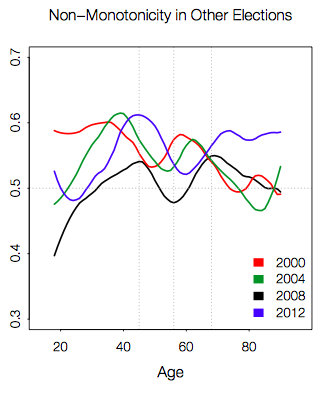
A story in the Tuesday NYTimes reports that our votes for president in the US is influenced by our year of birth.  Or rather, who whites vote for is influenced by when they were born, whites who don't live in the South.  The story describes a model constructed by Yair Ghitza and Andrew Gelman at Columbia and published as a working paper titled "The Great Society, Reagan's Revolution, and Generations of Presidential Voting."  The Times piece has a nice graphic showing the effect of birth year on a lifetime of voting.

Ghitza and Gelman write
The political events of a voter’s teenage and early adult years, centered around the age of 18, are enormously important in the formation of these long- term partisan preferences. The model is shown to be powerful, explaining a substantial amount of the macro-level voting trends of the last half century, especially for white voters and non-Southern whites in particular.
Their model is a way to explain the non-monotonic pattern of voting by age.  That is, the proportion of Republican votes doesn't increase steadily as people age, for example, and young people do not overwhelmingly vote Democratic, as some analysts would suggest.  Instead, the graphs of votes by age jump around, as below, and Ghitza and Gelman believe their model explains why.

Republican vote by age; Ghitza and Gelman, 2014

So, while people tend to vote as their parents voted, the stronger influence according to the model is formative events when the voter is in his or her teens and early twenties.  If the country was going through good times, with a president with high approval ratings, those who were teenagers at that time will vote that president's party, on average, for the rest of their lives.  And vice versa.  So, people who were teenagers during the Reagan years tend to vote Republican, and those who were teenagers during the Clinton years tend to vote Democratic.  The authors note that the model works best for whites in general, and non-Southern whites in particular.  African Americans tend to always vote Democratic, and the data weren't good enough in early years to enable the authors to treat Hispanics separately.

So, this is sort of interesting.  Does it mean that candidates are wasting their money on political advertising, and it doesn't matter whether corporations are people or not?  Or is the non-trend flexibility enough to swing an election and hence worth all the PAC and other sketchy dealings candidates engage in?

But wait a minute.  Weren't we told not too long ago that how we vote is genetic?  Fixed before birth -- yes, we take our voting patterns from our parents, but it's hard-wired, not learned.  An associate professor of political science and microbiology here at Penn State, Peter Hatemi, along with a collaborator published a paper in Trends in Genetics in 2012 reviewing evidence for genes that influence our political leanings, and how we vote.  So who's right?  Is it our genes, or pivotal events in our adolescence?

Does science require replication?
Replication of results is one of the standard criteria for science: if you did your work right, the idea (taught to all science students) is that anyone else who wishes to should be able, at least in principle, to replicate your result.  That is routinely given as the way science automatically polices itself against bad work or fraud.

The importance of replication is currently a major issue in psychology, with heated debate about whether failures to replicate original results show that they were wrong and should be reported to the authors, and what it means for the careers of the non-replicators, and so on. But, there's less discussion about what failure to replicate might really mean.

Jason Mitchell, a social psychologist at Harvard, has written on this subject, and his paper is getting torn apart by scientists of many stripes.  In essence, his argument is that scientists should not attempt to replicate other's results because failure to do so is meaningless, largely because the replicators won't be as expert at the science as the original investigators.  It's understandable that scientists who routinely rely on replicability, at least in principle, would criticize Mitchell's point of view.

But there are some central, yet poorly recognized issues here.  And this is not to say that we agree with Mitchell's take, just that there are issues that we don't see being discussed.  First, social science is not physics, or chemistry or even biology; replication is not as straightforward when humans are the subject, not atoms that are all alike, and methodology is, well, soft.  A bottle of gozillions of oxygen molecules may represent replicable phenomena since each molecule is identical, and statistical methods were largely developed for and suitable to such truly replicable phenomena.  Indeed, much of chemistry and physics depend on this because the behavior of individual elements, like atoms or electrons, can't be observed directly.  But this is by no means so clearly the case for social or genetic or evolutionary phenomena.  We've blogged before on the imperfectability of the social sciences (e.g., here), so enough said about that.

More importantly, researchers routinely try to replicate studies in epidemiology, to identify the cause of obesity or heart disease or asthma -- and what we now know is that obesity is caused by energy imbalance or processed foods or sugar or high fructose corn syrup or the not-Mediterranean diet or gluten and much much more, including an ever-growing list of genes.  And, asthma is caused by breast feeding, bottle feeding, poverty, wealth, prenatal stress, postnatal stress, antibiotics, acetaminophen and much much more, as well as an ever-growing list of genes.  A tentative finding is followed-up (a favored grant strategy, in fact) with larger samples to try to refine the estimates of effects -- assuming the effects are still there!

In fact, genetic and epidemiological studies of complex diseases often fail to replicate earlier studies, which is why we so often see science news stories that, shockingly, overturn accepted beliefs.  But it's usually not clear why a new study doesn't find the same as an earlier one, and sometimes can't be clear. It's too easy to say that things weren't measured as accurately etc. in the previous study -- or the replicating study -- but that is often not a very convincing explanation.  There are many pathways to complex diseases, and people can get to the same place in their own way.  So, two studies, though they yield different results, might well be correct.  But how would we know?  Replicate again?  Two out of three?  Toss a coin?  Take a vote of 'experts'?

A sample involving complex living organisms -- mice, humans, ferrets -- is never possible to completely replicate. Because we're the result of evolution, which is about diversity, we are simply never the same.  Even the same investigators, using the same equipment run by the same technicians in the same lab may fail to replicate their own earlier results if they are analyzing samples from different study populations.  Or even a second sample of the same people at a later time, or different people from the same population. People aren't atoms.  If an effect is small, its detectability or net effect may depend on the presence and frequency of other causal factors in a given sample.  Even a positive replication may be for differing reasons (more than one cause for a similar outcome, a different mix in different samples).  So failure to replicate need not mean a suspected cause isn't a cause after all -- it may reflect a poor understanding of evolution and variation.  We do not have an adequate body of theory for understanding the specifics of given cases, even in genetics and certainly in social sciences.

P.S. Our vote on the voting studies
For what it's worth, we wouldn't bet on either of the explanations for how we vote, replicated or not.  The pivotal-events hypothesis is as unlikely to actually explain voting as is the political-genetics hypothesis, largely because both are attempting to reduce a complex, population-level trait to simple, single explanations.  And then apply them to individuals -- there's a name for this; it's called the ecological fallacy.  As with complex diseases, there surely isn't a one-to-one relationship (Ghitza and Gelman no doubt would agree, given that they don't find the same results for African Americans, and the effect is stronger outside the Southern US); there are many paths to how people vote, and how people vote can change over time.

And despite what behavioral geneticists claim, we don't know nearly enough about genetics to be able to attribute a culturally laden trait like voting preference to genes.  Political preference can cluster in families and appear genetic for a variety of reasons, and we know that voting patterns are transitory.

So, pardon us if we don't take seriously either model of what makes us vote the way we do.  Maybe we need to fix up social science, and maybe some people who do 'genetics' ought to have a better understanding of genetics, before we start making assertions about cause, by confusing correlation with causation, and temporary patterns as if they were inherent.

Tuesday, July 8, 2014

Have we reached peak longevity?

The July 4 episode of the excellent BBC Radio 4 program, More or Less, addressed a question that demographers and public health researchers have been pondering in recent years: Will upcoming generations be the first to die at younger ages than their parents?  It has been accepted wisdom for a long time that each generation is healthier than the previous one, and life expectancies have risen for generations.  This was largely the result of declining infant and childhood mortality rates until perhaps the 1950's, but in most wealthy countries infant and childhood mortality are now so low that further decreases can't make very much difference in life expectancy; if life expectancy is to continue to improve, it will have to come from improved health at later ages.

But now, given the increasing prevalence of obesity in so many populations, more specifically childhood obesity, the concern is that we're eating ourselves right out of these life expectancy gains.  So More or Less took a look at the numbers.

It turns out that, yes, the obesity rate is higher, but the death rates from obesity related conditions such as heart attacks and stroke have been going down steeply.  Sir Richard Peto, Professor of Medical Statistics and Epidemiology at Oxford, said that while obesity has been rising sharply in Britain, the chances of dying from coronary heart disease-related conditions 30 years ago was 16%, at 1980 death rates, but 4% at 2010 death rates.  That is, it has declined by a factor of 4.


[1] 2009 rates; http://www.worldobesity.org/what-we-do/policy-prevention/ via Wikipedia


The trend is the same globally, the program notes.  Mexico is now the fattest country in the world but the probability of dying from obesity-related conditions at age 70 or younger in 1970 was 50%, but it is now 25%.  This is what's called the Obesity Paradox -- the fatter we get, the less likely it is to kill us.

What's responsible for this?  Well, obesity causes cardiovascular conditions but, so the thinking goes, treatment is better than it was 30 or 40 years ago, so while obese people may have chronic illnesses, they aren't as likely to die from them.  Perhaps they are getting medical care for heart or renal failure, or hypertension and type 2 diabetes, conditions associated with obesity, while thinner people don't see their doctors for anything, and thus are more likely to die.

By this reasoning, though, it's healthier to be ill!  And while the obesity paradox looks real, there's some question as to whether it is instead a statistical artifact.  The sample sizes were small in the studies that showed a benefit to being chronically ill and obese; the diagnoses of heart failure don't all match; the thin controls may be sicker than the obese subjects; when the effects of chronic conditions of obesity become life-threatening, the patient may have lost a lot of weight and no longer be obese (thus, obesity and weight gain themselves may indicate better health); BMI and fat patterning, two measures of obesity, may not be measuring the same thing, and so forth.  (See Habbu et al., e.g., for consideration of the obesity paradox.)

Whether or not the obesity paradox is real, the drop in death rates certainly is.  As Peto said, unless your country is chronically at war, or suffering an HIV epidemic, or you drink gallons of vodka, your probability of dying before age 50 is half what it was 40 years ago.  Or better -- in Iran the probability has fallen from 36% to 6%.

Death rates have fallen in rich countries -- by 1 or 2 percent a year since 1900, according to the National Bureau of Economic Research -- because of clean water, vaccination, antibiotics and other life-saving drugs, safer vehicles, the drop in smoking, improved obstetrics, safer food.  Public health measures, by and large.

Still, if half or more of the population of many countries is overweight or obese, and obesity is the cause of many chronic illnesses, what's going on?  Perhaps it's that it's not actually so risky to be overweight, as a paper in the Journal of the American Medical Association by Flegal et al. reported last year.  This was a meta-analysis of papers reporting the relative mortality risks associated with normal weight, overweight, and obesity, as defined by body mass index (BMI).  The authors found that obesity was associated with higher risk of mortality relative to normal weight, while overweight was associated with significantly lower risk.  It is healthier to be a bit fat than it is to be thin or obese. Perhaps the reserve energy is good when one is ill.

The paper was the subject of much controversy (e.g., discussed here), largely because everyone knows that being overweight is bad for your health.  But apparently there are many ways to be thin and unhealthy, and many ways to be "overweight" and healthy.  Does this answer the question of whether death rates will continue to decline, even as we get fatter?  No, because we haven't solved the looming antibiotic resistance problem, we can't predict which emerging infectious diseases will become pandemic but it's likely that something will, we don't yet know the health or agricultural consequences of climate change, though we can predict there will be some, and so on.

Measures of longevity
Life expectancy is the average age at death at a given age, and that's important, and must be stipulated.  Life expectancy at birth is affected by infant mortality rates.  Life expectancy at age 12 (say, beginning of adolescence) is average age at death of those who have escaped childhood mortality.  And so on.  So we must be aware of more than just chance of dying, but of dying after a specified age as the starting point.

Another important fact is that when we remove one trait -- say, obesity -- as a cause of disease and that disease becomes later or rarer, we automatically increase the risk of death (though perhaps at later ages) from other causes.  That's because if you escape, say, heart disease, you live to get cancer or dementia or arthritis -- or perhaps in the not so distant future, strep throat or gonorrhea.  So all of these health vs longevity statistics need to be viewed with care.

But at least we do know that smoking is still bad for you.

Monday, July 7, 2014

IRBs: Insider control can't do what's expected. Part II: Loss of control going viral

The virus that might roar
A story published in The Independent last week reported the controversial work of virologist Dr Yoshihiro Kawaoka at the University of Wisconsin-Madison.  Kawaoka was in the news several years ago for manipulating the H5N1 strain of flu virus so that it would be able to evade the immune defenses that much of the world developed when the virus was pandemic in 2009, killing over 500,000 people (the story was covered at the time by ScienceInsider).  That work was the subject of intense debate and scrutiny, and a moratorium was imposed while it underwent review.  The moratorium was lifted last year, and the work eventually cleared for publication.  

According to a recent piece in the Wisconsin State Journal, during the moratorium Kawaoka began to do the same kind of work with the virus that killed so many people globally in 1918.  The results of that project were recently published in Cell Host and Microbe.  Kawaoka's goal is to understand the kinds of genetic changes that would make these viruses circumvent human immunity to become even more infectious or more lethal.  The rationale, according to The Independent, is that it will help in the development of vaccines if such genetic changes were to occur in the wild.  

The problem, as many see it, is that there is no guarantee that these virulent strains won't escape from the lab and do much harm.  While Kawaoka says this won't happen, other lethal experimental organisms have done, and for new technologies like this such risk is always a concern.  Indeed, for old technologies -- the debate about whether to keep smallpox virus in labs has been going on for decades.  Kawaoka's work was approved by the university institutional review board although, according to The Independent, at least one member of the board was not willing to approve his current project.  

Does the fact that Kawaoka is a star on the faculty of the University of Wisconsin, where he has been treated extremely well, influence the IRB?  He is well-known in the field of influenza research, and has been involved in much recent work on emerging viruses, and no doubt his track record should count when his work is evaluated, but it's also possible, as always when power may be an issue, that Kawaoka's proposals have an easier time passing review than, say, a new researcher's would.  

But what is the IRB's role here?  Is it the board's job to decide what kind of risk society should be subjected to when academics do their work?  Or is that the job of an inter-institutional, or governmental agency, such as the U.S. National Science Advisory Board for Biosecurity (NSABB), which reviewed, and approved, Kawaoka's earlier work?

The risk of an inadvertent epidemic or even pandemic from this research may be small to very slight, but the consequences of such a thing would be so huge as to ask about the risk-benefit balance.  The importance of the discovery, should the research be successful, could be very great as well.  So there is no easy answer.

But that the University of Wisconsin allowed one of its very well-heeled faculty members to develop a modified pathogenic virus to which humans would no longer have resistance sounds like something out of Dr Strangelove.  How often is this sort of thing being done in a university near you--with or without its noble IRB being aware of it?

As we noted above, the previous work that got Kawaoka and Dutch investigators into hot water involved tinkering with the H5N1 flu virus to see what it would take to escape our immune system. Their idea was essentially to test virus genomic modification on ferrets, who in many ways are similar to humans immunologically.  The work was allowed to proceed after review, but in fact how can anyone guarantee that an accident won't happen?  We don't happen to know the conditions of the lifting of the moratorium, but no matter how extensive the review, or how cautious the scientists promised to be, no one can be absolutely certain that an accidental release of these viruses won't occur.  It reminds me of the time a little boy was getting on his bike to ride down the hill in front of our house.  His father reminded him to put on his helmet before he went, in case he fell off the bike.  "But Dad," he protested, "I'm not going to fall off!"

Similar concerns about recombinant DNA were raised a generation ago, and over time adequate protections were worked out and no disaster occurred that we know of.  But recombinant DNA doesn't pose the kinds of dangers that virulent viruses do.  And we have seen with other things, like stem cells, that scientists will do their best to find ways to do what they want to do.  Scientists, and the private sector, are both anxious to find new cures and also, one must acknowledge, looking for the major profits that are to be made.  The stem cell issue is more complicated because objections largely were religious.  Scientists may sneer at such things as ignorance standing the way of progress, but religious people are citizens and taxpayers, and if they are the majority, and aren't in favor of such a project, in a democracy, perhaps that should rule, whether frustrated scientists like it or not.

And there are other issues.  If a rock-star scientist threatens to leave the institution and go work elsewhere, this can be an incentive for an institution that treats faculty members like celebrities--particularly if they bring in big grant money--to compromise standards. 

And, should a properly independent system, with zero vested interests, be allowed or instructed to impose research bans for some number of years, appropriate to the offense, for investigators about whom there is evidence of misleading the IRB, or doing things not approved or even disapproved?    

It is, as in most similar kinds of situations, difficult to see how policy should be formed and implemented. After all, even amoral scientists are still scientists and citizens, and if they think something should be done, they have their votes, too.  And major public good might often also entail risks. 

The IRBs were started in the wake of abuses by Nazi and other scientists, including the most respected pillars of their society, and including in our country, as we mentioned last week.  That showed that scientists can't automatically be trusted not to intentionally, or even inadvertently do harm.  But many of us feel that the tenor of the committees has itself drifted from that proper gate-keeping job to a primary function to protect the institution against law-suits, part of a general trend in universities that is stifling in many ways, as well as costly in time and resources.  

Our mistaken mixing of messages
Making decisions is not easy, but there should be a balance of power.  However, in Thursday's post on IRBs, we mixed two aspects of bioethics.  One was about treatment of research subjects, human or otherwise.  The other was about priorities for spending society's resources (both are involved in our discussion here as well).  The issues overlap somewhat but we probably should have kept them separate.  IRBs are not mandated to deal with research priorities or societal concerns, though they do have to judge whether a project violates those concerns, and about whether doing some procedure on mice or other animals is warranted for the stated purpose of a project.

The peer review and policies of funders are the bodies that deal with research priorities.  My view is, as stated in Part I and elsewhere is that our priorities often too much depend on vested interests.  That is because agencies like NIH ask scientists what should be the next research priority.  Indeed, as I have seen directly several times, an agency like the National Academy of Sciences, entrusted with advising the government, can be paid by an NIH agency to hold a meeting about priorities, at which the agency's funded clients, and agency administrators, attend.  This is, essentially, insider trading and the NAS should not accept such contracts.  However, how to set priorities is not an easy thing to decide, since asking scientists their view is begging for self-interest to be at play, yet scientists know better than the public what the issues are.

In this sense, humans or animals are involved in projects that subject them to conditions that are allowed because of the social politics of the funding and academic career apparatus.  Are we out of proper alignment with what most would agree are appropriate societal priorities?  The payoff in actual public or scientific good is often, I think, far below what is promised.  This is of course a value judgment, but so are all IRB decisions and policies.

In any case, the Wisconsin issue that triggered these comments is more closely related to IRBs and its degree of real control of research ethics than about whether funds should be spent on this type of project rather than some other. Here, in fact, the story as written suggests serious abuse of what IRBs should rightly be policing.  One can argue that the knowledge being sought would properly have very high societal priority (because it deals with dangerous infectious disease), but that's a separate question. 

More generally, the funding priority issue may often even more important than the safer, local IRB protections. Billions of dollars go to feed the established research system, making it very self-aggrandizing and far less innovative than it might be if funding commitments, mega-longterm projects and the like were not so entrenched.  Instead of spending mega-bucks on more Big Data surveys we might focus funding on problems that were well-posed enough to be soluble.  This is again a societal issue about how resources are used, or captured, which does, of course, go beyond local IRB concerns that we were mainly intending to comment on.

So, while the ethical issues are not entirely separate, it confuses things to mix them as I did in our previous post.

Thursday, July 3, 2014

IRBs: Insider control can't do what's expected. Part I: some history

We are supposedly able to sleep peacefully in the security of our homes because Institutional Review Boards (IRBs) are on guard to protect us from harm at the hands of universities' Dr Frankensteins.  But the system was built by the potential Frankensteins, so any such comfort goes the way of any belief that people can police their own ethics, especially when money is involved.  This is shown by a recent revelation in the news (the short version: scientist creates flu strain that human immune system can't fight, with IRB approval), that we'll be seeing more about in the near future.  So, get your face mask on and head under the covers if you want to sleep in peaceful bliss.

First, however, a brief history of IRBs

What protects us from mad scientists?
The idea of IRBs arose largely not from Frankenstein but from abuses, especially courtesy of the Nazis. Absolutely horrid crimes by almost any standard were committed in the name of research.  It wasn't just the Germans.  The Nuremberg Code for research, which stipulates essentially that it must involve voluntary consent, do no harm, have some benefit, and so on, was one result.

But abuses weren't patented by the Nazis.  Anatomists at least as far back as Galen did vivisection, at least on mammals and perhaps on humans.  People still object to vivisection--animal research--and if you knew what is allowed you might join them, even though the rationale is, as it has been since ancient times, that we make the animals suffer ultimately to relieve human disease.  Of course, we claim the animals aren't suffering, on various rationales (they aren't sentient, aren't conscious, aren't really suffering, .....).

The abuses before WWII didn't stop what happened afterwards. The well-documented Tuskegee study of southern black men affected by syphilis was, once revealed for its cruelty, another motivation for current IRBs.  A similar study in Guatemala and some shady doings of research in Africa because it can't be done here, all show the pressure that is needed to keep scientists under control.  Formal requirements for each research institute to form an IRB to review and approve any research done there, has led to very widely applied general standards, in principle consistent with the Nuremberg Code.  More recently up to date issues, like confidentiality in the computer-data era, have been added.

The idea is that the IRB will prevent research that violates a stated set of principles from being done in their facilities or by their employees.  Over the past few decades, everyone entering the research system has become aware (indeed, via formal training, has been made to become aware) of these rules and standards.  Every proposal must show how it adheres to them.

So, the rationale behind IRBs is unquestionably good, and much that is positive has resulted.  In broadest terms, we each know that we must pay attention to the ethical criteria for conducting research.  Of course, we are humans and the reality may not match the ideal.

From ideal to institutionalization
IRBs are committees comprised of a panel of investigators from the institution (though, even there  one can't review one's own proposals), plus administrators working for the institution, and at least one 'community' member.  The latter may be a minister, nurse, or some other outsider.

The idea is that each institution knows its own circumstances best and having its own independent IRB is better than some meddling government behemoth like, say NIH, that would make decisions from the outside (when NIH is, for example, the funder who will decide what will be funded--an obvious conflict of interest).  So those in, say, Wisconsin, know what's ethical for cheesedom, while Alabamians and San Franciscans have their own high ethical sense of self-restraint.

But this is a system run by humans, and over the decades it has become something of a System.  For example, perhaps you can imagine how a non-academic member from the community, even a minister, might be cajoled or cowed by the huge majority of insiders, the often knowingly obfuscating technological thicket of proposals, and so on.  As is also a problem for any peer review system, IRB members may or may not be anonymous, but within an institution even if they are, their identity can certainly be discovered.  They know, even if it's never said out loud, that if they scotch a proposal from someone on their campus, that person will be on the IRB in the future and could return the favor.  This can obviously be corrupting in itself, even if the IRB members take the care required to read each proposal carefully, and even if everything proposed is clearly stated.  Sometimes they do, but being on the board is a largely thankless task and how often do they not take that care?

It is not hard to see how IRBs will pay close attention to the details and insist on this or that tweak of a proposed protocol, what I call safe ethics.  They certainly do impose this sort of ethics--ethics that don't really stand in the way of what their faculty want to do.  But they may be reluctant to simply follow Nancy Reagan and just say 'no' to a major proposal.

IRB members from the administration are bureaucrats whose first instinct is to protect their institution (and, perhaps, their own jobs?).  They want to avoid public scandal and obvious abuse, but every proposal that is rejected is a proposal that can't be funded, and won't bring in overhead money and generate publications for the institution to boast about.  I have personally known of a case in a major university medical school whose administrator-member unashamedly (though privately) acknowledged discouraging their IRB from rejecting proposals because the institution wanted the overhead. You can guess whether research that ordinary people, people without a vested interest, might consider objectionable--such as unnecessary harsh experiments on hapless mice or other animals or studies that could jeopardize human confidentiality but with realistically scant likelihood to discover anything really important--is going to get a pass.  Maybe the investigator will be asked for some minor revisions.  But a lot of dicey research gets approved.

There are professional bioethicists in most large research-based universities including medical schools. They may have PhDs in ethics per se, and can be very good and perceptive people (I've trained some myself).  They write compelling, widely seen papers on their subject.  But in most cases they live directly or indirectly on grant funds.  They may get 5% or so of their salary on a grant as the project's ethicist.  Their careers, especially in medical schools, depend on bringing in external funds.  This is almost automatically corrupting.  Do you think it affords any sort of actual protection of research subjects for more than some rather formal issues like guaranteeing anonymity that usually few would object to?  How likely is it that a project's pet ethicist can say simply "No, this is wrong and you can't do it!"?  Surely it does sometimes happen, but since ethicists must make their own careers by being part of research projects, this really is an obvious case of foxes guarding hen-houses.

The Human Genome Research Institute (NHGRI) at NIH has had some fraction, we think 3%, of its research budget mandated to cover ethics related to genomic studies.  Decades of experience show that this should be re-named 'safe ethics'.  NIH does protect (where possible) against plagiarism, unethical revealing of subject identities, and that sort of thing.  But not against whole enterprises they want to fund that might be very wasteful (e.g., the funds would buy much more actual health--the 'H' in NIH--than, say, another mega-genomics study).  This is a truly and deeply ethical issue that cuts to the bone of vested interests, even in this case of the NHGRI.  If such things have ever been prohibited, we don't know of them, and they surely are the exception rather than the rule.  Even harmless research in the human rights sense, that is very costly, is an ethical affront to the competing interests of even more important things society can do with its funds.  But reports from the NIH ELSI (ethics) meetings have always been entirely consistent with the view I'm laying out here.

The truth is that in science, as in other areas of human affairs, money talks, and mutual or reciprocal interests lead to a system predominated by insider-trading.  The untold millions being spent on countless studies of humans or other animals, whose serious payoff to the society supporting them, if any, is no closer than light years away, is, in my opinion, offensive.  Peer review is not totally useless by any means, and doesn't always fund the insiders, but there are certainly major aspects of interlocking conflicts of interest in science.

Scientists are experts at hiding behind complex technical details and rhetoric, and we are as self-interested as any other group of humans.  We have our Frankensteins, who are amorally driven to study whatever interests them, rationalizing all the way that they're just innocent babes just following Nature's trail, and if what they do might be harmful (to humans, forget what it might do to mice, who can't vote) it's up to the political system, not scientists, to prevent that.  It's an age-old argument.

One must admit that having bureaucrats and real outsiders make decisions about what sort of research should be allowed, has its own problems.  Bureaucrats have careers, and often live by protecting their bailiwicks and the thicket of rules by which they wield power.  There aren't any easy answers.  And not all scientists are Frankensteins by any means, most being truly hoping to do good.  But the motivation to do whatever one wants even if, or perhaps especially if, it is edgy and has shock-value is often coin of the realm today.

Tomorrow, in Part II, we'll take a look at a most recent example, the influenza research mentioned at the beginning, of what is an abject failure at worst, and at best a questionable lack of institutional oversight of its own IRB.

Wednesday, July 2, 2014

Skin color and vitamin D -- a beautiful theory destroyed by inconvenient facts?

I love a well-done challenge to an iconic evolutionary tale.  Such tales are often easy to devise but hard to test, so I was intrigued to see that there was a new paper challenging what has come to be a well-accepted theory in Anthropology, the story of why skin color lightened as humans left Africa and migrated north.  The new theory is all over the web (here and here, e.g.).  And, there are certainly good reasons to challenge this iconic tale... but they aren't in this paper.

We make most of the vitamin D3 (VD3) circulating in our blood when we're exposed to sunlight.  The synthesize is a multi-step process, and we can store the VD3 we produce for months at a time.  Light skinned people tend to have higher levels of circulating vitamin D3 than dark skinned people, because the dark pigment, melanin, blocks UV, and thus, VD3 synthesis.  Severe vitamin D deficiency leads to rickets, with its deformities and accompanying weakness and so forth, and less severe but chronic low vitamin D3 levels in people with light skin are a risk factor for osteoporosis, bone fractures, and perhaps chronic diseases like type 2 diabetes, and so forth.  Paradoxically, while on average darker skinned women have lower VD3 levels, they are also at lower risk of osteoporosis and fractures than their lighter skinned counterparts.

The wintery Lapporten mountain pass in Lappland, Sweden; Wikipedia
The iconic story about skin color has been that when darkly pigmented humans left Africa 30,000 or so years ago. they were leaving regions in which dark skin was maintained by natural selection, presumably because it really does protect against sunburn and skin cancer.  The descendants who eventually settled in northern Eurasian climes were then in places where lighter skin was beneficial because sunlight was weaker  and the melanin in dark skin would have prevented the synthesis of enough vitamin D to maintain strong bones.  So, during the many generations that it took humans to make their way from Africa to northern Europe, their skin lightened due to natural selection for a beneficial trait.

This hypothesis has been challenged before, for numerous reasons -- notably in a paper by Ashley Robins in the American Journal of Physical Anthropology in 2009.  Among other problems with the hypothesis are that there was no evidence of excessive rickets in the late Pleistocene and early Holocene, when humans were expanding northward, that light and dark skin both can synthesize vitamin D when exposed to sufficient ultraviolet B (UVB) radiation and that early humans in northern Europe would have spent much of the summer and spring outside, partially covered with animal skin, able to manufacture enough VD3 to last through the winter when the rays of the sun were weak.

One might also note that the earliest depictions of human variation in art, not to mention evidence such as mummies, go pretty far back and show that Egyptians and others in their intensely sunny part of the world were not dark-skinned and they knew they were different from sub-Saharan Africans. So were they a back-flow from Europeans who had already become lighter? Or was lightening already a fact of human life before the expansion?  Why are some African indigenes light skinned though living in the open desert?  On the other hand, if sunlight exposure is not the reason that dark skin evolved, why are Americans darker in the tropics, especially those who live in jungle shade?

Now a paper in a recent issue of Evolutionary Biology ("Evidence That Loss-of-Function Filaggrin Gene Mutations Evolved in Northern Europeans to Favor Intracutaneous Vitamin D3 Production", Thyssen et al. -- paywall) challenges the accepted wisdom for another reason.  Thyssen et al. suggest that in northern latitudes, the skin wouldn't have been able to synthesize the required levels of vitamin D by loss of pigmentation alone, but a change in a protein that helps to maintain the skin as a barrier to outside elements could have facilitated increased VD3 synthesis.
We hypothesized that loss-of-function mutations in the epidermal structural protein, filaggrin (FLG), could have evolved to sustain adequate VD3 status. Loss of FLG results in reduced generation of trans-urocanic acid, the principal endogenous ultraviolet-B (UV-B) filter in lightly-pigmented individuals. Accordingly, we identified a higher prevalence of FLG mutations in northern European populations when compared to more southern European, Asian and African populations that correlates significantly with differ- ences in circulating 25-OH-VD3 levels in these same populations.
That is, it was changes in the filaggrin protein that enabled people in northern climates to make enough vitamin D, rather than decreased melanin.  And, indeed, Thyssen et al. write, the difference in skin color from the tropics northward is not nearly as finely graded as filaggrin variants; this, they believe, is a convincing reason that the latter is more likely to explain why northern peoples produce enough VD3.

Vitamin D by frequency of FLG variation; source Thyssen et al.

The authors also write that because people with dark skin can produce vitamin D as efficiently as people with lighter skin, this would have meant no adaptive pressure on skin color as people moved northward.  While skin did lighten in the far north, it didn't lighten everywhere -- Inuit and northern Asians, for whom seafood, the best food source of vitamin D, has long been a large part of the diet, still have substantially pigmented skin.  Some Africans don't, though living in open, sun-blazed unforgiving desert.  And, even the lightest skinned inhabitants of the far north can't synthesize enough VD3 to maintain healthy bones, so something other than pigmentation must have changed.

And indeed the VD3 pathways did change, at least in some people; polymorphisms in genes involved in VD3 synthesis and transport have been identified in Europeans (Wang et al., 2010), and are associated with increased vitamin D3 levels.  Thyssen et al. also report European variants in the FLG gene, which is involved in skin architecture.  The variants seem to enhance UVB sensitivity, but they also seem to increase susceptibility to various conditions such as dry skin, ichthyosis vulgaris, and allergies.

This is sounding like a good story.

But...
There are problems.  The correlation between these variants and VD3 synthesis are, as Thyssen et al. themselves say, currently only correlations, not demonstrated causal relationships.  The authors suggest that looking for FLG variants in Inuit populations could make or break their hypothesis; if they had lower frequencies of these variants, it would be supportive because they have always eaten vitamin D-rich seafoods, and have darker skin than most peoples in the far north.  Nice idea.

Unfortunately for this whole hypothesis, however, the frequencies of the FLG variants that Thyssen et al. are reporting are, well, very low; 7.02% in Sweden, 7.86 in Denmark, 11.0 in Canada.  Yes, there is a gradient (0.91% in Tunisia), but these kinds of frequencies really can't explain why whole populations in northern latitudes don't have rickets. So at present these are strong claims and shouldn't be treated as if they show a major new theory, based on the rather thin evidence available to date.

It's often difficult to reconstruct evolutionary scenarios, which is why strongly held stories such as the vitamin D/skin color story should not be so strongly held.  While there are, we think, compelling reasons to question the conventional wisdom about vitamin D and skin color, this new report isn't yet a convincing replacement.

However, it does raise the question of whether there are other vitamin D synthesis or absorption pathways that aren't yet known, and that might explain, for example, why lower serum vitamin D levels aren't as deleterious in dark-skinned women as in light-skinned women.  Melanin is in some immune pathways, so there could be other correlates of 'climate' that don't involve vitamin D. Indeed, this story may not yet be completely told.

Tuesday, July 1, 2014

Bird brains, continued

Yesterday the BBC reported that the British Trust for Ornithology is asking citizens to report on behavior in rooks that they observe, and consider to reflect intelligence.  Rooks are in decline in the UK, and the Trust is hoping that understanding their behavior might help explain why.

From the BBC story:
Rooks have already demonstrated their intelligence in lab-based studies that have tested their ability to solve problems and use tools.

This survey will examine if and how wild rooks apply these skills.
From the above-linked BBC story
The study will look at six categories of behaviour: feeding, caching (hiding and storing food), tolerance, object play, socialising and vocalisation.

Dr Nathan Emery from Queen Mary University of London, an expert in corvid behaviour who is helping run the study, explained that many of the abilities the birds had demonstrated were previously thought to be uniquely human.

"We've done a lot of different studies on a number of corvids looking into their intelligence and behaviour, focusing on their amazing memories, their ability to imagine future scenarios and plan for them," he told BBC News.

"This survey will provide vital information that couldn't be attained any other way into how rooks use our gardens, eat and cache our food and, importantly, whether rooks can produce innovative solutions to novel problems they don't encounter in the wild."
While not everyone agrees that bees exhibit what we'd call 'intelligence', people do seem to agree that corvids (crows and their relatives) are 'intelligent', and we've written about this subject recently here, and in previous posts.  Why something about intelligent rook behavior would be responsible for their decline is curious, though -- the results of this study will be interesting.