Friday, February 10, 2012

Do we need to know why airplanes fly? What does this have to do with life?

Do we know why airplanes fly?
Why do airplanes fly?  Or rather, why do airplanes fly if, as it turns out, we didn't understand how they do?

From Freewebs.com
To summarize some elementary physics, the four forces of fluid dynamics, drag, thrust, lift and weight, are what allow airplanes to fly.  These forces only exist in a fluid (liquid or gas).  Thrust pulls or pushes the plane forward, while at the same time, drag inhibits it.  Thrust must be greater than drag for a plane to move forward. 

Weight and lift are also opposing forces; lift must be greater than the weight of the object.  And, the object must be moving for lift to come into force.  The classic explanation for flight is that a moving object, the wing of the plane, splits the airflow in two -- both up and over the wing, and down under it.  Because the wing is curved on top, the air that goes over the wing travels faster than the air moving underneath.  As airspeed increases, its pressure falls, which means that the air above the wing exerts less pressure than the air under the wing moving more slowly, and this pushes the wing and thus the airplane up, against the opposing force of gravity -- lift.

www.laesieworks.co


The relevant wing shape is called an airfoil. It's shown in the above figure we grabbed from the web.  Everyone has known this since Bernoulli proposed this principle in 1738.  However, this explanation has frustrated people who know better for a long time.  The "principle of equal transit times," that is, that the air above the wing must 'catch up' with the air beneath, is just plain wrong.  As it happens, there's no reason that the air above and below must converge.  In fact, the air above, indeed moving faster than the air below, reaches the end of the wing much ahead of the latter, as this video from Holger Babinsky's lab at Cambridge University shows.


Quoted in a story at Physorg.com, Babinsky said, "What actually causes lift is introducing a shape into the airflow, which curves the streamlines and introduces pressure changes – lower pressure on the upper surface and higher pressure on the lower surface. This is why a flat surface like a sail is able to cause lift – here the distance on each side is the same but it is slightly curved when it is rigged and so it acts as an aerofoil. In other words, it’s the curvature that creates lift, not the distance.”

Is this nitpicking?  Does it matter that we haven't really understood this?  Planes do fly, no matter whether we've understood in detail why.  And, after all, no matter how much faster the air above the wing moves, it's still faster than the air underneath, and the end result -- lower air pressure above -- is the same.  The important thing is that planes do fly.

When Ken was, long ago, a graduate student in meteorology (training to be an Air Force weather officer), it was taught that the theory was as above but that many aspects of actual fluid flow theory were inadequate for the actual complexities of airfoils.  Things such as local eddies or turbulent areas that broke up the smooth airflow could reduce lift or even be dangerous to staying aloft under some circumstances.  So engineers -- like even the Wright brothers -- used models in wind tunnels, then tests on actual prototype aircraft to tinker with the design til it worked.  Regardless of the niceties of the theory, with lots of experimentation -- engineering -- predictable function was arrived at. This is the basis of many applied sciences.  In the case of airfoils, Babinsky is hoping that a more precise understanding of lift can lead to the design of more efficient, faster planes, relying at least somewhat less on tinkering.

Why are we talking about this on MT?
But, how does this relate to MT and what we usually write about here?  We write about cause and effect all the time, in evolution and genetics and the practicalities of observational science in particular, and how cause is so often not understood, or misunderstood, or simplified.  But, sometimes it doesn't matter -- how aspirin works wasn't understood for decades after it came on the market, and how the most effective antimalarial in history, artemisinin, works is still not understood, as discussed here, and as indicated in this figure from a paper entitled, "The Molecular Mechanism of Action of Artemisinin--The Debate Continues".  

From O'Neill, Barton and Ward, 2010

When empirical demonstration of efficacy comes before theoretical understanding, application can happen without fundamental principles.  It's when application depends on principles that things can get difficult.  Should sugar be regulated?  Should we eat eggs?  Can we predict disease from our genotypes?

You can tinker with airfoils as much as you want.  Once you get a design, you can test it as often as you want.  For all practical purposes once you work it out experimentally, every wing with the same shape works the same.  That's why you can relax and order a nice drink on your flight, without looking out fearfully at the wing to see if the one supposedly holding up your plane actually works.

But that is definitely not the way life works!  All individuals today are different, and it is difficult in most cases to isolate the same genetic variant in many study subjects and assume the rest of the individuals' causal environments are the same.  Life is inherently about difference: evolution works strictly through variation, and without evolution neither we nor airfoils would be here.  That's why the same conditions don't apply in the evolutionary past any more than they do in the present.  That's why, while evolution tinkers with what it has available at any given time, it's not an engineer working towards some preconceived goal.  And it's also why it is so hard to predict traits from genomes, and why GWAS doesn't account for most variation in traits.

We cannot even take the engineering who-cares-about-theory approach when studying life, except in some relatively clear cases of, say disease, or traits like eye color and so on.  Even they turn out to be not so simple (even Mendel's peas, from which he and we developed our basic ideas about genetic inheritance, weren't totally simple).  Compared to airfoils, there is no 'theory' of a person or of evolution, beyond some rather broad generalities.  So the lesson from airfoil discoveries is.....that they are not very relevant to what so many hope to discover about life.

Thursday, February 9, 2012

The politics of malaria control?

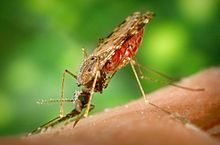
Anopheles albimanus mosquito feeding
It has been said that malaria has killed more human beings than any other single cause during the course of our evolutionary history. It is certainly a scourge but because control is a combat against both an insect carrier and a parasite, both of which reproduce faster than we do and can evolve treatment-resistance, it's a challenge to global public health.

The news had recently been that we were making overall progress. But a new study, published in The Lancet, and described on the BBC website, reports that the global number of deaths from malaria between 1980 and 2010 was double previous reports, though the number is falling, and has been falling since it peaked in 2004. That's good news and bad news -- the revised mortality statistic, suggesting that the disease has been even more devastating than previously thought, and the falling number of deaths due to malaria, which continues to be welcome news, presumably indicating success in eradication measures.

Malaria statistics are notoriously unreliable because malaria is most prevalent in parts of the world where the public health infrastructure is thin and unreliable itself as a source of case counts. So, the authors collected as much actual data as they could for the years between 1980 and 2010, and then developed models to account for missing data. They built into their models predictors of malaria mortality such as prevalence of the parasite, drug resistance rates, and mosquito control measures.

They estimate that the number of deaths from malaria increased from 995,000 in 1980 (with a 95% uncertainty interval of 711,000-1,412,000) to 1,817,000 in 2004 (1,430,000-2,366,000), decreasing to 1,238,000 in 2010 (929,000-1,685,000). Deaths in Africa decreased by about 30% between 2004 and 2010, and by nearly 80% elsewhere. We needn't quibble about the assumptions upon which the uncertainty intervals were estimated. But this doesn't take into account increasing population sizes, so the decrease in mortality rates (deaths per thousand or hundred thousand) based on counts alone, rather than people-at-risk, would be even steeper.
Our findings show that the malaria mortality burden is larger than previously estimated, especially in adults. There has been a rapid decrease in malaria mortality in Africa because of the scaling up of control activities supported by international donors. Donor support, however, needs to be increased if malaria elimination and eradication and broader health and development goals are to be met.
From the CDC web page on malaria
This study was funded by the Bill and Melinda Gates Foundation, so the fact that the findings support increased funding of malarial control is perhaps not a surprise.  And, declining mortality from malaria is extremely good news, and we certainly do not question the benefit of bed nets and the best treatment.  But, we do wonder if the decline is as easy to explain as this paper makes it sound.  This is not at all to say that control measures aren't working, as clearly they are!  But, the story is more complex. 

For example, a paper in Malaria Journal in 2011 (which we blogged about here at the time) reported that:
A longitudinal decline in the density of malaria mosquito vectors was seen during both study periods despite the absence of organized vector control. Part of the decline could be associated with changes in the pattern of monthly rainfall, but other factors may also contribute to the dramatic downward trend.
And, a report in The Lancet in 2010, title, suggests that the story is indeed more complex than the recent paper suggests.  Indeed, this paper states that malaria declined in Ethiopia between 1998 and 2004, and:
It is very likely that the massive scale-up of ITNs [insecticide treated bednets], indoor residual spraying, community-based management of fevers, and environmental management of mosquito breeding sites all contributed to these results. However, the incidence of malaria was already declining at the beginning of the surveillance period, before these interventions were introduced.
And in the coastal area of Kenya, where "pediatric malaria admissions declined by as much as 75% between 2003 and 2007" and parasite prevalence has declined dramatically:
Although ITN use has increased concurrently with the decline in paediatric admissions, the prevalence of malaria infection declined from 35% to 10% before ITN coverage reached 25%, and before the introduction of ACTs [artemisinin combination therapies, currently the best treatment available].
And:
In Rwanda, data from 20 facilities representing every district in the country showed a decline of more than 50% between 2005 and 2007 in both inpatient and outpatient slide-confirmed malaria cases. Before 2005, the number of cases had been increasing annually, but began to decline shortly before or at the same time as mass distribution of long-lasting insecticidal bednets and the use of ACTs in 2006–07.
And:
An urban hospital in Libreville, Gabon reported an 80% decline in the number of children with positive blood smears in the inpatient and outpatient services. The decline began in 2003 and persisted until the end of the surveillance period in 2008. The decline pre-dated both the introduction of ACTs in 2006 and ITN distribution in 2005, the coverage of the latter reaching 50% in 2008.
And so on.  The 2011 Lancet paper concludes:
Alternative explanations for these changes should be considered. Previous experience in Europe and North America has shown that malaria declines as social conditions and education improve. However, these changes (eg, improvements in house construction) are likely to be gradual and cannot account for the sudden changes seen during the past few years, although they might have contributed. Malaria transmission is strongly affected by climate. However, climate has been carefully monitored in several case studies, and although there have been fluctuations from year to year, no overall pattern emerges that can explain the remarkable reductions in malaria cases in some countries. A highly speculative explanation for the reductions is a change in the parasite or its mosquito vector that has reduced transmissibility of the infection. Both of these are biological possibilities, but such a change seems unlikely on the opposite sides of the continent at the same time. Finally, the transmissibility of P falciparummalaria might not be as high as has been previously thought, making it easier for any transmission blocking intervention directed at either the parasite (ACTs) or the vector (ITNs or indoor residual spraying) to reduce transmission.
A student in our department  is working on malaria in southeast Asia, and he tells us that there are still many unknowns.  For example, infection is higher in males than females in Thailand, which suggests that men are becoming infected while working in the fields, so that the usual approaches of mosquito control in living quarters, and the use of bed nets, aren't enough to control infection there.  Also, infection peaks at unexpected times of the year, which suggests that the life cycle of the parasite (primarily plasmodium vivax in Southeast Asia but not entirely) is not well-understood, or may be changing.  And, climate change, as predicted, is changing the distribution of mosquitoes in all malarial zones, so that infection is now occurring or increasing in places (higher altitudes, e.g.) where it has been rare to non-existent before.

Climatic factors (rainfall amounts, temperature changes, e.g.), and even agricultural practices, such as the use or interruption in the use of irrigation, will explain seasonality of infection and short-term trends, but so will newly developed resistance of mosquitoes to treatments or insecticides, a chronic problem for malarial control. And, determining when a trend is short or long-term, and thus what is causing it, can be difficult.  

If we can find all this with a little poking around the web, presumably it's all well-known in the international health arena, too, so it's curious that a paper attributing all of the decline to improved control could be published so prominently. Could there be an element of coloring of the situation to serve the purpose of massaging donors ('MalariaGates'?), to keep the money coming?  If there is any of that involved, it would do a disservice to the understanding of the complexity of factors underlying malarial transmission and control.

Evolutionarily one must expect a continuing race between human susceptibility, drugs, attacks on the parasites and carriers, and the latters' ability to change in response.  Hopefully, in this case, the problem can be understood well enough that technology can be fast enough that we can win.  But for this to happen, all the variables need to be understood, not just the easy ones.

Wednesday, February 8, 2012

Reducible Complexity: reply to the IDeologs

The gaggle that continue to raid evolutionary biology blogs, patrolling for things that can be naively or intentionally misinterpreted as evidence for their theological views, specifically 'Intelligent Design' (ID), loves to concentrate on complex traits.  They claim such traits cannot have evolved because the independent components won't function on their own and the whole breaks down without them.  They call that Irreducible Complexity:  since you can't take any components of complex traits away and still be viable, such traits could not have arisen gradually by natural selection.  Therefore (the IDeologs say), Intelligent Design is true.  But this is false on several grounds, not all of them even recognized by biologists, who often defend evolution by needlessly agreeing to do it on the IDeologs' turf.

First, it is IDiotic to argue that if an evolutionary claim is false, therefore creationism is true.  That is simply a logical fallacy.  If evolution as biologists see it were being misperceived, that in no way provides evidence for any specific counter explanation.  Only an IDeolog would make such an argument.  It would be just as sensible--that is, as nonsensical--to say that our misperception proved that life came to earth from a parallel universe in a spaceship made of banana peels.  We get things wrong or understand them incompletely in evolutionary biology, which is why it remains an active science, but that is not evidence that evolution didn't happen.

Second, the major IDiotic argument about the need for completeness was one Darwin was aware of and even speculated on in regard to the eye, a favorite irreducible complexity example cited from that time to the present day.  Darwin suggested ways that primitive light sensitivity could have evolved bit by bit.  In what was really striking prescience, his basic speculations have been shown to be about right, because species alive today with 'partial' vision have been found, and genetic components of vision are shared among species with simple as well as complex light reception.  Even saying 'partial' vision is a subtle misnomer, because each species uses what it has: the light sensitivity of a worm or bacterium is not partial for their uses, and to use the adjective suggests the IDiological view that humans are at an intended pinnacle, that our vision is somehow more complete or real than a clam's.  That's an egocentric misperception of evolution.

Complexity is reducible!  It always has been.  It's a central aspect of life.   Right here and now
Thirdly, and perhaps even more important than the first two reasons why the anti-evolutionary IDeology is just plain wrong is that complexity is typically reducible!  The basic IDeologs' premise doesn't have to be refuted because it's not true.

What we know very well is that most traits of organisms are, in fact, the result of multiple interacting factors (gene networks, the  polymeric, cooperative nature of DNA and proteins, signaling and receptors systems, gene regulation, and multipart proteins, etc.).  And, eyes, too.  That is a central fact, and a main point of MT (the blog and the book).  We know from thousands of studies (yes, even the GWAS and other 'omics' studies whose excesses we love to point out) that complex traits really are complex at the gene level.

The same studies also show by their very nature--by the very fact that we are doing so many of them in the first place--that each person will have a different genotype, a different set of variants, involved--even if they have the 'same' trait, like stature, insulin levels, blood pressure, or behavior.  That is why personalized genetic medicine is unlikely to work nearly as well as advertised.  Personalized medicine almost assumes irreducible complexity: enumerate the parts and then any variation in the trait must be due to a broken part that can be identified.  But that isn't how Nature works.

Reducible complexity is true even of vision: Color-blind people are people and they have vision, yet they are missing functional light-sensitive genes (e.g., genes that are used in red or green detection, or overall light sensitivity). Visual acuity varies in all sorts of ways among perfectly viable people.

This is typical of biological traits.  And recent studies have clearly shown that each of us is walking around with numerous completely inactivated genes, whose 'damaged' sequence variants we have inherited--from parents who somehow had managed without them.  One recent paper found that around 165 different genes were completely inactivated (both copies not working) in a typical person.  And there are many others in which one of our two copies is not working normally.  The combination of inactive genes would be different for each person, but the truth is that we do not normally need all the genes in our genome.  That tolerance of variation is exactly the working material that biologists have known is at the basis for evolution from Darwin's own time.

Confirming this in another way, and also very clearly, is that it is routine that a gene experimentally inactivated in a laboratory animal, like a mouse, has serious effects in some strains but little or even no effect in others. A mutation causing a serious disease in humans may do nothing when the same mutation is tested in a mouse, or it may have similarly bad effects only in some strains.  That's one of the notorious problems with mouse models for human traits: mice and people share many traits but we make them differently to various extents. There is more than one way to make the same trait.  Complexity is reducible.

The reducibility of a trait, to put it in terms even an IDeolog could understand, depends on the combination of genes being viable, not on every gene having the most functionally efficient variants.  The importance of component cooperation, a favorite MT word, is in part that various types of cooperation are viable.  That aspect of redundancy and variation is one of the central reasons that complexity could evolve in the first place, exactly in the general fashion argued by Darwin and since.  No biologist suggests that an eye just emerged wholesale from the primeval slime.

But there's more.  Studies of the nature and evolution of genomes shows very clearly that genetic mechanisms arise largely by means that generate redundancy as well as alternative pathways to given outcomes, as cells respond to their local environment.  Gene duplication occasionally leads to individuals with two copies of a gene where in their ancestors there was only one (this happens in species generally, not particular to humans in any way).  That can provide redundancy, so that one of the copies can acquire mutations that alter what the gene does, while the other copy keeps plugging along with the original function.  The new function can be due to mutations in the  protein code of one of the copies, or the DNA sequences that regulate when and where the gene is used.

For these reasons, traits are the result of many different genetic contributions, all varying among individuals, each reaching similarly viable traits with different combinations of that variation.  Those combinations that aren't functional don't survive or reproduce; those that have an advantage may do better.  Over time, the mix of variation, including even the number and set of contributing genes, allow traits to evolve new or altered function.

This is how evolution works, gradually producing new or varied traits.  We understand this because we are aware that complexity is often, or even typically, reducible.  Although it hasn't been put this way before to our knowledge, this is nothing more than a modern understanding of classical evolutionary ideas.

The IDeologs claim that reduced complexity could not have existed in a stepwise, bit by bit, assembly of a new trait from parts that would not work on their own--that evolution couldn't get from there to here. But the deeper truth is that evolution is both there ('incomplete') and here ('complete') today and has been that way at any or even every time in the past.   It isn't just that things have to be assembled over time by different steps, but that they exist at any given time in various steps or stages of 'completeness.'  To a great extent, biological complexity is  inherently reducible at any time as well as over time.

And one more reason:  Of course, we needn't have gone through all of this to convince you that complexity was reducible, after all.  That is because the IDeologs disprove their own irreducibility argument by their very existence:  one can function as a human being even with a brain that allows you intentionally not to use it to recognize the realities of the world--by not using the thinking complexity they were born with!  We would apply this to those who lead the movement, and do or should know better, but not those who they naively lure into adopting its know-nothing IDeology.


Finally, we may make sport of intentionally or willfully self-deluded critics of evolution.  For any of those who are sincere but naive, one can only say that it's too bad, and poignant, too, that science shows the evolutionary nature of life, rather than the comforting existence of a benign divinity who graced the earth with our presence.  How nice if that could be true!  How hard it makes it to understand the injustices and suffering in the world.  But science is about the real world, not the one we might wish for.

Tuesday, February 7, 2012

Doubt and dogmatism in science -- questioning natural selection

Through no fault of his own, a friend of ours finds his written words being used (or rather, abused) by the ID community.  Again.  This has happened to us from time to time as well, so we thought we'd address it here.  Not the actual arguments, which we have no interest in, but the misconstruing of what scientists say, or clearly mean. 

Adam Wilkins, a biologist and long-time very thoughtful editor of BioEssays, a leading biology journal, recently published a well-considered review of a new book by James Shapiro, Evolution: A View from the 21st Century.  Adam reviews the book favorably in general as a thoughtful one that those seriously interested in the nature of evolution should read; but he takes widespread exception to the author's view, taking him to task for writing that natural selection may be less important than most biologists would accept.

Adam is not the first reviewer to take Shapiro to task for this. And, probably because he relegates natural selection to a minor role, Shapiro has been assumed to be an IDer by some, including some people in the ID community.  This right here means there's a problem -- if a biologist can't question accepted wisdom in evolutionary theory, this makes evolutionary theory a dogma, just like ID.  Science should always be questioning itself -- that's how knowledge is built and expanded upon.

But, giving succor to ID is not Shapiro's intention.  This is clear from the 'debate' he has with IDers, which we won't even link to because it's tiresome, and really not much more than a clash of ideologies (you'll find it anyway, if you really must).

But, after this rather fruitless 'debate', Adam, or at least his review, gets pulled into the fray.  Adam's piece was published in Genome Biology and Evolution in January.  And the authors of the post believe it's a gotcha moment, saying that Wilkins admits something that few 'Darwinists' (and yes, that's a slur) will, which is that "a growing body of scientists" are starting to question the "alleged power of Darwin's natural selection to create the world of life that we see."

Yes, Adam does say that there are biologists who feel that the role of n.s. has been overstated (and yes, you've seen that here on MT, in fact).  But, he absolutely does not include the 'therefore' that's implied -- therefore, if n.s. didn't do it, a designer did.  The gotcha quote they pull from the review is this:
…the book’s contention that natural selection’s importance for evolution has been hugely overstated represents a point of view that has a growing set of adherents. (A few months ago, I was amazed to hear it expressed, in the strongest terms, from another highly eminent microbiologist.) My impression is that evolutionary biology is increasingly separating into two camps, divided over just this question. On the one hand are the population geneticists and evolutionary biologists who continue to believe that selection has a ‘creative’ and crucial role in evolution and, on the other, there is a growing body of scientists (largely those who have come into evolution from molecular biology, developmental biology or developmental genetics, and microbiology) who reject it.
Adam's following paragraph draws their scorn. 
The arguments from paleontological evidence for the importance of natural selection largely concern the observed long-term trends of morphological change, which are visible in many lineages. It is hard to imagine what else but natural selection could be responsible for such trends, unless one invokes supernatural or mystical forces such as the long-popular but ultimately discredited force of “orthogenesis.”
Obviously this draws scorn, because invoking the supernatural is exactly what IDers do.  But, equally obviously, to a biologist such as Adam, that's not an explanation.  Adam of course was writing for biologists, and for the overwhelming number of biologists evolution is a fact of life.  He wasn't writing with creationists/IDers in mind.  If he had been, he might have restructured his argument somewhat, but he still wouldn't have hidden the fact that there are disagreements among biologists about the strength or predominance of natural selection as a force in evolution.  The disagreement doesn't make it false.  It makes it science.

For biologists, for whom not a shred of evidence collected in the last 150 years has called into question the idea that all of life descended from a common ancestor that lived nearly 4 billion years ago, this kind of disagreement is arguing around the edges. But for an ID adherent, any kind of disagreement within the fold must mean that, therefore, evolution didn't happen.

We and other biologists don't question that natural selection can occur, or that it does occur, but ask when, where, how, how strongly, and how systematically it occurs--and how we can know which is which.  We ask how it works in general or in specific instances relative to other factors that can lead to differential proliferation of variation, or of the way genetic and other transmissible variation arises and works.  That is totally different from asking whether natural selection or Divine intervention account for life, which is not what legitimate science does.  Science is only one way to know, but it rests on observable causation in the material world only.

We could put this another way.  If it were somehow possible to show--to really show--that Divine intervention were the explanation, or that Jesus was divine, or that Mohammed really did get his inspiration from the Angel Gabriel, or that ants had souls, any sane scientist would love to be the one to do that.  His or her reputation would dwarf even Darwin's!  But that's simply not the message the material world gives us.  Even if natural selection were somehow shown to be totally wrong, it would provide not a scintilla of evidence for creationist explanations.  It would just say we've been accepting an incorrect theory and have more work to do.  That is not a threat to science, even if many scientists do cling too tightly to simple explanations for complex things.

There are separate worldviews operating here, and, even if IDers actually understood the science, their fundamentalist view of the world still prohibits questioning their dogmatic view, creationism.  And this is why something like Adam's review can be taken in vain -- IDers assume that if scientists disagree, that's a crack in the religion of evolution.

But evolution isn't supposed to be a religion.  Scientists are supposed to question what they know.  Jim Shapiro's questioning of the pre-eminence of natural selection in evolution is perfectly valid science, and will either stand the test of time, and questioning by other scientists, or it will fall.  But it doesn't mean he sees the hand of a watchmaker behind every complex living thing.  It means he thinks evolutionary theory hasn't yet explained everything.

Monday, February 6, 2012

Sweet tooth or sweet talk? The truth about the truth about sugar

You have to suspect any story with a title that begins "The truth about....", and the story in last week's Nature is no exception: "Public Health: The Toxic Truth about Sugar". Just the latest in a number of stories indicting sugar as the cause of all that ails us (almost literally), the piece's own summary is this:

  • Sugar consumption is linked to a rise in non-communicable disease
  • Sugar's effects on the body can be similar to those of alcohol
  • Regulation could include tax, limiting sales during school hours and placing age limits on purchase
The link is largely based on epidemiological evidence -- everywhere that people have switched to a "western diet", meaning lots of processed foods, including sugar, obesity has skyrocketed, as have hypertension, type II diabetes, cardiovascular disease, and cancers.  Therefore, sugar is the cause.

The evidence is clear:  even at Starbuck's it's hard to find some actual coffee (not to mention the impossibility of a 'small' coffee) in amongst the choco-banana-raspberry flattes.  And then there are the Scots' deep-fried Mars bars.  Who could doubt that our commercially whetted sweet tooth is the tooth that bites with poisoned fangs?  But is the evidence actually so clear?

The conclusion looks suspiciously in need of the "correlation is not causation" reminder.  Indeed, a reader who posted a comment on the paper in Nature, Geoff Russell, pointed this out with cogent examples. We'll reproduce his entire comment here, as it makes the point well.
Geoff Russell said:
Australia provides a natural test of the sugar-is-the-evil-bullet theory. We don't produce much corn here, so continue to use cane sugar for most of our sweetening. In the 1960s we didn't have an obesity epidemic. How much sugar did we consume? According to the FAO, 52.3 kg per person per year in 1965 (of 55kg total sweeteners). 
What about now, in the midst of our own obesity and type 2 diabetes epidemics?
We are down to 39.6 kg of cane sugar per person per year, with an additional 8kg of non-sugar sweeteners. Overall there has been a modest decline in all sugars despite a rise in obesity and diabetes. How has our food supply has changed over the past 4 decades? We have more Calories. If may be tempting to attribute the US obesity crisis to sugars, but obesity increases elsewhere demonstrate that more Calories and less exercise are a sufficient explanation.
Similarly, compare Cuba and Italy. Cuba consumes 500 kCal per day of sugar and Italy just 300 kCal, Italy has an obesity/type 2 diabetes problem while Cuba's rates are very low. Historically, Cuba has eaten even more sugar than she does now ... without the evil consequences that this article portends.
There is no denying, of course, that obesity and what are usually thought of as its sequelae are public health problems in much of the world.  Whether or not said sequelae are indeed sequelae of obesity, or whether obesity and the rest are, individually, consequences of fat consumption, or sugar consumption, or processed food in general, or simply of excess calories relative to energy usage (too much munching in front of the telly) has still not been determined, though many have their favorite candidates.  Cholesterol, saturated fat, red meat, the non-Mediterranean diet, not enough exercise, and others.  

There's a fundamental problem with this simple sugar analysis when it doesn't reliably predict on either the individual or population basis (as Geoff Russell's comment points out).  Sugar, and/or what it's usually allied with, may well have detrimental effects on health, but clearly it's not as simple as is being said.  There's a well-known issue in epidemiology called the ecological fallacy, whereby we paint individuals with a brush dipped in a population-based paint.  That is, when we attribute generalizations about a group to causation at the individual level -- stereotyping is an example, but so is the (erroneous) assumption that because, say, risk of heart disease is higher among people who smoke, everyone who smokes will have a heart attack. 

It simply can't be possible that sugar is the single or even primary cause of the obesity etc. epidemic.  Too many healthy people consume a lot of sugar for this to be true.  And surely too many unhealthy people don't.  Trying to attribute this vast epidemic to a single dietary substance is denying the complexity of these diseases and of causation.  Unfortunately (in our view), people are beginning to feel so fiercely about sugar as the root of all evil that they are (in our view) no longer able to assess the science.  Instead, it's become such a strongly held belief that it's in danger of becoming a dogma that no longer needs to be tested, or the supporting studies examined with a skeptical eye.  That's never a good thing.

This is relevant for an MT post not because we don't want it to be true because we both OD on sugar all the time (we don't), or that we only eat celery and carrots (we don't), but because it relates to the general problem of inferring causation, especially when we can't do definitive experiments.  That is the common situation in human and evolutionary genetics.   So, it's worth sitting contemplatively over a cup (small) of coffee discussing whether there are better ways to know about weak, gradual,  or complex causation.

One lump, or  two?

Friday, February 3, 2012

Ectopic thinking?

Our gene mapping project, which we first blogged about here, is starting to get interesting.  And not necessarily for the reasons that we'd hoped.  You might remember that our project is looking for genes involved in variation in specific craniofacial traits in the F34 generation of descendants of a cross between two inbred mouse lines.  We've measured a handful of traits in over a thousand mouse skulls, and mapped their genetic effects by looking for genetic variation across the genome that might be associated with variation in the traits.

Sparing you the gory details, we'll just say that the chromosomal intervals that one or more of the traits mapped to span 30% of the genome, and 10% of all coding genes. That's 2400 genes or so that could potentially be of interest in affecting head shape in just these particular mice, with the restricted genetic variation they have (because they are descendants of only two inbred parental mouse strains).  That's a lot of genes to wade through to figure out which might be most likely to be involved in the traits we're looking at.

One way to prioritize candidate genes from such a study is to look for the genes in every interval that you know from prior work to be involved in your trait of interest.  Or to identify genes in families that include genes involved in your trait of interest -- these would then be considered guilty by association.

But this means most genes don't have a fighting chance of being considered, because you don't happen to know anything about them, or because nobody knows anything about them, or because what's known about them only partially represents what they do. 

To try to minimize this, many people automate the search, with programs that cull the genes that the literature indicates might be of interest, or that seem to be expressed where you want them to be.  So, this might solve the problem of no one knowing everything about all genes, but it doesn't solve the problem of nothing being known about so many genes, or that there's only partial knowledge.  And it doesn't solve the problem of having to tell the program what to look for, which means you're constraining it in the same way you would if you were doing the search by hand, looking for specific families of genes.  Nor, of course, does it solve the problem of what's happening in all the non-coding DNA that flanks all those genes. 

Thus, we decided that the least biased way to comb the data was to go through all the genes in all the intervals by hand.   We're still making sense of all that, not least because we are hoping not to be constrained by the usual ideas about statistical significance, but we've learned some interesting things along the way.

For example, one of the intervals of interest is loaded with olfactory receptor (OR) genes.  Olfactory receptors reside on the cell surface of olfactory receptor neurons, and are involved in odorant detection.  ORs form the largest family of genes in many genomes -- about 1000 different genes -- and they cluster in sets of genes in various locations on a number of chromosomes.  ORs have a distinctive expression pattern, with only one expressed per neuron in the tissue lining the nose, where they each are sensitive to particular aspects of molecules the animal inhales, and hopes to smell.  How expression of the remaining 999 genes in each cell is blocked is still not known.

ORs are an interesting example of something we've blogged about before, but that continually surprises us.  One of the ways we're evaluating the possible role of all these genes in development of the traits we're looking at is to look at where they are expressed in the developing embryo.  We initially thought this would be helpful for narrowing the search, but it turns out that about 95% or even more of genes (for which there are expression data) are expressed in the head (80% alone in the brain), so it's turning out that expression isn't all that helpful for narrowing the search.  But it does mean we've looked at images of gene expression for around 2000 genes.

Olfr66, GenePaint, E14.5
And ORs are a good example of how what we think we know can inhibit our understanding.  Here, e.g., are the expression results for olfactory receptor 66 (Olfr66) in a developing mouse (at embryonic day 14.5).  Just to orient you if you're not used to looking at such images, it's a single front to back section, the snout halfway down the image and pointing to the left, and the tail at the bottom.  The dark blue is a stain showing cells where the gene is expressed at this particular stage of development.  It's no surprise to see it in the olfactory epithelium in the snout, but notice that it's also in the axial skeleton (vertebral column), probably in cartilage cells that will soon become bone.

What's it doing there?  These are olfactory receptors!  You don't smell with your backbone!  In fact, a lot of ORs are known to be expressed outside the olfactory region, particularly in the testes, but also in the spleen, the thyroid, salivary glands, the uterus, the skin, and other tissues.  A 2006 paper is of interest in this regard, not only because it documents non-olfactory related expression, but because of its title -- "Widespread ectopic expression of olfactory receptor genes".  Ectopic expression, meaning expression where it's not supposed to be. 

But it's only not supposed to be expressed in the axial skeleton because that's not where its name says it will be, not because Nature says so!  People named these genes!  And, there is some discussion in the paper about how ORs might be involved in chemotaxis of sperm as they try to reach and penetrate the egg -- how they direct their movement, based on chemicals in their environment.  Which is equivalent to assuming they are essentially carrying out their olfactory function in the testes, where a different form of molecular reaction than odorant-detection is going on.  But, what about in cartilage, in the image above?  It's hard to imagine chemotaxis has anything to do with OR function here.

Well then, maybe it's an experimental artifact -- maybe the experiment picked up expression of a gene sort of like Olfr66, but not quite, along with Olfr66?  Maybe.  But, then we'd have to explain away all the expression studies showing non olfactory expression of many ORs, and it's rather unlikely that it's all due to experimental artifact.  This is how our own assumptions constrain what we know or even want to know about the function of so many genes.  Maybe Olfr66 has a function we don't yet understand.  As do other ORs.  And, by extension, so many other genes. 

But calling unexpected expression 'ectopic', or naming genes based on only a single role, or in their involvement in disease, when they have other perfectly normal functions, are ways of building in assumptions that, once accepted, can keep us from recognizing that there's a lot we don't yet understand about genes.