Showing posts with label space. Show all posts

Wednesday, September 30, 2015

Does Mark Watney dream of red potatoes?

Puh-tay-toe
Puh-tah-toe


Before we get down to business ...


As commander of this blog post, I order you to read The Martian by Andy Weir before you even watch the trailer for the upcoming movie. If you watch the trailer before you read the book you will ruin your life. Plain and simple. I can't even imagine what horrible things will happen to you if you see the whole movie without reading the book first.


Do not deprive yourself of this head trip. There is just no way this film will walk you through this astronaut's brain like the book does. Movies can be wonderful, but this is one of those reading experiences (of which there are infinitely finite) that cannot be matched on screen. 


You'll notice that I'm not linking the movie trailer here. I'm not even pasting a picture of Matt Damon in this post, knowing full well that it will get me more clicks and will beautify this screen, because I don't want anyone looking at any of that until they've read the book. If you're really hearing me, stop reading this blog post and don't come back until you've read the book. Do you read me? Over.
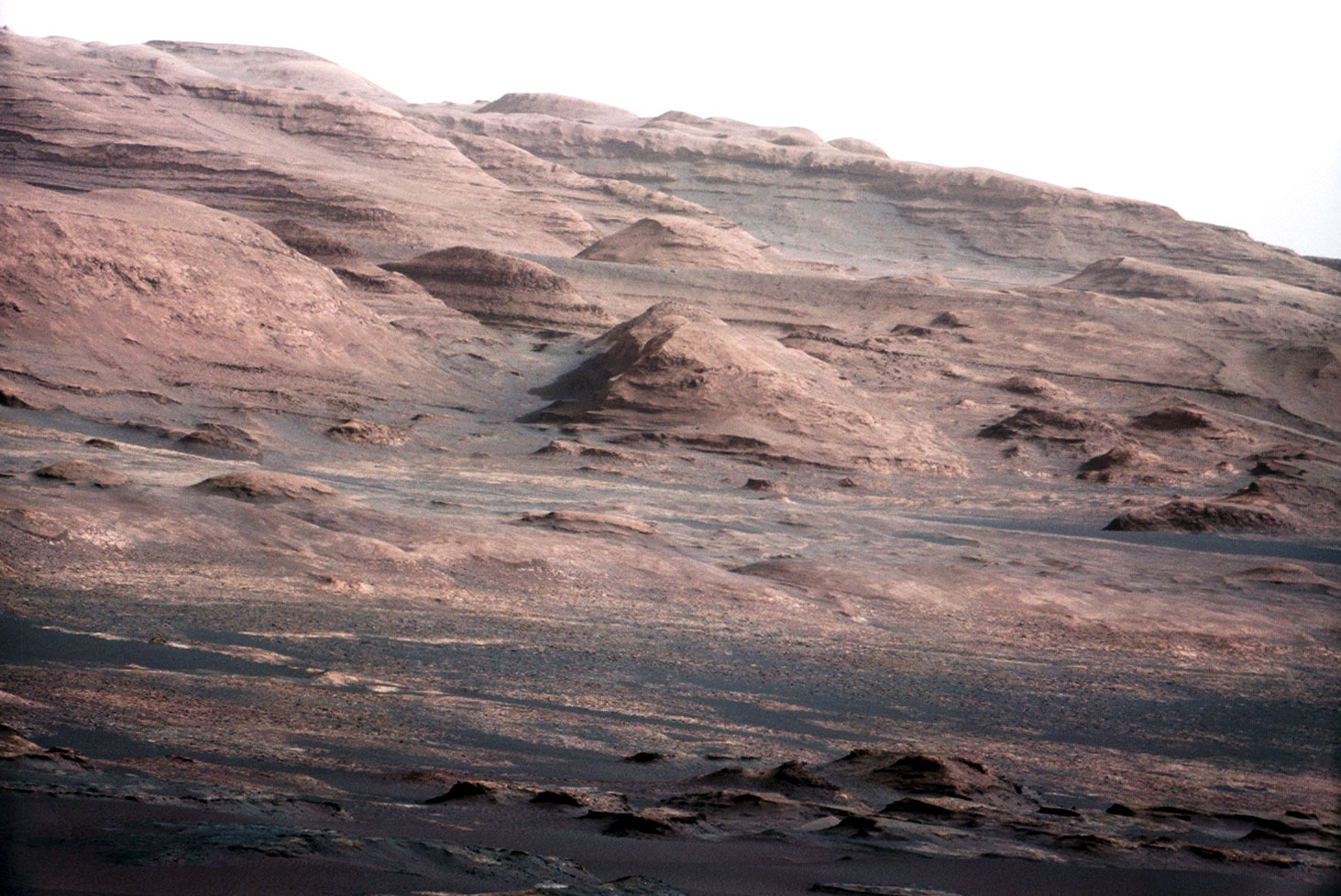


Layers at the base of Mount Sharp (source)
With the movie  The Martian opening this Friday, many people will soon be familiar with Mark Watney and his incredible ordeal. 

This is not a book review. I'm done with those for the time being. The last one I did turned out to be a bit of a disaster.  


I just have a few thoughts about Mark Watney's Martian diet that need to escape through my fingers and out onto your computer screens.


To survive on Mars and to think his way to salvation, he eats a lot of venison, kale, and blueberries.


Psych! He eats a lot of potatoes. You know, the "problem" food that causes disease. The food that so many trademarked diet plans avoid, like the Paleo Diet. 


There was some pre-made, pre-packaged NASA fare for Watney, but no way would it last as long as he needed if he was to try to get off Mars. So he actually grew potatoes. A shitload of them. With a shitload of astronaut shit as fertilizer. 


The whole spirit of the book is one that inspires us to think our way out of problems. To remember that possibility is a state of mind. To be skeptical of our inner skeptics who speak of impossibilities. And it's with that skepticism that I wonder about those potatoes.


Let's forget our questions about soil volume, nutrients, and moisture  (mostly because I don't know how to usefully critique the thorough explanations that Watney provides for his decisions about these things). 


And let's drop the question that drove me crazy until the very end of the book when Watney finally explained that he was microwaving the potatoes and thereby getting more calories from them than he would by eating them raw. Given all the calorie-calculations he ran through while sciencing, the chance that Watney might be eating raw potatoes was slowly killing me (and, potentially, him). 


Now I'm curious about something more fundamental: would potatoes grow the same on Mars as they do on Earth given the gravity's different? Could Watney's Earth botany translate as well as it did on Mars?


His training and thinking might not translate well on Mars if we're talking about making a different kind of tot. I'm fond of this paper hypothesizing how difficult it might be to extend the evolution of our own species, extra-terrestrially. Earth's gravity may matter a whole lot to human reproduction, especially those earliest stages of development. 


link to paper

We're not potatoes, sure, but potatoes aren't yeast. Given that there's less gravity on Mars, can we assume that sciencing all those Earth potatoes in Martian conditions is as straightforward as Watney makes it sound?


I don't think anyone knows the answer to this, however, tons of anyones (like Andy Weir) have more informed guesses than I do. Indeed, it is possible to grow spuds on the space station. So maybe my gravitational question lacks gravitas.  


(That groaner was for you, Mark.)


But one thing is for sure. In The Martian, as in life on Earth, a diet based primarily on potatoes fueled a human for quite some time. Maybe not all humans could handle this, and maybe not all humans could be as extraordinarily brilliant while eating mostly potatoes for so many cold and lonely days. But the potato industry has got to be thrilled. 


Not only is one of humanity's best (fictitious) members existing as one of humanity's best members thanks to potatoes, but the food's public image got a separate but related boost recently. Potatoes, and other similar carbohydrate sources, might have been crucial to our lineage's brain evolution. 


Anthropologists have known for a good while now that "underground storage organs" or USOs, like potatoes past and present and many other species, have probably been a big deal during the last several million years of human evolution. But a recent review paper in the Quarterly Review of Biology argues, based on up-to-the-minute cross-disciplinary findings, that cooked starches were crucial to the evolution of our big glucose-sucking, calorie-burning brains. Here's the paper's abstract:


source (and see Zimmer's write up)

So, Paleo dieters and potato-haters of the world, you have just been publicly flogged by both science fiction and science faction. What do you do now?


Well, if you haven't read The Martian, I'll plug it one last time. 


When you're on about page two you might be cursing me. By then I was cursing the book and everyone who liked it. I nearly gave up at the start for reasons to do with the style of writing (gasp! a blog! Ugh!) and my narrow-minded expectations of astronauts, but I'm so glad I dominated my inner bigot and turned the page. All the pages. To the last page. In solidarity with my new favorite Martian blogger, I'm moved to thank you for reading this gasp! a blog! Thank you. Now get to reading Watney's.


P.S. If you can't access the two articles I reference, email me and I'll send them to you: holly_dunsworth at uri.edu

Thursday, July 9, 2015

Factoid of the day: A stellar journey?

The factoid of the day is the excitement that New Horizons Pluto explorer is about to take a few snaps of the dwarf planet, assuming it points the camera the right way, and doesn't just take selfies.  That should happen but does require some very delicate, very long-distance telecommunication from here on earth to the flying obersvatory.

One highly touted amazing! fact the media have given us to help make the event more festive is that the explorer is by far the fastest object we have ever sent into space, according to recent news releases that have appeared as the mission nears the 'dwarf planet'.  Its speed is about 9,000 mph. It had to be micro-miniaturized so all of its stuff could fit in a small, light-weight package (essentially, one might say, carry-ons only).  That was apparently quite a skillful engineering feat.

New Horizons' exciting (fake) adventure picture
This picture is from the NASA website, and while they do tell you in the small print that this is an artist's conception, not the real thing, this and other images are part of the promotional effort to sell space adventures.  For many space discoveries they, or the news media or journals touting them, only have artist's conceptions.  So they are free to take the proverbial artistic license to make them as exciting as they can. Such excited hype is only natural, we guess.  But in this case, if all goes well, there really will be images, in the near future.  For someone interested in actual science, they will be far more interesting and, yes, truly exciting than the made-up versions.  Hopefully we will learn at least a few things about this very distant snowball.

In fact, and without any element of hyperbole, the great distance from here to Pluto is quite thought-provoking.  New Horizons is zooming so fast as to make your head spin.  In round numbers (and why not?), it covers about 80,000,000 miles per year (not counting leap day!).  That's about 10^8 miles. To put that in perspective we shouldn't compare it, say, to a cop-free transit of I-80 from New York to where we live in central Pennsylvania, though, given the nature of the I-80 traffic, that might take a few light years.  Maybe some more space-related comparison would be better.

So, to start with, the nearest star to the earth is Proxima Centauri, which is about 4.24 light years away.  A light year is about 5.9 x 10^12 miles, a mere 10,000 times faster than New Horizons, give or take an order of magnitude.  That means that Proxima is about 2.4 x 10^13 miles from here (forgetting what season and hence what relative position, the Earth is in at launch-time).

If we have our math close to right, that means, again on the back of an envelope, that a mission to zip to the nearest star or any planet it may have--the kind of voyage that space agencies cleverly hint at without actually promising, would take a mere 100,000 to 1,000,000 years, give or take a few millennia.

Any such exploration is unlikely to involve astronauts! The invention of agriculture occurred roughly 10,000 years ago.  100,000 years ago all human ancestors were scrounging around Africa for wildebeests, roots, and berries or perhaps had started to expand into Eurasia (where they had different kinds of deer, roots, and berries).  A million years ago all our ancestors were grunting around in Africa, with some side-branches perhaps in Eurasia.

If a very smart Homo erectus (probably some nerdy teenager) had sent a "Hiya!" radio message into deep space, it would just have got there this week, or maybe next.  It will take a while before we hear back, if the ETs got it, understood the early erectine language, had radios, and decide that it wasn't spam and that they should answer.

So, let's plan a voyage to find ETs on another planet!  Right off the bat, the space agencies can post 'artist's interpretation' of what's out there, and after all, if it fails, there won't be any humans on earth to know that the money was wasted.  Or better yet, here's a far better and more sane idea when it comes to exploring space and searching for ETs:  let's have the video game industry (A) try it themselves, or (B) simulate it.  They have the funds, and the government has more important things on its plate, like health care and poverty and so on.  Of the two approaches, Plan B would make some actual sense, even if NASA, ESA, or SpaceX weren't involved (even assuming their rockets didn't blow up).

Monday, April 21, 2014

Earths galore: we're getting closer...but to what?

Well, NASA's done it again.  They've found another exciting planet lurking in the depths of near space.  This time, the BBC proclaims, we have Kepler find 186f (illustrated, even!), the best one yet and (maybe) it (could) be watery!  It seems that the news cycle isn't just 24/7, but longer: every time NASA can release the story about some newly found somewhat-earthlike rock, the news outlet pick it up as if it were the first time and nobody can remember that we've seen almost the same many times before. But if they can get their sales with re-runs, we can't be blamed for at least returning to this topic (e.g., we blogged about this when NASA reported the news of an exoplanet circling the star Gliese 581, as well as others), though hopefully with a little bit more that's different compared with NASA's releases!

Just like Earth! [in an artist's ebullient imagination]  Credit:
CreditNASA Ames/SETI Institute/JPL-CalTec
Cred
A planetary plenitude
This discovery is called by the ever-sober news media an 'earth twin' or as the knowledgeable NY Times puts it, 'perhaps a cousin' (whatever that means).  Sssh!  If you keep very quiet, you might be able to hear your Keplerian kin-folk talking!

 Well, we can overlook such verbiage since ours attempts to be a science blog.

Actually, the discovery of a plenitude of possible planets, or 'habitable' ones as they seem often to be referred to, is interesting and continues apace.  They now number in the hundreds and only a trivial fraction of the universe has been scanned, or is even scannable with available technologies.

These truly are interesting findings, though they are, surprisingly, not at all surprising.  After all, space is massively large and filled with a chaos of objects hot and cold, large and small.  If, as seems likely, Newton was right and gravitation is universal, then the small stuff will often be captured by the gravitational attraction of the big stuff. Big hot stuff (stars) can capture smaller wandering rocks and they'll end up in orbit.  Some even smaller rocks are captured by the pull of, and orbit around, bigger rocks (like moons around planets). Lots of other rocks and stars will be in all sorts of relationships as well.  But some of these will be special.

If we care about our sort of life, then we want what is being called a Goldilocks planet: like her porridge, the rock will be not too hot, and not too cold, not too wet and not too dry, but just right!  That is, there will be water and warmth enough to keep it liquid but not turn it all to steam, and other things of that sort.  There is where, we're told, we'll find the ETs.  Some day.

Now this is genuinely thought-provoking, but it needs none of the circus hype of the news media.  That's because it basically tells us what we already knew.  In fact, the actual facts are to us a lot more interesting than the Disneyfication.

We've previously in general terms discussed the idea that if there are an infinity of starts, galaxies, planets or universes, there would just as likely be all sorts of life on them.  Here, we can be a tad more specific than that.  For example, if there are hundreds of planet-like things just here in our own local galaxy (the Milky Way), somewhat like 186f, and we've really just begun looking and technically can only see some of what might be out there, and if what we know is largely within our own galaxy, where there are in the range of 100 billion stars, then thousands and thousands of those stars must have orbiting rocks.  There are around 100 billion other galaxies (give or take a few), and we can assume that there must be thousands upon thousands of the same sorts of rocks orbiting stars and rocks orbiting around those rocks, in each galaxy.

That is, even on the back of the proverbial envelope, one would estimate that there would be at least 100 thousand billion habitable planets.  That is 100 trillion planets (100,000,000,000,000), as a minimal estimate.  Once we knew that there were 'habitable' rocks orbiting stars, such as Earth and perhaps one or two more even just around our own sun, there likely are around 100 or more billion earth-maybes in the Milky Way alone!  Of course, if you hold to Genesis, our Earth could be God's only watering hole, but once we had clear evidence of other possibles, a reasoning person must accept that these larger numbers become plausible.

The point is that even without the Kepler and other telescopes scanning the heavens for these things, the totally convincing plausibility argument would be that the universe is awash in 'habitable' planets.

But, ETs?
Now the fact that there are lots of warm, wet rocks out there is one thing, but it doesn't imply that there is anybody living on them. However, life--even just our sort of life--is clearly possible because we're here living it as proof.  Given that,  even a modest kind of belief in natural science would lead one to believe that if you have 100 trillion tries, there really has to be some sort of life out there, and probably lots of it, even if it's only on a trivially teeny fraction of the habitable planets.

This of course does not address whether it's our sort of life in the 'intelligent' sense.  Or life based on DNA. The fact that we are here is not quite so persuasive about that, because the numbers get astronomical (so to speak, but in the other direction--of smallness).  The number of nucleotides in earth-life's genetic history, from primal RNA to global DNA today, likely dwarfs even 100 trillion.  Each has arisen and/or later been changed by largely independent individual probabilities that are very, very small.  A net result is, in essence, the product of these probabilities (this and this and this...and this--the result--had to happen).  So to go from primal soup to any given form of  complex 'intelligence' over 3.5 billion years, that is, our form of it, would be minuscule relative even to the numbers of potentially habitable planets.  This could mean that intelligent life arising more than once, even with so many trials, would be very unlikely, and thus that we are lonely in our uniqueness.

But if others just like us may not happen more than once, there are also countlessly many such pathways to intelligence: after all, each human has a different genotype and there have been billions upon billions of us.  So it really is impossible to do more than muse about what the net resulting probabilities are.  To a great extent it depends on what we count as intelligent life.  To a greater extent, "Are we alone?"  is hardly even a scientific question to ask.

Worse for NASA (and Disney) is that even here on Earth where we know intelligent life has arisen, we've only been at it for, say 1,000,000 years, being generous and depending on what 'intelligent' means. But if it means having language and communicating by electromagnetic radiation (like radio), so we could communicate with ET's, that's only been about 100 years and probably we won't last much longer, either. So the probability that at any given time smart life is present in us and any other such place is a minuscule fraction of the time that life has been around on any of these lucky 100 trillion planets.

In that sense, large numbers don't nearly guarantee that there are smart anythings anywhere else.  The chance that us-like life is out there now, and that 'now' means we can communicate with it, becomes possibly rather miniscule.

Forget about chatting!
In one of our previous posts about Gliese 667C, we note the problems about thinking that we could communicate with, much less actually go to, such places (assuming we understand physics, like the limiting speed of light, correctly).

Kepler 186f is said to be about 500 light years away.  That means that a signal that we can pick up from there was sent when Da Vinci was painting the Mona Lisa.  If there was intelligent life there, and they're at all like us, they may well have obliterated themselves long ago.  But suppose they're peaceful (having evolved way beyond us), then just to send a friendly radio wave of "Hi!" to them, and get a wave back would take until the year 3014. By then most everything would have changed about human life here, with lots of world wars (though, of course, Republicans would still be trying to keep ordinary people from being able to afford a doctor).  Forget about chatting with the ETs!  Even Google will be out of business by that time.

And as we said about Gliese 667C which is a mere 22 light years away, 20 times closer than 186f, physically getting there would not be half or any of the fun.  It would be impossible in any practical sense, and even if we could actually do it, it would take millennia of space travel to get to 186f, and when we got there there might be nobody still around to drop in on.

So, what is the purpose of the space probe?
Without being too much of a spoil sport, because up to a point this kind of exploration really is interesting and in some ways now and then may tell us important things about our universe (not likely to be comforting to dogmatic religion), we have to ask about the purpose of this kind of probing.  In a sense, for reasons we suggest above, the numbers suggest that it really tells us nothing that we didn't have almost just as strong a reason to know anyway.  It would take something like a Genesis literalist to think that there would be no other planets with life on them, or even that they would be very few.  And of course either we think these findings suggest the plausibility that forms of life must exist out there, or else the burden of proof should be on a denier to show how, in the face of these overwhelming numbers (and not counting theories about multiple independent universes), there could fail to be some such 'life' on lots and lots of planets.

Of course, this is really just science fiction, almost literally.  The vast majority of any such planets are, were, or will be millions or even billions of light-years away. That means what we see today isn't there now, but was there eons ago.  Much of that light has been streaming here since before there was life on Earth--or even before there was an Earth!  Indeed, if a typical star's lifetime is around 10 billion years, much of what we see no loner exists as such and, likewise, much or most of what actually is out there came into existence too recently (even if millions or billions of years ago) for any evidence to have reached us.

So, it takes either a television sci-fi producer, a NASA PR rep, or a real dreamer to think we could ever go there or really communicate with much or even any of what must be out there.  If we really thought anything like that, we should intensely be doing very down-to-earth studies to see if the speed of light and relativity are limiting factors or whether transformative new aspects of space itself remain to be discovered.

At what point is the research cost** not worth the number of people who could be fed by the same funds, and so on?  When does asking such questions make one just a killjoy, and when does it make one concerned for the problems, and the actual unknowns, on the one planet we actually can do something about?


**Or, as we've suggested before, if this really is mainly just entertainment, why not let the video or other entertainment industries pay for it?

Wednesday, June 22, 2011

The Twilight Zone, Part I: Is there life elsewhere in the universe?

Figure 1 from the article.
MT is about biology, genetics, evolution, and the anthropology of science (besides digressions, ramblings, rants, and other miscellany).  But sometimes these subjects can get rather far afield.  A case in point in the current (July-August) issue of American Scientist,  a very nice article by Howard Smith, entitled "Alone in the Universe" (the abstract, or if you subscribe, the entire article, is here).  Read it if you have a chance, but here we'll present just some thoughts of our own, partly overlapping with his.  In Part I, here, we will lay out some of the basic case. In our next post, Part II, we'll go over why this is relevant to evolution and the nature of life here and (maybe) elsewhere--and we'll show how even in cosmology, naive views about evolution are rife.  In Part III, we talk about the multiverse theory, which posits infinitely many universes right here on earth.

A favorite subject of Science Fiction is how we would deal (and be dealt) with by ET's, aliens from outer space.  The idea that ETs are real and have, could, or are trying to contact earth, is irresistable.  NASA panders to it widely to justify spending (wasting?) gobs of money on sending people to find life on Mars.  Even they are at least restrained enough not to claim that there are Little Green Men there.  Still, so distinguished a scientist as DNA co-discoverer Francis Crick suggested that life here was seeded, perhaps by trash if not intent, by alien spacecraft passing by earth (yes, he did!).

Nobody expects to be able to spot a SpaceBus with our usual visual telescopes, but with the advent of radio and other non-optical telescopes the idea that 'intelligent' life may--or must--exist out there has been taken seriously, including that the ETs would know about elecromagnetic means of information transfer (radio, for example).  This doesn't mean they know about us or want to communicate specifically with us (why would they, if they knew about what kind of beasts we are?).  If so, and if we can intercept signals by al Qaeda, why not from ETs as well?

We don't know what kind of signals they might send, but they should be different from the remorselessly mechanical signals of the broiling, expanding universe.  So if we at least listen, perhaps we can filter out the mechanical to detect the intelligent communications buried within it?  A huge project called SETI (Search for ExtraTerrestrial Intelligence) is one such effort, and has involved co-opting thousands of volunteers' computers to screen incoming electromagnetic radiation.  Wikipedia has an informative page about SETI. Perhaps sadly, but not surprisingly, the result so far can be summarized as: [nothing].

Besides having to guess at what kind of signal would be wafting around in space, detecting ETI requires defining what's mechanical, to see what's left.  But there is much in the order and chaos of space, reflecting many different things: the behavior of galaxies, exploding or coalescing stars, black holes, overall expansion, remnant signals from the Big Bang, and more.  This of course doesn't include such things as anti-matter and so on.

These phenomena vary from object to object or quadrant to quadrant because in the splat! of spatial history each star, galaxy, etc. is behaving differently.  The first task is to be able to identify that, from all directions.  Doing that is not easy since we have no prior theory (if, indeed, we have any theory that everybody agrees on) for what is going on.  Much of what we believe we understand comes from interpreting the signals.  There is a danger of interpreting something as ETI that is really another phenomenon we're misunderstanding.

So for the moment we need some prior thinking to decide why or whether we should make the effort.  The basic reasoning, besides just human interest and curiosity is a kind of infinity argument that goes something like this:
  1. If there are essentially infinitely many objects in space, and if any non-zero fraction of them contain conditions on which life could exist, there simply must be life 'out there'.  Our existence proves by itself that such conditions can, and do, exist
  2. If that is so, there must be all possible kinds of life.  No probability is so small that in an infinite distribution of objects, it will never occur;
  3. Indeed, for the same reason, it must occur an infinite number of times, and with every possible variation!
  4. If life can exist, and therefore must exist, it must exist in infinitely many places
  5. If life can exist, it can evolve--our human existence proves that, too
  6. If it can evolve, it can evolve intelligence--ditto here as well
  7. If it can evolve intelligence, intelligent life can travel
  8. If it can communicate, it can also--indeed must also--communicate
  9. If we understand the physics of the world, we know that communication must (at least in some forms) involve electromagnetic means
Electromagnetic communication travels at speeds and takes forms that we understand.  Thus, radio telescopy is a means to detect what must, inevitably by this reasoning, exist in space.  Wherever, and whenever, the signal was sent, it will travel at the speed of light in all directions, and that means in our direction (it need not be directed here specifically). 

If we have sensitive enough instruments, we should be able to detect the emanations.  For them to be intelligent, they must have systematic rather than random structure, and must be different from the other electromagnetic 'noise' in space.  Why?  Because otherwise Spaceship X could not communicate with its home base.

None of this implies when a given level of intelligent life will arise, or where.  But if the universe is effectively infinite, there must be some signals that will reach us at any given time (such as today).  If the signal comes from very far away, all we know is what the ETs were like back at the time the signal was sent--not what they're like now.  So while detection doesn't help direct space travel plans, or booking of exotic vacations, it would at least answer the question:  Are We Alone in the Universe?

There have been many arguments, some of which we've given above, why we must not be alone, and thus must be able to detect the life that does exist elsewhere.  On the other hand, there are various things that must be true for a given planet to have life that can communicate in the way we've discussed.  The planet must be suitable for life and old enough that life there has already originated.  It must have had life long enough for it to evolve intelligence.  The intelligent beings must have been their and their culture evolved to the stage of sending electromagnetic signals.  And long enough ago for the signal to get here.  And these things must be compatible with the age of the universe, and the age of the Earth.

So, for there to be ETI there are issues of habitability, evolution, time, and coincidence.  The latter is perhaps the most vital, because there must be an intersection between the ETI's stage (at the time of signal sending) and our stage today.  Planets alive but only with moss or bacteria won't help.  Planets that have ETI but too recently for their signals to reach Earth won't help either.  Emanations blocked on their way here by other objects or gravitation, or that got sucked into a black hole, will never get here.  Likewise for planets with ET's that haven't discovered radio, or who are isolationists and don't care to venture forth, or who were too far away from us when they got their smarts for the signal to have got here yet.

Still if space is really infinite there must be at least some such coincidences.  Indeed, there must be infinitely many of them!  Emanations we can detect, scanning in any direction, must literally be loaded with their messages.  And that means such messages must be coming at us from all directions right now!

But there are more issues to discuss, that can make you depressed if you're into SETI, or happy if you wish to be left alone.  We'll discuss some of these in our next post.