Showing posts with label brain. Show all posts

Wednesday, September 30, 2015

Does Mark Watney dream of red potatoes?

Puh-tay-toe
Puh-tah-toe


Before we get down to business ...


As commander of this blog post, I order you to read The Martian by Andy Weir before you even watch the trailer for the upcoming movie. If you watch the trailer before you read the book you will ruin your life. Plain and simple. I can't even imagine what horrible things will happen to you if you see the whole movie without reading the book first.


Do not deprive yourself of this head trip. There is just no way this film will walk you through this astronaut's brain like the book does. Movies can be wonderful, but this is one of those reading experiences (of which there are infinitely finite) that cannot be matched on screen. 


You'll notice that I'm not linking the movie trailer here. I'm not even pasting a picture of Matt Damon in this post, knowing full well that it will get me more clicks and will beautify this screen, because I don't want anyone looking at any of that until they've read the book. If you're really hearing me, stop reading this blog post and don't come back until you've read the book. Do you read me? Over.


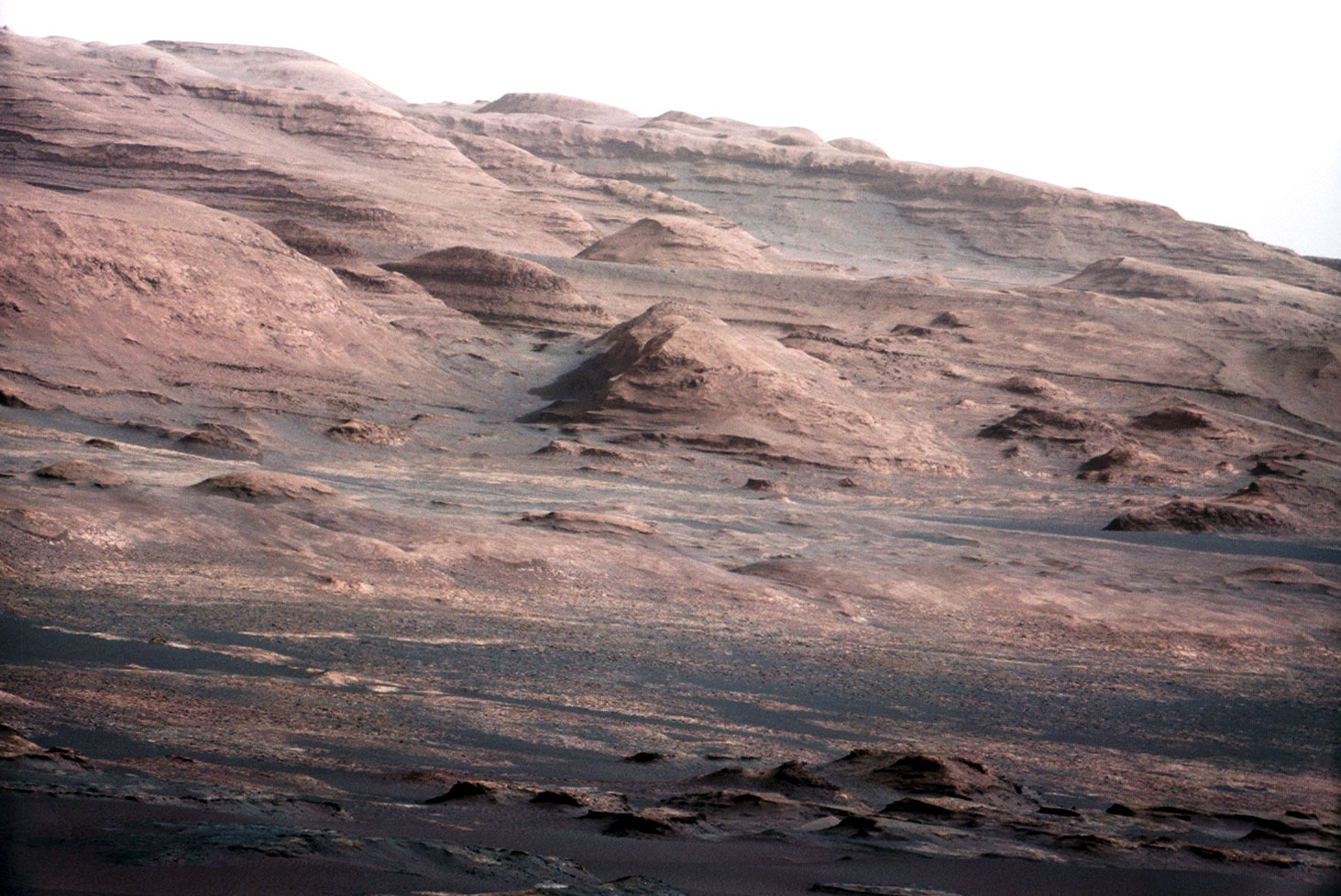
Layers at the base of Mount Sharp (source)
With the movie  The Martian opening this Friday, many people will soon be familiar with Mark Watney and his incredible ordeal. 

This is not a book review. I'm done with those for the time being. The last one I did turned out to be a bit of a disaster.  


I just have a few thoughts about Mark Watney's Martian diet that need to escape through my fingers and out onto your computer screens.


To survive on Mars and to think his way to salvation, he eats a lot of venison, kale, and blueberries.


Psych! He eats a lot of potatoes. You know, the "problem" food that causes disease. The food that so many trademarked diet plans avoid, like the Paleo Diet. 


There was some pre-made, pre-packaged NASA fare for Watney, but no way would it last as long as he needed if he was to try to get off Mars. So he actually grew potatoes. A shitload of them. With a shitload of astronaut shit as fertilizer. 


The whole spirit of the book is one that inspires us to think our way out of problems. To remember that possibility is a state of mind. To be skeptical of our inner skeptics who speak of impossibilities. And it's with that skepticism that I wonder about those potatoes.


Let's forget our questions about soil volume, nutrients, and moisture  (mostly because I don't know how to usefully critique the thorough explanations that Watney provides for his decisions about these things). 


And let's drop the question that drove me crazy until the very end of the book when Watney finally explained that he was microwaving the potatoes and thereby getting more calories from them than he would by eating them raw. Given all the calorie-calculations he ran through while sciencing, the chance that Watney might be eating raw potatoes was slowly killing me (and, potentially, him). 


Now I'm curious about something more fundamental: would potatoes grow the same on Mars as they do on Earth given the gravity's different? Could Watney's Earth botany translate as well as it did on Mars?


His training and thinking might not translate well on Mars if we're talking about making a different kind of tot. I'm fond of this paper hypothesizing how difficult it might be to extend the evolution of our own species, extra-terrestrially. Earth's gravity may matter a whole lot to human reproduction, especially those earliest stages of development. 


link to paper

We're not potatoes, sure, but potatoes aren't yeast. Given that there's less gravity on Mars, can we assume that sciencing all those Earth potatoes in Martian conditions is as straightforward as Watney makes it sound?


I don't think anyone knows the answer to this, however, tons of anyones (like Andy Weir) have more informed guesses than I do. Indeed, it is possible to grow spuds on the space station. So maybe my gravitational question lacks gravitas.  


(That groaner was for you, Mark.)


But one thing is for sure. In The Martian, as in life on Earth, a diet based primarily on potatoes fueled a human for quite some time. Maybe not all humans could handle this, and maybe not all humans could be as extraordinarily brilliant while eating mostly potatoes for so many cold and lonely days. But the potato industry has got to be thrilled. 


Not only is one of humanity's best (fictitious) members existing as one of humanity's best members thanks to potatoes, but the food's public image got a separate but related boost recently. Potatoes, and other similar carbohydrate sources, might have been crucial to our lineage's brain evolution. 


Anthropologists have known for a good while now that "underground storage organs" or USOs, like potatoes past and present and many other species, have probably been a big deal during the last several million years of human evolution. But a recent review paper in the Quarterly Review of Biology argues, based on up-to-the-minute cross-disciplinary findings, that cooked starches were crucial to the evolution of our big glucose-sucking, calorie-burning brains. Here's the paper's abstract:


source (and see Zimmer's write up)

So, Paleo dieters and potato-haters of the world, you have just been publicly flogged by both science fiction and science faction. What do you do now?


Well, if you haven't read The Martian, I'll plug it one last time. 


When you're on about page two you might be cursing me. By then I was cursing the book and everyone who liked it. I nearly gave up at the start for reasons to do with the style of writing (gasp! a blog! Ugh!) and my narrow-minded expectations of astronauts, but I'm so glad I dominated my inner bigot and turned the page. All the pages. To the last page. In solidarity with my new favorite Martian blogger, I'm moved to thank you for reading this gasp! a blog! Thank you. Now get to reading Watney's.


P.S. If you can't access the two articles I reference, email me and I'll send them to you: holly_dunsworth at uri.edu

Tuesday, November 18, 2014

Darwin and the evolution of my brain

 My drawing ability stalled out at the second grade level.  To wit, this drawing of an imaginary place that I did in reply to a request from my daughter just 3 months ago.


It is embarrassingly bad, and it perfectly illustrates why I didn't draw for my entire life.  At least by hand.  (What are those green blobs in the pond? Frogs? Lily pads?)  Ok, yes, somehow I did manage to produce illustrations for two different, 'serious' books, but I thought of that as 90% Adobe Illustrator and 10% me.  But I did learn as I went along, or maybe AI and I trained each other.

Here's one of my first Illustrator drawings, from our earlier book.


From Genetics and the Logic of Evolution, Weiss and Buchanan, 2004


I remember how much I struggled just to make this simple line drawing.

And then one of my favorites, which not coincidentally was among the last I did for The Mermaid's Tale.

From The Mermaid's Tale; Weiss and Buchanan, 2009


Ok, two of my favorites.

C. elegans body plan; The Mermaid's Tale; Weiss and Buchanan, 2009


I learned a lot about using AI by the time that book was finished.  But see drawing above as to how much that applied to hand drawing.

And then a few months ago, by chance I saw that a painter at the local art co-op was offering a beginning drawing class. On a whim, I decided to sign up.  I knew someone in college who drew her way through Norway on a postcard-sized sketchbook, and I always thought it would be wonderful to be able to do that, though I had no illusion that I would ever be able to.  Still, I liked the idea of perhaps being able to improve my drawing at least to the point of being able to enjoy doing it.

I took the list of supplies we'd need to the art store before the first class, bought the pencils, erasers, pencil sharpener, and the suggested sketch pad, which was so large that it was unwieldy to carry.  I was embarrassed to walk out of the store with that 18 x 24" sketch pad under my arm.  I felt a total fraud.


The first class was a bit intimidating -- one woman was already seated at her easel, half-way through copying a da Vinci drawing, which didn't help.  As it turned out, she was a private student but I didn't know that at the time.  I sat down at one of the free drawing tables and opened the sketch pad to the first yawningly empty sheet of paper.  I laid my 2HB pencils and my erasers and my sharpener next to the paper, and looked around at the 6 other students doing the same.  What if they were all as good as the woman copying the master?

Introductions followed -- relief, the rest of us really were beginners -- and then the instructor sat down to demonstrate what he was asking us to do.  He put a simple box on the pedestal that was the hub of the circle of tables and nervous students, and began to draw.  Yes, he did put up his thumb to measure the size of the object.  It was in fact a revelation to me that artists actually do that -- and the beginning of the evolution of my brain.

After watching how it was supposed to be done, I sat back down to try to draw the box myself.  Huge blank sheet, everyday object, render to paper.  Just picking up the pencil was awkward, and the act of putting the first line to paper felt like it was being done by someone else's arm, driven by someone else's brain.  But I did it, and this is what I drew.


Ok, tentative lines, no attention to technical issues, but there are lines on paper.  That was good enough for day 1.

We had eight classes, three hours long, each utterly basic but utterly eye-opening to someone stuck in second grade drawing mode.  Perspective! Oh, that's why I could draw the diagrammatic figures for the books that I did with Illustrator!  No need to make them look life-like.  Oh, we're supposed to draw what we see, not what we think we see!  Revolution.  Negative space! A whole new way of seeing.  Organizational lines, vanishing points, units; all basic, all essential.

As I practiced, somehow the rust fell away, and my muscles started to be willing to move.  Not just arm muscles, but the seeing, rendering muscles.  We went outside to draw houses for one class, and here's the one I drew.


Still tentative, still technical issues, and the house looks rather more haunted in my rendering than it does on the street (it's a very tidy, well-kept house, in fact), but still, progress I thought.  I started to sort of like what I drew, so I kept drawing.

And then the other day I woke up wondering if I could draw Darwin.  Who does that?  So, me, online photo of Darwin, sketchbook and a pencil.  I wish I'd taken more photos as I worked, because the fascinating thing, to me, is that at some point early on, my lines on paper began to actually look like the famously familiar photo of this man.  This absolutely amazed me, and continues to.

Here's a photo of just the face, before I added the trimmings, which turn out not to be necessary for the effect.  I actually kind of like this picture better than the 'finished' one.  But the thing is, it was Darwin after just the first eye was done.


Now, 'finished' (which brings up another artistic problem: how do you know when you're finished?)


How does the brain turn lines on paper into a sense of a three-dimensional person?  Is it because we know this image so well that we excuse my raw attempt at rendering it, and fill in the blanks?  Simple (or not so simple) pattern recognition?  That could be.

And, to pull this tale back to the beginning of evolutionary time, at the end of each drawing class we looked at all of our drawings, and 'critiqued' them.  To me the fascinating thing, each week, was how very differently each of the seven of us put pencil to paper; same beginnings, usually the same object, totally different renderings.  One woman drew a bird's-eye view of the house she was sitting in front of, in the beautiful dark confident lines she used for everything; another man drew every shingle on the roof of his chosen house.  Speciation in action.

As well as evolution of the mind.  My mind, my understanding, my confidence and ability to tell my muscles what to do.  I have a long way to go, having drawn my way into a number of technical corners in just this one Darwin drawing, and I have no idea where to even begin working with color, but I've learned a lot.  Not least about what this optical illusion, this effect of graphite on paper, tells us about the power of the brain, of its constant, effortless brilliance at solving 'the binding problem', the putting together of the results of what so many different parts of the brain are perceiving and making final sense of it.  Indeed, to the brain, this isn't a 'problem' at all.  Even ants and bees and crows and dolphin brains can do it.  It's a 'problem' only for those who want to put it into words.

Wednesday, October 10, 2012

A Leash of Hemp: Does our slow, overbearing consciousness mislead us about human nature?

source

Running is a precious 30 or so minutes for me. It's a drug. If the pace and the light and the rock'n'roll in the earpods are just right, it's god. But today while I ran on the old railroad-turned-trail in our neighborhood, everything was more or less ungodly, more or less routine. As always, I passed by many walkers, cyclists, runners, dogs, cats, squirrels going the other direction. Most humans say hi or wave. I give the peace sign. I live in Peace Dale. I like words and peace and cute.

And as I'm apt to do, I meditate on the people I see, sizing them up, giving them roles, stories, assessing their general vibe, riffing on them until new thoughts hijack those neurons, which is frequent on a run. And I want to tell you about a specific people-passing incident from this morning because it illustrates, just in that fleeting, mundane, snapshot of a throwaway moment something much more profound, not just about human nature but about how we perceive it which folds back on the nature of human nature itself. (whoa)

He's about 50 yards away when I first notice him:  White, in his twenties, gray hooded sweatshirt and jeans, hood up over his hair, walking a dark-brown pitbull-looking breed. 

And I think to myself, I bet his dog's leash is made of hemp.

To me, all those traits I'm observing together scream 'leash of hemp.'

And sure enough, as the space between us narrows, I can see it's a leash of hemp. 

Naturally I'm thinking something like, See? See, politically correct world? Stereotypes can be true. Some biological and cultural traits cluster together predictably. Calm down everybody. It's just human nature! We vary predictably in many ways.

And nobody can argue against the fact that some traits do cluster and that you can predict some things about people based on things like their sex, their clothes, their age, their gait, their dog breed, ... 

Okay, cool. But whoa whoa whoa.

Did I really use all those observations to successfully predict the leash was made of hemp? Did I really just validate that stereotype about 'hemp dog leash people?' Did I really just support that theory (stereotypes are real, baby) by forming a hypothesis that ended up being correct?

Of course it could have been a coincidence, my correct guess. There are only so many kinds of dog leashes: Leather, acrylic, and hemp are the main ones I think. So, given a leash exists, the odds are pretty good that I'll guess what kind it is, regardless of what the guy or the dog look like who are tethered together by it. 

But that's not what I meant by my doubt. I'm wondering about something other than coincidence, something quite sinister.

I'm wondering whether I actually predicted the leash was made of hemp or if my brain tricked me into thinking I did.

I mean, don't you think it's suspicious that I caught myself predicting what the leash would be made of? Doesn't that seem weird?

I could, just as easily, have tried to guess his shoe or jeans brand, whether he was wearing a watch or not, if he was going to smile at me or not, harass me or not. Many things that I could see or experience upon closer proximity were available for prediction and, instead of any those things, I chose to predict the material of the dog leash.

Why? What was my consciousness up to?

Let's cut to the punchline: I don't think I predicted anything at all. Right after the whole thing went down, I caught my consciousness red-handed.[1] 

From as far away as I was, I could still have quite easily perceived that the leash draped and swung like hemp, and unlike leather or acrylic. I could also have very easily perceived the pale color, unlike the dark colors that acrylic and leather usually are.

So I could have known it was hemp without yet knowing it, consciously, since there's a delay between perception and consciousness.

And instead of coming to know 'hemp' from my immediate perception of it, I think my consciousness narrated my experience in such a way that I was predicting something I already knew! My consciousness made me believe that I had a clever hunch, a hunch that was consistent with a stereotype of this 'hemp dog leash person.'

Put another way, my consciousness was taking creative credit for the observations that the perceptive parts of my brain were already processing. Sounds a bit like some people you work with, doesn't it?

All this is happening in split seconds. It's not hard to imagine how my consciousness--since it's already very busy trying to constantly make sense of the world--could garble this input and the timing of it by inserting a narrative. It's not hard to imagine, given the delay between perception and consciousness, how my mind could mangle the more likely true story which was simply...

input-input-input (ad nauseam)

by editing it into a story of ...


input-prediction-input-I'mAGenius


OK. Besides how fascinating this cognitive delay is, with all its relevancy for studies of ESP, pre-cognition, magic tricks, and falling for them. Besides all the implications for the existence (or not) of free will ... since, if your consciousness is delayed, are you really deciding your life or are you just experiencing life and narrating it as if you're deciding it?

Aside from all those fascinating supernatural and existential implications, this is the kicker: This illusion stemming from our slow and overbearing consciousness probably affects how we relate to other human beings who we encounter every day.

See, the leash of hemp boosted my confidence in two things that are already boosting one another to begin with:

1. I think I'm good at predicting human nature.

2. I think human nature, especially in stereotyped and categorical terms, is predictable.

These two things may be true in many regards. But my experience, my little experiment, my leash of hemp, lead me to believe that 1 and 2 are stronger than they are and that they're realer than they probably are, in reality.

And a leash of hemp moment is just so exhilarating, at least for a scientist like me, when it's about traits untied to value, like leash material. It's a similar feeling you get once you're so familiar with the chimpanzees you're observing that you can predict, given a set of circumstances or time of day or whatever, what they'll do next, where they'll walk, climb, who they'll play with or groom. It's a real high.

But how about when those links, those predictions, are about value-laden traits like beauty, intelligence, sexual orientation, religious belief, violence? I'm more likely to believe stereotypes and my own abilities to predict human nature when it comes to these much more sensitive or much more volatile issues simply because I guessed that a dog's leash was hemp while running this morning.

A leash of hemp's no big deal when it's just about a leash of hemp,[2] but a taking a 'leash of hemp' about someone who's wearing a head scarf or a short skirt, about someone who speaks with a Southern accent or an educated accent, who goes to temple or to church, who has darkly or lightly pigmented skin? Maybe that's when we should humble our consciousness. Maybe that's when we should remind it that perception was there first. Maybe help it question whether it's really so smart. After all, maybe it already saw, heard, smelt what it so cleverly claims to have sensed, believed, predicted. Maybe it doesn't deserve the credit it's taking, thereby encouraging itself to apply its methods to other situations that require more nuance, more sensitivity, more observation, more time, actually getting to know a person, that whole human connection thing, you know?

It might feel like it, but we're not, objectively, human nature experts. We can be too easily tricked by our delayed and overbearing consciousness. We're too quick to be seduced by these split-second cognitive events that validate our intellect, our experience, and our beliefs all at once.[3]

Knowing this, being conscious of the lag between perception and consciousness, catching one's mind in the act, why is it still so hard to change our minds going into the future?

Maybe if leashes of hemp were more ubiquitous they'd serve as a nice gimmicky reminder about these illusions--dampening our habit of skyrocketing all the way up to "human nature" from a dog's leash. But would that really do any good? After all, skin colors, eye shapes, skirt lengths, accents... these things are ubiquitous and yet they clearly aren't gimmick enough to humble our consciousness, to help us remain skeptical of what each of us knows so well about human nature just from our itty bitty n of 1.


**

Related reading...

[1] I thank running for opening my brain to such a thing--a good hypothesis considering how my most satisfying thoughts usually come during the 30 minutes of the day that I am pushing my body down the running trail.

[2] Unless you've got something against hemp, hippies, dogs, pitbulls, white people, men, hoodies.

[3] Implicit here is an assumption that all humans suffer from this delayed consciousness, that it's part of "human nature." oy, is it?

Tuesday, March 15, 2011

Science without hypotheses? Not exactly penis-spine tingling

I’m still a bit bewildered after attending an afternoon of talks at the American Academy of Forensic Sciences (AAFS) conference held in Chicago a few weeks ago.

For one, I was stunned by the practical use of “mongoloid,” “caucasoid,” and “negroid” which I thought were long ago shelved as artifacts of physical anthropology’s racist past. But, whatever.

There was another surreal aspect to the meetings. I attended five talks and not one had a hypothesis. Based on these few talks, the conventional format appeared to be: Show photos of dead things. For example, even if the stated aim is to find anatomical indicators or predictors of intentional animal abuse, it was clear that one need not provide a single hypothesis and that one can conclude a slide show of dog strangulations and gunshot deaths with a simple, “animal abuse happens.” And if you thought it was impossible to make a disappointing presentation about a tiger attack, you’d have been as surprised as I was.

So instead of learning anything new about how forensic science is practiced, I discovered something (that I’d hardly thought about before) about how science is presented to the public.

Science without hypotheses is boring. Hypotheses aren’t just critical to the scientific method, they’re crucial for telling captivating and satisfying science stories to other humans.

Without hypotheses, there is no mystery and there is nothing for your audience to do.

Without hypotheses there’s no engagement—that thing that we strive so hard to foster in the classroom because we have good reason to believe that it’s correlated to learning success.

And outside the classroom, it’s clear that people really dig engagement. Why do you think people read The Da Vinci Code in one sitting from cover to cover?

Because it beckons the reader to solve the riddles and puzzles before turning the page!

This is what hypotheses do for presentations of scientific research.

And for scientists, there’s no need to concoct or conjure anything. Doing science is writing the mystery itself. No need to take a weekend seminar in suspense writing from Stephen King or to even call your hypotheses “foreshadowing.” Scientists, by the very nature of their work, have all the tools to build a good mystery. And this is how they should present their research to others.

Just lay out your process for the listeners/readers and let them anticipate what comes next. Let them mentally guess which hypotheses will be supported or not and then allow them to be surprised or vindicated by the results.

I offer you an example. I’ve written two blurbs about a recent paper in Nature. In the first blurb, I offer hypotheses and leading questions. In the second blurb I do no such thing. Which one is better?
***
Number 1: With hypotheses and leading questions
Did you know that humans not only have unique brains but unique penises as well?

Compared to chimpanzees, our closest relatives, and other mammals we have large brains for our body size and we also have no spines on our penises.

There must have been genetic mutations during our evolution that contributed to these traits. But what kinds of mutations were they and what kinds of genes were affected?

For the loss of penis spines here are just four hypotheses, phrased as questions:
(1) Are we missing genes that code for penis spines?
(2) Or are there penis spine-coding genes in our genome but they’re nonfunctional?
(3) Are we missing genes that are involved in regulating penis-spine-coding genes?
(4) Or are there regulatory genes for penis-spine development within our genome but they’re nonfunctional?

According to McLean et al., it’s hypothesis 3… sort of. It’s a bit more circumvented than that. Humans have a deletion of a highly conserved region in chimpanzees and other mammals that’s in a noncoding region near genes involved in steroid hormone signaling. The deletion removes a penile spine enhancer from the human androgen receptor (AR) gene, a molecular change correlated with anatomical loss of androgen-dependent penile spines in the human lineage.

Okay, then what about the brain? What kind of mutations could have caused it to increase in size?

Here are just four hypotheses, phrased as questions:
(1) Do humans have additional genes linked to brain development that chimpanzees don’t have?
(2) Do we have mutated regulatory genes that supercharge our brain growth genes?
(3) Do we have mutated genes that code for growth hormones that affect brain growth uniquely in us?
(4) Are the regulatory genes for those growth hormone genes different in humans compared to chimps?

According to McLean et al., it’s none of these hypotheses! It’s actually another deletion, if you can believe that. A deletion that leads to more brains? Yep.

Humans have a deletion of a highly conserved region in chimpanzees and other mammals that’s in a non-coding region near genes involved in neural function. The deletion “removes a forebrain subventricular zone enhancer near the tumor suppressor gene growth arrest and DNA-damage inducible, gamma (GADD45G), a loss correlated with expansion of specific brain regions in humans.” In other words, the deletion removes something that inhibits growth.

And why put these two discoveries, one about penises and one about brains, in the same paper?

[Insert your favorite _______-head joke here.]

First of all, as you probably gathered by now, both discoveries are dealing with deletions. The team identified 510 of these in humans. They saw these deletions as hypothetical fertile ground for human-specific traits. And almost all of these deletions occur in non-coding regions and are “enriched” near genes involved in steroid hormone signaling (penis spines) and neural function (brain size). As they say in the abstract,
“Deletions of tissue-specific enhancers may thus accompany both loss and gain traits in the human lineage, and provide specific examples of the kinds of regulatory alterations– and inactivation events long proposed to have an important role in human evolutionary divergence.”
Also, both discoveries about brains and penises were achieved through the use of similar methods. Beyond the fancy computing and statistical techniques used to identify the deletions as candidates in the first place, both the brain and the penis stories required mouse embryos to check to see what these deletions do during development. According to the paper, the experiments with the mouse embryos supported these deletions as influencing the loss of penis spines and the enhancement of brain size (e.g. cortical expansion) in humans.

And there are further questions too. Most things we know about the genetics of the development of our bodies indicate that the genes are pleiotropic, meaning they are involved in more than one process. So did the loss of penis spines during development coincide with the loss of anything else? If so, what could that thing be? Something else to do with the penis? Something else to do with male-specific traits? Something that affects female reproductive organs?

It turns out, the same deletion that’s linked to loss of penis spines is linked to loss of whiskers (or “sensory vibrissae”). And it makes sense given that the development of both are dependent on androgen and the deletion has to do with androgen.

Okay, though. Which is it? Did natural selection prefer hominin males without penis spines? Or did natural selection prefer hominin males (or females) without whiskers? The latter seems silly. Why would natural selection favor the loss of something that provides sensory information to an organism?

It seems more likely that natural selection would favor the loss of penis spines and that whiskers were lost as collateral damage. But penis spines may be useful for scrubbing out a rival male’s sperm while inserting one’s own, right? So, again, why would natural selection favor the loss of such a seemingly useful trait as that? Hmmm? How could one survive and reproduce if you’ve lost the ability to scrub out unwanted semen to make room for your own swimmers? The environment would have to change. And the environment is not just trees and grasses, it’s also others within your own species.

Are you thinking what I’m thinking? Male-male competition changed. That’s where the authors go. Here’s how they explain the evolutionary loss of penis spines. (Heavily citing Dixson’s 1998 book Primate Sexuality and also citing Lovejoy’s 2009 piece at the end of Ardi’s special issue in Science.)
“Simplified penile morphology tends to be associated with monogamous reproductive strategies in primates. Ablation of spines decreases tactile sensitivity and increases the duration of intromission, indicating their loss in the human lineage may be associated with the longer duration of copulation in our species relative to chimpanzees. This fits with an adaptive suite, including feminization of the male canine dentition, moderate sized testes with low sperm motility, and concealed ovulation with permanently enlarged mammary glands, that suggests our ancestors evolved numerous morphological characteristics associated with pair-bonding and increased paternal care.”
So the loss of penis spines makes intercourse take longer which is better for bonding a male and a female together emotionally and that sort of bond helps them work together better to raise big, helpless, slow-growing offspring.

All right.

(But but but… what if extending the duration of intercourse is just another type of male-male competition? You monopolize a lady so long that other guys can’t have their chance. But I digress…Also, spineless (actually, "simplified") penises are linked to monogamy, but is duration of intercourse positively correlated with pair-bonding behavior as well? I think there are data for this...Again, I digress...)


But then they conclude…
“We cannot exclude the possibility that loss of AR and GADD45G enhancers has occurred because of relaxed selection following other genetic changes that have led to anatomical differences in the human lineage. However, based on the previously established role of AR in vibrissae and penile spine development, and of GADD45G in negative regulation of tissue proliferation, we think it probable that deletions of tissue-specific enhancers in these genes have contributed to both loss and expansion of particular tissues during human evolution.”
If you're like me, you're wondering, What other human-specific traits could be influenced by deletions in our genome? This is fun.

And this notion of adaptive deletion leading to brain expansion conjures up thoughts of this recent paper: "EXPERIMENTAL EVOLUTION, LOSS-OF-FUNCTION MUTATIONS, AND “THE FIRST RULE OF ADAPTIVE EVOLUTION.”

***
Number 2: Without hypotheses
There are numerous deleted regions in the human genome that are conserved (i.e. not deleted) in chimps and other mammals. One such deletion is involved in the loss of whiskers and penis spines. Another such deletion is involved in the development of our large brain. In conclusion, genes were altered during human evolutionary history that affected human-specific brain size increase and the loss of whiskers and penis spines.

***
I can’t even bring myself to fill in the details in that second piece because it's so boring.

When scientists are speaking to a room of colleagues at a professional meeting (like at the AAFS), their hypotheses are well-understood by most listeners and will probably continue to be jettisoned from time-constrained talks. The same thing happens in page-limited publications, where hypotheses are often banished to the supplemental materials. The problem with all of this is that stating the hypotheses actually strengthens your study.

When scientists are presenting their research to broader audiences, leaving out the hypotheses is the biggest mistake they can make. Good teachers know that formulating and testing hypotheses are some of our strongest tools for student engagement. And good science writers, like Carl Zimmer, get this too and they write tantalizing yet responsible pieces.

There’s no harm in spicing up the presentation of your research with the thoughts and processes you’ve already gone through while you did your research in the first place! You really can make whatever it is that you do into a good story for the rest of us.

Scientific literacy—that thing we all want our students and neighbors to achieve—is not just about numeracy and rote memorization. It’s literally about literary literacy too… about stimulating the literature-lovers in us all.

So go ahead and tingle our spines, Scientists.

It’s not that hard.

(That’s what she said.)

Wednesday, March 10, 2010

Infant brain and equally naive thinking by scientists?

The program for this week, in our favorite radio program, In OurTime on BBCRadio 4 (applauded recently in The New York Times, and The London Review of Books, so clearly we're not alone!), is about the infant brain. Three psychologists discuss the history of modern ideas on how the brain works and develops, as an infant grows towards fully functional status.

The discussion contrasts a complete tabula rasa (blank slate) view that the infant learns everything from experience, to a totally nativist view that everything is built in. The former was advocated by Jean Piaget, the latter by Noam Chomsky. The discussants went over many intriguing experiments that have been done.

Clearly the way the brain actually develops is in the middle somewhere: the brain has regions that are dedicated to or specialize in some function, such as processing retinal images from the eye, or verbal sounds, or smells. Some parts of the brain regulate things like heartbeat and blood pressure, or secrete hormones. Except when adaptively relocating in recovery from injury, these seem at least generally to be in similar places in different individuals. That is a kind of functional hard-wiring, but it's very generic. It is a regionalization of areas that are set up, so to speak, to learn from experience--to learn sounds, language, the way animate and inanimate objects behave, and so on.

In interesting and important ways, this contrasts sharply with the dream of Darwinian psychologists and similar schools of thought, that want to be able to pry (rather pruriently, we might say) into a person's brain and claim the ability to see what they're really like, rather than how they fancy themselves to be.

The need to find a selective or even essentially deterministic explanation for the evolution of everything and anything mental is strong in our current culture, even if it's manifestly naive. If we are hard-wired for anything, overall, it is not to be hard-wired any more than was necessary. Humans are par excellence the learning and assessing organism, not one pre-programmed for our various tasks and traits. Pre-programmed to be able to scope out a new situation and figure out how to respond to it. That's what human beings are.

This is also the most parsimonious (simplest and easiest to explain) view of the human mind, if one feels a need for a selective explanation: if you were too rigidly hard-wired, you got caught by surprise and eaten at an early age! You didn't need countless specific selective adventures to weed out vagueness in any and every aspect of your thought. But it's harder to understand neurologically how unprogramming evolved than the 'genes-for' kind of dream. It also isn't as sexy and media-genic a view. Unfortunately, in our society oversimplified determinism and darwinism seems to be the order of the day.

In addition, the anthropocentric explanations of brain function are undermined by the fact that psychologists have shown that many of our traits are found in all sorts of other species, at least of mammals. Things found in dolphins and hedgehogs do not need a human-specific, much less a recent-evolutionary explanation. Such explanations are redundant, not parsimonious--not good science.

How the ability to recognize simple phonetic (sound) contrasts and the like, that is present in other species, led to our ability to build language, symbolic behavior, and all that goes with it, is the core question. Very interesting, but very hard to answer.