Showing posts with label human exceptionalism. Show all posts

Monday, September 14, 2015

Oh Koko!

We'll be sharing much more, in the coming months, about why Anne and I are a wee bit obsessed with Koko the gorilla. She's one of the stars of a project we've got going--a project that will likely diminish our chances of ever meeting the lovely and extraordinary creature.

It's because we've been stalking Koko that Anne and I were perplexed, but not surprised, by this recent piece in The Atlantic:


Click here for the article.

Our eyebrows arched just reading the headline.

It leads a reader to anticipate a conversation with Koko the gorilla, but instead it is mostly an interview with Koko's main human, Penny Patterson. So, I guess the headline is describing what that interview is about--a conversation about conversing. There's no other way to make sense of it. Yet, it's still problematic because gorillas don't converse. Not even Koko.

The piece begins with an anecdote about Koko describing herself with the "queen" sign. Morin, the article's author, follows it with this quote of explanation from Patterson:
Koko understands that she’s special because of all the attention she's had from professors, and caregivers, and the media.
And this is where, to my mind, any interviewer actually fascinated with Koko's mind asks: This is amazing...how could Koko understand that she receives more human attention than most other gorillas on the planet? And how does she make the connection between this concept, this existence of hers, and that of a queen? When you taught her "queen," what was the definition? 

Unfortunately, this isn't the direction the piece goes. That nugget was a foray into her backstory about her sign language training and her home in California.  And just because the written product of Morin's interview doesn't dive into questions like those italicized up there, it doesn't mean it didn't. But if he did go there, why on earth didn't that gold make it into the piece?

More to the point, why have I never read an interview about Koko that asks penetrating questions about the stories that Koko's humans tell about her mind? Is that nuts and bolts stuff merely uninteresting fodder for readers or is it off-limits to writers who are permitted access? There's an answer at the end of this blog post.

But first, I have more, seemingly infinite, questions... How does Koko's language ability, and let's add Kanzi's too, compare to a highly-trained border collie like Chaser?


Is it categorically different, indicating an actually different kind of cognition?
You might be thinking about this video of Kanzi and saying, yes, yes it's different:


But how is it different? Kanzi is just pairing up two things, which is not really all that different from Chaser getting one toy at a time. It might appear to be more extraordinary than it is because in pairing the two objects for which Kanzi knows the English words, he behaves with them in ways they're meant to be behaved with by people.

That was a sentence worthy of a tinier brain than mine.

What I'm trying to say, poorly, with my human language "abilities," is that grabbing two things, like a soap pumper and a ball, and behaving routinely with one of them (like pumping the soap, which is what one does with a soap pumper) doesn't necessarily require as much human-like comprehension of what Sue's saying as a we might assume--that is, without thinking it through more deeply, or perhaps without trying to think like a dog or like a bonobo, or like a toddler.

Or like a gorilla--a gorilla who's arguably not a gorilla, given she's not socialized like one and given how her humans have admitted that they've intentionally raised her as a human and consider her one:


As they've raised Koko, they've narrated her mind as if it works like ours.This is evident right from the beginning of the interview portion of Morin's article. Patterson is explaining how Koko generalized the sign for "food", saying:
She would perch on this high spot where she could watch people come and go and she would sign “food” to them. It might mean “Give me the treat you’ve got,” or it might mean “I want my toothbrush,” or even just, “Engage with me.” She understood that signs had power. That particular sign got her food, so she wondered, “What else can I do with it?
She did? She wondered? And it was about how to use a sign in different settings to get what she wants? It's not just simply that it's something she could produce and did, in various circumstances? I think describing such processes as "wondering" would be giving humans too much conscious credit most of the time. But it's how we talk about minds. It's how we narrate one another's behaviors, and that of our pets, and that of whatever Koko is.

Often this is lumped into "anthropomorphism" and it's not all bad, but one could argue that it's to be avoided like the plague. If the goal is to understand how an animal thinks, then anthropomorphism risks being more of an obstacle than a helpful metaphor.

Whether the Koko project is scientifically rigorous, I have absolutely no idea. But Patterson's fantasy description of wild gorilla communication rings more of science fiction:
The free-living gorillas might talk about simple things like “Where are we going to get our next meal?” but here [at the research facility] there is so much more to talk about.
Death is one of those things. Here's Patterson's evidence that Koko understands things about death:
The caregiver showed Koko a skeleton and asked, “Is this alive or dead?” Koko signed, “Dead, draped.” “Draped” means “covered up.” 
Again, this is where my dream interviewer asks, What is the connection between "dead" and "draped"? It's even harder to understand the connection between a skeleton and draped. Can you help us understand the logic of her language? 

But we're not given that in this piece.  Morin does follow with "How would Koko know about death?" but it's not demanding a response that gets at the crucial connection between her mind and her signs.

We need to know whether what Patterson says about Koko's mind is true or not and no one seems to be able to  help us learn this. As the piece continues, my desperation for such a person escalates.

Patterson describes how Koko was making a sign that her brother made just before jumping off a rock. It took Koko's people a while to understand what she was trying to say because they hadn't seen her brother do this, but once they saw a film, it was apparent that the sign...
...means “take off” in the sense of “jump off.” Koko wanted us to take off our lab coats.
How does Koko's mind connect "jump off" a rock with "take off" your lab coats? If Morin asked this, he neither published it nor the answer. If Morin asked this question, then he is hoarding the gold all to himself.

The rest of Morin's piece is fascinating, and in parts it's heart-warming, especially if you have a soft spot for gorillas and for people who have those soft spots too. But there's still no conversation with a gorilla, or a conversation about a conversation either.

Read far enough into the article and you'll see what happened to Morin as he prepared to meet Koko:
Patterson cautioned me earlier to refrain from asking Koko questions. I was to let the gorilla take the lead. “She has that royal air about her,” the researcher explained, “and she doesn't entertain questions. Just like you wouldn’t question the queen—Koko is the same way. She’ll disengage.”
So, no conversation is going to be had with an ape, conveniently, because that totally capable ape wouldn't like it if he tried. Hm.

But there would be some lovely and touching moments through the enclosure's fence.

After recounting those, Morin reflects on what I've been discussing:
There was no way to know how much of her behavior was intentional and how much was my own or Patterson’s projection. Allegations of selective interpretation have accompanied ape-language research from the beginning. Still, it was impossible to be there interacting with her, and not feel that I was in the presence of another self-conscious being.
I don't see anything wrong with describing her as self-conscious while also doubting that her mind works like ours.  I live with a one-year old. And even before I had this baby, before I lived with an alien mind, I didn't see anything wrong with this thinking. Morin's final thoughts compare Koko's mind to an alien's, but his piece paints that alien as just another Hollywood humanoid.

When you share the link to Morin's The Atlantic piece on Facebook, the headline in the feed reads: "What gorillas can teach us about being human"

Well, what can they?

I think it's obvious from the article, and from others like it, that Koko is teaching us about our limitations. She's teaching us that we wouldn't care as much about gorillas without her fairytales; that we wouldn't care as much about these truly magnificent animals if they weren't furry humans. And that would be less depressing if we were any good at caring about actual humans.

Monday, August 27, 2012

That [obstetrical dilemma] really tied the [human evolution] together. Part 2.

Update (Aug 30, 6:41 am): Paper's up. Here.

Update (Aug 28, 3:32 pm):  Jeepers, if I'd have known readership (err, clickership) was going to jump way above normal with this post, or that writers would lift quotes from here, I'm sure I would have crafted it better. 

Note: We're past our embargo, so I'm posting this now even though it doesn't appear that the article is posted on-line yet. I'll update this post and link to it once it is.

Some colleagues and I have a paper this week in early view at PNAS (1). I already told a big part of the story here.

In our paper, we show how weak--given current evidence--the popular obstetrical dilemma hypothesis (OD) is for explaining human gestation length. And, we offer up an alternative hypothesis as well.

It gets a lot bigger than this, doesn't it moms!  
(image: http://classes.biology.ucsd.edu)

The EGG hypothesis
What limits fetal growth during pregnancy? The OD says it's the pelvis--implying it's a unique constraint due to bipedalism. But the EGG hypothesis suggests that the primary constraint on fetal growth and gestation length is maternal metabolism (energetics, growth, gestation). Mothers give birth when they do because they cannot possibly give anymore energy into gestation and fetal growth. And when you look at the data available on pregnancy and lactation metabolism in humans... it shows that right around 9 months of gestation, mothers reach the energetic throughput ceiling for most humans.

Here's Herman's Figure 3 showing the EGG for humans, plotted with real metabolic data. Circles are the offspring, squares are the mother. Notice how fetal energy demands increase exponentially as the end of a normal human gestation period approaches. To keep it in any longer, mother would have to burst through her normal metabolic ceiling. Instead, she gives birth and remains in a safe and possible (!) metabolic zone.


The starred dot is a human infant at the developmental equivalency of a newborn chimpanzee. This is the thought experiment that Stephen Jay Gould famously wrote about. That's the age you'd have to birth a human baby to be like a newborn chimp, since we're born born more helpless than chimps. Keeping a fetus in this long--that is, adding 7 or more months to our gestation--would be physiologically impossible because it would require a mother to exceed 2.1x the basal metabolic rate, bursting through the ceiling for most humans. We actually gestate as long or maybe a little longer than you'd expect for a primate or a mammal, not shorter! So our relative helplessness at birth is indicating how much more neurological growth we have to achieve during our lives, after birth, than chimps and other relatives.

The EGG is a more general incarnation and a broader application of Peter Ellison's "metabolic crossover hypothesis" for the timing of human birth. The EGG branches out beyond our species, considering humans to operate within the physiological confines of other primates and mammals. But comparable data for other species, for testing the EGG, are not yet available to our knowledge.

Why do we grow babies that seem too big to fit through our birth canals? A strong hypothesis is that it's our diets that have radically changed compared to most of our evolutionary history. Many humans have constant and easy access to high calorie foods while pregnant and they can grow bigger babies over longer pregnancies. Very much related to this idea, check out Herman's recent NYT article about how our energy intake affects our health: "Debunking the Hunter-Gatherer Workout."

***
We named the hypothesis for ease of communication, not because we're eggomaniacs. We were tempted to call it HAM (humans are mammals) but felt that EGG better described the idea and was also adorable considering how babies are made.

HAM and EGG, or EGG and HAM, to me, is the ideal name but try saying that without going all Dr. Seuss on a wumbus full of thneed-suited who-scientists.

And that goes for here too. Your pop culture references best remain R-rated if you're to retain an ounce of R-word. And because it's just so enlightening, we'll continue to employ the very mature and refined Lebowski theme from Part 1 in our discussion here.

Call me Maude.

“The [species] abides.”
Part of the trouble I and others have with the obstetrical dilemma is this: We do just fine in the face of the tight fit at birth. Just because there's a tight fit, just because childbirth is terrifying, just because it's not an easy or enjoyable experience, that's not necessarily a "bad" thing evolutionarily. Clearly it's the opposite. It's a good thing. We're here to think about it! It can't possibly be "bad" if we keep having babies despite the hellishness of childbirth. This perspective was one of the contributions of "The obstetrical dilemma revisited" (2): Our behaviors, our aiding of women during childbirth, have probably reduced selection pressures against the tightness of fit, or other contributors to childbirth difficulty and danger. The species abides.

When you look at childbirth not as a biological failure, or as God's plague on lascivious women invited by Eve, but when you see it instead as a raging success, the obstetrical dilemma hypothesis is much easier to doubt.

The picture of evolutionary success. (source)

"Say what you like about the tenets of [Natural Selection], Dude, at least it's an ethos."
The widespread popularity of the OD may well be rooted in its adaptationist appeal, where nonoptimality (e.g. human altriciality, or helplessness and relative underdeveloped-ness at birth) is explained as a contribution to the best possible design of the whole (e.g. big brain and efficient bipedalism). Gould and Lewontin (3) famously criticized the “adaptationist programme” by cautioning that “organisms must be analyzed as integrated wholes” that are “constrained by phyletic heritage, pathways of development, and general architecture” and that “the constraints themselves become more interesting and more important in delimiting pathways of change than the selective force that may mediate change when it occurs.” They faulted this approach for failing to “consider alternatives to adaptive stories” and for its “reliance on plausibility alone as a criterion for accepting speculative tales.”

From this perspective, it's inappropriate to root the evolution of human altriciality in a compromise between adaptations for big brains and adaptations for bipedalism when there are most likely more basic, conserved, phyletic constraints on pathways of development and general architecture (e.g. gestation, pregnancy and fetal growth) at play.

“Yeah, well, that’s just like, uh, your opinion man.” 
Over the last five years as I’ve been thinking about this, specifically, I've had a teeny tiny bit of resentment creep up now and again towards the field that coaxed me into buying this OD as dogma. But I have nobody to blame but myself! A hypothesis is just that and why I just swallowed it whole without doubt is partly because it's a cool idea! And partly because an alternative idea just wasn't as well-known yet! Our paper is not attacking anyone, despite the guilt we've induced in folks who have been treating the OD as fact and teaching it to hordes of students for the last 50 years. To those researchers and teachers who came before us, we’re grateful! And to anyone who thinks of our paper as gotcha or an attempt at it: Please remember how science works and how knowledge accumulation works. That's all this is. It's just a little more hyped because it's about humans, not sea squirts.

The OD is not dead. It's just put in a less omnipotent place. The heaviest burdens should always be on supporting hypotheses for human exceptionalism; we should never default to them. Humans are animals/mammals/primates/hominoids and when we fail at that default view, that's when we can claim human exceptionalism.


References
1. Dunsworth HM, Warrener A, Deacon T, Ellison P, and H Pontzer (2012) Metabolic hypothesis for human altriciality. PNAS on-line early view.
2. Rosenberg K, Trevathan WR (2002) Birth, obstetrics, and human evolution. BJOG 109(11): 1199–1206.
3. Gould, SJ and RC Lewontin (1979) The spandrels of San Marco and the Panglossian paradigm: A critique of the adaptationist programme. Proceedings of the Royal Society of London, Series B 205(1161): 581-598.

Note
Please do look to the PNAS paper to read about the EGG or to see how we've exposed the challenges to testing the traditional OD. I did not write this post to stand for anyone's sole source. If you cannot access the paper once it's posted on-line, then please email me and I'll happily send the paper to you.

Another Update (Aug. 30, 6:41 am)


Wednesday, December 7, 2011

The intelligent bird brain

Nicola Clayton, zoologist and Professor of Comparative Cognition in the Department of Experimental Psychology at the University of Cambridge, UK, and recent guest on the BBC radio program, "The Life Scientific," believes that intelligence has evolved more than once, in apes and in birds -- corvids to be precise.  That's primarily crows, jays, ravens and jackdaws.  In a 2004 Science paper, she and a co-author, Nathan Emery, wrote that
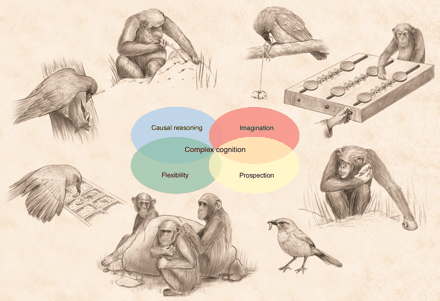
...complex cognition depends on a "tool kit" consisting of causal reasoning, flexibility, imagination, and prospection. Because corvids and apes share these cognitive tools, we argue that complex cognitive abilities evolved multiple times in distantly related species with vastly different brain structures in order to solve similar socioecological problems. 
The socioecological problems corvids and great apes have evolved to solve, say Emery and Clayton, include finding and keeping perishable foods over time and space, and understanding individual relationships in social groups.  Emery and Clayton propose that corvids are more intelligent than any other bird, except perhaps parrots, and their intelligence rivals that of most non-human primates. Indeed, Clayton calls corvids "feathered apes".  "You only have to look in the beady eye and see them watching you," she says.

Clayton told the radio presenter that she had her original inspiration jointly with Nathan Emery, now her husband, who was studying primates when they met as students.  He was working on eye gaze, on which there's been a lot of work in primates, and they wondered whether they could collaborate on a project having to do with that.  But, instead, Clayton was inspired by her daily walks around campus when she'd watch the local scrub jays stealing food from students eating lunch on the lawn.

Not only would these birds hide what they'd stolen for later, but Clayton observed that when they knew they'd been watched as they hid their find, they would re-hide it when no other birds were watching.  This led Clayton and Emery to conceive of the corvid "theory of mind".  Previously, it had been thought that only great apes and humans could imagine the future, and put themselves in it, but to Clayton the fact that these jays were sensitive to others watching, and changed their behavior based on that knowledge, meant that they are able to make interesting inferences and deductions that most other animals cannot.  Dogs bury bones "but nobody has shown they are capable of putting themselves into another's shoes." 
The crow has a brain significantly larger than would be predicted for its body size, and it is relatively the same size as the chimpanzee brain. The relative size of the forebrain in corvids is significantly larger than in other birds (with the exception of some parrots), particularly those areas thought to be analogous to the mammalian prefrontal cortex: the nidopallium and mesopallium. This enlargement of the “avian prefrontal cortex” may reflect an increase in primate-like intelligence in corvids. 
Illustration of the four nonverbal cognitive tools displayed by corvids and apes, which are proposed as the basis for complex cognition: causal reasoning (New Caledonian crow and chimpanzee tool use), imagination (insight in ravens and role taking in chimpanzees), flexibility (western scrub jays' flexible memory for degraded and fresh food items and tactical deception in apes), and prospection (western scrub jays recaching food and chimpanzees carrying stone tools). These cognitive tools interact in different ways to produce complex cognition. [Drawing by C. Cain].  From Science
In addition to food stealing and hiding behavior, evidence of corvid intelligence, according to Clayton, includes their use of tools, with tool use defined as “the use of an external object as a functional extension of mouth, beak, hand, or claw, in the attainment of an immediate goal".  They make these tools in ways that suggest to Clayton that they have complex cognition. 

These birds "travel mentally in time and space", that is, they plan for the future, including for tomorrow's breakfast, as described here.  They can remember where they've hidden food; Clark's nutcrackers cache up to 30,000 pine seeds which they can retrieve up to 6 months later.  Some corvids cache perishable foods, but don't eat them past their sell-by dates.  These birds can watch others caching foods and pilfer them later, when the storer's not watching.  Or they'll hide their stores behind barriers so that observers can't see its exact location, as in the video.


These birds may well be able to solve these 'socioecological' problems, but we do have to be careful about defining 'intelligence' in human terms, which is at least a bit circular.  After all, other birds, closely related, relatively speaking, do perfectly well at what they do, and that involves using the brain to solve problems, assess their situation, and so on.  This doesn't take away from corvid achievements, of course, but helps put things in perspective.  If corvids actually have markedly better abilities at some kinds of problems solving that we seem to relate to our own, and are closely related to species that don't, then it could suggest that something relatively simple can lead to major jumps in such abilities.

Still, it's always interesting when human, or primate exceptionalism is challenged.


Monday, March 14, 2011

Maybe the sky really is falling

It turns out that chickens feel your pain.  Or at least they feel each other's pain, researchers at the University of Bristol in the UK have determined.  The story has been reported all over, including here.
When chicks were exposed to puffs of air, they showed signs of distress that were mirrored by their mothers. The hens' heart rate increased, their eye temperature lowered - a recognised stress sign - and they became increasingly alert. Levels of preening were reduced, and the hens made more clucking noises directed at their chicks.
These results were published in the Proceedings of the Royal Society B on Mar 9.

The authors say that empathy evolved for parental care-taking, and that this must explain why hens feel for their young.  But, how do we know it's empathy and not fear that their young will be harmed?  Fierce parental care-taking is evident in a whole host of animals, more and less primitive than chickens, and it is certainly arguable that empathy has nothing to do with it.

Not to mention that not all humans are empathetic.  If empathy evolved 'for' parent caretaking so long ago that chickens have it, there should be no variance in humans by now, but there clearly is.

And, even if chickens are empathic, the fact that anyone is surprised that birds might have emotions represents, to us, a human exceptionalism that is unwarranted.  Who hasn't seen a sheepish, embarrassed dog?  And vengeful birds are well-documented.  

The authors conclude that the ability to suffer with others should be taken into account in the way chickens are farmed -- the fact that they are empathic means that they shouldn't be slaughtered in front of each other, for example, or otherwise mistreated.

But that's a strange argument.  Why shouldn't they be well-treated on their own merits, because they can suffer?

Of course, human exceptionalism allows empathetic beings (us) to slaughter and eat other beings.  Thinking that the rest of 'creation' is there for our pleasures, as apparently the loving God mandated, is very convenient, isn't it?  But as evolutionary biologists we know very well that nothing comes of nothing, and nothing complex arises de novo without antecedents.  Almost everything we find in genetics or phenotypes, comes as an initial surprise and then we learn that it's been around for hundreds of millions of years.  This has been true of so many things, but examples are RNA interference (antisense RNA), the immune system, and more--basically any system that is complex in humans.

So of course other animals have some versions of what we experience as consciousness, as well as other mental attributes!  As the saying goes, if it walks and quacks like a duck, it probably is a duck.  So chickens with emotions?  Naturally!  How could we be surprised?