
Showing posts with label exploration. Show all posts

Monday, April 1, 2013

How to tell a woodpecker from a monkey

Humboldt
The 1700-1800's were great times for intrepid naturalists and collectors of insect and plant specimens who traveled the world in search of exotica.  Alexander von Humboldt was one.  From 1799-1804 he traveled throughout the Amazon region of South America, collecting specimens and taking notes for his extensive 21 volume description of his travels. Humboldt brought scientific instruments and a belief that much could be understood through systematic observation to his travels.

Darwin's 5 year voyage
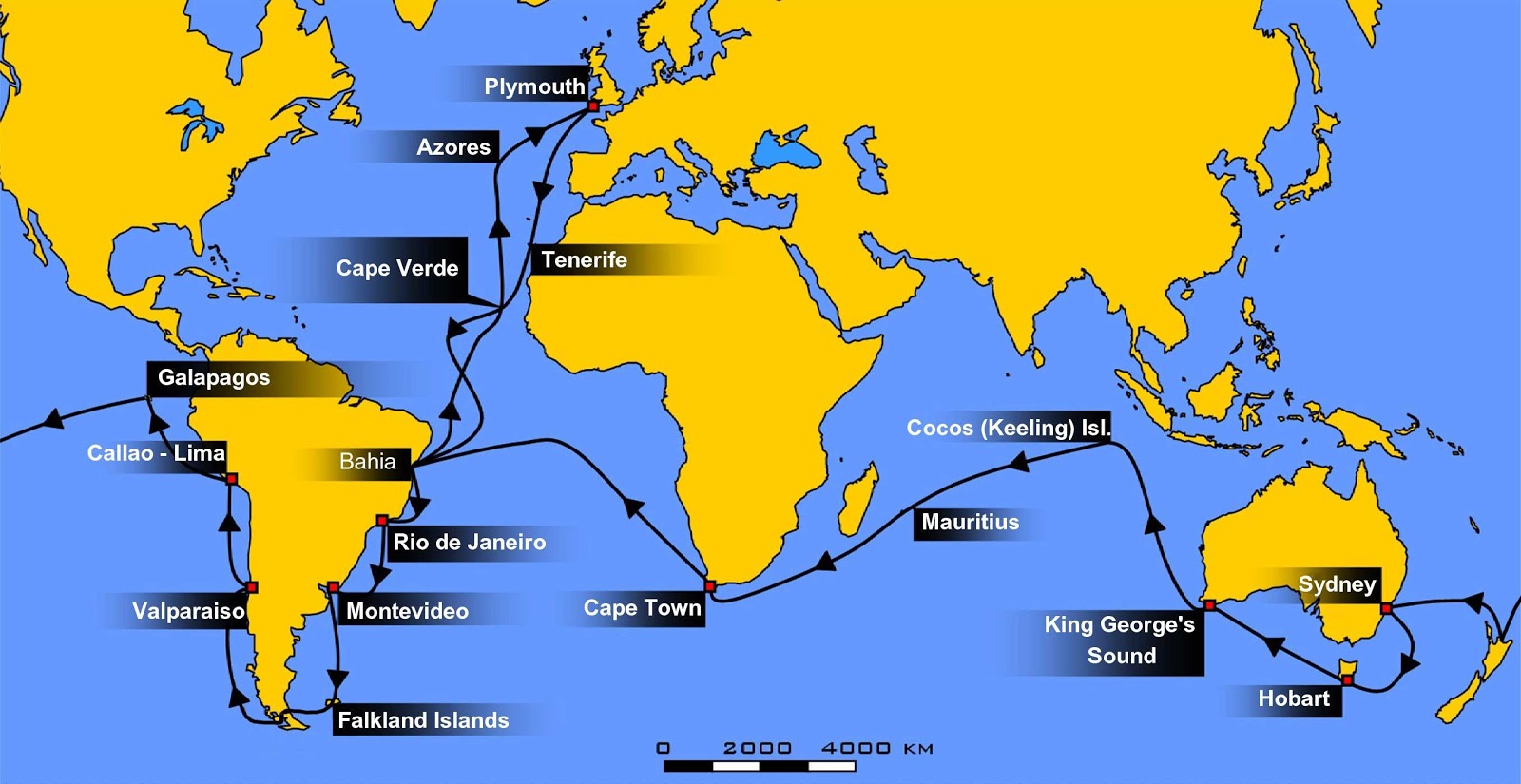
Charles Darwin and Alfred Russel Wallace were both inspired by Humboldt's work as they set off on their own travels.  Darwin, of course, spent 5 years as naturalist on The Beagle, traveling around South America, Africa, Australia and back again to England.  He collected thousands of specimens himself, sending them back to various contacts and museums throughout his journey.  (His handwriting on the labels he attached was so bad that curators curse him for it to this day.)

Wallace
Wallace first went to Brazil, but, not being of the upper class as Darwin was, his purpose was as much to make his living by selling specimens to interested collectors back in England as it was to document the flora and fauna he found there.  He spent 4 years in Brazil.  When, in 1852 he finally set sail to return to England with most of his collection, 26 days into the voyage the ship caught fire and all were forced to abandon ship.  His entire collection and most of his notes were lost.  Then, from 1854-1862 he traveled the Malay Archepelago, collecting specimens and making notes.  It was there that, in a malaria-induced fever, he first intuited his theory of evolution by natural selection, which motivated him to write to Charles Darwin suggesting his theory.  This in turn, as is well known, motivated Darwin to finally write the book he'd long been contemplating, his Origin of Species, describing the same theory.    

And these are only three of the best known explorers, people who set out for foreign shores knowing little to nothing of what they would find there.  We had occasion to think about this yesterday, as we were out walking in the woods on the first real spring day of the year.  Ahead of us by about 50 yards was a young couple.  He was American, she Chinese.

A pileated woodpecker called its eerie warlockian call in the distance.  If you don't know the sound, here it is.


We had caught up to the couple by then, and as we passed we heard him say, "No, it wasn't a monkey!  It was a bird!"  And they were laughing.

We laughed, too.  But not derisively.  It was lovely to imagine thinking we might be surrounded by monkeys in our local woods!  And indeed, how would she know?  Perhaps she came from a part of China where it was common to see monkeys, though whether they sound like pileated woodpeckers is a question we can't answer.

This incident of gentle innocence is in itself harmless of course, and even humorous.  But it shows how very easy it is for people from different, far-flung places, even intelligent educated people, to have deep misunderstandings of each other's world.  How might we do were we to take a walk in a wood somewhere in China?  And think about how much moreso this kind of naive misperception or expectations can be for each other's worldview. 

Were Humboldt, Darwin and Wallace better informed about the flora and fauna of the regions they explored when they first arrived than this woman about central PA?  In fact we don't know, but how could they have been?  They did work with various guides, ranging from European settlers or missionaries, or natives who were bilingual, and so on, so they were surely quickly disabused of any such innocent mistakes.  Until Europeans had explored these areas and settled more systematically, there were no guides to birds or insects or lizards -- or rocks, or trees, or flowers.  In a sense that was what they were trying to do, in good Enlightenment tradition, systematically observing and cataloguing what they saw. But they must have made a great many mistakes, until someone who lived there and knew better set them straight.

Where does ambiguity end and knowledge begin?
Indeed, in science we believe that we try to bridge understanding-gaps by being precise in our terminology, and stating our hypotheses and designs in unambiguous, logical, and specific terms. And, scientists at least tend to believe that we try to collect data objectively and without preconceived notions as to what we'll find.  After all, objectivity is our purported aim, is it not?  Or is it?

The extent and intricacies of science within areas like genetics or evolution are such that they can be most fully within the reach of only narrow specialists.  The rest of us have to assume we know what 'gene' or 'adapted' or 'function', or even 'next-generation sequencing'  actually mean.  And these are relatively simple compared to other issues that we face (like multiple-test correction, various other statistical niceties, and so on).  So someone coming in from another field could easily make the 'monkey' mistake, and be viewed as incredibly naive.

But there's more.  We are often, or even typically, clearly not trying to be 'objective' except in some rather technical senses of accurately describing our methods (e.g., the pH of our PCR reactions, our significance testing p-values, and so on).  When it comes to what 'hypothesis' we've chosen to 'test', what aspect of something we've chosen to study, our interpretations, or the issues we've stated (or not), what is clear is something rather different:  to a great extent all of us, even in science, have our preferences, assumptions, and predispositions to believe and hence prove (but not really test).

So one can wonder, when we as scientists are presenting their work, whether what's being heard is a monkey.....or just a bird.

Wednesday, September 12, 2012

Life in the cold zone? And in space?? Part II

On Monday we described the existence of subglacial lakes in Antarctica (and elsewhere in the solar system), and the effort to bore into them to sample their water and surfaces.  Geochemists and geologists have various questions they'd like to answer about this interesting phenomenon.  Such ice sheets initially form on the surface just as it does in the winter where you and we live, but in an ever-winter climate it never thaws.  As it becomes ever thicker, the insulation it provides from solar heating, the pressure at its base, and geothermal heating from below melt water at the earth-glacier interface--it liquifies the ice there.  The water then builds up over time in to a sizable lake, and will naturally also follow available ground channels to connect with other such lakes and so on.  Maybe even to connect to subsurface water.

On Earth, there is an old saw that where there's water, there's life, so one question is whether that is a rigorous enough theory to suggest that there's life in these subglacial Antarctic lakes.  And since there is similar subglacial liquid water elsewhere even in our own solar system, such as on Jupiter's moon Europa, the question is naturally raised as to whether there's life there, too.  Or all over the universe.

Do Earthly matters matter?
What would we expect to find in water samples brought up from probes into Antarctic subglacial lakes?  Well, we know that millions of years ago, there were complete living ecosystems, even tropical in their abundant and diverse life.  So, if they could last long enough, remnants must have once been on the surface when it initially froze over and could still be there today.  That would range from what would now be fossils, to perhaps the kind of frozen, mineralized microbial life that has been found at the surface of Antarctica.  So it would be no total surprise to find that kind of evidence (though this project is not going to bore into the ground surface below the lake, where fossils of multicellular organisms might be most likely to be found).  We have to leave such speculations to geologists and paleontologists.

One could also not be surprised if there are organic molecules in the water that were once part of that ancient life, and were embedded in the initial ice layer as it formed.  Conditions may have been stable enough that such molecules didn't degrade.  DNA is unlikely to have been preserved intact, but many kinds of molecules and perhaps even nucleotides (DNA building blocks) might have survived the Long Chill.  Finding them would be at most mildly interesting (since we know they must have been there at one time).  Organic molecules continually rain down on Earth from space, so they would have landed on the forming ice, and hence be in the melted subglacial water.

Since we know that fish and many other types of life have adapted genetically to be able to live in the frigid waters around the poles, could we find them in these subglacial lakes?  It seems unlikely, to us at least, for several reasons.  First, terrestrial life would have had to survive the long eons of climate cooling and then unmelting snow, eventually covering the entire surface leaving nothing to eat, and then somehow adapted to live embedded in ice for millions of years until the Big Thaw at the bottom.  So this seems highly unlikely and we doubt the lakes' explorers expect that kind of life.

Darwinian adaptation can be remarkable, but it seems to be a stretch in this case, unless signs of life that were found were from things that seeped up from underground or from the surrounding oceans. 

Perhaps micro-organisms could have adapted to the cold, but where would they have lived during the millions of years that the earth-glacier interface was frozen solid?  It would probably have had to be under the surface, surviving and adapting somehow until a liquid lake formed--perhaps they lived in underground liquid water and then seeped into the subglacial lake as it formed?

Most likely one would find simply signs of life--molecules of life, but that would in itself tell us nothing since it would be expected for the above reasons (that there was life there before the freeze).  In a way, perhaps we would be surprised not to find such molecules, though in this case the planned samples will be small--only a few hundred ml of liquid--so a very chancy sampling of the lake.

So, one wonders just what the evidence for life would be that would be any sort of surprise.  Even if it's true that on earth where there's water there's life, it doesn't mean that the 'life' is alive.  It would take some clever argument to suggest how adaptations would have been possible unless as we suggested above it were from subterranean water and/or perhaps had some deep channels to the water surrounding Antarctica.

In any case, it will be interesting to see what is found.  It may tell us things about geological history and processes.  And maybe we, not geologists, are missing some points of the goals of the expedition that didn't come through in an interview program on the BBC or on the Wiki pages devoted to subglacial lakes.

Life in space
But what about the sexy hint that it will tell us about life on ice-bound orbs like Europa?  Just because, or if, it's true that where there's water there's life on earth, has no bearing whatever on the relevance of this kind of generalization elsewhere.  Water is compatible with life, at least life as we know it here, and life evolved from watery beginnings and hence depends on water, but water doesn't cause life.  What's in the liquid water under Europa's icy coat may be interesting for all sorts of reasons, but to justify it on the grounds of it being evidence for life, and using Earth as a precedent, is the kind of stretch that can be very misleading.

The public is hungry for science stories (and for science fiction), and NASA does big business in 'astrobiology', at least partly if not mainly as a marketing component.  And if half our population doesn't believe that evolution took place, how can we expect them to be able to discriminate the fairy tales used to justify the cost of space exploration?  Maybe it would be better to be a bit more critical in what is said to scientists and public alike, about the value and interest in simply learning more about the universe--genuine excitement about the genuinely interesting knowledge of existence that can be gained.  Or, equally, whether that value is worth the cost given other problems that people face here on the surface, where it's warm and indisputably lively.

Monday, September 10, 2012

Life in the cold zone? And in space?? Part I

This post was triggered by a BBC Radio program called "The Life Scientific" in which a geologist, Martin Siegert, was interviewed about the team effort he is leading to obtain samples of water from Lake Ellsworth, to see if there's any life there.  After all, on Earth, where there's water, there's life.

So what?  So what, is that this is a subglacial lake, several km below the Antarctic ice sheet.  The liquid water in this lake hasn't seen the light of day for millions of years.  In fact, aerial radar exploration has identified hundreds of lakes at various depths below the continent's icy surface.  One of, if not the, largest is Lake Vostok of which this is an image:

As the ice forms over the surface and grows in thickness, the pressure at its base, combined with thermal heating, causes the base to melt (not to be warm by our standards, but to be liquid).  The lakes can be very large.  Ellsworth is 4km deep, 10km long and tens of meters in depth.  This makes it manageable to explore: very isolated from surface life, yet accessible and samples can be drawn from the top, the water, and the lake bottom.  By contrast, Vostok is largest, 250x50km and 350m deep.  This lake, too, is being explored.

Exploration is a challenge since one needs to preserve the lake ecology and not contaminate it with the probe that is bored into the lake.  What the explorers want are pure (uncontaminated) samples of the water, ice, and bottom surface of the lakes, to define its characteristics.  Once contaminants are introduced, this will be very difficult, so international standards for cleanliness are used to help prevent this and save the subglacial environment for future exploration.

The Siegert-led team is being very careful.  The method wasn't described in detail in the interview, but the idea is that a narrow sterile probe will slowly melt its way down, staying surrounded by liquid water.  Once there, after several days of boring-down, it will have 24 hours to collect a number of small samples from various depths and so on, and then will be withdrawn.  At that point, the bore-hole, which was always water-filled, will freeze over, re-sealing the lake and preventing contamination from the surface.

So what?  Isn't water just water?
There are many interesting questions a geologist can ask about such an unusual (for us) phenomenon as a liquid water lake deep below thick, very cold glaciers.  But one that, as usual, is raised to justify the costly explorations using special boring technology to keep things clean, is based on the current understanding that here on earth, wherever there's water, there's life.  Or so the 'theory' goes.  But is it correct?  What would one expect?

Because of continental drift and other factors in Earth history, Antarctica used to teem with plant and animal, and surely also microbial life.  Fossils have been found, and they show that the climate was once warm if not tropical, when the land mass was not located at the frosty pole.  But gradually, the movement of the continent to its down-under location caused its climate to cool, and eventually to stay below freezing temperatures all year round.  Gradually, the glacial covering built up, as precipitation and condensation froze and was not thawed.

This means that there was life there once and for a long time and it was diverse.  So either it all just froze into extinction, or adapted.  We know of 'antifreeze' genes that allow organisms to life at below-freezing temperatures, so one possibility is that life adapted to this new temperature by natural selection for survivable physiology and form.

There are other issues as well.  It is known from direct exploration that other objects in the solar system, like Jupiter's moon Europa, are covered with ice and have liquid water underneath.  And, of course, the hype-machine is very actively promoting the excitement of the apparent fact that Mars was once at least partly covered in water.  Why we haven't seen the Little Green Men (or even little green algae) is the question you're paying taxes handsomely to answer!

So, does this rather generic reasoning mean we would expect to find life in these lakes?  And what kind of 'life'?  And what does this tell us about life elsewhere in the universe--if anything--and why would such a question ever arise if it is more than just hype seeking attention and funding?  Is this just some geologists' boondoggle to poke around in a lake because it's there, or is there a real scientific question here (about life, not about geology)?

We'll address these questions tomorrow.