Showing posts with label domestication. Show all posts

Wednesday, June 3, 2015

A wrench in the domestication of corn story

Holly and I are working on a book together, and it's fun.  It was her idea originally, and I just had the good fortune to be invited on.  So, imagine a book that includes discussion of things like sperm-ejecting hens, Koko the talking gorilla choosing how to expand her family, what the origins of agriculture have to teach us about sex, what sex has to teach us about the origins of agriculture, and so much more, and you'll perhaps be able to imagine why this is so much fun. 


This month I've been reading and writing a lot about the agricultural transition.  As most things, the more you learn about something the more you realize how little is actually known.  I thought I knew the history of the domestication of corn, say, but that was before I actually read anything about it.  

The Neolithic
For at least the last two million years of the evolution of the genus Homo, and for maybe even longer than that, reaching back into Australopithecus times, our ancestors foraged for food, collecting seeds, roots, fruits, eggs, and scavenging or hunting for meat and fish. This came to an end in much of the world some 10-12,000 years ago.

Since intention isn't preserved in the archaeological record, the reason for this will probably never be known, but possible explanations include population pressure; perhaps that foraging could no longer feed growing populations, or climate change; the end of the last glacial age, and the warming of the climate, which among other things may have brought changes in the availability of familiar wild foods.  

Why it happened at generally the same time around the world is a curious thing; first in the Fertile Crescent of the Near East, then in Mesoamerica, followed by Southeast Asia, although there is evidence that plants were being domesticated in Ecuador at about the same time as they were in the Fertile Crescent.  The fact that the transition to agriculture happened pretty much simultaneously everywhere suggests that global climate change was in fact that driver, but that's hard to demonstrate.

In any case, as far as is known today, plant domestication happened in 24 different regions, and in 13 of those regions grain crops were the primary focus. 

Centers of plant domestication; The nature of selection during plant domestication
Michael D. Purugganan & Dorian Q. Fuller, Nature 457, 843-848(12 February 2009)

Eight plants were domesticated in the Fertile Crescent; einkorn and eimmer wheat; barley; lentils; peas; chickpeas and bitter vetch, and flax. Rice was domesticated in Asia, potatoes and beans in South America, maize, and bottle gourd and squash in Mesoamerica, with many more as the agricultural transition progressed.     

Dogs were probably the first domesticated animal, about 35,000 years ago, from wolves, followed by cats near the time of the agricultural transition, but it's possible that both these animals were attracted to people and domesticated themselves. Cats may have been attracted to settlements because rodents would have lived in and around stored grain. 

Goats were probably the first animals domesticated for food, in the Fertile Crescent, and then cattle, sheep, pigs, and horses.  These then were dispersed, along with agriculture, into Europe and North Africa. Alpaca and llamas were domesticated in South America, chickens in southeast Asia, and, again, many more over time.  

How is all this known?  In part, molecular genetics has revealed some of the relationships between wild and domesticated forms of each of these plants and animals, but for animals, bones found at early Neolithic settlement sites have told much of the tale.  However, the tale they tell isn't always clear -- it was thought early on that size of the animals indicated domestication, until archaeologists realized that all animals had gotten smaller through the Paleolithic, including humans.  And, sex and age of animals in piles near settlements was thought to be a sign, if the animals were primarily female, and the males were young, until it was realized that this demographic profile could just as credibly indicate that the males had been hunted.  And so on.  

Teosinte to maize
The only way paleoanthropologists can interpret what they find is through a contemporary lens.  E.g., we know that males aren't of use to a modern dairy farmer so probably weren't to Neolithic farmers either, which could explain the predominance of female sheep or goats in piles of bones.  Many animals did get smaller when domesticated, so size could legitimately be a signature of domestication.  For some grains, the primary difference between wild and domesticated forms are that the seeds of the domesticate don't 'shatter', or fall to the ground when blown by a breeze or brushed by an animal, or when the grain is harvested. But domesticated grains lose the shattering trait, and that's a huge advantage when it comes to harvesting and storing the grain.  


Teosinte and maize;  Nicolle Rager Fuller, National Science Foundation

Corn is another matter.  The wild form of maize is teosinte, which was domesticated about 9000 years ago.  But, teosinte doesn't look much like maize.  It has many branches, it's not as tall, it has tiny ears, the seeds are encased in hard nut-like shells and, unlike maize, they mature serially rather than simultaneously.  Molecular comparison of the genomes of modern wild teosinte and domesticated maize show basically five genetic differences between the plants, and these are responsible for the transition from teosinte to corn.  

But still, the question was why was this plant a candidate for domestication at all, given its less than ideal characteristics for farming? And even for foraging, if the seeds from this scrappy plant didn't ripen all at once, and the shells were difficult to open.  Early farmers couldn't see into the plant's future, weren't thinking ahead to a maizeier form of the plant.  Presumably they were just planting the seeds, assuming they'd get more of the same.  So why try domesticating it?  

Well, it turns out that modern teosinte may not be what teosinte looked like 10,000 years ago, when the temperature was 3-4 degrees lower than it is now, and there was less carbon dioxide in the atmosphere.  Anthropologist Dolores Piperno and colleagues published a paper in Quaternary International last year reporting a an experiment with teosinte that might be the explanation.  They decided to grow teosinte in a greenhouse under early Neolithic environmental conditions, so the built a greenhouse and supplied teosinte plants with the growing conditions they assumed were true at the beginning of the Neolithic.  And they found that even with the same genome that now builds a leggy, short plant with lots of tiny cobs and nut-like kernels, changing growing conditions produced plants that were in fact maizier. 

The plants had a single tall stem, the ears were topped with the tassels we’re familiar with from modern corn, and they had a few short branches with ears, and seeds that matured all at once rather than sequentially. The seeds were exposed, too, rather than encased in the hard seedcase.  With fewer branches, and seeds that were easily visible, all maturing at once, teosinte would have been much easier to harvest for early Neolithic farmers, and it might not have been such a leap to produce maize.     


Complicating evolutionary just-so stories
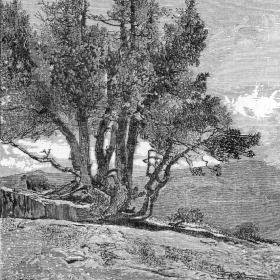
If Piperno and her coauthors are right, this means that modern versions of wild plants don't necessarily represent their ancestral selves.  The reason for this, they suggest, is ‘phenotypic plasticity,’ which is characteristic of many organisms as they respond to different environmental conditions with changes in appearance.  


Phenotypic plasticity: Pines in California mountains. (Top) At high altitude they hunker downlike bushes. (Bottom). Lower down, these trees are . . . trees. Pictures by John Muir, from Muir, 1894
The teosinte story is a cautionary tale for several reasons.  While molecular data confirm that teosinte is the mother of maize, and that part of the story isn't in doubt, it should be a reminder that evolutionary Just-so stories told from our vantage point today may be skewed.  This is true for archaeology but the moral -- we may not have all the data -- applies just as well to all other sciences.  And probably equally to life in general.  

It's also important because phenotypic plasticity is the norm, which makes evolutionary sense since environments frequently change, and organisms that can't adapt may well be doomed.  But, adaptive stories are so tempting.  

Thursday, December 12, 2013

What domestication can and can't tell us about evolution

Domestication is the harnessing of one species by and for the benefit of another, usually via selective breeding. Humans are master domesticators, but we're not the only ones.  There are ants that farm fungi, and milk aphids, but it has also been suggested that the Melissotarsus ant in continental Africa and Madagascar has domesticated a scale insect for its meat but if not for meat, some other nutritional benefit such as of waxy secretions from the scale insect. Whether these ant/domesticate relationships depend on genetic changes is not clear, at least to us.

Two key differences are, first, that humans work teleologically, or so we assume!  That is, the 'artificial selection' that the domesticators had some end in mind--more yield, more easy harvestability, drought resistance, and so on.  Secondly, we presume that in the past, as now, this process involved not just purposive breeding, but strong selection -- much faster and more directed than natural selection.  If domestication was slow or inadvertent, then the resulting genetic picture may differ.

Humans appear to have begun to domesticate plants and animals ~12,000 years ago, and a new review in Nature Reviews Genetics ("Evolution of crop species: genetics of domestication and diversification," Meyer and Purugganan, online 18 Nov 2013) reports that recent work has identified genetic signatures of that artificial selection in plants, and of subsequent diversification of these crops.  These studies "reveal the functions of genes that are involved in the evolution of crops that are under domestication, the types of mutations that occur during this process and the parallelism of mutations that occur in the same pathways and proteins, as well as the selective forces that are acting on these mutations and that are associated with geographical adaptation of crop species."

Charles Darwin, of course, based much of his argument about evolution and natural selection in The Origin of Species on observations about artificial selection from the breeding of plants and animals for food.  He writes of this explicitly in these frequently quoted words from his autobiography:
..After my return to England it appeared to me that by following the example of Lyell in Geology, and by collecting all facts which bore in any way on the variation of animals and plants under domestication and nature, some light might perhaps be thrown on the whole subject. My first note-book was opened in July 1837. I worked on true Baconian principles, and without any theory collected facts on a wholesale scale, more especially with respect to domesticated productions, by printed enquiries, by conversation with skilful breeders and gardeners, and by extensive reading. When I see the list of books of all kinds which I read and abstracted, including whole series of Journals and Transactions, I am surprised at my industry. I soon perceived that selection was the keystone of man's success in making useful races of animals and plants. But how selection could be applied to organisms living in a state of nature remained for some time a mystery to me.
Fifteen months after I had begun my systematic enquiry, I happened to read for amusement Malthus on Population, and being well prepared to appreciate the struggle for existence which everywhere goes on from long-continued observation of the habits of animals and plants, it at once struck me that under these circumstances favourable variations would tend to be preserved, and unfavourable ones to be destroyed. The result of this would be the formation of a new species.
Here, then, I had at last got a theory by which to work; but I was so anxious to avoid prejudice, that I determined not for some time to write even the briefest sketch of it.   
Indeed, after the Origin, Darwin published two hefty volumes of the effects of artifical selection on plants and animals.

Now, in a modern parallel, Meyer and Purugganan argue that understanding of the genetic underpinnings of domestication can shed light on evolutionary processes, in general, specifically because domesticated crops are recent, selection was strong, and (presumably) consistently directional, and there is good archaeological and historic evidence of the origin, spread and diversification of domesticated crops.

Humans first began to domesticate plants about 12,000 years ago in the Middle East and Fertile Crescent, but plants were also domesticated elsewhere, in China, Mesoamerica, South America, sub-Saharan Africa, and North America from 10,000 to 6000 years ago as well.  Many of these were independent of each other, and involved totally different species, providing, in principle at least, multiple independent views of the genomic aspect of the process.  Artificial selection often involves genetic changes that reduce a plant's fitness in the wild, and species that are completely domesticated cannot survive without human intervention in their reproduction and growth. The process may be rapid, or may take thousands of years.

After domestication, in the "improvement phase", the species can diversify and spread, involving genetic and phenotypic changes that allow adaptation to different ecosystems and climates, generally as a response to selection pressure on chosen traits.  Many such traits have been selected for, but generally they have to do with increasing quality, yield and ease of farming.  Milk yield in dairy animals, tameness or ability to reproduce under domestication, for example.  Or, in grasses, the evolution of larger seeds than in wild grasses, and crucially, a non-shattering rachis.

Commonly observed traits accompanying domestication and diversification; Table 1, Meyer and Purugganan, 2013

When wild wheat is ripe, for example, the rachis (the stem on which the wheat shafts grow) easily shatters, allowing seeds to disperse in a wind or when otherwise disturbed.  This wouldn't be desirable in a crop plant, which the farmer wants to be able to harvest at his or her chosen time, and domesticated wheat has a history of selection for a less brittle rachis so that the seed remains in situ until ready for harvest.
 
Hulled wheat vs free-threshing wheat (wild vs domesticated); Wikimedia


Genes associated with domestication and diversification have been identified with fine-mapping or GWAS, primarily in maize and rice, although, say Meyer and Parugganan, identifying causal mutations has been difficult, although some functional studies have been done.  In addition, they point out, it can be difficult to distinguish mere correlation with domestication and diversification with causation. 

The first "domestication gene" identified was teosinte branched1 (tb1) which is responsible for differences in the shoot of wild and domesticated maize.  Not all changes can be traced to a single gene, however.  Hundreds of domestication genes and loci have been identified in other plants as well, largely in cereal crops, although, for many of the same reasons that genes 'for' disease and other traits can be hard to identify, the specific genes responsible and their functions are often difficult to narrow down--just as we have trouble finding 'the' gene or genes 'for' human traits. 

Architecture of domesticated maize vs wild teosinte; Doesbley, 2003
Even with complications, however, Murray and Parugganan evaluate the role in domestication or diversification of 60 specific genes that have been functionally validated and/or included in population genetic studies.  They note that many of these are regulatory genes that control the timing, amount, or cell-context of the gene's usage.  And, many of the genetic changes correlated with domestication and diversification are nonsense mutations or frameshift indels that alter the protein coded for by a gene, and result in the "large phenotypic effects that are observed during crop evolution."

Among the genes the authors identify with domestication are those involved in regulation of inflorescence development (an inflorescence is the cluster of flowers on a stem that will become seeds; see image above), vegetative growth habit and height, seed pigment, size, casing, nitrogen access and efficiency, and fruit flavor in strawberry, and so forth. Diversification genes include those involved in fruit shape and size, inflorescence architecture, color, starch composition, dwarfism, flowering time, and more. 

It is difficult to know whether a mutation is a precursor to domestication or diversification, or simply happened to arise at around the same time.  People might have noticed a precursor and chosen to breed it, for example.  Some are present in the wild plant but at much lower frequency than in the cultivated plant, which suggests that it, in conjunction with other genetic changes, may be associated with domestication. 

It's possible that because domestication is selection on a trait not a gene, the underlying genetic architecture of a trait is different in different species.  This is certainly true for many phenotypes not related to domestication, so wouldn't be unexpected.  Murray and Parugganan suggest that finding such parallelisms can explain the genetic basis for Darwin's idea of "analogous variations" and for Russian botanist and geneticist of the early 20th century, Nikolay Vavilov's idea of the Law of Homologous Series (I can't resist noting here that Gary Nabhan writes beautifully about Vavilov's life and work in his 2009 book, "Where Our Food Comes From: Retracing Nikolay Vivilov's Quest to End Famine").  This can happen by phenogenetic drift, or by parallel evolution.

This paper is an excellent reprise of the state of knowledge of crop domestication -- with one quibble. Murray and Parugganan write that "Domestication provides a fascinating model for the study of evolution..."  Darwin thought so, too, but artificial selection, the basis for domestication, is directed, strong, and often fast.  Not only is natural selection generally much weaker, but it is not directed and evolution by natural selection is typically slow.  With complex causation, strong selection should often have very different genomic consequences compared to weak selection -- the former being more single-gene or at least simpler in nature.  But even with relatively simple causation that could be picked out at a specific gene level by artificial selection, slow natural selection may not be so gene-specific.

In addition, much of evolution seems not to happen by natural selection but instead by genetic drift or other forms of selection (organismal selection, niche selection, and so forth), while domestication is due to strong, directed artificial selection.  Thus, the lessons of domestication aren't always a good model for evolution in general.

Indeed, while Darwin thought of domestication as a good model, Alfred Wallace, the co-discoverer of evolution did not.  He noted, in his letter read to the Linnean Society ("On the Tendency of Varieties to depart indefinitely from the Original Type"), in 1858 along with Darwin's, announcing their co-discovery,
     One of the strongest arguments which have been adduced to prove the original and permanent distinctness of species is, that varieties produced in a state of domesticity are more or less unstable, and often have a tendency, if left to themselves, to return to the normal form of the parent species; and this instability is considered to be a distinctive peculiarity of all varieities, even of those occurring among wild animals in a state of nature, and to constitute a provision for preserving unchanged the originally created distinct species....
     It will be observed that this argument rests entirely on the assumption, that varieties occurring in a state of nature are in all respects analogous to or even identical with those of domestic animals, and are governed by the same laws as regards their permanence or further variation.  But it is the object of the present paper to show that this assumption is altogether false, that there is a general principle in nature which will cause many varieties to survive the parent species, and to give rise to successive variations departing further and further from the original type, and which also produces, in domesticated animals, the tendency of varieties to return to the parent form.
Selection is a far more curious phenomenon than it is typically given credit for being.  It is too easy for us to compress time in our minds and think of natural selection as if it were artificial, strong and directed.   But the beasts and foliage of nature may, like a Rousseau painting, be a thicket of meandering change, sometimes for inscrutable reasons.

Thursday, June 13, 2013

My dogs' evolutionary history. Part 2: Results


Yesterday we made the predictions of the breed signatures we'd find in our dogs' DNA.

If you didn't already, please consider going back to yesterday's post first before reading today's. Predictions are key! It's best if you confirm our guesses and/or add your own. (...what are the reasons for your predictions? Size? Color? Ears? Tails? Fur? Snout? Furnishings?)

Sadly (yes, sadly), predictions are not part of the official Wisdom Panel or 23andMe experiences. When I teach with 23andMe predicting the results is a major assignment early in the semester. Not only is making predictions the best practice for later scientific evaluation of the results, and it's the best way to force yourself to come to terms with how inheritance and gene expression work (and don't work), but guessing the outcome first makes reading the results orders of magnitude more fun ... not to mention how it makes things a lot less nerve-wracking when it's about your own DNA with 23andMe.

Briefly, before I reveal our dogs' results, let's consider a couple important things first...

Dog breed markers are mutations. 
Just like anything else alive right now, all dog breeds, no matter how "pure" or revered, are mutants. All of their dog traits just like all of our human traits, good and bad, started out as new mutations. Even the ones we all share that contain little variation now (like our genes involved in the development of five fingers and five toes), but also the ones that vary among our populations (like our genes that affect our pigmentation).

And mutations aren't just a population thing; each of us has a tiny fraction of our genome that's mutated compared to our parents. As far as we know, mutations occur in the making of all babies and puppies, etc. Most are neutral, some are bad, some are good.

We're all mutants because mutation, perpetual change generation upon generation within a lineage, is constant. Stasis is not.

This constant change in every puppy is fundamental to why we can have hundreds of dog breeds today.

Many dog breed traits are genetically simple.
Dogs seem to be particularly simple kinds of mutants.

The mutated genes that determine the traits that distinguish one dog breed from another are remarkably few and remarkably simple, but that simplicity makes a lot of sense.

Since humans coaxed these breeds out of ancestral dog stocks and also out of other breeds (as they still do today), it's easy to imagine that new simple traits, not new complex ones, had the best potential to be easily and quickly propagated into future generations and eventually into new breeds.

If a trait arose that was preferred, and it was caused by the kind of genetic mutation that could be simply and somewhat reliably expressed in offspring that inherited it, that mutation and the trait it produced could be increased in future generations by promoting breeding of those new attractive mutant dogs and their offspring.
(source)
If dog breed traits were genetically complex (based on many genes, for example), they would be terribly difficult to produce through controlled breeding of parents with those traits... at all... let alone during one human breeder's lifetime! That's at least partly because there would be far too many puppies without the preferred trait and it would be far too difficult to preserve a trait at an appreciable frequency in a lineage. Of course, inbreeding with very close relatives that share the mutations helps a great deal with this.

Humans have taken advantage of the simple mutations that have popped up in dogs (as they pop up in all living things!), due to sheer feasibility of the breeding outcomes those simple mutations allowed. Like that new coat curl or those new furnishings? Some puppies will have the exact same look. And we're off and running with a new kind of dog...
(source)
I don't know about the genes for Dalmatian spots (and honestly haven't even looked) but I do know about this paper by Cadieu and colleagues from 2009. Apparently you need only three genes (FGF5, RSPO2 and KRT71), each with two alleles (i.e. gene variants; denoted +/- in the figure below) to explain all this coat variation among dogs:

Cadieu et al., 2009
Dog genes are made of the same goop that ours are, and their genomes are very similar to ours because of our shared mammalian ancestry, but they're described as "simple." Evan Ratliff explains some more about why dog genes are simple in "How to Build a Dog:"
The vast mosaic of dog shapes, colors, and sizes is decided largely by changes in a mere handful of gene regions. The difference between the dachshund's diminutive body and the Rottweiler's massive one hangs on the sequence of a single gene. The disparity between the dachshund's stumpy legs—known officially as disproportionate dwarfism, or chondrodysplasia—and a greyhound's sleek ones is determined by another one. The same holds true across every breed and almost every physical trait. In a project called CanMap, a collaboration among Cornell University, UCLA, and the National Institutes of Health, researchers gathered DNA from more than 900 dogs representing 80 breeds, as well as from wild canids such as gray wolves and coyotes. They found that body size, hair length, fur type, nose shape, ear positioning, coat color, and the other traits that together define a breed's appearance are controlled by somewhere in the neighborhood of 50 genetic switches. The difference between floppy and erect ears is determined by a single gene region in canine chromosome 10, or CFA10. The wrinkled skin of a Chinese shar-pei traces to another region, called HAS2. The patch of ridged fur on Rhodesian ridgebacks? That's from a change in CFA18. Flip a few switches, and your dachshund becomes a Doberman, at least in appearance. Flip again, and your Doberman is a Dalmatian. "The story that is emerging," says Robert Wayne, a biologist at UCLA, "is that the diversity in domestic dogs derives from a small genetic tool kit."
So it's this simplicity that allows companies like Wisdom Panel to genetically distinguish breeds and then look for the signatures/markers of those breeds in our dogs' DNA. It's also the recency of most of these breeds (no more than a few to several hundred years at most) that allows us to assume (maybe not rightly but still...) that so much of what genetically identifies a breed today is similar to what the breed was working with all along.

And so... without further ado...

Here are the results of mailing off our dogs' cheek swabs and having 321 markers for 200 breeds analyzed.

For Elroy...
This is his "Breed Ancestry Certificate"

The report notes how Rottweiler and Chow Chow are the only ones with confidence. 

How do they make the pedigree chart? 
What I think they do is estimate what percent of the breed contributes to the dog's ancestry and if it's something like 50%, it's one parent. If it's like 25%, it's one grand-parent and if it's like 12.5%, it's one great-grandparent. Any % less than that is lumped into "mixed breed" ... the details of those are guessed at below.  So those placements on either side of his chart are just best fit in terms of percentage. 

What I'm not sure about is why we must assume that 100% of Elroy's ancestry comes from any breed. But, remember that 100% of the markers in the Wisdom Panel test distinguish breeds. That means, this Breed Ancestry Certificate is missing all the information about Elroy that's not analyzed by Wisdom Panel. 

Non-surprises.
We guessed the breeds that they were confident about! There must be something to this test. Especially since we had seen his litter mates and were told by the adoption agency that he was probably rott/sharpei (and later on we figured he was just as likely chow chow as sharpei). SCIENCE works.

Surprises.
German Shepherd and Collie aren't terribly surprising either. He came from Ohio. Those breeds are abundant enough in the region, are allowed to roam free and probably mated like that too for decades upon decades in those regions. And he's a big boy!

But Westie? Westie is a bit of a head-cocker.

Or is it? Westies had to have had big ancestors, first of all, since they descended from wolf ancestors like all other dogs. But something that distinguishes Westies from other breeds is in Elroy's DNA. That means a relatively recent Westie left a signature in his genome. So was it kamasutra lovemaking between tiny Elroy ancestor and big Elroy ancestor?  Or are we talking about love between mixed breeds and pure breeds and mixed breeds over time? Probably.

Here are their best guesses about what contributed to those "mixed breed" mysteries on his certificate.
Mostly big dogs, some ancient and awesome. The Dogo! (Ugh, don't google it... so many fighting and abuse videos.)

Nothing to really take home from this list because they're far off guesses without even a report of percentage there with the bar graph.

For Murphy...
This is her "breed ancestry certificate"

Akita, German Shepherd and Lab are the only confident ones (as noted in the report). 
And here are the most likely breeds contributing to those "mixed breed" mysteries on her certificate.


Non-surprises.
Shepherd! And Lab is another good one considering friends and relatives see lab in her.
Many of her mix guesses are herders!

Surprises.
Akita? That's phenotypically (and maybe genetically(?) will have to check) close to Husky which is another guess we often hear for her. So this is only a little bit surprising.

French Bulldog? Now that's a real head-cocker.

But again, like with the Westie, it's not noted as "confident" in the report, but on the other hand, why not French Bulldog in her ancestry? It just means this is a marker, like with the Westie, that's not tied to outward appearance/phenotype.*

Not enough information...
I wonder what these markers are then; if Westie and French Bulldog are showing up, why? As the website explains, “Physical features characteristic of certain breeds, such as the flattened face of the English Bulldog or the extremely curled tail of the Pug, seldom survive even the first crossbreeding.”

So these markers for unseen traits are fascinating but not explained in the report.  I'm spoiled rotten by 23andMe that tells you everything, down to the A,T,C, or G you have for your allele for whatever gene. I'm guessing that Wisdom Panel keeps all this under wraps because (a) most consumers don't care to know those details and (b) it's in their best competitive and economic interests to keep their methods to themselves.

What's interesting is how some of the hype about these dog tests is similar to 23andMe: They're "for your health!" But unlike with 23andMe, Wisdom Panel says that you're good just going to your vet and saying "she's got Akita in her blood" when you're dealing with health issues.  While 23andMe advocates that you know each and every SNP.  My health is more important than my dog's I suppose, but what's absolutely not clear is how these two very different approaches (ancestry and family history vs. SNP data) are resulting in different health outcomes.

As you might imagine, there's a lot more to say about the evolutionary and anthropological issues these dog tests raise, so please stay tuned. (Here's part 3.)

Kevin and me and our Westie, Elroy, and our French Bulldog, Murphy.

*Or if it is, it's present in only one recessive copy and would require two copies for the visible trait in the Westie or French Bulldog  to be expressed (added June 14)

Wednesday, June 12, 2013

My dogs' evolutionary history. Part 1: Predictions

[Click here to skip to Part 2 and Part 3]

You might remember Murphy and Elroy from the time we used science to solve the book-eating mystery. Or the time they figured out evolution. (Still looking for puplisher! [sick]) Or maybe you already know Elroy because you follow him (@ElroyBeefstu) on Twitter.
Elroy (I fit in your phone!)

Murphy (awww)

These are the mutts that inhabit our lives, and we theirs.

It's because of our tremendous love for these dogs but mostly because of our tremendous fascination with evolution that we ordered Wisdom Panel kits for each, for my birthday.

What we do
With Wisdom Panel, the process on the consumer end isn't a whole lot different from 23andMe. You purchase the kits online, they arrive at your house, you activate the kits online, you swab your dogs' mouths, pop the kits back in the mail with the postage-prepaid packaging, and wait for an email with the results.

Wisdom panel needs far less of the contents of a dog's mouth than 23andMe requires. And that's not only because the analysis will be far less extensive, but because dogs' lips and face muscles aren't hooked up for spitting into a test tube.

The turnaround was speedy. We sent in the samples on May 28 and got the results June 6.

At this stage in the process, the only red flag is that they require you to submit your dog's weight during online registration. For the love of science, there should be no phenotypic hints required. I hope they don't use weight to discard or confirm dog breeds for their results report.

What they do
Here's what the FAQ says:
Testing your dog with Wisdom Panel® 2.0 begins when you use the cheek swabs to simply collect a small DNA sample from inside your dog’s cheek and send the swabs into the laboratory. Once your sample is received at our lab it is scanned into our database and assigned to a batch for testing. It then undergoes processing to extract the DNA from your dog’s cells which is examined for the 321 markers that are used in the test. The results for these markers are sent to a computer that evaluated them using a program designed to consider all of the pedigree trees that are possible in the last three generations. The trees considered include a simple pedigree with a single breed (a likely pure-bred dog), two different breeds at the parental level (a first-generation cross), all the way up to a complex tree with eight different great-grandparent breeds allowed. Our computer used information from our extensive breed database to fill these potential pedigrees. For each of the millions of combinations of ancestry trees built and considered, the computer gave each a score representing how well that selected combination of breeds matched to your dog’s data. The pedigree with the overall best score is the one which is selected and provided to you in your dog’s individualized report.
This doesn't really cut it for me. I want to know what the methods are and this is all they provide in answers to "Science Based Questions!" This isn't helping much:
Not only does the computer analyze a dog’s DNA for the breeds and their likely proportions in the dog’s ancestry, but it also models which side of a dog’s ancestry each breed is likely coming from.
I'll just have to assume for now that they use something like a chip (because sequencing is still not thrifty) to identify markers that they've already linked to breeds and then they're applying their probability-based analyses to those markers in our dogs in order to provide an estimate of our dogs' ancestry. And what are those markers?
Wisdom Panel only uses what are called autosomal DNA markers, chromosomes that contain most of the genetic instructions for every canine’s body make up (height, weight, size etc.). There are no markers from either the so-called sex chromosomes (the canine X or Y chromosomes). Mitochondrial DNA, or Y-chromosome DNA testing, is rather different as these parts of the genome are passed on intact from mother to child and father to son respectively, but are therefore only representative of either the female or the male lineage. Autosomal DNA is inherited both from the maternal and paternal lineages equally and constantly shuffled by a process called recombination at each successive generation, and therefore is able to give useful information on the breeds found on both sides of a dog’s lineage.
To find the genetic markers that performed best at distinguishing between breeds, Mars Veterinary™ tested over 4,600 SNPs (single nucleotide polymorphisms or genetic markers, where genetic variation has been found between different dogs), from positions across the whole canine autosomal genome from over 3,200 dogs. To further refine the search, Mars Veterinary determined the best 1,536 genetic variations and ran them against an additional 4,400 dogs from a wide range of breeds. This stage of testing resulted in the selection of the final panel of DNA markers that performed best at distinguishing between breeds, ultimately creating the Wisdom Panel genetic database which presently covers over 200 different breeds.
Predicting our results
Both Elroy and Murphy are mixed breed dogs. Here's the list of breeds they say they can detect.  And here's more from the website:
Wisdom Panel® 2.0 breaks down a dog’s lineage in the form of an ancestry tree.  This allows you to see which breeds are present at a parent, grandparent, or great-grandparent level.  Keep in mind that a parent contributes 50% of their DNA to the puppy while a grandparent contributes about 25% of their DNA on average to the puppy.  It follows that a great-grandparent would contribute approximately 12.5% of their DNA to the puppy on average.
Since each of these different levels can contribute different amount of DNA to the puppy, you can see a variety of influence in the puppy’s physical and behavioral traits.  With a parental breed, you are likely to see some physical and behavioral traits from this breed represented unless some of the genes are recessive (requires two copies of the gene variant to show it).  Examples of recessive traits include longhair in most breeds, a clear yellow or red hair coat, a brown or chocolate hair coat, and prick or upright ear set (e.g. like a German Shepherd Dog).  You may see traits from breeds at the grandparent level and it becomes less likely to see physical and behavioral traits from breeds at the great-grandparent level unless those traits are dominant (requires only one copy of the gene variant to show it).  Examples of dominant traits include shorthair in most breeds, black hair coat, black nose, a drop or down ear set (e.g. like a Beagle), and merle/dapple (e.g. like a Australian Shepherd or Great Dane).

For Elroy (85 lbs)
Our guesses = 50% sharpei or chow chow; 50% rottweiler

Kevin was told he was half sharpei and half rottweiler when he adopted him and all his litter mates were black and looked like rotts. He's got tiny ears and a huge square head and heavy neck relative to his body.

We started to wonder whether he was chow chow instead of sharpei when I checked my best dog reference for another breed with a black tongue.


If he's part chow chow then my envy of his fur is no longer so crazy, since the breed was long made for that... and for dinner too. It makes me chuckle every time I call Elroy's dinnertime, "chow time."


For Murphy (40 lbs)

My guess = 25 % German shepherd; 25 % Border collie; 25 % Hound of some kind; 25% unknown village dog. Kevin's guess = 25% German shepherd; 75% Border Collie
Before her greybeard took over.
Unlike for Elroy, Murphy's behavior came into play for these predictions. Her main occupation is to herd each car that comes down the lane along the edge of our lot. She also stalks squirrels and chases shorebirds. And compared to Elroy, she doesn't have as many breed-specific morphological traits.

Who knows? We could be way off. After all, I just took this Dog Bark Interactive Quiz and failed miserably despite knowing exactly what Elroy and Murphy's vocalizations mean.

Results and analysis, right here, tomorrow...