

It seems like everyone wants to know when we started eating animals, and why we started eating animals, and how that affected our evolution downstream. (Or, if you’d rather, upstream.)
Even if they’re not intrinsically interested in human evolution, most people (including Ozzy over there) still want to learn more about some of our species’ favorite pastimes: Eating and killing things.
If you're ever visiting the gorillas at the zoo, it's pretty obvious what humans are interested in. Of the juvenile chewing on lettuce and carrots, a mother says to her toddler,
 “Look sweetie, he’s eating his vegetables like a good little boy,” and a teen-aged girl says to her brother, “See, they don’t eat meat and since we share, like, most the genome with them we shouldn’t eat meat either.” Of the silverback male sitting quietly in the corner, a man observes, “Dude’s large and in-charge. I wouldn’t want to [bleep] with that. He’d kill the [bleep] outta me.”
Most of the profound pronouncements you’ll hear at the zoo’s mirror for humanity are centered around food and violence.
Likewise, many, if not most, of the big-picture explanations for human evolution—for why humans are the way we are, for why humans are unlike other apes—revolve around eating and killing animals. Just to name a few…We walk upright to carry and throw things like tools, which are presumably used for hunting prey and processing carcasses (Darwin).We walk upright to move about as terrestrial foragers (which at some point begins to include scavenging and hunting) on the open savannas (The Savanna Hypothesis). Humanity was born in a hunting past (Washburn and Lancaster). Big brains were able to evolve because of the supplemental nutrition and calories obtained through scavenging and hunting (just about everyone). Scavenging, hunting, and stone-tool manufacture require a larger, more cognitively complex brain (just about everyone).
So it makes sense that paleoanthropologists are desperately searching for evidence of our ancestors eating animals. Especially very early evidence. And, in order to find it, you’ve got to not only collect every scrap of bone that you see while you survey or that you dig up while you excavate, but you’ve got to scrutinize each one of those scraps, preferably under a microscope.
Otherwise, you might miss something like the ten scratches on two bone fragments (one rib and one femur) that were just recently reported in Nature.
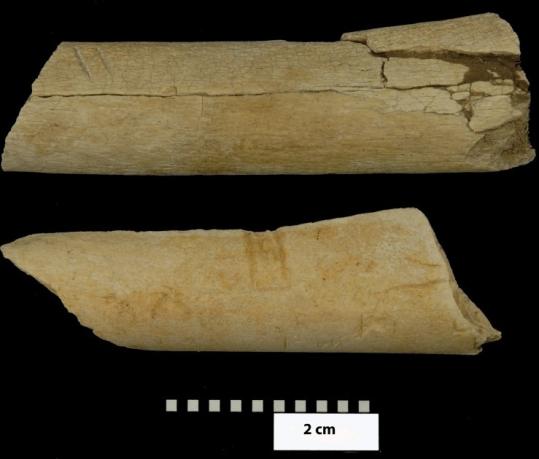

Cut-marked bone at 3.4 million years ago takes the title of First Meat-Eater away from the genus Homo (Homo habilis, Homo erectus,.... , Homo sapiens) and gives it to the only hominin species known at the time from that region of Ethiopia: Australopithecus afarensis, known for being Lucy’s species.
If you're not quaking in your seat right now, well, then you have got some serious nerding-up to do. This is kind of HUGE: Lucy’s relatives, and maybe Lucy herself, not only used stone tools but used them on big mammal carcasses!?
Until this discovery, all we had were stone tools at 2.6 mya and cut-marked bones at 2.5 mya and everyone was content in thinking that the major behavioral shift associated with the human genus, Homo, was obtaining ever-increasing amounts of animal fats and proteins into our diets. That's the best way to make sense of the trend for encephalization which is so much more pronounced in Homo than in previous hominins (where brain sizes were basically chimp-like for the four million years that our ancestors were undergoing selection for increasingly efficient bipedal locomotion).
And see... that has been a little bit of problem: Why would natural selection continue to hone our bodies for bipedal locomotion if not to use them for hunting? With this new evidence for meat-eating earlier in our past, bipedalism makes a lot more sense. At least from the traditional standpoint.
But you’re probably thinking… ten scratches on just two bones? Well, it’s come down to less than this before. When the evidence is good, you certainly don’t need more than a meal’s-worth to show that an animal was butchered with stone tools.
Even if those stone tools were not shaped or chipped or flaked first, even if they were just rocks that somebody grabbed from a dried-up riverbed, nobody but us and our ancestors uses/used stone tools on animals. (Okay, otters use rocks to
 bash open sea urchins and other snacks but not bones of East African bovids.) Chimpanzees use rocks to crack open nuts, but when they occasionally hunt prey they either use sticks as spears or they simply use their strong bare hands, like baboons are known to do as well. So, bones with scratch marks that were made by stone tools can’t be interpreted any other way than to have been made by human ancestors, or at least relatives of our ancestors (collectively termed hominins or hominids, depending on preference).
Except, EXCEPT!, there are some who would still disagree and they may make the following arguments:
1. Carnivores, like lions and hyenas, can scratch bones of prey with their teeth and if those bones aren’t crushed to smithereens as part of the meal, then they can be discovered millions of years later and trick paleontologists. Okay, but that old chestnut’s been cracked wide open. Microscopic details that distinguish tooth scratches from tool scratches have been established and these bones weren’t scratched by teeth.
2. At any time after the animal’s death, its bones could have been trampled and that could explain the scratch marks. Okay, but again, under a microscope and x-rays, those marks differ from the marks left by tools and, again, these bones weren’t scratched by feet.
So what does this mean for our reconstruction of human evolution?
Well, first of all, like we discussed after the Malapa hominins were announced, the genus Homo is probably going to have a makeover here soon. As of now, the earliest members of the genus Homo are no older than 2.4 million years ago. And now that there are three sites (Bouri, Ethiopia at 2.5 mya, Gona, Ethiopia at 2.6 mya, and now Dikika, Ethiopia at 3.4 mya) with stone tools or cut-marked bones that precede the appearance of Homo fossils, either the behavioral or the anatomical criteria must change or both.
We must now accept the idea that eating meat had a much earlier involvement in our evolutionary history than we thought.
It also means that australopiths, with their ape-sized brains, were performing activities that we have always considered pretty difficult. And this cognitive complexity came not only without the aide of human brains but without the aide of human trainers!
And finally, if you ever have a chance to have Lucy over for dinner, now you know what she likes: BBQ ribs and rump roast. Good thing, because vegetarian dinner-party guests can be so persnickety and, oh boy, does that beat the heck out of underground storage organs!
References
Shannon P. McPherron et al. 2010. Evidence for stone-tool-assisted consumption of animal tissues before 3.39 million years ago at Dikika, Ethiopia. Nature 466: 857-860
