Showing posts with label race. Show all posts

Monday, June 1, 2020

It is unethical to teach evolution without confronting racism and sexism (updated, additional resources)

It's been 1.5 years since I posted this: https://ecodevoevo.blogspot.com/2018/11/it-is-unethical-to-teach-evolution-no.html

There were so many ugly comments under its repost at the Evolution Institute.  But what was actually worse than the white supremacist shit on social media was a not insignificant resistance among professors and teachers who teach biology/evolution and who felt strongly that confronting racism was not their job. 

"There's no room in the semester" was common, and there was also plenty of "that's not my problem." 

Maybe recent, intense anti-racist activism in response to a rapid series of horrific, racist violence on top of a racist pandemic on top of a blatantly and shamelessly racist Administration has changed some of those scientists' minds about what is and what is not their problem.  

If so, perhaps these resources I'm sharing below will help others design their approaches to tearing down racism and sexism in their evolution courses, like I try to do. 

In the 2018 post, I suggested that people bring in anthropologists, social scientists, journalists, historians, etc to deal with racism and sexism if they'd rather collaborate or punt on the problem, but I guess that working with colleagues in other departments isn't taken as a serious suggestion. No idea. But it was a serious suggestion. I'm not great at this but I'm always trying to get better and I'm more than willing to help colleagues who are less experienced than I am. I'm experienced enough to get my human evolution course designated to count for "diversity and inclusion" general education credit and so are many anthropologists, some of whom may be working at your very institution! Look around!

I teach a whole unit on race/racism and sexism in my introductory Human Origins and Evolution course (APG 201). It's at the very end. I begin the unit with our first coverage of Neanderthals and we explore how they've been othered throughout history. Students easily see how the history of the scientific treatment of Neanderthals fits with how Linnaeus and his peers and those he influenced (like Darwin) othered and categorized humans, justifying human oppression with bad evolutionary "logic," in an increasingly global political economy through to today.  Darwin's just-so story about how intelligence evolved is just horrid and so are his passages about the "lower races" and how they relate to other primates (as opposed to Europeans who are, you guessed it, the higher races). It's always a struggle to decide whether to read those passages from Descent of Man aloud or not; some semesters I have and others I haven't, but I always share Darwin's b.s. on race (and gender), even if I don't read it out loud.  After that history lesson about the foundations of evolutionary biology, we cover eugenics, Ota Benga, and how race, the system of oppression, has had negative biological consequences on human health.  It's important that students learn that "race" is not a synonym for biological variation, ancestry, or skin color. Despite many of them being so progressive, many still think "race" is just human biological variation. It's clear, for many of them who take APG 201, that there is no race without racism which is why race is not merely about how humans vary in skin color and so talking about skin color variation, for example, is not talking about the complex social-political phenomenon of race. We consider, deeply, how observed physical differences are too easily parlayed into imaginary evidence for imaginary cognitive and behavioral differences. We challenge the old, exclusive, oppressive history of the telling of our shared human origins story in order to tell a new story that can be embraced by us all. 

Not being able to lead those weeks of lecture and discussion in the classroom, and, instead, having to somehow lead 120 students through these issues remotely during the pandemic this semester wasn't ideal.  But the discussion prompts that they worked on, remotely, are prompts that I will be keeping even when we return to face-to-face learning. I'm pasted them here, and at the end of this post, I included the letter I wrote to my students at the end of the semester. 


Wednesday, April 15
Ancestry is not race is not human biological variation

TODAY’S PROMPT: Distinguish all three of the following from one another: ancestry, race, and human biological variation.

Resources for your contributions towards your group’s answer to today’s prompt: 
These are the only resources you may use. Obviously there are far more than you need in order to contribute and obviously they are not all required. 

·Human Races are not like dog breeds - Norton et al. (EEO)
https://evolution-outreach.biomedcentral.com/articles/10.1186/s12052-019-0109-y
·         Chapter 15: Ten Facts about human variation – Marks (Human Evolutionary Biology)
                https://webpages.uncc.edu/~jmarks/pubs/tenfacts.pdf (copy and paste that URL into your  browser because just clicking on it may not work)
·         There’s No Scientific Basis for Race—It's a Made-Up Label: It's been used to define and separate people for millennia. But the concept of race is not grounded in genetics—Kolbert (NatGeo) https://www.nationalgeographic.com/magazine/2018/04/race-genetics-science-africa/
·         Surprise! Africans are not all the same (or why we need diversity in science) – Lasisi
·         Human Skin Color Variation (NMNH): http://humanorigins.si.edu/evidence/genetics/skin-color
·         Skin color is an illusion – Nina Jablonski (14 mins video): https://www.ted.com/talks/nina_jablonski_skin_color_is_an_illusion?language=en
·         Skin Deep. By: KOLBERT, ELIZABETH, National Geographic, 00279358, Apr2018, Vol. 233, Issue 4 (via URI library, and you may have to go in and find it yourself, but here’s the link just in case… ) http://web.a.ebscohost.com.uri.idm.oclc.org/ehost/detail/detail?vid=5&sid=a198d26e-2dc0-4a4e-90fb-5bef0a9b910c%40sdc-v-sessmgr01&bdata=JnNpdGU9ZWhvc3QtbGl2ZSZzY29wZT1zaXRl#AN=129188416&db=a9h


Friday, April 17
There is no race without racism; Racist science

TODAY’S PROMPT: Support the fact that there is no “race” without racism.

Resources for your contributions towards your group’s answer to today’s prompt: 
These are the only resources you may use. Obviously there are far more than you need in order to contribute and obviously they are not all required. 

·         'National Geographic' Reckons With Its Past: 'For Decades, Our Coverage Was Racist'
·         There's no such thing as a 'pure' European—or anyone else – Gibbons (Science)
·         Frederick Douglass’s fight against scientific racism – Herschthal (NYT)
·         The unwelcome revival of race science—Evans  (The Guardian)
·         A lot of Southern whites are a little bit black – Ingraham (Washington Post)
·         Skin Deep. By: KOLBERT, ELIZABETH, National Geographic, 00279358, Apr2018, Vol. 233, Issue 4 (via URI library, and you may have to go in and find it yourself, but here’s the link just in case… ) http://web.a.ebscohost.com.uri.idm.oclc.org/ehost/detail/detail?vid=5&sid=a198d26e-2dc0-4a4e-90fb-5bef0a9b910c%40sdc-v-sessmgr01&bdata=JnNpdGU9ZWhvc3QtbGl2ZSZzY29wZT1zaXRl#AN=129188416&db=a9h
·         From the Belgian Congo to the Bronx Zoo (NPR): http://www.npr.org/templates/story/story.php?storyId=5787947
·         [Note! This is a fictional account based on the real history.]  A True and Faithful Account of Mr. Ota Benga the Pygmy, Written by M. Berman, Zookeeper – Mansbach  http://adammansbach.com/other/otabenga.html
·         [Note! This is very dark sarcasm and not to be taken literally.] How to write about Africa – Wainaina (Granta):  https://granta.com/how-to-write-about-africa/
·         Anthropological genetics: Inferring the history of our species through the analysis of DNA – Hodgson & Disotell (Evolution: Education and Outreach)
·         Paternity Testing: Blood Types and DNA – Adams (Nature Ed)
·         Colonialism and narratives of human origins in Asia and Africa— Athreya and Ackerman
·         #WakandanSTEM: Teaching the evolution of skin color—Lasisi
·         In the Name of Darwin – Kevles (PBS) http://www.pbs.org/wgbh/evolution/darwin/nameof/
·         Why be against Darwin? https://onlinelibrary.wiley.com/doi/epdf/10.1002/ajpa.22163
·         Human Skin Color Variation (NMNH): http://humanorigins.si.edu/evidence/genetics/skin-color
·         On the Origin of White Power – Johnson (SciAm blogs)
·         White People Are Noticing Something New: Their Own Whiteness—Bazelon (The New York Times) https://www.nytimes.com/2018/06/13/magazine/white-people-are-noticing-something-new-their-own-whiteness.html
·         Surprise! Africans are not all the same (or why we need diversity in science) – Lasisi
·         Why white supremacists are chugging milk (and why geneticists are alarmed) – Harmon (NYT)
·         Why America’s Black Mothers and Babies Are in a Life-or-Death Crisis - Villarosa (The New York Times) https://www.nytimes.com/2018/04/11/magazine/black-mothers-babies-death-maternal-mortality.html
·         The labor of racism –Davis (Anthrodendum) https://anthrodendum.org/2018/05/07/the-labor-of-racism/
·         Human Races are not like dog breeds - Norton et al. (EEO)
https://evolution-outreach.biomedcentral.com/articles/10.1186/s12052-019-0109-y
·         Against Human Nature—Ingold
·         Skin color is an illusion – Nina Jablonski (14 mins video): https://www.ted.com/talks/nina_jablonski_skin_color_is_an_illusion?language=en
·         Black Americans Face Alarming Rates of Coronavirus Infection in Some States (NYTimes) https://www.nytimes.com/2020/04/07/us/coronavirus-race.html
April 22
Sex, gender, sexism, and science

TODAY’S PROMPT: Consult your friends, family, or the Internet, or all and you’ll find that people associate evolution with sexism (like they also do with racism).  Explain this association with either (a) science’s history of ignoring and misinterpreting the evolution of the human female, and/or (b) the enduring, infuriating misapplication of bad science to justify the evolved “inferiority” of women.

Resources for your contributions towards your group’s answer to today’s prompt: 
These are the only resources you may use. Obviously there are far more than you need in order to contribute and obviously they are not all required. 

·         Sex Redefined – Ainsworth (Nature)
·         The book that fights sexism with science – review of Saini’s book (Guardian)
 Darwin was sexist and so are many modern scientists – Horgan (Sci Am) https://blogs.scientificamerican.com/cross-check/darwin-was-sexist-and-so-are-many-modern-scientists/
·         Bluebirds, babies, and orgasms: the women scientists who fought Darwinism’s sexist myths – Saini (Prospect) https://www.prospectmagazine.co.uk/science-and-technology/bluebirds-babies-and-orgasms-the-women-scientists-who-fought-darwinisms-sexist-myths
·         How Donald Trump Got Human Evolution Wrong – Dunsworth (Washington Post – In case this is paywalled for you, I have posted the pdf under Resources on Sakai)
·         Sexual selection – Brennan (Nature Ed)  http://www.nature.com/scitable/knowledge/library/sexual-selection-13255240
·         How the alt-right’s sexism lures men into white supremacy – Romano (Vox)
https://www.vox.com/culture/2016/12/14/13576192/alt-right-sexism-recruitment
·         The Clitoris, Uncovered: An Intimate History (scroll down to see 8 mins video) https://www.scientificamerican.com/article/the-clitoris-uncovered-an-intimate-history/

May 14, 2020

Dear APG 201ers,

This is my last email blast to the class.

Grades are posted. Don’t panic if there is a mistake. Mistakes are possible because of these strange circumstances and because mistakes are in my genome. Just double-check your grades in the gradebook on Sakai and then let me know what’s wrong, ASAP. If you want to take the S/U option, then get cracking immediately with the URI procedures (https://web.uri.edu/coronavirus/alternative-grade-option/overview/).

Your Books of Origins were the best I’ve ever seen. The sheer volume of awesomeness was overwhelming! I wish you could all bask in this pile of art and ideas as I have—truly wonder-full.

If you plan on returning to campus when it reopens for face-to-face classes (whenever that will be), then please come by my office (Chafee 132A) and pick your book up. Pick your friends’ up too if that helps them out. It will be great to see you in person! I’d love to talk about answers to  any questions you posed directly to me in your book or that you would like to chat about, period. I will hold onto these books through summer 2021.

If you take any more courses with me, which I hope you do (APG 282G Sapiens: The changing nature of human evolution; APG 399 Sex and Reproduction in Our Species; APG 411 Paleoanthropology;  APG 412 Primatology) then you can just get your book then. I hope you do take more anthropology courses even if they’re not biologically-themed (i.e. taught by me) because we have a great program that has lots of general education offerings for people who like to dabble in anthro but don’t wish to add the anthropology major. Though, you should add the anthropology major because it complements everything wonderfully. To find out more about that and/or the minor, just reach out to me! 

If you are not planning to return to campus because you’re graduating, transferring, or for whatever reason, then please email me your address so that I can snail-mail your back to you. I am not extending this offer to those who are returning to campus because the cost will add up and we can just hand it off in person!

Congratulations on getting through this semester. Whether you think it was a success or not, it’s over. Before I wish you a good summer, I want to leave you with two important sentiments that I wish I could have shared with you in the classroom…

  1. Facts are good and all, but…
While it may seem like learning facts is the point of courses like APG 201, they’re not.  You’re in college to learn how to make knowledge, that is, to learn about how knowledge gets made so that you can make knowledge your own and so that you make knowledge yourself. No one goes to culinary school to learn recipes or to learn about cooking.  They go to culinary school to learn how to cook, to learn how to make food. No one joins a sports team to learn the rules of the sport. They do it to play the sport. Going to college is no different. You are not here to learn about something, you’re here to do something.  What is that something? Making knowledge, which is, simply put learning and thinking and learning and thinking, on repeat, forever. Facts are good and all but what good are facts if you can’t think like a professional thinker about them? Thinking like a professional feels especially crucial now in this pandemic and also this time of political disinformation. Thinking is our species’ superpower but for most of us, realizing our potential requires much practice and much training, and that’s what you’re doing in college. Facts came from human thinking. That’s you. Thinking. You. Thinking is active, it’s doing. You’re here to do. There are facts and there are stories we tell about those facts, which are not the facts themselves but are the way all humans make sense of the facts! It’s up to YOU to tell better stories than your ancestors. You will because you’ll have no choice but also because you’ll be trained thinkers. It is your superpower.

  1. Being kind to people isn’t going to end racism, sexism, etc… It takes hard work.
Everyone experiences racism and sexism. If you are a man, then you experience it by not being a woman.  If you are white, you experience it by being arbitrarily privileged over people of color merely for being white.  If you have never had a negative racist or sexist thing directed at you, those experiences still affect you personally because someone you know has experienced them, and their lives affect yours. No one is an island; Everyone’s lives affect everyone else’s and that’s never been more palpable or salient for so many people than it is now during this pandemic.

By your writing, I glean that a good majority of you have bought the myth that racism is treating people badly because of their race and that racism is mostly a thing of the past (presumably because you don’t see people treating people badly very often).  I call that racism a “myth” not because it’s not real and harmful, but because believing that is all that racism is, is to obscure the much tougher issues that are harder for white people to know exist, to understand, and to try to help change if/when they do know they exist and understand them. Racism is built into our sociocultural, economic, and political systems which were founded in, and on the backs of, a horrific slave-labor economy that simultaneously drove away and killed indigenous peoples across this continent. Racism is built into how America runs and, in spite of the Statue of Liberty, the United States has historically been terribly anti-immigrant too. Because of history we have present-day systematic oppression that excludes people from equal opportunity, from equal protection, from full participation, and from power.  That’s not freedom!

Not knowing that racism is built into our culture is like not knowing that we’re built from ancient fishes, monkeys, apes, and our parents. Once you know history, you can’t deny how it has shaped our present.  “We are history” was an important quote from Alice Roberts’ book for so many of you.  One important difference between our evolutionary history and our sociocultural-political-economic history, is that while our biology cannot evolve into the future without our parents’, ape, monkey, fish (etc) ancestry encoded in our genomes, our culture CAN evolve into the future in such a way that eradicates the racism that is encoded in our social, political, and economic institutions. Please, do keep being kind. But, white people, we must do more than be kind to be not-racists. Being kind  and having beautiful beliefs about how we’re “all one human race” is not enough; it’s not even close to enough.

Instead of squandering their privilege, white people must disrupt and change our society’s white supremacist culture. Instead of squandering their privilege, men must disrupt and change patriarchal traditions of oppression. It should help a great deal to know, as you do as APG 201ers, that racism and sexism have no legit footing in science, human evolution, or fantasies about “human nature. ” We must continue to learn about race and racism and sex and sexism (and other forms of oppression) above and beyond what we’ve done in this course and you must carry that work forward, far beyond what you do at URI, for as long as you’re capable.  I’ll keep learning and fighting too; I promise.  

Have a great summer, and never stop evolving!

Professor Holly Dunsworth


Thursday, July 11, 2019

Human races are not like dog breeds

If you googled for information comparing race in humans to dog breeds, we wrote this open access, peer-reviewed article specifically for you. There is even a glossary at the end of the main text, and some of the sources we cite are also open access. Thanks for reading.


Are human races like dog breeds? No.
Are human races the same as dog breeds? No.
Are human races just like dog breeds? No.
Are human races basically dog breeds? No.


Monday, November 19, 2018

It is unethical to teach evolution, no matter the organism, without confronting racism and sexism

People say we’re the storytelling ape. I hear that. Though conjuring fiction is beyond me, and I only remember the worst punchlines, I love trading stories and so do you. Storytelling is a definitively human trait. But if stories make us human, what went wrong with the mother of them all?

Human origins should be universally cherished but it’s not even universally known. It just doesn’t appeal to most people. This goes far beyond religion. Human evolution hasn’t caught on despite it being over 150 years old.  Where it has, it’s subversive or offensive. We have a problem. How could my life be subversive or offensive. How could yours?

Whether or not we evolved to tell stories, the one about where we came from should be beloved, near and dear to our hearts, not cold, clinical, and pedantic, not repulsive or embarrassing, not controversial, racist, sexist and anti-theist, not merely “survival of the fittest,” end of story, not something that only pertains to the world’s champions of wealth or babymaking. We deserve so much better. We deserve a sprawling, heart-thumping, face-melting epic, inspiring its routine telling and retelling. It’s time for a human evolution that’s fit for all humankind.

Such a human evolution requires a new narrative, both hyper-sensitive to the power of narrative and rooted in science that is light years ahead of Victorian dogma. This is the antidote to a long history of weaponizing human nature against ourselves. Our 45th president credits the survival-of-the-fittest brand of human evolution for his success over less kick-ass men in business and in bed. Pick-up artists and men’s rights activists, inspired by personalities like Jordan Peterson, use mistaken evolutionary thinking to justify their sexism and misogyny. Genetic and biological determinism have a stranglehold on the popular imagination, where evolution is frequently invoked to excuse inequity, like in the notorious Google Memo. Public intellectuals like David Brooks and Jon Haidt root what seems like every single observation of 2018 in tropes from Descent of Man. And there's the White House memo that unscientifically defines biological sex. Evolution is all wrapped up in white supremacy and a genetically-destined patriarchy.  This is not evolution. And this is not my evolution. I know you're nodding your head along with  me.

Without alternative perspectives, who can blame so many folks for out-right avoiding evolutionary thinking? We must lift the undeserved stigma on our species' origins story and rip it away from those who would perpetuate its abuses.

**

It took me a while to get to this point, to have this view that I wish I'd had from the very beginning. No one should feel defensive in reaction to my opinion, which is...

Evolution educators—even if sticking to E.coli, fruit flies, or sticklebacks—must confront the ways that evolutionary science has implicitly undergirded and explicitly promoted, or has naively inspired so many racist, sexist, and otherwise harmful beliefs and actions. We can no longer arm students with the ideas that have had harmful sociocultural consequences without addressing them explicitly, because our failure to do so effectively is the primary reason these horrible consequences exist. The worst of all being a human origins that refuses humanity.


Make this history ancient history. We've waited too long.  (image: Marks, 2012)

So many of us are still thinking and teaching from the charged tradition of demonstrating that evolution is true. Thanks to everyone's hard work, it is undeniably true. Now we must go beyond this habit of reacting to creationism and instead react to a problem that is just as old but is far more urgent because it actually affects human well-being.

Bad evolutionary thinking and its siblings, genetic determinism and genetic essentialism, are used to justify civil rights restrictions, human rights violations, white supremacy, and the patriarchy. And as a result, evolution is avoided and unclaimed by scholars, students, and their communities who know this all too well.

In Why be against Darwin? Creationism, racism, and the roots of anthropology,* Jon Marks explains how early anthropologists, in the immediate wake of Darwin's ideas, faced a dilemma. If they were to continue as if there were a "psychic unity of (hu)mankind" then they felt compelled to reject an evolution which was being championed by some influential scientific racists. Marks writes, "So either you challenge the authority of the speaker to speak for Darwinism or you reject the program of Darwinism." Anyone who knows someone who's not a fan of evolution, knows that the latter option is a favorite still today. And it's not  creationism and it's not science denial. It's the rejection of what we know to be an outdated and tainted notion of evolution. No one can update and clean up evolution as powerfully as we can if we do it ourselves, right there, in the classroom.

We are teaching more and more people evolution which may be exciting but only if we are equally as energetic in our confrontation of its sordid past. I can say this without attracting any indignation (right?) because of the fact that evolution has a sordid present.

Let's put that to an end.

Here I offer some general suggestions for how to do that and I'm speaking to all of us, whether we teach  a course dedicated to human origins and evolution, whether we teach a course dedicated to evolution and only cover humans for part of it, whether we teach a course dedicated to evolution but exclude humans entirely... because we all have to actively fix this. Learners will apply evolutionary thinking to humans, whether or not your focal organisms are human. Making rules in one domain and transferring them to new ones is humanity's jam. Eugenics is proof that our jam can go rancid.

And while we're actively disassociating the reality of evolution (which is just a synonym for 'nature' and for 'biology') from all the shitty things humans do in its name, we can help make it more personal as we all deserve our origins story to be. We deserve a human origins we can embrace.

Model that personal satisfaction in thinking evolutionarily about your own life. Don't be afraid to bring the humanities into your evolution courses.

Choose examples and activities focused on the evolution of the human body or focused on the unity of the species. Go there if you don't already.  Here are some awesome lesson plans: http://humanorigins.si.edu/education/teaching-evolution-through-human-examples 

Guide students in composing scientifically sourced and scientifically sound origins stories for their favorite things in life, like their friends or pizza (maybe by tracking down the origins of wheat, lactase persistence, cooking, teeth, or even way back to the first eaters of anything at all).

For actively dismantling evolution's racist/etc past and present, may I suggest checking out and maybe assigning (+ the Marks article linked above):

10 Facts about human variation by Marks

Is Science Racist? by Marks

Racing around, getting nowhere* by Weiss (fellow mermaid) and Fullerton

A Dangerous Idea: Eugenics and the American Dream (film)

If you are feeling under-prepared or uncomfortable going beyond biology in your course, find a colleague who can help out or do it entirely for you. If they're on campus, pick their brains about assignments or activities, or ask them for a guest lecture.  If they're not on campus, invite them to campus or connect them to your classroom via Skype. There are all stripes of anthropologists (and there are also historians) who are comfortable and more than  happily willing to help you cover evolution as it should be, which is to explicitly include its sociocultural context and consequences.


*This article is open access but if for some reason you still cannot access it, just email me at holly_dunsworth@uri.edu and I will send you the pdf.


Additional Resources of Relevance...

There's no such thing as a 'pure' European—or anyone else – Gibbons (Science)

A lot of Southern whites are a little bit black – Ingraham (Washington Post)

From the Belgian Congo to the Bronx Zoo (NPR)

A True and Faithful Account of Mr. Ota Benga the Pygmy, Written by M. Berman, Zookeeper – Mansbach

In the Name of Darwin – Kevles (PBS) http://www.pbs.org/wgbh/evolution/darwin/nameof/

Are humans hard-wired for racial prejudice?  - Sapolsky (LA Times)

How to write about Africa – Wainaina (Granta) https://granta.com/how-to-write-about-africa/
Colonialism and narratives of human origins in Asia and Africa— Athreya and Ackerman
Frederick Douglass’s fight against scientific racism – Herschthal (NYT)
The unwelcome revival of race science—Evans  (The Guardian)
#WakandanSTEM: Teaching the evolution of skin color—Lasisi
For Decades, Our Coverage Was Racist. To Rise Above Our Past, We Must Acknowledge It: We asked a preeminent historian to investigate our coverage of people of color in the U.S. and abroad. Here’s what he found—Goldberg (NatGeo) https://www.nationalgeographic.com/magazine/2018/04/from-the-editor-race-racism-history/
There’s No Scientific Basis for Race—It's a Made-Up Label: It's been used to define and separate people for millennia. But the concept of race is not grounded in genetic—Kolbert (NatGeo) https://www.nationalgeographic.com/magazine/2018/04/race-genetics-science-africa/
Why America’s Black Mothers and Babies Are in a Life-or-Death Crisis - Villarosa (The New York Times) https://www.nytimes.com/2018/04/11/magazine/black-mothers-babies-death-maternal-mortality.html
The labor of racism –Davis (Anthrodendum) https://anthrodendum.org/2018/05/07/the-labor-of-racism/
Being black in America can be hazardous to your health – Khazan (The Atlantic) https://www.theatlantic.com/magazine/archive/2018/07/being-black-in-america-can-be-hazardous-to-your-health/561740/
White People Are Noticing Something New: Their Own Whiteness—Bazelon (The New York Times) https://www.nytimes.com/2018/06/13/magazine/white-people-are-noticing-something-new-their-own-whiteness.html
Ancestry Tests Pose a Threat to Our Social Fabric: Commercial DNA testing isn’t just harmless entertainment. It’s keeping alive ideas that deserve to die – Terrell (Sapiens) https://www.sapiens.org/technology/dna-test-ethnicity/
Surprise! Africans are not all the same (or why we need diversity in science) – Lasisi
Why white supremacists are chugging milk (and why geneticists are alarmed) – Harmon (NYT)
Everyday discrimination raises womens blood pressure – Yong (The Atlantic)
How the alt-right’s sexism lures men into white supremacy – Romano (Vox)
Sex Redefined – Ainsworth (Nature)

Peace Among Primates – Sapolsky (The Greater Good)

Against Human Nature—Ingold


Thursday, August 14, 2014

Anthropology's troublesome arguments

By Anne Buchanan and Ken Weiss

These last few months have been strange ones for anthropology.  So much linen being aired so prominently, dirty and otherwise.  First we had a best-selling book by science journalist Nicholas Wade that in effect defines the field as the science of genetically determined traits, declaring among other things that there are five human races and that anyone who doesn't accept the biological basis of race is motivated not by science but by politics -- unlike his own stance. Then we had two papers (here and here) in PNAS suggesting that one of the now extinct short people on the Indonesian island of Flores had Down syndrome. And now we have a paper, albeit in a less visible journal than PNAS, but nothing's invisible to Twitter, declaring that premenstrual syndrome evolved to keep women from staying with partners with whom they are infertile.

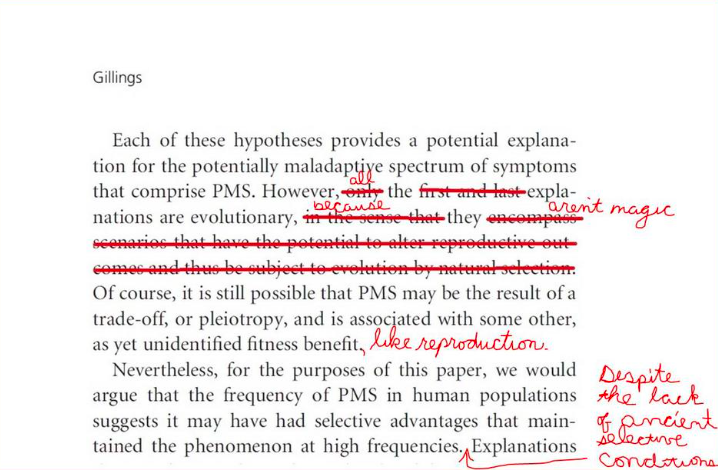
The Wade book, of course, has gotten a lot of press, both positive and negative, including a letter in the New York Times last week refuting Wade's use of population biology by a long list of population biologists, many of whom are authors of the work Wade cites in support of his own political views, although of course he doesn't see it that way.  The PNAS papers got huge amounts of publicity around the world, but very accepting, none that we saw questioning the hypothesis. The PMS hypothesis, on the other hand, has been critiqued as nicely as 140 characters allow (including by Holly, who red-inks it below (it's a Twitter thing), and blames PLS (pre labor syndrome) for any perceived snark).


Each of these publications happens to bring up deep and long-standing issues in anthropology.  The issues involve the usual scientific food fights, but over and above the specific details, there are problems, and it's these that we want to discuss today.

Troublesome arguments
We'll take these issues one at a time.  Enough has been written about Wade's book that there's no need to look at the specific arguments again.  It's a continuation of retailing Just-So stories and selective reporting and misreporting, that he's been doing for many years; it sells well and he serves a surreptitious audience that includes various shades of racist enmity, as well as readers who have no way to know better, including many anthropologists.

Fine.  What's interesting to us, in terms of the broader field of Anthropology, is that it has clarified how deeply politics affects what we all make of scientific 'facts'.  You've got your genetic determinists on the right and your gene/environment interactionists on the left, and if you know how someone feels about genetic determinism -- that what and who you are is basically set the moment you are conceived -- then you know a lot about how s/he feels about IQ, scientific racism, natural selection vs drift, the importance of adaptation in evolution, and indeed about immigration, Obama, economic inequality, and so much more.  Sociopolitical views are correlated with what one seeks, accepts, or promotes when it comes to science -- not just some purportedly objective truth.

Genetic determinism is an interesting hot button issue.  Too often, people believe either that it explains virtually all traits or explains none, but of course it's some of both.  Some diseases, e.g., are caused with high predictability by a genetic variant, some diseases are due to gene/environment interaction, and some 'causal' variants are fairly useless for disease prediction.  Even infectious diseases that can affect almost anyone, that is, almost any genotype, do so in concert with genes.  Genes contribute to every trait, directly or indirectly: without genes we would not be here, and genetic variation can affect almost anything.  But that is not the same as saying that they determine, or specify, every trait.

There are academics who have trouble accepting strongly genetic arguments, because they believe they are, as the phrase goes, 'politically incorrect'.  But behind the political incorrectness smear is of course a dark history of eugenics, lynchings, the slaughter of 11 million people during World War II, including Jews, homosexuals, disabled people, and more.  But further, even if all of genetic-deterministic arguments were fully supported by the science, and we all were to accept that, for example, 'race' is a clear-cut biologically determined category of humans, why would that justify unequal, and worse, treatment of groups we (those in decision-making positions) deem unequal to ourselves?  Unequal because science tells us so.  Science doesn't make value judgements -- people do.  That is why the assertion of such points, or even the funding of studies to find them, is itself a political act.

To the people whose politics are supported by the new 'genomic' version of scientific racism (the latter term, we think, was invented in pre-Nazi Germany), of course, those arguments are 'politically correct' and their generally left-leaning proponents are just idiotic know-nothings.  Not in science, but in scientific racism, it's perfectly fine to cherry-pick the data when making an argument -- and the argument is supported by white supremacists, people who see genes behind everything, people who believe that every trait is here because it was naturally selected, and so on.  Genetic determinism and other labels have become code for accepting inequality, for hording resources, for rationalizing us having and them not having, and this often goes hand-in-hand with racism and hate (often not openly stated, of course, but sometimes it is). It's hard to argue that's science, not politics.  And, the disagreement won't be solved by science.

The problem here is simply the facile telling of stories without anything close to a sufficient understanding of the available information, the mixing of how things are today with how they got here, the assumption that how they are today is driven by genes rather than by much stronger and more ephemeral cultural factors, and the simple assumption that everything simply must be simply explained by genetic natural selection above other evolutionary paths.  In these conditions, a measured discussion of the issues is not possible -- and by the conflicting parties with their agendas, perhaps not even desired.

Getting to now may have nothing to do with then
The PMS paper is interesting for a number of reasons.  First, the author is a biologist who, at least judging from his web page, works on genetic variation in non-human organisms.  Mostly not even mammals.  So it's curious that he's decided to, er, wade into the evo psych realm.  Evo psych can be troubling enough when the arguments are coherent, so this one is particularly troublesome. In "Were there evolutionary advantages to premenstrual syndrome?" Gillings repeats and then discounts a number of previous evolutionary arguments about PMS, and then argues that premenstrual syndrome or premenstrual dysphoric disorder are essentially universal and experienced by all women, so there must be an adaptive explanation for such a maladaptive trait.  And of course it has a genetic basis.
Ongoing bonding between humans is complex, depending on sexual and nonsexual behaviours, and on previous experience in the relationship. Where such relationships do not result in pregnancy, premenstrual hostility may cause varying degrees of rejection, both sexually and of the relationship in more general terms. It might then be conjectured that infertile pair bonds are more likely to break down, freeing both partners to pursue fertile mates (Morriss and Keverne 1974).
Women suffering from PMS are likely to direct their anger at current partners, Gillings suggests, but most often it is when they have no children, that is, when one of the pair is infertile (or the pair, together, is infertile), that this will result in the dissolution of the pairing.

So, PMS evolved to dissolve infertile couplings.  But Gillings then says that this wasn't a problem in hunter gatherer times because women then weren't cycling nearly as frequently as women today -- they were pregnant or lactating, or poorly enough nourished that they didn't menstruate.  In that case, it's hard to understand how this evolved.  Gillings argues, though, that modern cycling is maladaptive, and that it causes health problems, as well as disrupts family dynamics with this genetically driven monthly bearishness of women.  He goes on to suggest that women should consider using cycle-stopping contraception (rather than, say, suggesting men should offer chocolate and not take it so personally).

But wait a minute.  First, a trait can only be selected if it's visible to natural selection.  It has nothing to do with whether people are paired up or happy (unless these are requirements for reproductive success, and the former is, according to some widely held evo psych-type assumptions), and it must be based on genetic variation, not cultural patterns.  If women weren't cycling regularly, and there's a lot of evidence that they weren't until modern times, how could PMS adaptively evolve if it didn't exist in any significant form?  And second, as Ken pointed out in his series a few weeks ago on the mythology of natural selection, there are many other ways that traits can evolve, including a series of reasons we might have no ability to guess, and including by drift relative to any Just-So story we reconstruct as if we got here in a straight adaptive line from then to now.

Like Wade's book, this paper makes the all-too-frequent mistake, in evo psych yes, but in anthropology -- and increasingly in other fields as well -- of assuming that every trait is adaptive, is here because of natural selection, and is thus genetically determined.  And that if we can build a plausible argument, it must be true.  And that the way it functions today is the reason for its evolution.  But, let's call this the geodesic fallacy.

SpaceTime trajectory real and imaginary (modified from GoogleImages)
See Ken's final post on the mythology of natural selection for the details, but here's the gist:
Even if the implicit complete determinism of Darwinian assumptions were true, the complex dynamic nature of earthly ecologies means that an evolutionary geodesic need not follow a retrospectively reconstructable path from then to now. A species or trait need not have evolved 'for' its current use, not even in stages aimed in a particular direction, not with its various components evolving synchronously or even sympatrically. Indeed, if and where ecologies are complex and dynamic, the meanderings of our object--a trait or species--may be essentially indistinguishable from random movement relative to any long-term 'purpose'.
It's very easy to make up adaptive scenarios.  That's why they are called Just-So stories.  And they are seductive.  But elegance or cleverness doesn't make them right.  Indeed, most often we have no idea if they are right, or even how to test them.

Again, the problem here is simply the facile telling of stories without anything close to a sufficient understanding of the available information, the mixing of how things are today with how they got here, the assumption that how they are today is driven by genes rather than by much stronger and more ephemeral cultural factors, and the simple assumption that everything simply must be explained by genetic natural selection.

Lumpers and splitters
The Flores controversy, of course, well-known in anthropology, has been ongoing since the first report of the findings of bones in Liang Bua Cave on the Indonesian island of Flores ten years ago.  The bones were from individuals obviously much smaller than other known hominids of the time, prompting the discoverers to declare them to be representatives of a species of human new to science.  The authors of the current re-interpretive papers on Flores at the time argued that no, these bones didn't represent a new species, but instead at least the one intact skull that was found represented an individual with microcephaly.  Now, it's an individual with Down syndrome.

LB1 skull: Wikipedia
 (associated postcranial remains can be seen here)

However, the argument is based on assuming that it's possible to definitively diagnose Down syndrome in a skeleton (among the many possible skeletal indicators of Down syndrome, most are not found exclusively in people with DS)  and that the asymmetry in the skull was present before the individual died, and not the result of thousands of years of burial, that this individual reached adulthood, and without modern medical care, that's less likely, all at least questionable assumptions.

But suppose LB1 really did have Down syndrome, then what?  Then it is completely irrelevant to any population or evolutionary argument.  One can argue about the Down diagnosis, a subject best left to actual experts of which there are many, but it matters not to the issue of whether the population experienced the very commonly observed evolutionary phenomenon of island dwarfism.

Cave where the bones were found: Wikipedia
This then gets into a very long-standing argumentation between those who tend to name each new fossil with a separate species designation (often called 'splitters' in evolutionary biology), and those who see a range of variation within species and argue that what we have found in the fossil record are representations of that variation, not of different species.  The latter are the 'lumpers'.  The snide and over-puffed Flores papers seem to be at heart a jab at those who see the Flores specimens as representative of a different species from the southeast Asian mainland.

Of course, 'species' is itself a largely subjective subject.  Even the idea of reproductive isolation is very hard to prove.  How many matings does one need to try to show that they never produce fertile offspring?  Usually, of course, and certainly with fossils we cannot do that directly!  The species problem has been debated for more than a century.

Were Neanderthals and early 'modern' Homo sapiens separate species?  Many would say so.  Are the recently prominent 'Denisovans', fossils from a region in Northwest Asia, a separate species?  They have separate names, after all!  Yet because they are recent enough, and perished under fortuitously helpful conditions, we have DNA from them.  And to date, the evidence suggests admixture between them (with remnants of both in modern humans today).  So: separate species, or not?

The arguments are heated among anthropologists about these sorts of issues and the more-heat-than-light regarding the Flores material reflects that.  There is, after all, a whole lot of publicity in the media for stories that sell, like tales of human fossils.  Anthropologists, whose field is often not all that rigorous given the problems of reconstructing the past, are particularly vulnerable to promoting their finds as different, or blasting their peers for doing so.  The media circus loves anthropologists, and anthropologists love it!

In these areas, the controversy is stirred up by the journals and the media.  Every week outrageously poorly supported evolutionary stories appear in journals and are eaten up by media reporters who either don't know the science, don't probe as they should, or don't care to be informed because the objective is to sell copy, and to do that content must be found.

Whether we'll see a day when appropriately measured questions can be asked and discussed, even if they can't really be 'answered', isn't clear.  Probably not in our lifetimes.