Showing posts with label competition. Show all posts

Thursday, April 24, 2014

Is it competition vs cooperation; or, cooperation lets competition be?

Since Darwin, emphasis in evolutionary theory has been on competition between individuals and species in the race for optimal fitness -- he or she who passes the most genes to subsequent generations wins.  Darwin saw this through the lens of the rampant cruelty of Nature, and the need for individuals to find food and mates and escape being eaten.

To many, this is a fundamental underpinning of evolution, although in recent years a number of evolutionary biologists have begun to think that perhaps cooperation deserves a larger role.  We have done our part, in our book (titled, in fact, The Mermaid's Tale: Four Billion Years of Cooperation in the Making of Living Things) and here on MT and elsewhere, though, despite our best efforts, competition remains the predominant view of how life works.

In our book we suggest that cooperation is a fundamental principle of life, arguably much more pervasive and important than competition because it happens at all levels all the time, from minuscule intracellular spaces to grander ecosystems, instantaneously as well as over evolutionary time.  It is, we think, hard to argue that competition plays such a central role.

A friend and sometime co-blogger Reed Goodman alerted us to an interesting piece the other day in The Baffler, "What's the Point if You Can't Have Fun?" by David Graeber.  Graeber, currently Professor of Anthropology at the London School of Economics, believes that behavioral scientists have gone over the top in arguing that there must be a rational purpose to every animal behavior.  
I’m simply saying that ethologists have boxed themselves into a world where to be scientific means to offer an explanation of behavior in rational terms—which in turn means describing an animal as if it were a calculating economic actor trying to maximize some sort of self-interest—whatever their theory of animal psychology, or motivation, might be.
Instead, why can't they just be having fun?  

Graeber notes that with the discovery of genes, evolutionary theorists quickly adopted the idea that everything animals did was in the service of passing along their own genes, an idea popularized by Richard Dawkins' in his book The Selfish Gene, but also widely accepted within evolutionary biology as well.  Indeed, evolutionary biologists tend to smell a competitive rat everywhere, nurturing the view that everything animals do must be adaptive, naturally selected, and for the purpose of out-reproducing the competition. 

This of course raises problems like altruism, cooperation among non-kin, animals sacrificing their own life for someone else, and so forth, but these have generally been hand-waved away with we would say rather contorted arguments that reframe kindness, cooperation and self-sacrifice as just competition in disguise.  Of course, that implicitly makes a tautology of every such explanation, based on an axiom -- an assumption -- of pervasive selective determinism.

Graeber isn't at all a fan of this strict view of biology and evolution.  His essay is wide ranging in scope,  from inchworms dangling in air for the sheer fun of it, to the historical context in which the idea that the purpose of life is the propagation of DNA (our genes thus made us invent the PCR machine, for  unlimited propagation of DNA?) could gain purchase, to the discussion of free will and consciousness.  It is provocative and well worth a read.  

But it was Graeber's mention of a 1902 book by Russian naturalist Peter Kropotkin (1842-1921) that most caught my eye.  In Mutual Aid: A Factor of Evolution Kropotkin argues that Darwin was wrong to place so much emphasis on competition, because cooperation -- mutual aid -- is so obviously in evidence all around us.  The idea of the struggle for life as a 'law of nature' was something he just couldn't accept because, as he wrote "...I was persuaded that to admit a pitiless inner war for life within each species, and to see in that war a condition of progress, was to admit something which not only had not yet been proved, but also lacked confirmation from direct observation." 

As a naturalist, Kropotkin spent much time traveling and observing nature. In Mutual Aid he documents  evidence of aid over conflict among animals, in humans and throughout human evolution and history, writing:
As soon as we study animals -- not in laboratories and museums only, but in the forest and prairie, in the steppe and the mountains -- we at once perceive that though there is an immense amount of warfare and extermination going on amidst various species, and especially amidst various classes of animals, there is, at the same time, as much, or perhaps even more, of mutual support, mutual aid, and mutual defense amidst animals belonging to the same species, or at least to the same society.  Sociability is as much a law of nature as mutual struggle.  
But which comes first, evidence or interpretation?
Kropotkin was a prominent figure in 19th century activist politics.  He was, according to the wisdom of the masses, a "geographer, economist, activist, philologist, zoologist, evolutionary theorist, philosopher, writer and prominent anarchist." (Wikipedia.)  He was sympathetic to the plight of the peasant in Russia as a young man, and to socialist ideas, though he eventually settled on anarchism and as a political activist, was imprisoned for subversive activities in 1876.  He escaped from prison before his trial, however, and fled to Europe, only returning to Russia after the revolution in 1917, enthusiastic about the changes he saw happening, though eventually disillusioned by the authoritarian socialism that the revolution became.

Kropotkin disliked capitalism and the idea that life must be a struggle.  As an anarchist, he preferred to believe that humans were capable of mutual aid and cooperation, and that we could effectively run our own societies.  On the other hand, competition was in the cultural air when Darwin was doing his thinking, with the British empire dominating much of the world, the beginning of the industrial age and the rise of capitalism, the economics of Thomas Malthus who was so influential to Darwin's thinking, so it was perhaps natural that Darwin, and Wallace too -- and indeed Richard Dawkins in the 1970's -- framed their theories of evolution in terms of competition.

One can assert that if Kropotkin was driven by his ideology to see in Nature what his filters allowed him to see, then the same certainly applies to the Darwinians and even to the gentle Charles himself.  If Darwin's view prevailed in the west, the cooperation-based views of Lysenko prevailed in the Soviet Union, with disastrous consequences for science.  But viewed in its context, these polarities are understandable. 

What does this say about which view is right?
I don't know.  Ken and I thought we were writing  The Mermaid's Tale about biology.  As we wrote in the book, competition and cooperation are laden words, but we explicitly chose 'cooperation' as an antidote to 'competition' with all its political and cultural meaning.  More neutral and scientifically appropriate terms like 'successful interaction' and 'differential proliferation' would serve science better and be less a matter of defining everything before it's observed.  However, our intention was to describe cooperation not just as kindness, but cooperative interactions among genes, organelles, organs, organisms and species.  In that context, we had little to say about culture, except insofar as we would argue that culture generally and manifestly usually trumps genetically driven behaviors.

So, I was surprised (and of course pleased) to see a recent review of our book on Amazon that says, among other things, "Would more anthropologists and policy makers read this…".  It's a favorable review, so presumably the author sees political and cultural meaning where we were explicitly only intending to describe biology.

But that's okay, and as it should be.  Science is always done in cultural or political context.  To a great extent, we see what we believe.  

Thursday, May 17, 2012

The Prisoner's Dilemma dilemma

Last week's In Our Time on BBC Radio 4 was a discussion of Game Theory.  It was an interesting discussion as far as it went, but we want to talk about the evolutionary implications here. 

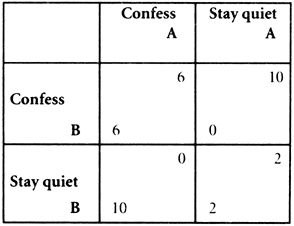
The Prisoner's Dilemma (PD) is a famous game theory game:
Two prisoners are accused of a crime. If one confesses and the other does not, the one who confesses will be released immediately and the other will spend 20 years in prison. If neither confesses, each will be held only a few months. If both confess, they will each be jailed 15 years. They cannot communicate with one another. Given that neither prisoner knows whether the other has confessed, it is in the self-interest of each to confess himself. Paradoxically, when each prisoner pursues his self-interest, both end up worse off than they would have been had they acted otherwise.  (Answers.com)
Both confessing can be shown mathematically to be an ESS--evolutionarily stable solution.  This is 'evolutionary' in the sense that competition for resources that involves some risk, involves similar kinds of decision-making.

Red-tailed hawk; Wikipedia
Another 'game' of evolutionary interest is called Hawk and Dove (HD), which biologist John Maynard Smith brought to prominence in the 1970's in an effort to solve the problem of how cooperation evolved.  Roughly, the idea is if there is a single resource and two competitors, each can be aggressive and try to get it all, or they each can offer to share.  You balance the expected gain by trying to out-muscle your competitor, but there is also a cost if you lose.  It's been shown that a balance can be struck in which depending on the Value and the Cost amounts, some fraction of the time--that is, with some probability--you behave aggressively, and the remaining fraction of instances, you decide to share.  That is the ESS.  The fractions depend on the Value and Cost amounts, and neither party reveals this probabilistic strategy to its opponent.

Bar-shouldered dove; Wikimedia
Both PD and HD and many other similar types of games reflect situations that are very common in human society, but also very common in Nature--ecological balances, mating competitions, competition for resources, and so on.

Game theory is immensely popular among evolutionary biologists (and others who are obsessed by the view that life is mainly about Darwinian winner-take-all competition, or who simply want to understand the balance between competition and cooperation).  There is the additional appeal that game theory usually requires sexy, sophisticated mathematics to find the right strategies, or stable ones.

If people or birds are seen to be following some strategy when they compete, it is then assumed that they probably evolved to do this.  This then whets the prurient appetites of those who want to peer into your genome to see how, despite silly illusions of free will, you're really just a genetic automaton.

So, is it realistic to assume that something so open-ended and complex as a game theory behavior could have evolved?   After all, games like PD or HD seem widespread and if birds, ants, or even humans are just complex gene machines, mustn't it be possible to pre-program them (i.e., genetically) to play the game the evolutionarily optimized way?

This is really a dilemma, because even just one game, say HD, can arise in all sorts of ways even within a given individual's lifetime.  How can genes be pre-wired to recognize all the situations and identify their similarity and then push the Play button?  After all, every brain is wired in zillions of different ways in detail.  So what kind of gene or genes could possibly produce this behavior?  Remember that genes code for proteins, and have to be regulated in specific contexts; they are not individual computer programs.

One way to answer this is by a kind of meta-evolutionary view: we may not be able to identify the wiring diagram, but the net result of evolution is a brain that can perceive the environment and evaluate costs and strategies, and figure out for itself what is best.  The selection pressure is general, and it's for evaluating conditions rather than 'for' some specific strategy.  No need whatever for any specific genes 'for' HD or PD playing!

In this view, and especially if games really are cosmically mathematical (as they must be, given how widely they are found and shown to have similar strategy properties), then a brain that is somehow good at evaluating the real world will figure this out and identify the better strategy.  The same brain is faced with multiple and diverse evaluation situations, so that all we need is overall evaluative ability to get what we see, however such ability actually can be built into neural synapses and the like.

One would certainly easily be able to relate this to probabilistic strategies like HD, because each individual is more or less guessing what to do each time, the result being an empirical probability--the observed fraction that individuals act like hawks, or doves.  Likewise, one could observe that played something like PD properly, because s/he figures out the general risk-benefit situation.  No need for specific evolution of some convoluted gene-based mechanism specific to the game (which would imply the same to evolve separately at the gene level, for every other situation-evaluating things that animals do).

This is a way in which things can be 'genetic' in a general sense, but not specifically hard-wired by selection for a specific task.  That's a big difference!

It is genetically deterministic in a sense, by not in the precise Darwinian sense so often invoked, explicitly or just under the surface, so routinely in discussions of behavioral evolution.

Thursday, June 16, 2011

Oh, what a tangled web we weave

Walter Scott is responsible for the famous line:  Oh, what a tangled web we weave, when first we practice to deceive.

It sounds profound, but is it wise words, or just bollocks?

Here, at least is the latest in the 'evolution was just like this' department.   A study on reasoning  that is part of an issue on the subject in the Journal of Behavioral and Brain Sciences, concludes that reasoning evolved to be deceiving rather than to tell the truth.  At least, the authors of this new just-so story don't claim it's genetic: deceptive rhetoric evolved socially. 

As the NYTimes reports, it has long been assumed that reasoning evolved to enable us to search for and determine Truth.  But,
[n]ow some researchers are suggesting that reason evolved for a completely different purpose: to win arguments. Rationality, by this yardstick (and irrationality too, but we’ll get to that) is nothing more or less than a servant of the hard-wired compulsion to triumph in the debating arena. According to this view, bias, lack of logic and other supposed flaws that pollute the stream of reason are instead social adaptations that enable one group to persuade (and defeat) another. Certitude works, however sharply it may depart from the truth.
The idea, labeled the argumentative theory of reasoning, is the brainchild of French cognitive social scientists, and it has stirred excited discussion (and appalled dissent) among philosophers, political scientists, educators and psychologists, some of whom say it offers profound insight into the way people think and behave. 
Now whether this is true in all societies, a uniform cultural evolution or a parallel one (similar in, say Pacific Islanders and African Ashanti or San, but of independent social-evolutionary origin) is a valid question.  In fact, much as we hate to take sides with the genetic-evolutionary view (!), there have been numerous arguments that human language is basically an extension of eons-old display tactics that were designed to intimidate or deceive, as in mating competition.  Such things are not new to humans, or even primates, so if it is biological it predates our species and the explanation is more general.

However, let's ignore whether it's cultural or biological.  The same people who fervidly see competition-everywhere, the arch-darwinian view of life,  will love the idea that she dissembles to deceive.  If you're looking for a rival under every bed, you'll certainly go along with the idea that we use language (reasoning, persuasion, rhetoric) to distract, derail, or deceive potential competitors:  you really do, as the article says, want to win rather than to inform others.

This certainly is one way language is used (at least in cultures in nation-states, where we have daily evidence).  But is it 'the' truth?  Is it part of culture, or only of some cultures....or did cultures evolve reasoning 'for' deception per se?

It is easy to see a polar opposite to the latest assault of selectionism.  If you deceive, you can cause others to come to loss or grief.  Why should they not have a long memory, that they'll use to even the score later?  Why isn't truth good for the group, and deception a way to make everyone vulnerable?  Our ancestors--including primates--lived in very small local groups.  They might be very vulnerable to internal misinformation.  Why is telling the truth institutionalized in many if not most cultural norms--what children are taught, for example, even if we're not perfect at it?  Is that because if everyone is convinced you're truth-telling, it's easier for you to mislead?  Or is it because truth-telling really is what's important, and you mutually have to rely on it for your survival?

Further, what is truth and how do you know what people's motives are (whether they are even aware of them or not)?  Since 'truth' is what we think we perceive, and since we always have imperfect data, imperfect perception, and imperfect intelligence, why should we assume that 'reasoning' is false rather than flawed?  After all, even 'experts' in most fields related to behavior (to wit: economists, pundits) are grossly wrong presumably because of ignorance or bias rather than intentional deception.  One might suggest that the journal article's authors' interpretation of the intent in reasoning is more a reflection of their ideologies and biases, than it is of the underlying truth (or are we just saying that to make you believe us??).

Anyway, why should our ability to reason have evolved for only one purpose?  Did our hands evolve just to let us hunt?  Like most traits, reason is multi-purpose, and can be as useful for cooperation as well as competition -- and many other things. It's how we express how we assess our environment, our circumstances.  Often it is verbal expression, imperfectly representing our internal thoughts.  We can reason our way to figuring out from these footprints what kind of prey we're likely to find if we hang out long enough at the waterhole, or that that plant is poisonous, or to formulating a mathematical proof just as we can clap with our hands, help another across a creek, and caress a child's cheek. And, it's not just that the functions other than winning arguments are exaptations (purposes beyond the one the trait first evolved 'for') of the ability to reason, because ants and bees can reason. Or is deceptive reasoning limited, by social constraints, to certain but not all topics of conversation?

The choice of a single overriding purpose for our ability to reason says more about the those doing the choosing than it does about the trait.

Sunday, September 13, 2009

The importance of cooperation in life: second installment

Back in June, we posted what we called a first installment on the importance of cooperation in life. Distracted by other issues and subjects, we never got around to posting a second installment. Here it is, and rather timely at that, as cooperation seems to be having its day, with entomologists and primatologists, sociologists and political scientists, among many others, now addressing this often slighted aspect of life. We, too, consider cooperation to be fundamental, even describing it as a principle of life in our book.

An essay in a recent Science by science writer Elizabeth Pennisi takes up the subject (On the origin of cooperation, Science, 4 September 2009: Vol. 325. no. 5945, pp. 1196 - 1199). Pennisi reminds us that Charles Darwin was perplexed by the existence of altruism--why would an individual help another at cost to him or herself?
Cooperation has created a conundrum for generations of evolutionary scientists. If natural selection among individuals favors the survival of the fittest, why would one individual help another at a cost to itself? Charles Darwin himself noted the difficulty of explaining why a worker bee would labor for the good of the colony, because its efforts do not lead to its own reproduction. The social insects are "one special difficulty, which first appeared to me insuperable, and actually fata to my theory," he wrote in On the Origin of Species.
And, biologists have been perplexed by this ever since, because it doesn't fit easily within the prevailing evolutionary framework.
And yet, [Pennisi continues] cooperation and sacrifice are rampant in nature. Humans working together have transformed the planet to meet the needs of billions of people. Countless examples of cooperation exist between species: Cleaner fish pick parasites off larger fish, and nitrogen-fixing bacteria team up with plants, to name just a few.
The usual discussions about cooperation, as above, are about social cooperation, among individuals in a population. Widespread as such examples are, they don't even hint at the extent of the cooperative nature of life, which is true at all levels, as our book is largely about. Genes cooperate with other genes, organelles with each other inside cells, receptors on and in cells cooperate with their ligands, cells with cells, tissues with tissues and organs with organs. Organisms cooperate with others of their own species (sexual reproduction being the quintessence of co-operation), and members of different species with each other. So, if cooperation is so all-pervasive, why has it been so consistently overlooked in favor of competition and selfishness?

The word cooperation may be denigrated from a fundamentalist Darwinian point of view as soft-headed goody-goody thinking. 'Cooperation' is indeed a culturally loaded word. But it is no more so than 'competition'! A 'selfish' gene is not competing in the same aware sense that a marathon runner is. Neither are two molecules aware of cooperating in the way members of a soccer team are.

We mean co-operation literally, that is, operating at the same time and place and in appropriate amounts and ways. That includes social cooperation. It might be better to call this 'interaction', as another way to stress that the elements of life don't act alone. But we want an antidote to the very loaded term 'competition', until the mainstream of biology changes that term to something like, say, 'differential proliferation'.

We aren't the first to point out that the idea that life is all about competition fits neatly with the history and politics of the culture within which evolutionary theory developed and grew. Historiographic context analysis is often written as if it shows the falseness of the idea being discussed. That doesn't necessarily follow, but it does seem correct that the words used and the approaches taken reflect social context whenever human affairs are the subject. In this case, our contention is that a cultural obsession with individual-based competition, which was shared by Darwin (but less so by Wallace), affects what we see and focus on and how we interpret it.

The focus on competition is one of the consequences of viewing life on the compressed evolutionary scale. Darwin himself understood that it was impossible for us to understand the immensity of time over which life evolved. Thinking in evolutionary terms makes it easy to forget that life is actually lived from moment to moment, and needs to be understood on that scale as well. When seen at the level of daily life, cooperation is omnipresent, and far more important than competition.

Nor are we the first to point out that even when cooperation is undeniable, it's often quickly redefined as competition--people are only altruistic because they get something out of it, or to help their kin, and so on. Why people help non-kin is easy to explain when you acknowledge the role of culture in what we do. If you filter everything through a strictly Darwinian lens, where reproductive fitness is the ultimate measure of success, and we're all in competition with each other, driven by natural selection, it is indeed impossible to understand why people would jump off a bridge to save a drowning stranger, or choose to limit their number of offspring (even if you explain this with r and k strategies, this only kicks the question back a step), or invent the concept of socialism, or, the ultimate inexplicable action in Darwinian terms, detonate a suicide belt in the service of religious conviction.

But, if you allow that culture can drive what we do, in perhaps biologically inexplicable ways, and not simply our sex drive, or the fact that helping our cousin favors some of our own genes, these actions don't then have to be explained in terms of competition or survival of the fittest or optimal energy expenditure or whatever. A Darwinian purist's post hoc explanations are, for example, to invoke 'reciprocal altruism'. In the moment of truth before you swim to the drowning stranger's aid, somewhere deeply in your reptilian brain is the little message "Do it, because if they survive they may save you some day!"

Baloney! One of us has had this exact experience, and there was no little Devil on the shoulder whispering in the ear.

The fundamentalist view of social behavior rests on the important, automatic, but erroneous assumption that cooperation always involves a cost of sufficient magnitude to be detected by selection and that the act has to be seen in terms of selection and the latent assumption is that the mechanism must be related to altruism itself. That's an industrial-age's argument for 'efficiency' as the Law of Life that justifies harshness towards workers in manufacturing companies.

We suggest to the contrary that cooperation is so fundamental to life that it needs to be accepted on its own terms, and need not even be specifically 'programmed' (or such program specifically reinforced by selection). If anything, for many species the cost is for not cooperating, and translating this into Darwinian terms only distracts from what is important.

What we see and how we view it have implications for what we don't do or don't see in science, even if the latter is there unmistakeably. We think that, regardless of the aspects of differential proliferation that were involved, a focus on the nature and extent of cooperation in its many forms of equal grandeur to anything Darwin ever remarked on, and would be healthy for biology to concentrate on.

Monday, June 29, 2009

The Centrality of Cooperation in Life: a first installment

A recent story in the New York Times science section about the importance of cooperation in ant colonies reminded us that we've been focused on things like disease and genetic causation in our blog for a while now. So we thought it was time to get back to other things, such as the importance of cooperation in all of biology, not just to ants.

Cooperation was in the subtitle of our book, and for a reason. Ever since Darwin's Origin of Species, whose 150th anniversary is rightly being celebrated this year, there has been what we think is an excessive belief that competition is central to the nature of life. In biology, this ethos is largely about the way that Darwinian evolution, with its stress on competition among individuals within a population, with its genetically determined winners, losers, inherent goods and bads, has fit the nature of our industrial culture's worldview. It is a convenient way to rationalize and hence justify self-interested gain by a few against the many.

Nobody can deny that there is competition in life, in the sense that some individuals do better at reproducing than others. Species have their day, and fade as other species flourish. It's an important mechanism for biological change and was a brilliant insight of Darwin, as well of others in his time (Wallace's attention was more on group competition against environmental limitations, than on individual competition). It helped demystify the origin and nature of life and its diversity.

However, it's not the whole truth about life. Instead, we think, a focus on competition draws disproportionate attention to the long-term historical aspects of life, even if the Darwinian explanation is accurate!, rather than what we can easily see every day before our very eyes. What we see everywhere, every day is mainly cooperation: among molecules within each of our cells, among cells within each individual, and among individuals. In a deep biological sense, if not in one that fits the value-loaded human word 'cooperation', even predator and prey must cooperate: both must be present for each to survive.

Classical evolutionary theory, and a lot of popular science writing based on it, assumes competition to be the fundamental force in life. But absolutely as essential to life is necessity for cooperation at all times and at all these levels--among genes in genetic pathways, among organelles in cells, among cells and tissues and organs, and in ecosystems among organisms within and between species.

And, our focus on cooperation leads us to a different view of natural selection and its importance in evolution. As we say in The Mermaid's Tale, natural selection does happen, but it depends on a lot of if's. For example, if a species over-reproduces, and if there is variation in the next generation, and if some of that variation leads its bearers to do better in a given environment, and if that's due to the inherited genome, and if the environment remains stable for long enough that this variant is favored consistently, and if the favored forms reproduce successfully, as do their offspring, and if they produce more offspring than organisms without the favored variant, then these favored organisms may become more common, due to natural selection. That is, they will be better adapted to their environment. But, all these if's must co-occur for natural selection to be an important force in change. If they are sporadic, or varying in nature and intensity, then their relative importance diminishes in relation to other aspects of life, including chance. Indeed, distinguishing chance from natural selection is no simple challenge.

No matter, to understand life in a deep sense one really has first to understand the nature of the countless cooperative interactions on which it is based. How those interactions change over long time periods of generations of cells, organisms, species, and ecosystems is important. But the interactions, and how they organize life, come first.

Tuesday, April 7, 2009

Proliferative differentiation and interaction

Our book examines the nature of cooperation at all levels, from molecules on up (although in fact we did not say much about social cooperation) so it is interesting that a variety of scientists are reacting to the excessive focus on competition in biological thinking (and even today, political columnist David Brooks in the NY Times, discusses cooperation in the sense of social and moral behavior). The centrality of cooperation is our basic theme, and we agree with Mr Zimmer and Brooks on its importance.

It should be said that the defenders of darwinian orthodoxy generally argue that, one way or another and call it what you will, if something proliferates something else doesn't, and that's called 'natural selection' and is the very definition of 'competition'. Since that is a socially loaded word, that is then used to justify aspects of our social structure, we like the equally loaded word 'cooperation' for what is actually going on most of the time--even if there is always some element of 'competition.' In our book we outline ways things can come about other than by classical selection, including drift, which is much more important to the evolution of traits (not just DNA sequence) than is usually credited. Cooperation is a much more accurate word to describe what goes on every day in every organism and every cell, even if over very long time periods, the effects of competition and chance add up to divergence.

We could unload this discussion somewhat if we used terms like 'differential proliferation' and 'interaction' instead of competition and cooperation.