Showing posts with label baseball. Show all posts

Wednesday, June 26, 2013

Can you throw with half a brain?

Homo erectus had half the brains that we have. This guy's got even less. (source)
This being at least my third post about the evolution of throwing here on the MT ("A prehistory of throwing things" and "Hurling words and turds, an evolutionary link"), I think I should give a little background about my interest. Even before I started graduate school my doctoral advisor got me (a lifelong athlete) interested in it, we teamed up with a biomechanist, did some modeling, wrote about what throwing might have been like for extinct hominins like Lucy and the Nariokotome Boy ("Throwing and bipedalism: A new look at an old idea" will email the pdf, just ask), and I was awarded an NSF graduate fellowship for the proposal to come out of that project.

So obviously I earnestly thought I was going to study hominin throwing for my dissertation, but when I started to try to pull a comparative experimental study together and realized that everything I wanted to do would require that I go somewhere(s) else and work with someone(s) else, it didn't make much sense. I needed a biomechanics lab and I needed lots of practice in one too. And, I couldn't even begin to figure out where to find chimps or other primates that I could work with, let alone that I could get to visit me in that biomechanics lab. Or I'd have to learn ways to study kinematics of animals without much control. And I'd have to go somewhere else to do most dissections too. And let's not forget how much smaller the fossil hominin sample was 12 years ago. It wasn't feasible for my dissertation.

It was okay though because while I was doing what eventually became my dissertation research on Proconsul feet in Kenya I met Neil Roach who was just starting his studies at Harvard and was working on the evolution throwing! If it wasn't going to be me, at least someone was going to figure this out for us, and that someone had the resources to do so. And that someone's research made the cover of Nature this week.

The paper's called "Elastic energy storage in the shoulder and the evolution of high-speed throwing in Homo." [link to paper]

Here's a promotional video that Harvard posted:


In the paper, the authors ask, Why can we throw like we do and why can't chimpanzees? and they look to the musculoskeletal differences between us to find out.

In this paper, it's all about the whip-like motion of the human body during a throw and the slingshot-like energy storage in tendons, ligaments and muscles that makes it work. They elegantly describe this process and write about three key differences between humans and chimpanzees that they say are critical to why we throw like pros:

(1) our flexible torsos that allow more rotation at the waist
Human (a) and Chimpanzee (b)
(Source: Figure 3 from Bramble and Lieberman, 2004)

(2) our lower amount of humeral torsion in our throwing arms
from Roach et al., 2012: "Fig. 1 Humeral torsion (in blue) is determined by measuring the angle
between the orientation of the humeral head and the distal condyle
of the humerus. In the clinical literature, the same angle is referred to
as humeral retroversion (in yellow) and is measured in the opposite
direction."

(3) the lateral, not cranial, orientation of our shoulder joints

From the study's website: "This image shows differences in the position of the shoulder between chimpanzees (left) and humans (right). These differences can be seen in both the muscular anatomy and in the bony anatomy of the scapula (shoulder blade). (Image credit: Brian Roach/Neil Roach)" 
Then the meat of the paper is devoted to their experimental analyses of a group of skilled human throwers that appear to support the importance of these traits in throwing, particularly for storing elastic energy for fast throws. I say "appear to" because I wasn't given any of the supplemental materials and what's in the main text (which is all I have) doesn't quite pull the analyses and those traits together for me, but that could just be my very rusty biomechanics training rearing its rusty head. Or it could be my incredibly high and probably impossible expectations about what we can take to the fossil record with only a study of human throwers upon which to rest our assumptions of functional anatomy.

For example, humeral torsion is often asymmetrical in humans, being lower in the dominant arm, adding support for the assumption that humeral torsion changes depending on activity during an individual's lifetime. Is it fair to compare that trait to chimpanzees when it's not necessarily an in-born difference? Yes. But that makes explaining selection on that trait a little bit more difficult. I think it's fair to consider it, at least its asymmetry, a marker that an individual may have been habitually throwing during its life. So in that regard, it's worth looking for in the fossil record.

But then there's another snafu: How important could it be in reality and across space and time when there is so much overlap in the quite acceptable (but relatively small compared to reality) sample here?

from the study (with my blue box added to highlight overlap): "d, Humans and chimpanzees show comparable degrees of torsion5, although throwing athletes show reduced dominant-arm torsion2 consistent with low torsion in Australopithecus and Homo erectus5. Chimpanzees are a combined sample as they do not show arm dominance, whereas human values are split between dominant and non-dominant arms as they show arm dominance. In d, the black and grey boxes and whiskers show torsion-angle quartiles, and the red dot shows the torsion angle mean."

There's good reason to believe that low torsion is different. But there's also reason to wonder if it's necessarily due to throwing or to, say, using the dominant arm to do any number of things, one of which is throwing.

There's also good reason to curse the early hominin fossil record for providing us with only five individuals to include in this figure!

And there's also good reason to curse australopiths for not clearly fitting in the human or chimpanzee box.

And there's also good reason to curse chimpanzees for not being different enough from us so that our evolutionary histories are easier to reconstruct.

That these three traits listed above do exist in Homo erectus means Homo erectus could have thrown like us. (How else would they have experienced such a shift in foraging strategy?) And that these traits don't exist in australopiths (although the flexible waist issue is still up in the air) means that australopiths couldn't have thrown like us, not with the force that we can put behind a projectile.

And if that caused you to pause and recall that chimpanzees are stronger than us, and to wonder why such a powerful animal is such a weak thrower... then you're right here with me, in my head.

This paper provides a strong explanation: it's all the elastic energy storage and the coordinated movements of the body to maximize it and to maximize its transfer to the projectile.

But that may be only part of it.

And because it's probably like most things about living organisms are (and like most things in the universe are), human throwing is probably more complicated... even more complicated than a complicated sequence of elastic energy storage and use.

There's a large body of literature that explains human throwing with another major difference we see between chimpanzees and humans: Our big brains.

That coordinated fine motor control of the body, head to toe, during a forceful throw is brainy. Is it brainier than what a chimpanzee's working with? It's not yet known, but it's not a bad assumption.

That fine-tuned timing of release that's crucial for accuracy, particularly with forceful throws is also brainy. Is it brainier than what a chimpanzee's working with? This is also, I believe, not yet known, but it's not a bad assumption either.

This isn't to say chimpanzees are klutzes. Far from it. It's to say that evolutionarily new and/or simply more motorneuronal matter in the brain and throughout the body is probably required to throw like a human, and to do all the things we do with our dexterous and powerful fingers, hands, and arms, and to do new-fangled, fast, sequential coordinated movements with our bodies. And it's probably a big part of why chimpanzees cannot or do not. (But trust also that it's highly likely that they have neurologically based abilities that we do not!)

Unfortunately, in this department, all we really have is brain size for early hominins and that's just not going to cut it for parsing apart these details we need to reconstruct throwing in extinct hominins even if we knew exactly what our brains were doing to aid in throwing. But comparative work with living species will continue to be enlightening about the brainy differences among us, even if they don't enable us to nail down behavioral details about fossil hominins.

Even still, I think there's a lot we can still hope to figure out about australopith throwing. We have a biped without a modern body. It would be really useful to better understand how well australopiths could throw under these circumstances. There’s a lot of variation on the baseball field but none that comes close to that between us and the australopiths. If we knew about their throwing ability and style, we could better know how they foraged for food, thwarted predators, and socialized with one another since action-at-a-distance is key for all. It's also important to know because there's only a bit (as one would predict), but there's evidence for tool use among them  (for example). What if having all the built-in throwing skill of a chimp is good enough as long as you’re built to be upright, you’ve been practicing, and you’re hungry?

As our 2003 research suggested...the long australopith arm would have given them a larger release window for slow, lobbing throws, something their puny brains could work with and still hit a target. But as arms got shorter with the genus Homo, particularly the forearms, the release window shrank, particularly as throwing velocity increases, and that’s when their larger brain would help with accuracy, especially for fast, flinging throws.

But that's only if the brain matters.

But it probably does.

And if brains do matter, then Homo erectus, with its half to three quarters of ours, was either throwing like a pro without all our fancy gear (suggesting we’re over-equipped) since it was pretty good at hunting  ...or that Homo erectus overcame its lackluster equipment somehow and still survived and reproduced just fine. Fine enough so that they could, over time, leave much brainier descendants. 

And then there's of course the running issue. Aside from humeral torsion, all the skeletal traits for human throwing are also for running. And doesn't every little step you take in a run feel like a little throw?

And then, to add to that, throwing anatomy appears to be important for making and using tools of all kinds, not just projectiles. If that's not intuitive, think of the similarities between throwing a ball and swinging a bat. If we want to reconstruct hominin evolution as a sequence of origins of traits and selection "for" this or that trait...this then that then this then that then tadaaa: modern  humans... we'll have to parse apart adaptations for throwing and for running and for tool making and use. But if that makes you wince, like I'm doing, that's because maybe that's the wrong question, the wrong tack. The more we understand about things like throwing, the more obvious it becomes that things are complicated (even moreso than this) and things are interrelated and they always were and in varying ways back through time.

While we're figuring out whether Homo erectus could throw like us with only half the brains that we have (at least as far as we're limited by cranial capacity and reconstructions of spinal cord diameter), and while we're figuring out more about what the australopiths could do, let's also figure out why chimpanzees are so much stronger than us. Is it because of this hypothesis about trading off muscular strength for speed? If someone has solved this mystery and I just missed out, please leave a comment! I feel like I could ramble on and on and on, but I'm going to leave it right here for today.


Note: References are linked within.

And here's one I just found while writing that I haven't read yet: "The uniquely human capacity to throw evolved from a non-throwing primate: an evolutionary dissociation between action and perception."

Thursday, September 29, 2011

Neanderthals are Soxier than ever

With the mounting evidence that Neanderthals are just humans, it's easier than ever to compare them to the Red Sox.

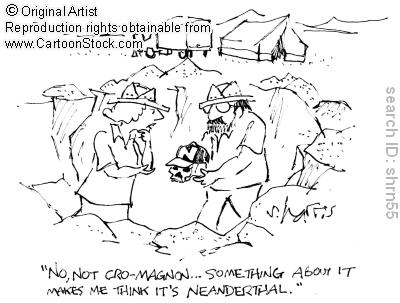
With their large brows and their super-jock bods, we have generally held Neanderthals apart as a separate, brutish species. And under the immortal wicked assumption that brawn cannot also have brain, there is practically an industry built on lampooning some members of our own species in comparison.

Exhibit A. (So meta, really.)


Back in Damon's Sox days, the Red Sox even called themselves a "bunch of idiots." (Causing cavemen, who were not idiotic at all, to roll over in their museum drawers.)

But the more that Neanderthal genes are studied (and cross-your- fingers that these results really are based on ancient caveman DNA and not modern lab-rat dandruff),  the harder it is to separate them into a separate species.

That is, the more we know about their DNA, the more fossils that are found to bridge the gaps, and the more artifacts that are found to blur cultural differences, well the less sense it makes to consider Neanderthals as being any different from other Paleolithic humans as the Red Sox are from the rest of us.

And so this begs the question, if Neanderthals are just humans is it appropriate anymore to refer to Neanderthal-human sex as "interbreeding"?

If "the Neanderthals" were just like" the French" or "the Inuit" then describing their extra-population mating behavior as interbreeding would be something you'd probably only do while wearing a white pointy hat or holding your right arm out in front of you like a hemiplegic Frankenstein.

So we could keep calling Neanderthals Neanderthals...okay sure. But instead of thinking of them as a separate animal from neighboring humans, we could just think of them as a separate baseball team.

Neanderthals had their own look, their own strategies, their own traditions, but when they got together with other humans they understood them well enough to play the same games. They could hit a homer just fine, in both senses of the phrase.

This year's Red Sox couldn't have made a link to Neanderthals more complete. They just collapsed--shrouded in mystery with hardly anyone able to really explain why--while others with less muscle managed to go on.

Neanderthals are Soxier than ever. But even though the derogatory stereotype no longer holds, fans would probably flip that thought the other way around.

Further reading: 
http://www.theatlantic.com/entertainment/archive/2011/09/the-red-sox-werent-cursed-they-were-just-terrible/245717/

Monday, October 12, 2009

A Prehistory of Throwing Things

A long post in honor of Major League Baseball’s upcoming World Series…

Music, language, and calculus have always kept us atop the animal kingdom, but what about baseball?

Before there could be baseball, people had to get good at throwing things. The evolution of throwing ability has been the subject of much more academic speculation than many Yankees fans may realize.

Back when people were still playing “rounders,” Chuck Darwin proposed that throwing may have developed for hunting, self-defense or both, by permitting action at a distance. Walking upright frees the hands to do all sorts of sinister things, leading others to speculate that we throw as a means to punish, as a way to perpetuate peace. And, others have credited the evolution of throwing with brain enlargement, language, and human intelligence. (Yes, intelligence.)

There is real genius in baseball.

Dude throws like a chimp
Besides being the only creatures to calculate batting averages and grow playoff beards, humans are the only animals that can throw accurately and fast with one hand overhead in such a complex motion. Some non-human primates have been known to throw on occasion in the wild. Those who have bravely traipsed through the rain forests of Costa Rica learn this all too well if they’ve been used for target practice by feces-flinging spider monkeys.

Probably victimized occasionally herself, Jane Goodall observed throwing behavior in the chimpanzees at Gombe. She found that chimps threw many objects, including rocks and sticks with both underarm and overarm, and one and two-handed styles. They could throw towards their targets, but they rarely hit them.

No chimp or any other great ape has been observed to throw with the calculated skill or accuracy of a human. If you’ve seen footage of chimps throwing you recognize right away that they look like toddlers when they do it, but toddlers that could bench 400 pounds. This has to do with their different musculoskeletal anatomy and motor control, and both are reasons why throwing is not implemented in any of their hunting forays. Instead, for chimps, throwing things is just a way to threaten other chimpanzees, baboons, bushpigs, or humans, with no real effort to maim or kill their target.

So if chimps are our guide for our earliest ancestors, then baseball didn’t emerge from a hunting history so much as it descended from a display tactic. Under this hypothesis, throwing was originally used to parade strength and skill to enemies or symbolized health and vigor and even intelligence to potential mates (without need for dagger-like canines). This same hypothesis has been put forward for why we walk upright as well and these traits can be linked together considering how it helps to be a balanced biped in order to throw well.

The littlest league
If our closest living relatives, chimpanzees, cannot throw overarm-style efficiently or accurately, then why and how did humans develop the ability to throw? What was the evolutionary pressure for throwing behavior in its earliest stages? I already mentioned the display and threat hypothesis, but accuracy had to develop at some point and greater throwing ability was probably linked to increasing the amount of meat in the diet.

The earliest hominins probably took breaks from their mostly vegetarian diets to hunt prey, as chimps do now. They likely chose species that can be seized with their bare hands or with the aid of handheld tools, like termite fishing sticks and spears for killing tree-dwelling bushbabies. Once regular meat-eating became important, hominins were scavengers before they were great hunters and this is probably when throwing ability started to surpass that of the chimpanzee.

Throwing stones or clods of earth, as a means of defense or aggression against larger carnivores, could have compensated for early hominin vulnerability – not just when preyed upon but also when directly competing with predators and other scavengers.

Imagine yourself, but about 2.5 million years ago, with a brain that has just started getting bigger than a chimpanzee’s, fighting lions or hyenas for access to a gazelle carcass, standing barely four feet tall, with no claws, no formidable canine teeth, no tools more sophisticated than bashed rocks, and possibly no thick coat of fur for protection. On top of all that, this may have been right around the time when the human lineage started to become physically weaker than chimpanzees are now, since there may be a neurological tradeoff between brains and brawn. Throwing things would have been an ingenious way to scare fangorious competitors away from dinner.

It also may have been a novel way to rebuke or punish cheaters without risking as much as in hand-to-hand combat. Like shepherds who throw rocks to steer wandering sheep, throwing could have initially been a way to keep your family, friends and neighbors on the straight-and-narrow. When Fenway revelers hurl hotdogs at rival fans, they are making their point at a much lower risk to their own personal safety than if they threw knuckle sandwiches instead.

This is the basis behind Paul Bingham’s idea of coalitional enforcement, where throwing in groups against cheaters of the system (as in stoning them) provided the mechanism for us to succeed at living rather peacefully within large cooperative groups.

Like in the scavenging scenario, throwing with a group to punish cheaters or criminals would not require much accuracy for our early hominin ancestors. They needed to merely lob with decent accuracy at best, and the need for much accuracy would be diminished if groups were cooperating in the throwing activity. But with hunting, accuracy is far more important. As time progressed, hominin hunting abilities grew increasingly more effective and were probably very well established as early as 1.8 million years ago when the much taller Homo erectus showed up on the evolutionary scene. This is when throwing with speed and accuracy would have been even more crucial to survival because hunting was now a way of life.

Pitcher’s got a big gluteus maximus
There were plenty of anatomical adaptations that occurred in our evolutionary history that made fast, accurate throwing possible. Since we evolved bipedalism our hands have gotten much better at manipulating objects. We have short, straight fingers and we are capable of various precise and strong grips.

Surely our hand anatomy has been crucial for throwing ability but there are few hands in the hominin fossil record and it is thus far impossible to separate out bony evidence for throwing abilities from stone-tool making abilities. Clearly, making and using stone tools was important and, clearly, throwing was a “go” once we could make stone tools. Generally this is agreed upon, by both anatomical and stone tool evidence appearing, by about 2.5 million years ago.

Another equally important trait for throwing, which also changed after we began walking upright, is the bulbous human buttocks. The human-like condition of the gluteus maximus muscle differs from chimpanzees in its size and mechanical functions. In throwing, the activation of the gluteus maximus can increase the velocity on a projectile and stabilize the trunk over the legs for effectively completing the motion. Although muscles don’t fossilize, their locations of attachment, their biomechanical properties, and their sizes can be estimated from fossil bones and it is clear that by 2 million years ago, human bodies, especially human tookuses, were built for walking and running upright, for swinging tools, and for throwing.

Bringing the heat to the Ice Ages
Once you’ve got a hand that can grip the ball, and once you’ve got enough junk-in-the-trunk to make cheese, are you all set to pitch against a roided-up bat-corker? Not yet.

Ultimately it’s the modifications in arm length and shoulder anatomy (and brains, below) that greatly affected throwing and those changes lagged quite a bit behind the hands and glutes.

Anatomically, things get complicated at about 2.5 million years ago. Although the body seems to have all the right stuff for walking upright, there’s a little stint between 2.5 and 1.8 million years ago when small-brained hominins had achieved modern bodies but kept their longish, apish arms, particularly in the forearm.

Sometimes this evolutionary baggage - which is even seen in Lucy over 3 million years ago - is used to argue that hominins were still partly arboreal even after adopting bipedalism. The long arms would have affected throwing ability since long arms can throw a projectile further than short ones. A long forearm is capable of putting more velocity on a projectile, similar to the way atlatls or spear-throwers do so by artificially lengthening the arm.

Even with this potential, early hominins must have lacked accuracy due to their small brains (i.e. less complex neural circuitry and more primitive motor control). However, they may have been able to compensate. A long forearm has a larger range of angular velocities than a shorter forearm; that is, it is moving faster at more limb positions, or angles, than a shorter forearm. Therefore a longer forearm has a “bigger window of opportunity” to release a projectile and hit the target in arcing, lobbed throws.

With little brain power, but with a long arm on a bipedal body, these little hominins would have been better hurlers than chimpanzees. But Major League scouts need not set their flux capacitors for the early Pleistocene. Homo sapiens are much better baseball prospects because we can throw much further and more accurately than our ancestors with the aid of our shorter forearms and our bigger brains. Accuracy is increased with a shorter forearm which, with the right motor control, can tolerate relatively small errors in timing better than longer ones in flinging fastballs dead-on target.

Beginning around 1.8 million years ago, with Homo erectus, hominins spread out beyond Africa and they began to look and behave like actual predators compared to any of their predecessors. When throwing was assimilated into hunting strategies, speed and accuracy became essential because a moving animal can react to the arrival of the projectile. Hunting requires the use of a flattened trajectory throw that is more direct than an arced throw and requires more accuracy.

The brain does enlarge with Homo erectus, but it is still only half to three-quarters the size of ours, so motor control would not have been stellar. Plus, although the arm proportions look modern at this point, the clavicle may still be too short for full human throwing ability. Homo erectus did not have quite as broad shoulders, with the shoulder blades far on the back, as us and these features are necessary to throw like us. When the shoulders are placed far on the back, and when the shoulders are broad enough, they allow a greater range of motion for the full throwing motion. So the first hunters were not anatomically equipped to throw like humans yet.

Modern shoulder anatomy doesn’t emerge until much later, at about 500,000 years ago with what are termed “archaic” humans. Coincidentally, at the point in time when shoulders are finally geared for throwing is the same time when brains reach modern size. Not surprisingly this is when hominins must have been excellent hunters, made obvious by the sophisticated weapons, culinary ware, and dinner leftovers they left behind.

There’s no thinking in baseball
Thinking through a throw is the surefire way to ruin it. It doesn’t take big league pitching experience to understand this point. Anyone who has tossed a wad of paper into the office bin or who has seen Bull Durham understands. This does not mean, however, that the brain is not crucial for throwing.

The cascade of actions that comprise a throw, from start to finish, cannot be changed once they begin. Because the motion is too fast for feedback to reach the brain during the event, the brain plans out the throwing motion before it is executed and then fine-tuned timings as well as momentum carry the action through until the very last moment of finger release. Despite our inability to improve a throw by thinking it through, throwing is a fantastically cerebral activity.

William Calvin proposed that hominins with bigger-than-average brains might have been able to apply more timing neurons to throwing tasks - with the success (hunting or otherwise) of the faster, more accurate throws then selecting for encephalization trends. In other words, he suggests that our big brains should thank our penchant for throwing things for making them that way.

So easy a caveman could do it?
Neanderthals, the quintessential cavemen and women, had anatomy like ours and even had brains just as big as, and sometimes bigger than, ours, but were our evolutionary cousins throwing like us? Debate continues as to whether or not these guys who sometimes lived in very close proximity to humans were actually our occasional bedmates or our enemies. People siding with the former probably root for both the Mets and the Yankees.

There are two main lines of evidence that suggest Neanderthals weren’t big on throwing as a hunting strategy. First of all, many of their fossils have healed bone fractures and the overall pattern of trauma resembles that seen in professional rodeo athletes. Animals weren’t domesticated at this point yet so the best explanation, far better than clumsiness, is that Neanderthals were coming into very close contact with large dangerous prey, like reindeer and mammoth. The thickness and strength of their arm bones also fits better with habitual thrusting of spears rather than throwing.

For now, throwing things, as well as we can today, should be considered a very recent phenomenon, something beginning around 500,000 years ago with archaic humans, after nearly five million years of evolutionary time since the split from the common ancestor we share with chimpanzees.

Most things that make humans strange or fantastic are rooted in either our bipedal, upright-walking anatomy or in the power of our humongous brains. Getting good at throwing took the evolution of both of those traits. But after our bodies mastered bipedalism there was up to one million years of lag time before the brain got to modern size and before the shoulders were tweaked for exquisite throwing. Until this point, hominin throwers may have looked no better than chimpanzees or than Andy Pettitte using his right hand, assuming he’s pretty bad at that.

Throwing ability requires some of the highest levels of brain functioning - There is real genius in baseball.

Players and fans owe a big debt of gratitude to the apeman and the caveman in all of us.

Short Bibliography
Bingham, Paul M. 1999. Human Uniqueness: A General Theory. The Quarterly Review of Biology 74(2):133-169.

Calvin, William H. 1983b. The Throwing Madonna: Essays on the Brain. New York: Bantam.

Darwin, Charles. 1871. Descent of Man. London: John Murray.

Dunsworth, Holly, John Challis, and Alan Walker. 2003. Throwing and bipedalism: A new look at an old idea. In Franzen JL, Dohler M, Moya-Sola S (editors). Upright Walking. Senckenberg Institute, Frankfurt, pp. 105-110.

Goodall, Jane. 1986. The Chimpanzees of Gombe: Patterns of Behavior. Cambridge: Harvard University Press.

Larson, Susan G. et al. 2007.
Homo floresiensis and the evolution of the hominin shoulder. Journal of Human Evolution 53(6): 718-731.

Walker, Alan. 2009. The strength of great apes and the speed of humans. Current Anthropology 50(2): 229-234.


Note: If you liked this, you'll love "Hurling words and turds, an evolutionary link" and you might like "Can you throw with half a brain?" too.

Update: This post has been cited in "How high can a human throw something?" http://what-if.xkcd.com/44/